24 Best Employee Rewards Programs of 2026
The true standouts in a sea of self-claimed best employee reward systems.








The best employee reward system helps you motivate staff, strengthen your workplace culture, and attract new talent without exhausting your human resources with piles of extra work. After testing over 50 options and giving and receiving hundreds of kudos over the past five years, we’ve experienced firsthand how easily such a platform can foster a culture of appreciation, especially when paired with its sibling employee recognition software.
What is the best rewards program for my staff? How much does it cost? Any pitfalls and adoption mistakes I need to bear in mind? These are some of the questions we’ll help you answer in this guide.
Flexibility and customization, reporting and analytics, and peer-to-peer engagement are the criteria we use to evaluate the best reward system for employees.
- Flexibility and customization: The strength of many workforces lies in their diversity, which means not everyone wants the same employee perks and benefits. To evaluate how customizable and flexible an employee rewards system is, we investigated the system’s rewards catalog. We examined the number of available reward types, merchants, and covered countries, and the option for custom company-branded swag.
- Reporting and analytics: After testing essential rewards features from both the employer's and employee's perspectives, we examined the system’s analytics dashboard. Let’s be honest: One of the best things about having technology by our side is its ability to diligently track data in real time and highlight critical points and trends that deserve our attention. We pulled standard and custom reports (if any), considering how easy (or hard) it was to get a set of data from the system and whether it’s helpful, actionable, and easy to digest for most users.
- Peer-to-peer engagement: Recent data shows that recognition from co-workers is 35.7% more likely to positively impact financial results than recognition only from managers. For that reason, we looked at features like milestone celebrations, kudos, shoutouts, and, really importantly, how easy they were to use.
The people behind this guide bring decades of HR, technology, and editorial experience.
- Huda Idris led the editorial development of this guide, ensuring every platform review is structured, clear, and genuinely helpful for HR professionals. With over 12 years in HR tech content, she focused each evaluation on practical considerations like ease of use, alignment with HR goals, and long-term value.
- Phil Strazzulla developed the criteria used to assess each employee rewards platform. As the founder of SelectSoftware Reviews and an experienced HR tech buyer, he helped shape evaluations around impact on culture, scalability, and ROI.
- Alison Hunter contributed hands-on insights to each review, analyzing how platforms perform in real-world use. With 10+ years of experience launching HR strategies, including recognition programs in tech companies, she evaluated systems based on rollout speed, user engagement, and long-term adoption across teams.
- Anh Nguyen led the research and testing of the rewards platforms featured in this guide. With a background in tech recruiting and academic research, she analyzed platforms for usability and how well they support HR teams in driving recognition and retention.
- Christina Moran contributed expert analysis on how each platform supports intrinsic motivation, team recognition dynamics, and cultural reinforcement. Her expertise in organizational psychology enriched our reviews with evidence-based perspectives on what actually drives meaningful reward experiences.
- Tracie Marie brought a scaling and strategic fit perspective to our reviews. With experience implementing recognition programs at both startups and Fortune 100s, she helped assess which platforms can adapt to complex organizational structures and evolving engagement needs.
At SelectSoftware Reviews, we test and review products with complete editorial independence. During testing, we signed up for a demo with vendors, examined the tools ourselves from both employer and employee perspectives, and sought verified user feedback to get a more holistic view of what each option has to offer.
Additionally, we’ve interviewed HR leaders from companies using employee rewards systems to understand what works in practice and what doesn’t. We’ve also consulted with industrial-organizational psychologists to better evaluate how rewards impact motivation and culture. Read more about our editorial standards.


Achievers

We chose Achievers because its international reward system performed more smoothly than most we’ve tested. Local vendor partnerships across 200-plus countries reduced friction for employees receiving rewards, and the platform’s real-time budgeting features kept things predictable at scale.
PROS
- Global reward fulfillment via localized vendor partnerships.
- The concierge redemption option lets employees choose virtually any legal reward.
- Swag, gift cards, cash-like options, and experiences available in a single platform.
- Budget controls and compliance tools support enterprise-wide reward governance.
- Highly flexible catalog that adjusts based on location, language, and user permissions.
- Native integrations with Workday, Slack, Outlook, and several other enterprise platforms.
- Global reward fulfillment via localized vendor partnerships.
- The concierge redemption option lets employees choose virtually any legal reward.
- Swag, gift cards, cash-like options, and experiences available in a single platform.
- Budget controls and compliance tools support enterprise-wide reward governance.
- Highly flexible catalog that adjusts based on location, language, and user permissions.
- Native integrations with Workday, Slack, Outlook, and several other enterprise platforms.
CONS
- Reward catalogs vary by region, with some users wishing for more variety.
- Some users noted that the redemption layout could be confusing, or they experienced difficulty locating specific reward items.
- Targeting organizations with 500+ employees, Achievers may be too costly for smaller companies.
- Reward catalogs vary by region, with some users wishing for more variety.
- Some users noted that the redemption layout could be confusing, or they experienced difficulty locating specific reward items.
- Targeting organizations with 500+ employees, Achievers may be too costly for smaller companies.

For large organizations that want to offer culturally relevant rewards across regions, we found that Achievers provides a solid global infrastructure, a flexible concierge option, and a clear no-markup pricing model.
What stood out most in our testing, perhaps, was the global fulfillment engine. Instead of steering everything toward Amazon gift cards or a small in-house catalog, Achievers works with local vendors in more than 200 countries through a drop-ship model. Seeing how this played out in sample flows, it felt more reliable than many systems we have tried. Employees in Canada and the U.K. generally receive rewards without the shipping delays or additional import fees that tend to frustrate users elsewhere. It is not perfect everywhere, but the consistency was noticeable.
The catalog itself is broad. We saw cash-like gift cards, charity options, travel and lifestyle perks, branded gear, and a wide mix of physical items. What gave the system a different feel was the concierge feature. Employees can request nearly any legal reward, and Achievers will attempt to source it using their vendor network. We have seen other platforms talk about flexibility, but this was one of the few cases where it actually came through in practice. Of course, how often employees use it depends heavily on internal guidance and manager discretion.
On the admin side, we found the budgeting tools straightforward to work with. Real-time visibility helps prevent overspending, and the no-markup pricing model keeps point values predictable. For organizations that need tight financial controls, this level of transparency can be useful. On the employee side, integrations with Microsoft Teams, Slack, and QR-based mobile access keep recognition close to where people already work. We appreciated that recognition did not require a separate login just to complete simple tasks.
There were also areas where the platform felt less strong, of course. In particular, users in less-supported countries often say the catalog feels thinner than in major markets. While that is not uncommon in global reward tools, it is still worth noting. We also saw comments that the redemption workflow felt a little harder to navigate, especially when users were looking for specific items rather than browsing. Additionally, because Achievers is built for organizations with 500 or more employees, smaller companies may find the platform heavier or more costly than they need.
Five Star Bank, General Motors, Sobeys, Wesley, Moxa.
Achievers uses custom pricing. A demo is required for an accurate quote.

Best For
We found Achievers to be a strong option for large, global organizations that need predictable pricing and a flexible reward model. Its strengths are most evident at enterprise scale, though companies in smaller markets or with leaner needs may want to weigh the trade-offs.

Nectar
Nectar's catalog covers an extensive range of reward programs for employees, from company swag to Amazon goods, gift cards, and charity donations. If that’s not enough, you also have the option to add custom rewards that are tailored to the relevant recipient(s), and save 10% on pricing with your SHRM membership.
PROS
- Transparent pricing.
- Volume discounts are available for organizations with 500+ employees.
- You only pay for the used rewards – unused pointed allowances won’t cost a dime.
- Regularly releases user-driven features and product updates.
- New AI-powered internal communications tool with drag-and-drop editor and templates for quick announcements.
- SHRM members get 10% discount on Nectar subscription.
- Regularly introduces new features and enhancements to its products.
- Volume discounts available for organizations with 500+ employees.
- You pay for the rewards that are claimed. Points and allowances that remain unused won’t cost you a dime.
CONS
- No longer offers a free plan. No free trial available.
- The rewards selection could feel limited to some teams, especially those looking for more experiences.
- Requires a minimum annual commitment of $4,000.
- The priced plans are not available to start off as a self-service process. You’d have to book a demo and pay to access some of the premium features.
- The rewards selection could feel limited to some teams, especially those looking for more experiences in offer.
- No longer offer a free plan.

Nectar’s employee rewards platform is comprehensive, customizable, and easy to use. We were particularly impressed by its variety of employee reward options. Through a direct integration with Amazon Business, employees can choose from Amazon's vast product catalog for their rewards.
For those who prefer gift cards, Nectar offers access to ones from hundreds of different brands all over the world. Employees can also opt to receive company-branded swag shipped directly to their door or donate their rewards to charity. For a more personal touch, you can add custom rewards to Nectar’s catalog like tickets to local events or lunch with the CEO. With this many options, there’s definitely something for everyone and the best part is, if we haven’t clarified this already, employees get to pick their own rewards!
Nectar also automates service awards and birthdays, eliminating the need to manually send gifts for employee milestones. We were able to quickly set up automated birthday and anniversary point awards and social feed shoutouts. Another way to see upcoming events is through Nectar’s calendar, which we’ve found quite straightforward and tells you what’s happening on a given day if you hover over it.
Beyond corporate rewards, you can create challenges aligned with goals or values, have employees self-report completion, and approve submissions. Plus, a new feature for internal communication has been added to the platform, which lets you create an announcement within minutes right within Nectar.
If we were to point out any drawbacks of this employee rewards platform, it was that it no longer offers a free edition while requiring a rather pricey minimum annual commitment of $4,000. Additionally, although the rewards catalog is generally versatile, we felt that the experiential rewards like events or travel are less emphasized compared to material gifts or gift cards.
Nectar is used by many known brands including Redfin, Golden State Warriors, Major League Baseball, and SHRM.
Nectar offers three plans with an annual agreement of $4,000.
- Plus plan: $5 per employee per month when billed annually.
- Premium plan: $6 per employee per month when billed annually.
- Custom plan: Quote-based pricing.
Nectar’s recent updates show a consistent focus on deepening its employee rewards ecosystem and making recognition data-driven, equitable, and globally accessible.
- New features rolled out: Nectar recently introduced automatic multi-language translation for internal communications, enabling employees to receive messages in their preferred language while giving admins built-in translation, audience breakdowns by language, and side-by-side previews before sending. The refreshed mobile app now mirrors the web experience, allowing employees to send shoutouts, redeem rewards (including Amazon and Axomo options), and access nominations and streaks directly from their phones. The app also adds multi-language support, live chat with support, and a discounts hub, expanding reward accessibility for deskless and global teams. Nectar also launched the Shoutouts Report, giving HR teams visibility into recognition trends, participation levels, and unrecognized employees.
- Enhanced features: The Custom Properties and Dynamic Lists updates let companies tailor rewards and communications by role, region, or language, while Purchasing Power Parity ensures global equity in reward values. Community Recognition now supports delegated admins, bulk approvals, and live widgets for real-time visibility. Advanced analytics, including reward spend and point distribution tracking, help organizations better understand program impact.
- Features on the roadmap and ecosystem partnerships: Nectar’s strategic partnership with SHRM aims to expand access to recognition and rewards tools for HR professionals globally, aligning the platform with SHRM’s mission to advance workplace culture. Future development, according to our latest demo with the vendor, appears geared toward continued personalization, data visibility, and expanding reward redemption options to support a more flexible, international recognition experience.
Best For
Companies of 50–2,000 employees who value flexibility in corporate rewards program choices and frequent product updates. Those with SHRM membership may also want to give this platform a go for its special pricing.


We have managers give recognition at least once a week. Employees use it to get items with their points. They also like to have another way to communicate with each other.
We like the user-friendly platform. They have great customer service. Our employees are able to use their points towards stuff they enjoy.
We purchased it to engage employees and give recognition. We love the idea of employees giving positive feedback to each other. Our employees wanted to be able to give each other recognition as well. We used it for 2.5 years.
Nectar took a while to implement. Our employees would like to see additional / new options to purchase with points. Notifications to employees didn’t always work.
They are very similar to competitors. Their gift selection seems smaller then others.
Consider time of implementation. Make sure that your team uses it on a regular basis. Give incentives for employees to give each other recognition.
They are always making updates to improve. They have improved the overall design of the app.
Larger companies that aren’t able to recognize and acknowledge every employee all the time.
Small companies that interact every day.

Awardco
Awardco helps you give thoughtful and personal reward programs to employees. Besides Amazon rewards, it features Bonus Boxes, digital MemoryBooks, and extensive redemption options, letting you appreciate people in creative ways.
PROS
- The platform is easy to use and navigate.
- It’s available in 16 languages.
- Awardco’s integration with Amazon gives employees a wide range of reward options redeemable in many countries.
- It can integrate easily with many popular tools including Slack, Teams, and Hubspot.
- Amazon Business integration, huge reward catalog for a multitude of countries.
- The platform is available in English, Spanish, French, German, Japanese, Portuguese, and Simplified Chinese.
CONS
- No free trial.
- Some users said that the prices for certain rewards are higher than retail prices.
- There have been complaints that reward delivery at times takes longer than expected.
- Actual pricing is not publicly available, so getting started won’t be a quick and self-service process like with other companies in the space.
- With Awardco, digital and physical gift cards are ineligible for refunds.
- Only Amazon-delivered products are available from Awardco. Goods sold by third-party vendors on Amazon are not available.
- The Awardco mobile app is only available as a Progressive Web Application, not from the App Store or Google Play, which might be less intuitive for some users.

Awardco helps you appreciate your people in unique ways. We’ve not seen other corporate rewards program platforms offer the same degree of gift customization and personalization as Awardco.
For starters, you can create and give out Bonus Boxes, which are creative care packages filled with fun branded items suited to the recipient. Digital MemoryBooks are another way to honor employees' work anniversaries. These interactive books compile messages and photos from colleagues into a cherished keepsake.
The way Awardco automates the rewards process is a major time-saver. It sends automatic reminders about service anniversaries, birthdays, and other occasions, prompting participation from the team. The software also seamlessly integrates with communication tools like Slack and Microsoft Teams, making it easy to give timely shoutouts.
Robust incentive programs are another thing we liked about Awardco. Employees can earn points for achieving goals, then redeem them from an extensive catalog including top brands like Apple and YETI. For sales teams, Awardco partners with Amazon Business to provide the ultimate flexibility - earners can choose their own rewards without any friction.
Compared to Nectar, Awardco’s annual entry price is slightly lower — $2,500 vs. $4,000. However, some users we surveyed noted that certain reward items cost more than standard retail pricing, which can reduce perceived value. Additionally, while most redemptions are seamless, there have been occasional reports of delays in reward delivery.
Awardco has over 3 million users including known companies like Percepta, Paramount, Hertz, Pacific Life, and Aptive
Awardco has multiple plans and add-ons one can choose. New startups and small businesses (up to 100 employees) can access flexible packages starting at $3,000.
Awardco’s most recent updates centered on platform usability, gamified recognition, and stronger global functionality.
- New features rolled out: The launch of Awardco 2.0 introduced a redesigned navigation system, a new recognition flow, customizable notifications, and an admin adoption dashboard. User profiles and in-platform Feature Highlights were also added to personalize experiences and drive awareness of new tools.
- Enhanced features: Recognition and redemption workflows gained gamified badges and achievements, the ability to pin standout recognitions, and improved marketplace search. AI updates now refine recognition themes and quality scoring to better align with company values.
- Additional improvements: Expanded international support now covers 163 countries and 135 currencies, along with Amazon secondary fulfillment and updated EU/UK compliance workflows.
Best For
Growing teams and multinational businesses looking for a powerful and flexible rewards and recognition program for employees.

I use Awardco regularly, with increased usage during key recognition periods and company initiatives. On a weekly basis, I review recognition activity and respond to questions from leaders and employees.
Monthly and quarterly, I use Awardco to support programs such as service anniversaries and performance-based recognition, as well as to review reporting. I also assist employees with redemption issues, particularly our international workforce.
During annual promotions, we use the tool to recognize promoted employees through the recognition news feed, highlighting the reasons for their promotions.
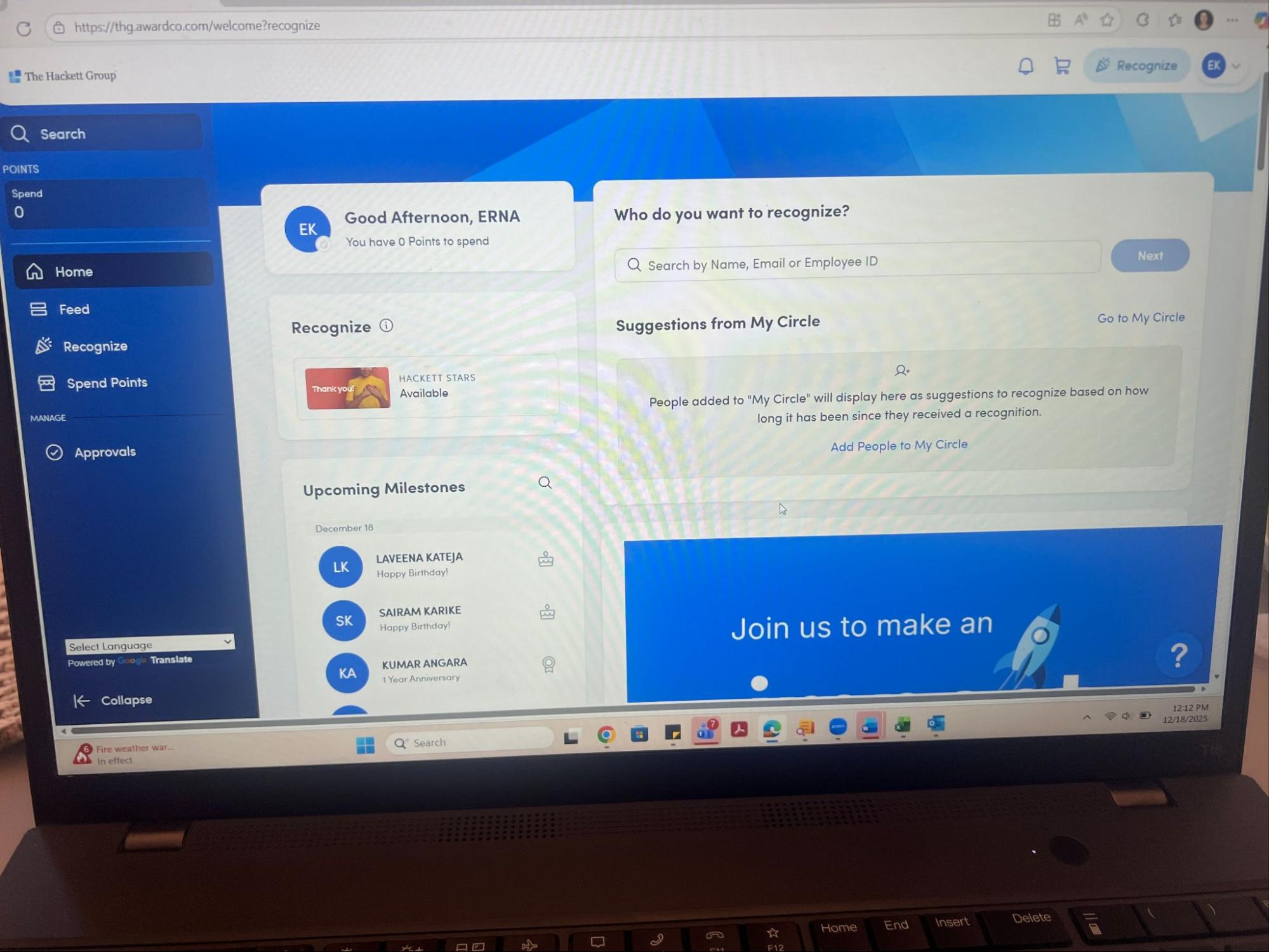
- It works well for a global workforce, as employees across different countries have a consistent experience.
- I have had a very positive experience with customer support, which has been responsive and helpful when assistance is needed.
- The platform is easy to use and visually clean, making navigation simple for employees and administration straightforward for HR.
My current organization purchased Awardco to address several challenges with our previous employee recognition and rewards process, particularly as a growing global organization.
Before Awardco, we struggled to ship physical awards to international employees, especially in India, which often resulted in delays, high costs, customs issues, or awards not arriving at all.
We also lacked a centralized platform that could support consistent recognition across regions while still allowing employees to choose rewards that were meaningful locally. The platform improved visibility and tracking of recognition activity, which helped leadership better understand engagement trends and participation across teams.
I have personally used Awardco as an administrator for approximately three years, supporting program setup, rollout, and employee inquiries.
- Reporting could be more robust, as pulling certain reports can require additional effort.
- Pricing and contract details are not always fully transparent upfront, which can make planning more difficult.
- The integration process required additional coordination with our previous system to complete setup correctly.
Awardco stands out because of how effectively it supports a global organization. Other tools we evaluated were more U.S.-centric and relied heavily on physical rewards, which created challenges for international teams.
Awardco’s localized redemption options make recognition more accessible and consistent across regions. Day-to-day HR workflows are also stronger than with previous tools.
When evaluating an employee recognition and rewards platform, organizations should consider how well it supports their workforce and whether rewards are meaningful across different countries.
Ease of administration is critical, as HR teams need an intuitive system that does not require significant manual effort. Strong customer support and responsiveness are also important, particularly during implementation and when issues arise.
The platform has improved usability through mobile capabilities and enhanced navigation, making daily administration easier. It has also added better visibility into engagement activity to support recognition programs at scale. We continue to see practical system upgrades.
Mid-sized to large organizations with a global or distributed workforce that want consistent recognition across regions are a strong fit for Awardco. It is especially helpful for companies that have struggled with international shipping of physical rewards or managing multiple recognition systems.
Organizations with very limited recognition budgets may not realize the full value of Awardco. Strong leadership support is also necessary for the program to succeed.

WorkTango
Employees can enjoy the freedom of choosing merchandise, gift cards, donations, and other custom rewards from WorkTango’s massive rewards catalog. The platform also ensures timely shoutouts for employee birthdays, work anniversaries, and other milestones via its robust automation features.
PROS
- The majority of users find WorkTango to be intuitive and easy to use.
- Points can be redeemed for a wide variety of gift cards, prizes, and other reward options.
- Coworkers can publicly or privately recognize one another in any direction, with or without reward points. Public recognition is viewable company-wide in a social media-like activity feed.
- The platform’s automated recognition ensures timely shoutouts for employee birthdays, work anniversaries, and other milestones.
- WorkTango is available in multiple languages, including English, Spanish, German, and French, making it accessible to diverse users.
- Create custom incentives to reinforce your company’s objectives, programs, core values, or any positive actions that help your employees and your business succeed.
- The reporting and analytics dashboard gives you near real-time insights on how your efforts are faring.
- Unlimited surveys available in English, Spanish, Chinese, French, German, Italian, Japanese, Portuguese, and Korean.
- You can add modules as you go and these will be charged on a prorated basis.
CONS
- Billing can only be done annually. All plans require a minimum commitment of 12 months.
- Support turnaround could be improved.
- Free trials aren't available at this time.
- Billing is only done annually and all plans require a minimum agreement for a 24-month subscription (see our FAQs for more and their pricing page for full details).
- Several users have complained about the rewards redeeming process being not very intuitive.
WorkTango’s all-in-one employee rewards platform makes appreciating and incentivizing employees easy and meaningful. We’ve peeked through their rewards catalog, and it is massive, packing over a million rewards from popular retail gift cards to charity donations.
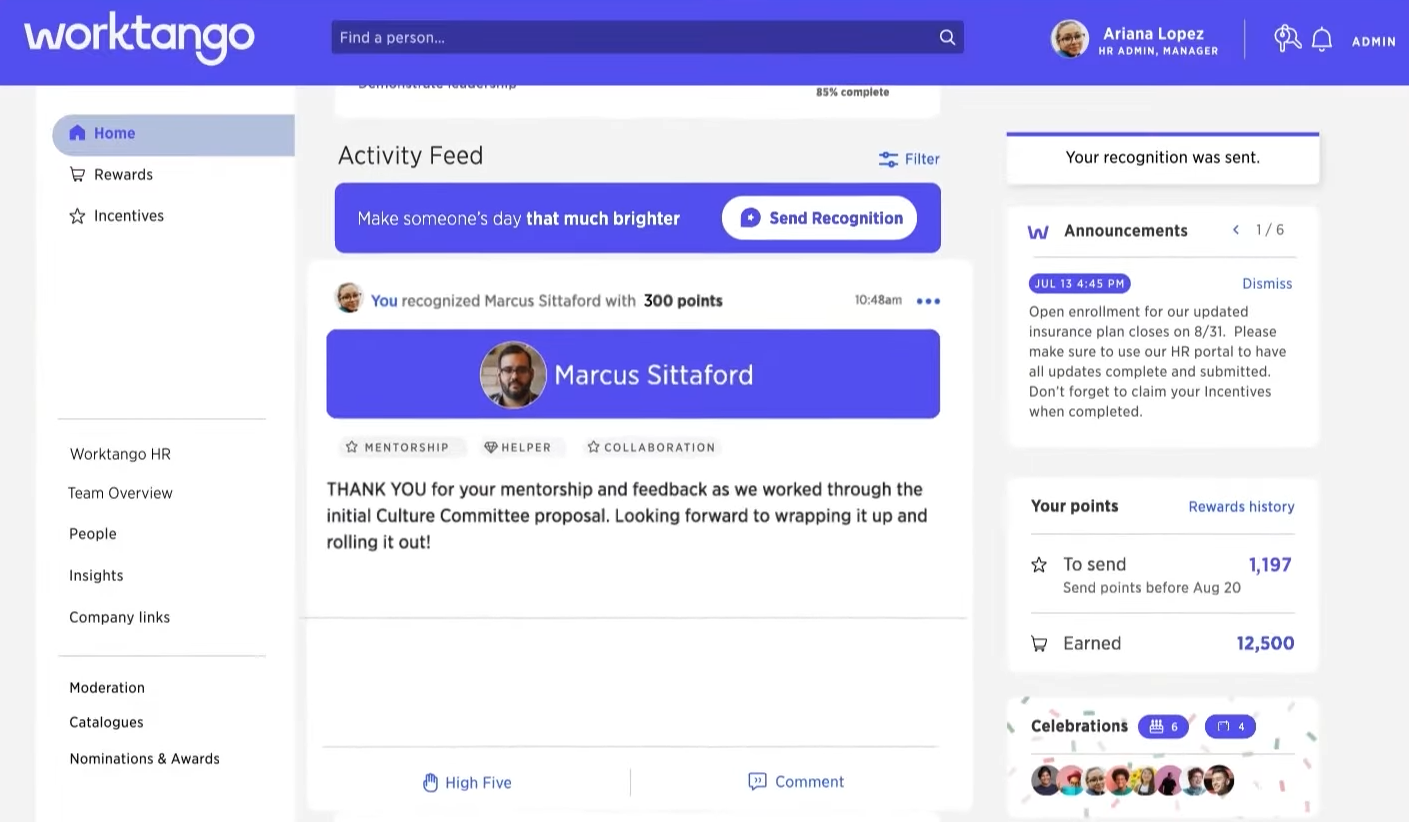
We like how the rewards catalog covers different price ranges, meaning you can incentivize all behaviors and achievements, no matter how big or small. Another thing we like is its built-in search and filtering capabilities. Despite how big the catalog is, employees can still search and accurately find rewards that fit their interests best. WorkTango also provides personalized suggestions based on each employee’s past activity, offers wishlists, reward point trackers, and a group reward redemption option to build camaraderie.
What impressed us most during our evaluations, though, was WorkTango’s automation features, which helped give timely shoutouts for employees much more efficiently. It also lets you create incentives, gamifying and make it more fun for employees to reach performance goals, demonstrate certain values, or take positive actions. It’s a win for everyone.
That said, we wouldn’t recommend this employee rewards system to budget-minded teams. One big reason is that this tool’s billing, which is only offered on an annual basis. No short-term pilots, no monthly payment.
Finally, some users we talked to shared their experience with the customer suggest team, suggesting opportunities for improvement, as some of their requests weren’t fully implemented or lacked clear next steps.
Kia Motors, HUB International, Rexall, Accruent
A minimum annual contract length of 12 months is standard. Based on our research, the minimum cost for this contract is often $8,750.
Best For
Businesses with an automation-first culure, particularly those in tech, FSI, healthcare, and business services.

I use WorkTango mostly to send out pulse surveys and check on how my team is feeling, ensuring any concerns are addressed quickly. I also like using it to recognize colleagues’ hard work and keep everyone motivated. Additionally, I utilize the platform's analytics to track engagement and spot any potential issues before they escalate.
I really like how easy it is to collect real-time feedback from the team, so we can tackle issues early. The recognition feature is great for keeping everyone motivated and connected. The analytics provide clear insights into engagement trends, which helped me make better decisions when I was in charge.
I believe my company decided to implement WorkTango because they felt the need for a more dynamic and real-time feedback mechanism. Before using this tool, it was challenging to regularly assess employee satisfaction and respond quickly to issues. Like many companies, they wanted to improve employee engagement and ensure that teams felt more connected to the company's mission and goals.
One key benefit of WorkTango is its ability to provide actionable insights through pulse surveys, allowing leadership to address issues in real-time. The platform’s recognition feature also helped boost morale, as employees can easily acknowledge each other’s achievements.
I personally felt very good using WorkTango during my time with the company (in the AI and SaaS industry), and it noticeably improved communication and alignment across teams.
Sometimes the surveys feel repetitive, which can cause employees to become less engaged. It would be nice if the recognition feature had more fun and creative ways to acknowledge colleagues. WorkTango could use more flexibility in customizing survey questions.
What makes WorkTango stand out is how simple and easy it is to navigate. The real-time feedback and recognition features make it much easier to stay on top of engagement and team morale. Other platforms can feel overwhelming, while WorkTango is more straightforward.
It's important to consider how easy the platform is to use and whether it fits your organization's needs. Good feedback options and solid analytics are crucial for understanding what’s working and where improvements are needed.
Over time, WorkTango has improved based on user feedback, making it more intuitive and user-friendly. New features, like more engaging recognition options, have helped us better connect with our team.
From my experience, WorkTango is particularly well-suited for mid to large-sized organizations that prioritize employee engagement and fostering a strong workplace culture. It's ideal for companies that want regular feedback and a culture of recognition, especially those with remote or hybrid work environments.
I would not recommend WorkTango for startups or very small organizations, as they may lack the necessary resources and the recognition tool might not be essential in the early stages. Companies with rigid hierarchies or those resistant to feedback and recognition might also struggle to fully utilize the platform’s capabilities.
Additionally, smaller, more traditional companies where the owner is the primary decision-maker might view this tool as a waste of money and resources.
ITA Group
We picked ITA Group (formerly Cooleaf) for its ability to automate, personalize, and globally fulfill rewards as part of a broader employee engagement strategy. Unlike tools that focus purely on points or catalogs, this platform connects rewards to performance data, survey participation, and peer recognition—making the incentive system feel more intentional and aligned with company goals.
PROS
- Reward programs can be tied to actions like training completion, hitting milestones, or participating in surveys.
- Cooleaf fulfills both physical merchandise and digital gift cards globally, removing the need for third-party logistics.
- The Slack integration is practically seamless– posts and recognitions are gathered within the team’s Slack channel.
- The platform includes analytics to track redemption trends by team, location, and role.
- Implementation support includes onboarding sessions and a personalized rollout plan.
- Full platform for all things employee engagement, not just rewards and recognition.
- The Slack integration is very seamless. Challenges, posts, and recognitions can all be gathered within dedicated channels in your team’s Slack workplace, if you want to.
- Wide variety of rewards including a team store, donations, entertainment, travel experiences, merch, products, and restaurant coupons.
CONS
- The initial setup for custom reward workflows may require onboarding support.
- Smaller companies may find the platform’s enterprise-scale design more than they need.
- Undisclosed pricing, as well as no free plan or free trial.
- For some of the workplace culture-building features, like challenges and activities, you can’t create your own, so you rely on how often Cooleaf’s team makes them available.
- We found the support center’s documentation to be somewhat limited in comparison to similar tools. Also, it seems like support is only done through an online form, no other channels are available.
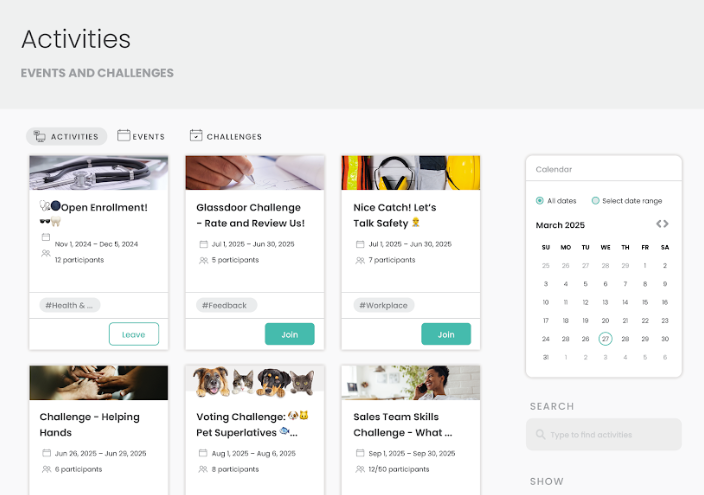
While many rewards platforms focus on gamification or catalog size, ITA Group takes a more strategic approach. It allows global organizations to design rewards programs that reflect their culture, reinforce key behaviors, and scale across distributed teams. In our demos, we’ve been particularly impressed with how rewards could be tied to performance metrics, participation in surveys, and learning and development initiatives.
ITA Group also supports a range of flexible program structures— from automated milestone incentives to nomination-based awards that include multi-layer approvals. This makes it suitable for both ongoing incentives and more formal recognition moments.
On the fulfillment side, ITA Group handles physical and digital reward logistics internally, which is a major plus for global teams. Whether it’s branded swag, gift cards, or high-value rewards, the company ships worldwide without the need for third-party coordination. Employees chan choose from 700+ brands, which provide access to thousands of rewards in the US and across the world.
Another area where ITA Group stands out is analytics. HR leaders can view reward redemption trends by team, geography, and department, helping them understand what's resonating with employees and where incentives may be falling flat.
The platform isn’t designed for small companies—ITA Group’s reward strategy, admin controls, and depth of configuration are geared toward enterprises with at least 2,000 employees. And while it doesn’t offer a free trial, their implementation support includes guided rollout, custom configuration, and post-launch check-ins to ensure success.
ITA Group is used by organizations like Acosta, Aprio, BlueLinx, Georgia’s Own Credit Union, Kids2, and Shipt.
Cooleaf offers custom pricing based on employee count and program needs.
- Subscription billed monthly
- Rewards budget is flexible and managed separately
- Implementation support and onboarding included
Recent ITA Group product updates include approval-based reward workflows, manager-facing usage insights, and robust analytics, making it easier for large organizations to build scalable, values-aligned incentive programs. International reward fulfillment and new nomination-based award options have also strengthened its appeal to global teams.
Best For
Global enterprises with with at least 2,000 employees.

I use Cooleaf weekly to check on health and reporting within my clients' companies. It improves social and cultural collaboration. The platform is an easy to use employee management system. Cooleaf makes employee communication fun for the team. Recognizing employee accomplishments through Cooleaf has helped my clients understand employee performance and perspectives.
Cooleaf is very employee friendly. It can be difficult for larger teams to keep track of accomplishments, birthdays etc but this platform eliminates that concern. It has been instrumental in improving engagement for remote team members post-pandemic.
I have used Cooleaf to manage employees for clients since 2021. The service allows HR to track employee engagement and handle employee reporting. Cooleaf allows me to send surveys, improve peer recognition, and offer rewards for staff. It integrates with other software that we use easily. Cooleaf has a fun interface that enables the HR team to keep track of important changes on the go.
There are sometimes issues with the mobile app sending push notifications. Cooleaf’s voucher program can be tedious to track if the employee does not use their points. The voucher system could use an update with more exciting redeemable options.
Cooleaf is a fun platform. The service is affordable and user friendly. Other platforms like Guusto have slightly better features and redeemable options.
How many employees need Cooleaf access? Do you have a remote staff and will any rewards be applicable in their location?
I have used Cooleaf since 2021 and since that time, they have improved their customer service response and engagement surveys.
Cooleaf is good for small-medium sized organizations that focus on employee engagement. It is a customizable service that can get expensive if you have budgetary constraints.
I would not recommend Cooleaf to large companies because the cost can increase as you expand but it is a solid service.

Guusto
We are big fans of Guusto’s inclusive approach to coporate rewards, with features that enforce a culture of appreciation across all employees - from the frontline to the executive suite. The platform is also easy to set up, has a straightforward redemption process and a free plan for SMBs.
PROS
- Guusto is remote-friendly and planet-conscious: All gift cards are digital, so no plastic waste and no shipping.
- The gifts are real dollar value – no confusing points.
- You can use the platform on mobile devices thanks to its Android and iOS apps.
- The subscription fee is for reward givers only. You can add unlimited recipients for free.
- Guusto partners with One Drop Foundation: the platform donates one day of clean drinking water for every gift sent.
- 4,000+ reward options available worldwide.
- Free plan available.
- They partnered with the One Drop Foundation to donate 1 day of clean drinking water for every gift sent.
- All gift cards are actually digital, meaning there’s no plastic waste. This also makes it a very remote-friendly product.
- Guusto is not a points program. All the gifts within the platform are real dollar value.
- As of early 2023, their global rewards options have grown to the thousands.
- In the process of becoming more international, gift redemptions can now be done in almost any currency within the regions they operate in.
CONS
- Accounts can only be funded with USD or CAD, although gift redemptions can be made in a variety of currencies.
- The starting price for subscriptions has increased from $40/month to $125/month.
- Accounts can only be funded with USD or CAD
Guusto makes rewards and recognition seamless for dispersed workforces with its inclusive and automated software. We appreciate a simple approach to rewards, and Guusto offers just that.

Rather than point systems, which can be confusing to understand, Guusto uses real dollar value rewards that can be sent to any employee, even if they aren't in the system yet. To make things even better, you only need to pay for users that send recognitions; recipients can be added for free, without any limit.
Another thing we love about Guusto is its focus on frontline and deskless workers, ensuring they’re not left out of any appreciation efforts. These employees are often on the move, and many of them don’t have corporate email access. Their rewards and shoutouts can be sent to them via SMS text messages and physical cards.
The software empowers managers with custom budgets to consistently recognize achievements, reinforce values, and automate milestone rewards. Peer-to-peer shoutouts boost morale across locations, automated drawings help randomly issue rewards and incentives, and employees can redeem their recognitions for hundreds of digital gift cards from top brands worldwide, company swag, donations, and more.
Unfortunately, the recent price change for Guusto left us a little disappointed. It used to start at an affordable rate of $40 per month. Now, the latest figure has tripled to $125 per month. And given that Guusto accounts can currently only be funded using USD or CAD, those operating across different currencies may find this restrictive.
Staples, Compass One Healthcare, The Body Shop, Fairmont, Rexall Pharmacies
Guusto offers four pricing plans: a free plan for single users sending rewards, a Lite plan at $125 per month for single users who send and schedule bulk rewards, and Essential and Premium plans, priced per seat per month. Essential costs $4 per sender seat and $0.7 per recipient seat with a minimum contract of $200 per month, while Premium is $5 per sender seat and $1 oer recipient seat with a minimum contract of $500 per month.
Best For
Companies with frontline employees, particularly in the Healthcare, Retail, Financial Services, and Hospitality industries.

We have only used it as a consumer, however, we will be speaking with Guusto to get final details and see the best way for our company to get the most out of the programs available.
We found it very easy for a consumer to sign up and get their gift registered, which is very important for our loyalty program. We are able to monitor how our customers are using Guusto and we can monitor the success of our program. The selection of Canadian companies available was very diverse which will benefit our customers across Canada.
This was the first time we have used Guusto. We received a reward and after seeing the ease in which we got set up, decided to use it for our loyalty program and employee incentives.
We have not found any concerns or issues with Guusto. We did not have the need to talk with Customer Service so I cannot vouch for this part of their service.
The portal that will be accessible is very detailed and will give us all of the tools we need to monitor our programs and determine the success of them.
Will it save time and money? Does it have all of the features and tools needed to simplify your process and measure the success? If there are gaps in what the system can do, and what you want to do, look for something that meets them. If you are interested in connecting with other software make sure they are compatible.
Unknown
Companies that use referral and rewards programs.
Fundraising - unless I have missed something.

Connecteam
Connecteam is an all-in-one workforce management hub for businesses, big and small with simple yet effective employee rewards program features. This vendor is also one the few rare in the space that provides a genuine free, functional option.
PROS
- Intuitive, mobile-friendly user interface.
- Customizable badges and recognition.
- Purchased tokens never expire and are refundable.
- A single platform for rewards and recognition, job scheduling, time management, team communication, and more.
- Free to use for teams with 10 users or fewer.
- One of the only fully-mobile HR tech tools for deskless workers
- Very adequately-priced for all it entails, SMB-friendly
- Quite open to feedback, having implemented user suggestions as features in the past.
CONS
- Fewer reward options than specialized rewards and recognition brands.
- Limited peer-to-peer features.
- Third-party integrations limited to 4 payroll software providers.
- API access is for Enterprise plan only.
- No phone support.
- In the communication hub, the app offers no confirmation that messages were sent and/or seen.
- Certain features that some teams consider essential, such as GPS-tracking, are only available in the higher-tier pricing plans.

Instead of taking the spotlight, Connecteam's rewards and recognition are designed to complement other features this workforce management software offers. And we must say, they totally nailed it.
Unlike Assembly, the tokens you buy from Connecteam never expire, and you can get a refund if you need to. There are fewer gift card options than with competitors like Bonusly or Motivosity, but popular brands like Amazon, Apple, and Best Buy are available.
Unsurprisingly, transaction fees are applied—10% for any purchased gift card in the U.S. and 15% for other countries. What we do appreciate here, though, is that the vendor has always been upfront about its prices. It always informs users about the cost of purchasing tokens and the price of the gift cards, so they know the difference before buying.
Connecteam gives you different ways to show appreciation for your employees. You can send recognition messages to individuals, select multiple users to send to everyone, or filter recipients based on specific criteria. Plus, you can create your own customized recognition badges to add a personal touch.
However, Connecteam doesn’t seem to give peer-to-peer recognition the attention it deserves. At the time of writing, there’s no way for employees to gift tokens to others. To give a colleague a shout-out, they either have to rely on the comment section on the admin’s recognition posts or use the chat feature.
Integration is another area in which this employee rewards software vendor falls short. It can connect natively with just 4 payroll solutions, while its API access is only available on the Enterprise plan.
36,000+ companies, including Siteline, EnviroCon, and Copernicus.
- Small Business Plan: Free for up to 10 users.
- Basic Plan: $29 per month for the first 30 users, $0.5 per additional user.
- Advanced Plan: $49 per month for the first 30 users, $1.5 per additional user.
- Expert Plan: $99 per month for the first 30 users, $3 per additional user.
- Enterprise Plan: Custom pricing with features like personal account managers, SSO, 2FA, biometric lock, and API access.
Best For
Non-desk or distributed teams seeking to celebrate achievements and show employee appreciation.

I use the solution to connect and collaborate with the team remotely, to develop work libraries that help our new team understand how we operate, our ethics, and our code of conduct during the orientations at our workplace, I also use the tool to share documents online for the team to work and to provide feedback on through the chat channel

- I like the software pricing of the tool, it is cheap to use for business purposes and hence does not affect the ROI of the company.
- I like the chat feature which you can use to broadcast your messages amongst the team at no extra cost.
- Event notifications make sure that our users never miss our internal meetings and events
Connecteam is faster and easier to use, which has helped us solve the problem of team management, team collaborations, and group work, it is helping us to share documents, and work plans with the team remotely, and, also we use it as decision-making tool where we use the chat feature of the software to chat with our team remotely to make important decision makings to our tool. I have used the solution for three years and eight months as an administrator of the software
The software has a lot of video tutorials that play automatically hence creating inconvenience, one should only play the video when needed and with his or her consent.It does not have a calendar integration which makes it hard for one to integrate a calendar within the software to track personal events and business events to prevent event conflicts, the text editor in the tool is too slow when you are creating event descriptions, it is impossible to add the ALT text on images that you add in the tool.
They have kept the pricing relatively lower to help even smaller businesses use the solution, and they have a responsive customer support team through the live chat
Good for HR, team leaders, and marketing teams
May not be a good solution for support teams

Workstars
Workstarts gives you the choice to gift employees from its online rewards and prepaid cards or to create your own catalog of incentives and perks that meet your employees’ liking, redeemable at both a local and global scale.
PROS
- Pretty simple to launch and navigate.
- Pricing is transparent—no fees for setting up the system.
- Cost-effective when compared to similar platforms.
- Culturally aware, while based mainly in the UK and the US, the Workstars team has been known to go the extra mile to adapt to the customs, expectations, and cost of living adjustments of clients in other parts of the world.
- 30-day trial with a dedicated support agent.
- Custom rewards like service awards, top performer awards, nominations, voting, etc
- Cost-effective when compared to similar platforms.
- Culturally-aware; while based mostly in the UK and US, the Workstars team has been known to go the extra mile to adapt to the customs, expectations, and cost of living adjustments of clients in other parts of the world.
CONS
- No HRMS integrations. To upload employee data, the user must either make do with XML/CSV files or set up the API integrations.
- No free plan.
- The user interface appears less modern than some competitors.
- Support is limited to UK and US business hours, which could result in delayed responses for international users.
- Neither a free plan nor a free trial is offered.

Workstars can help you deliver an exceptional employee experience with its global flexibility, seamless integrations, actionable insights, and strong security. Through the platform, you can access an online catalog of rewards and prepaid cards to incentivize employees, locally or globally. In our testing, we were quite impressed by how the platform let us add and change languages, countries, currencies, and cost of living adjustments without extra fees. It’s got a level of flexibility we’ve not seen on other platforms.
We are also fans of Workstars’ analytics capabilities, giving users valuable insights into workforce engagement trends, undercover achievers, and corporate value effectiveness. It also provides the reports you need for finance, IT security audits, and more.
Workstars also integrates with popular tools like Slack, Microsoft Teams, and Salesforce, and prioritizes security, with robust protocols around data storage, GDPR compliance, and penetration testing. To top it all off, the platform is fully responsive on mobile devices, ensuring employees can access Workstars anywhere.
Still, we wish Workstars offered pre-built HRMS integrations just like most of its peers. In order to connect the employee rewards program with your existing HR tech stacks, you must have to resort to XML or CSV uploads, or invest engineering resources into building out API connections. Similar to Guusto and Nectar, this vendor also don’t offer a free trial.
TT Electronics, Trac, and AstraZeneca are some of the many companies that use Workstars.
Workstars offers three subscription plans, billed monthly: Entry, Pro, and Global. The pricing for these plans ranges from £1.50 - £4 per user depending on the number of user seats you need and whether you need to use the platform in multiple languages/currencies.
Best For
Companies with a workforce ranging from 50 to 10,000 employees.
We use it to say happy birthdays. We use it to wish each other happy work anniversaries. We use it to create a positive environment for our employees. It has helped increase overall morale.
I really like the design of emails. I like that you can custom-make emails that are sent to employees. I like to provide employees with a fun tool.
They decided to use workstars as an additional resource for employee recognition for birthdays. They also wanted to recognize employees for anniversaries. They wanted to be able to give each other props on a regular basis.
Thought it was expensive for the platform. Wish it was more user-friendly. Wish we had one dedicated rep.
They are very similar to other platforms out there.
How often you plan to use it. How many employees you will have using it.
I haven’t noticed changes while we used it.
Hybrid organization that has employees all over the world.
It’s good for all organizations
C.A. Short Company
C.A. Short is a great option if you value high-touch support, deep customization, and a strong mix of digital and physical rewards and recognition programs for employees. Its peer-to-peer recognition features allow for both digital and physical forms of acknowledgment, while the dedicated support team makes sure the entire system is customized to your needs.
PROS
- The rewards and recognition programs are coded to fully match each customer’s needs.
- Combines digital (peer-to-peer eCards, social feed-style recognition) and physical recognition (on-the-spot recognition cards).
- Dedicated account managers, customer service reps, and an implementation team.
- The rewards and recognition programs are coded to fully match each customer’s needs.
- Combines digital (peer-to-peer eCards, social feed-style recognition) and physical recognition (on-the-spot recognition cards.)
- Dedicated account managers, customer service reps, and an implementation team.
CONS
- The UI is not as modern as some competitors.
- Changes to the system require communication with support rather than self-service configurations.
- Reporting relies on Power BI rather than being embedded within the platform.
- The UI is not as modern as some competitors.
- Changes to the system require communication with support rather than self-service configurations.
- Reporting relies on Power BI rather than being embedded within the platform.
C.A. Short is not the most modern-looking or feature-rich employee rewards platform we’ve reviewed, but its white-glove, concierge-style support is among the best, especially for businesses that want hands-on guidance in designing and implementing a corporate rewards program.

We evaluate dozens of new vendors every month, and it’s clear that most platforms are moving toward a fully digital approach. However, C.A. Short is one of the rare few who embrace a hybrid model of peer recognition, combining digital tools with tangible, in-person acknowledgment. This unique approach adds a personal touch that sets it apart.
During our assessment, as employee users, we could send eCards with or without monetary rewards, celebrate achievements with peers in the social feed-style "Rec Room," and even receive on-the-spot recognition cards—physical cards handed out by managers for a job well done. The point redemption process was smooth, too: we scanned a QR code on the card, and our recognition points were redeemed almost instantly.
When it comes to customization, C.A. Short takes a highly personalized approach. In our tests, simply communicating our needs to the customer success team resulted in a system coded to our specifications, complete with fully tailored corporate rewards program packages. This makes for a less flexible, self-service experience, but it also significantly reduces the administrative burden—something many companies may prefer over off-the-shelf tools.
On the reporting front, C.A. Short offers a robust tool called C.A. Insights, which provides strong visibility into recognition engagement, usage patterns, and program effectiveness. However, a notable drawback is that the analytics are not built directly into the platform. Instead, they rely on Power BI, requiring users to leave the system to access data. The good news is that the vendor has confirmed full in-app reporting integration is on their roadmap, and we’ll be sure to keep you posted once it’s available.
Another thing to keep in mind is that while the employee rewards software excels in customization, the user interface is not as intuitive or visually appealing as solutions like Motivosity or Connecteam.
Dollar General, Penske, Sysco, and Tractor Supply are some of C.A. Short Company’s customers.
Custom.
Best For
Mid-sized to large organizations prioritizing hands-on support and a deeply tailored employee rewards program experience.

Bonusly
Bonusly’s specialty lies in its global rewards catalog and its ability to connect recognition with rewards to drive employee performance. The platform packs over a thousand gift cards and curated physical gifts. Teams of 50–5,000 can roll out Bonusly quickly, and nonprofits especially benefit from its discounted pricing.
PROS
- Bonusly offers an intuitive user interface for admins, managers and employees.
- The platform is available in German, English, French, and Spanish.
- There are Android and iOS apps for on-the-go access.
- Nonprofits and educational organizations get discounted pricing from Bonusly.
- There is a free plan and a 14-day, full-featured free trial that anyone can sign up for.
- Intuitive user interface.
- Available in German, English, French, and Spanish.
- Supports Android and iOS.
- Discounts for nonprofit and education organizations.
- 14-day, full-featured free trial.
CONS
- Less suitable for experiential rewards due to its point-based system.
- Some users have reported issues with user imports, redemptions, or platform downtime.
- Analytics and reporting features are relatively underdeveloped.
- The reward catalog lacks in-person experiences and physical goods.
- All our plans are billed annually, and the vendor no longer discloses their pricing.
Bonusly is one of the most flexible and employee-friendly rewards platforms we’ve tested, which is designed to offer tangible value, personal choice, and global accessibility. From gift cards to branded swag and curated physical gifts, this tool makes it easier for companies to build meaningful employee rewards programs that scale across teams and geographies.
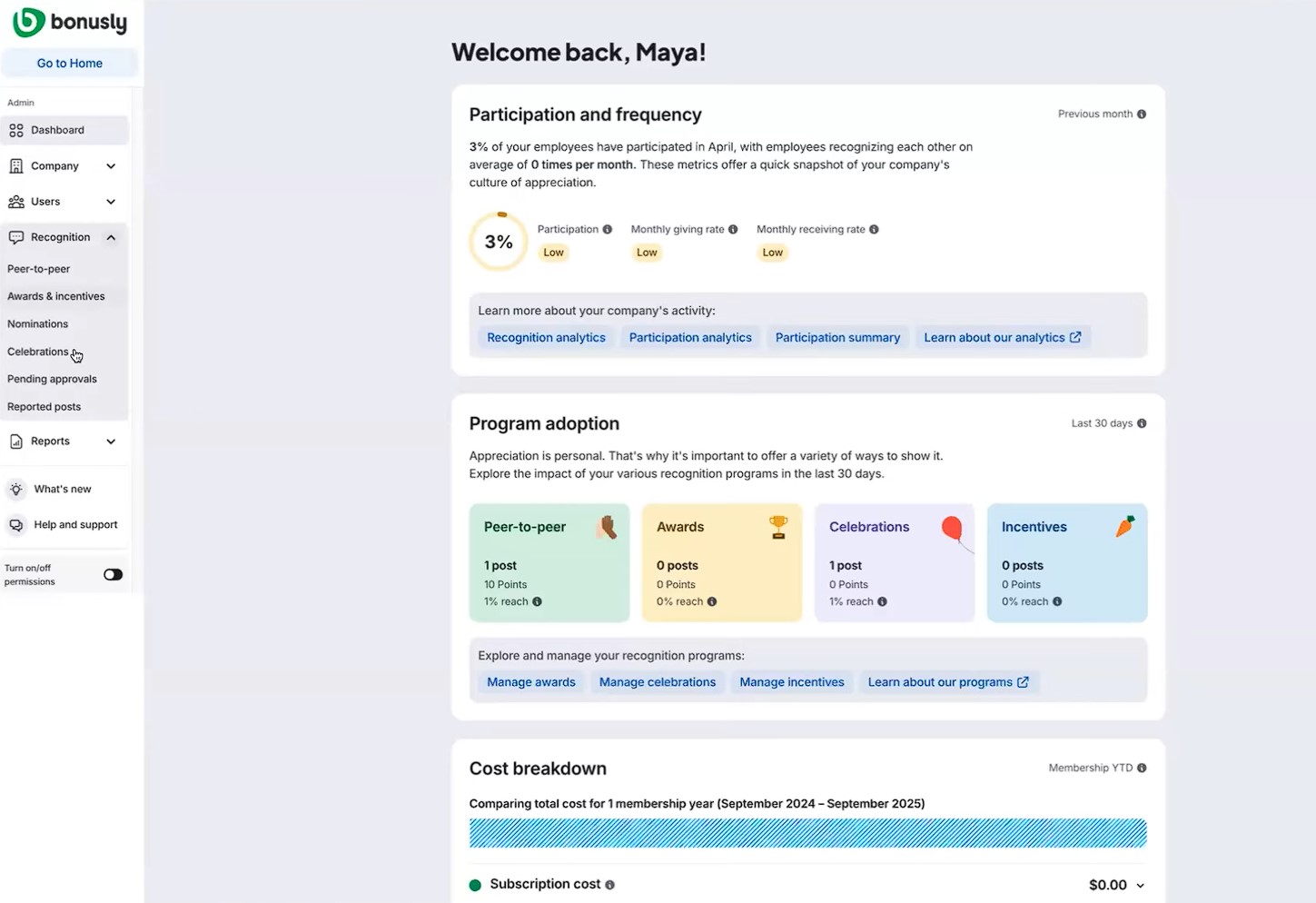
The core offering is Bonusly’s global rewards catalog, featuring over 1,200 gift cards in over 200 countries and curated gifts that feel personal and meaningful. Employees can choose from categories like apparel, dining, travel, and entertainment. In our tests, the redemption process was pretty straightforward, with clear navigation and strong international coverage. Through its AXOMO integration, companies can also offer branded swag on demand, which one can utilize to keep rewards on-brand without giving more work to HR.
Moreover, recent product updates have improved reward delivery and platform control. Slack and Teams integrations now allow one-click reward actions with real-time previews, and admins can moderate content by restricting hashtags or emojis. Bonusly has now also expanded its integrations to include Paylocity, Rippling, and Workday, enhancing compatibility within larger HR ecosystems.
Additional enhancements include structured 1:1s with shared agendas, lightweight check-ins to keep everyone on the same page, and automated performance recaps that highlight not only recent contributions but also trends over weeks and months.
That said, given that this solution’s rewards model is primarily point-based and individual-focused, companies aiming for more non-monetary, experiential reward strategies may find it less compelling.
We’d also like to see Bonusly improve its analytics further, as the current dashboards provide high-level trends but lack granular filtering by department, tenure, or region. Additionally, some global users report limited local reward options and lower redemption caps, which can affect fairness and engagement abroad.
Hulu, InVision, SurveyMonkey, and Headspace are among Bonusly's 3,400+ customers.
Bonusly has 3 plans, all of which are billed annually:
- Free: up to 8 users
- Team: $3 per seat per month
- Organization: custom
Best For
Companies ranging from 50 to 5,000 employees looking to build a culture of appreciation via employee points reward programs.

I use Bonusly as an end user to give and receive recognition from my coworkers. I try to provide on-the-spot feedback when someone has helped me with a task or project. Bonusly also recognizes employees on their birthdays and work anniversaries, allowing others to add recognition and points to those posts. Employees can save up their Bonusly points and redeem them for gift cards, donations to charity, or other rewards.
Additionally, I was involved in setting up the integration between our HRIS (Workday) and Bonusly to ensure seamless data synchronization.

- I like recognition platforms in general because they add an element of fun and reward beyond what employees receive from their managers, annual raises, or bonuses.
- Bonusly's interface is very intuitive. When starting a recognition post, it prompts you with "@" to tag a coworker, "$" to add points, and "#" to include a company value/hashtag.
- The Slack integration is particularly useful. Not only is the recognition feed available in Slack, but users receive direct Slack notifications when recognized and can also send recognition without leaving Slack.
I'm not sure when my company started using Bonusly, but I’ve been using it as an employee since joining about six months ago. Bonusly is our company's chosen recognition platform, allowing employees to acknowledge and reward each other for contributions.
It provides an easy way to give real-time recognition, fostering a culture of appreciation across teams. Employees can accumulate points through recognition and redeem them for rewards. Overall, it has helped encourage peer-to-peer engagement and recognition within the company.
- While I like that Bonusly offers GIFs to include in recognition posts, the selection is somewhat limited.
- The setup process was smooth, but Bonusly does not offer a non-production instance, which made testing the Workday integration a bit riskier since we had to connect directly to our production environment.
- Aside from that, it's difficult to find something I dislike, as even the integration instructions were clear, and the support team was responsive and helpful.
It's hard to say, as many recognition platforms function similarly. Bonusly is easy to use, like most competitors, and offers a variety of redemption options for points. One standout feature is its strong Slack integration, which enhances engagement for companies that rely on Slack. Otherwise, it operates similarly to other recognition platforms.
Consider how employees will interact with the platform. If your company relies heavily on Slack or Microsoft Teams, integration with those tools is important. It's also crucial to understand how the platform charges for points—some systems require companies to pay for all allocated points, whether they are used or not. (I don’t have visibility into Bonusly’s billing structure.)
Also, having a variety of redemption options is valuable, including gift cards, company swag, and charitable donations, to ensure broad employee engagement.
I can’t speak to long-term changes, as I’ve only used Bonusly for about six months. However, the fact that they offer a pre-built Workday integration template suggests they are keeping up with evolving HR technologies and ensuring compatibility with widely used systems.
Bonusly is a good fit for any organization looking to foster a culture of recognition. Because it is designed for peer-to-peer engagement, it benefits companies of all sizes by encouraging employees to acknowledge each other’s contributions.
A very small company may not see as much value in Bonusly since recognition is often more informal in smaller teams. The platform is more engaging when there are enough employees to distribute and receive points frequently. Otherwise, it seems like a solution that could benefit a wide range of organizations.
Motivosity
Motivosity lets employees choose personalized, exciting rewards; automates service awards and birthdays; and leverages gamification to drive engagement in company initiatives.
PROS
- Motivosity is mobile-friendly. Users can access the platform via phones, desktops, and collaboration apps like Teams and Slack.
- The company offers free software (namely Connect) with fundamental features for employee engagement.
- The free trials are available for all paid subscriptions.
- In addition to rewards, it’s easy to give a shout-out or recognition to another colleague through the platform.
- The built-in reporting provides helpful insights around potential attrition, most recognized employees, and performance highlights.
- Employees can access this system from their phones, desktop, and apps they are in at work such as Teams/Slack
- One platform that combines rewards, recognition, employee engagement, and more
- Built in reporting with insights around potential attrition, most recognized employees, managers that need coaching, etc.
CONS
- Lack of rules to regulate the distribution of points. For example, a team member could give 100% of their monthly rewards to a friend.
- Performance management features, like 1:1s and coaching, are no longer available.
- Only has dollar (not points) based rewards. Their research shows dollars is more effective, but many companies want points.
- Some users claimed sometimes it can be a bit buggy connecting to Slack to notify people that an appreciation came through.
- It would have broadened the number of gift card options for users to choose from.
- There could have been an easier way to integrate the software with swag stores. For now, you have to transfer funds to a card and then link that card with the swag store, which slows down a bit the process to cash in funds.

Motivosity is easy to recommend given how this vendor reinvents employee rewards by letting companies move beyond cookie-cutter gift cards to create recognition programs that truly resonate with their teams. Testing the platform, the first thing that sticks out is the rewards store. It’s so customizable, covering both digital or physical gift cards, from national retailers or local merchandise.
Adding custom rewards was straightforward. We liked how flexible the platform is in letting administrators set up unique competitions—anything from wellness challenges to book clubs—complete with badges and awards for winners. Impressively, you can set up the platform so that participants can upload proof such as step counts or book reviews to foster integrity and fairness to the process.
For milestones, Motivosity automates service awards and birthday celebrations with personalized gifts and shoutouts. These moments appear in a social feed, where colleagues can leave social recognition to amplify the celebration and build camaraderie.
However, we think you'd hesitate to make an investment in this platform if all-in-one solution with both recognition and performance management capabilities is what you’re eyeing. Motivosity has phased out its performance management tools, so features like one-on-ones and coaching are no longer available.
Another potential drawback is that the rewards platform lacks rules or limits on how employees distribute their points. This means someone could, in theory, send 100% of their monthly reward allocation to a close friend, which can hurt the fairness of the system if not monitored.
Health Catalyst, Cotopaxi, Health Equity, Instructure, Ivanti
Motivosity uses custom, volume-discounted pricing based on company size and chosen modules. The platform fee is approximately $0-$2 per employee per month (PEPM), with additional modules starting around $1 PEPM. Typical annual investment ranges, assuming an average of 2 modules, are:
- Small businesses (20–250 employees): $3,000-$10,000 per year
- Mid-market (250–5,000 employees): $7,500-$75,000 per year
- Enterprise (5,000+ employees): $40,000-$300,000+ per year
Final pricing is tailored to exact employee count, selected modules, and contract structure. Small business plans start at a minimal spend of $3,000 annually.
Best For
Organizations with 10 - 10,000 employees.

We had used Motivosity to promote events in the community. We also used it to facilitate Employee Giving (i.e. Hurricane Maria in Puerto Rico several years ago). During the pandemic, it was leveraged especially to lean into our Employee Resource Groups. We used it to focus on specific dates on the calendar, such as Veteran's Day, Juneteenth, and International Women's Day. We also used this platform to encourage Employees to take the Employee Experience Survey.
Clean Interface. Multi-faceted and easy-to-use
Our organization bought Motivosity as part of our strategy for Corporate Social Responsibility. A discovery from our Employee Experience survey showed that there was an interest in our employees who wanted to give back to the community.
The interface is easy to use. The benefits of the platform include multiple functions such as global connection and employee giving. I used this Motivosity for close to a year.
I don't have anything negative to see about Motivosity.
I would say that Motivosity offers multiple streams to help support Employee Engagement.
Executives should think about the company culture. Does the culture support employees taking on projects and missions for CSR projects? Also, from a Technical standpoint, is it easy to integrate with their current systems?
I would say Motivosity has made our needs, and it has stayed the same.
For-profit corporations and/or organizations with many employees.
Small non-profit companies with small margins.
Assembly
Assembly makes rewarding employees easy and friendly towards SMBs with a flexible pricing structure, good integration options, and support for both peer and top-down rewards.
PROS
- Feature-rich for the price point.
- Customize rewards and set up a points system with automated incentives.
- Month-to-month plan or a long-term contract (12-month minimum agreement). A large team with a long-term contract can get a custom deal.
- Explore the platform for free, no need for a credit card or demo
- Great set of features for the price point
- Make your own rewards and even set up a points system with automated incentives
- You have the option to go with a month-to-month plan or a long-term contract. For the latter, you can reach out to their team for a custom deal if it’s a larger team. However, keep in mind that the minimum agreement is 12 months.
CONS
- Coins and points expire and do not roll over.
- SSO is not standard for all plans. In some cases, it must be purchased as an add-on.
- iOS and Android apps are available, but this information is hard to find on the site.
- Only supports English.
- Coins and points do expire, so sometimes they’ll expire by the end of the month before you can use them, although you get more the next period.
- SSO is only included with some plans. For others, it can be purchased as an add-on.
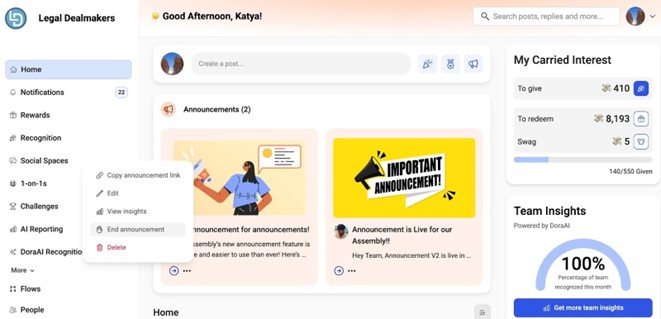
Assembly makes rewarding and recognizing employees effortless. Its seamless integrations with Slack and Microsoft Teams mean you never have to leave your workflow to show appreciation. These social apps are also where team members can publicly nominate one another for recognition and rewards. The personalized points system enables employees to redeem rewards tailored to what makes them feel valued, whether that's gift cards, donations to charity, or experiences that enrich company culture.
With Assembly, you can align rewards to core values, ensuring they resonate with what truly matters to your team. Milestones like birthdays, work anniversaries, and achievements big or small are never missed. The software proactively surfaces these moments and prompts personalized messages of appreciation.
The wide variety of reward options ensures there’s something that’ll appeal to everyone, while the variety of built-in templates and automated reminders for milestones empower managers to turn recognition into a lasting habit, driving engagement and retention.
However, please note that coins and points earned through the platform expire and do not roll over. Another limitation is that Assembly is currently only available in English.
Over 4,000 companies use Assembly, including Casper, Keck School of Medicine, and Perforce.
Assembly customers are charged between $2 and $4 per employee per month, depending on the features and monthly vs. yearly pricing plan. There’s also a Enterprise plan available at a custom quote.
From what we’ve tracked, Assembly’s recent development has been squarely aimed at tightening the integrity and usability of its rewards and recognition system.
- New features rolled out: Assembly added point-swapping controls, giving admins the ability to cap how many points two employees can exchange within a set period. New custom groups also make it easier to target rewards, announcements, and point deposits to more precise employee segments.
- Enhanced features: The filtered home feed helps employees surface recognition activity that matters most to them. The Microsoft Teams notifications integration also makes reward activity more immediate by pushing recognition alerts directly into Teams.
- Features on the roadmap: Upcoming updates focus on 1:1s, HRIS improvements, and Challenges redesign to deliver a simplified, more visual experience for both admins and employee users.
Best For
Growing SMBs.

We use assembly on a daily basis for employee recognition and engagement, and team announcements such as birthdays. We use assembly messenger every week amongst our HR team to share ideas. In addition to a quick way to retrieve company policies, one of the key workflows we use it for is onboarding.

I love the ability to recognize and reward employees in multiple ways. We love digital gift cards, peer nominations, and culture rewards. We are able to reward employees based on their motivation style. We also enjoy the survey feature.
Our company recently expanded and we wanted a centralized platform to assist us with employee recognition and engagement. Preferably one that was automated.
At this time there isn’t anything we dislike.
Assembly is very affordable and scalable for small businesses. The platform is easy to navigate and we enjoy the integrated training. Other platforms we demoed required us to call an account manager for most inquiries or training. It is also very user-friendly and was easy to roll out to our staff.
They should first have an internal employee recognition and performance management process in mind. This will help them determine which system is best for them. The next thing they should look for is if the tool aligns with their business needs and goals. Lastly, the level of complexity requires to implement and use the system on a daily basis. It needs to be user-friendly to drive employee use.
Assembly has evolved with the the level of integrations it offers. They have also created RecognitionGPT to help create professional recognition responses and announcements.
I think assembly is great for all-size companies. The ideal user is someone in operations such as Supervisors and HR. The best part is the user doesn’t have to be tech-savvy.
A person who is unfamiliar with social engagement platforms and unwilling to learn the technology.

Matter
It's rare to find a vendor that can so effectively integrate employee rewards and recognition within tools we're already using daily. So seeing Matter automate global reward delivery, birthdays, work anniversaries, and employee surveys, all inside Slack or Teams—and it does so beautifully—is truly impressive.
PROS
- One app for rewards, recognition, and surveys working right inside your Slack or Teams.
- Gift cards, donations, and prepaid card rewards in 100+ countries.
- Visually appealing and user-friendly software design.
- Transparent, affordable plans with discounts for non-profits and educational institutions.
- Free plan offers unlimited users, customizable notifications, and kudos.
- 200+ HRIS integrations available.
- Option to reward survey completions with redeemable Matter coins.
- Pulse Survey delivered and responded to right in Slack or MS Teams.
- Pulse Surveys use real-time data from a library of 100 questions to provide insights on cultural categories.
- Survey recipients won't see the same question twice within 90 days.
- Real-time anonymous feedback with custom notifications.
- Affordable and transparent plans with discounts for non-profits and schools.
CONS
- You have to use either Slack or Microsoft Teams to be able to use Matter.
- Coin allowance resets weekly if not fully used. (Kudos coins don't expire though.)
- Free plan only support 30 days of analytics history.
- To use Matter, you must have either Slack or Teams installed.
- At this time, the vendor doesn't allow the Pulse Survey questions to be editable.
- Pulse surveys are only available on the highest-priced plan.
We love the fact that Matter automates the delivery of global corporate rewards programs, celebrates birthdays and work anniversaries, and even conducts employee surveys—all within the familiar interfaces of communication platforms Slack and MS Teams. As a remote team that uses Slack daily, it felt natural and incredibly efficient to incorporate the tool into our workflow.
Navigating the software, it became apparent to us that the vendor has paid close attention to their product’s user experience. Matter’s app not only possesses an elegant design but also a straightforward set of functionalities. It only took a few minutes to set everything up: we selected the rewards categories we wanted, used the built-in Rewards Calculator to figure out how many coins to allocate to each team member given our budget, and tweaked the default coin allocation accordingly. Then, all that was left was to approve or reject incoming rewards requests, either in bulk or one by one.

The pricing structure is another aspect we found quite reasonable. At $3 per month, it didn't feel like a significant investment, and the fact that there's a free trial and a free plan available made it an even easier decision for small teams like us to give Metter a go. When compared to Connecteam’s free offerings, Matter's free plan may not match up in terms of verticalization, as Connecteam provides several HR toolkits in its free version. However, it does offer a more robust set of features specifically for employee rewards.
Nevertheless, the requirement to use Slack or Microsoft Teams means Matter wouldn't be suitable for every organization. While we’re aware that Matter does have some very large teams in its customer base, its offerings seem to be most valued by small-to-medium-sized companies with less than a thousand employees.
A note for those looking to start with Matter’s free plan: there’s a 30-day limit on analytics history. It can be a bit of an inconvenience, but we know some budget-minded teams would be willing to work around.
4,700+ companies, including Petco, Shell, and JiffyLube.
Matter offers four pricing plans, ranging from free to $5 per month. All features are accessible during a 30-day free trial.
Best For
Small businesses that are using communication platforms Teams or Slack and are open to incorporating their corporate rewards programs within these apps.

Semos Cloud
Semos Cloud stands out for enterprise reward programs that need to integrate directly into SAP SuccessFactors, Workday, or Oracle while maintaining global reward fulfillment, fraud monitoring, and budget intelligence at scale.
PROS
- Native integration with SAP SuccessFactors, Workday, and Oracle HCM eliminates separate logins and reward data sync issues.
- Global rewards catalog supports 170+ countries with local vendors and zero markup pricing.
- AI-powered Fraud Intelligence monitors suspicious point circulation and redemption behavior.
- Department-level budget allocation and approval workflows add strong governance.
- Frontline enablement through SMS access and no-email-required login expands reward participation.
- Native integration with SAP SuccessFactors, Workday, and Oracle HCM eliminates separate logins and sync issues.
- AI-powered Recognition Copilot and Message Quality Indicator improve message quality and inclusivity.
- Strong frontline enablement with SMS access and no-email-required login options.
- Built-in fraud detection monitors suspicious point circulation and favoritism patterns.
- Global rewards catalog supports 170+ countries with zero markup on rewards.
CONS
- Pricing is not publicly disclosed.
- Primarily designed for large enterprises; may exceed the needs of smaller teams.
- Comprehensive platform scope may feel complex for companies seeking a simple points-based rewards tool.
- No free trial available.
- No free trial available.
- Pricing is not publicly disclosed.
- Primarily designed for enterprises; may be too robust for small businesses.
- Broad platform scope (recognition, engagement, performance, AI agents) may feel complex for teams seeking a lightweight recognition-only tool.
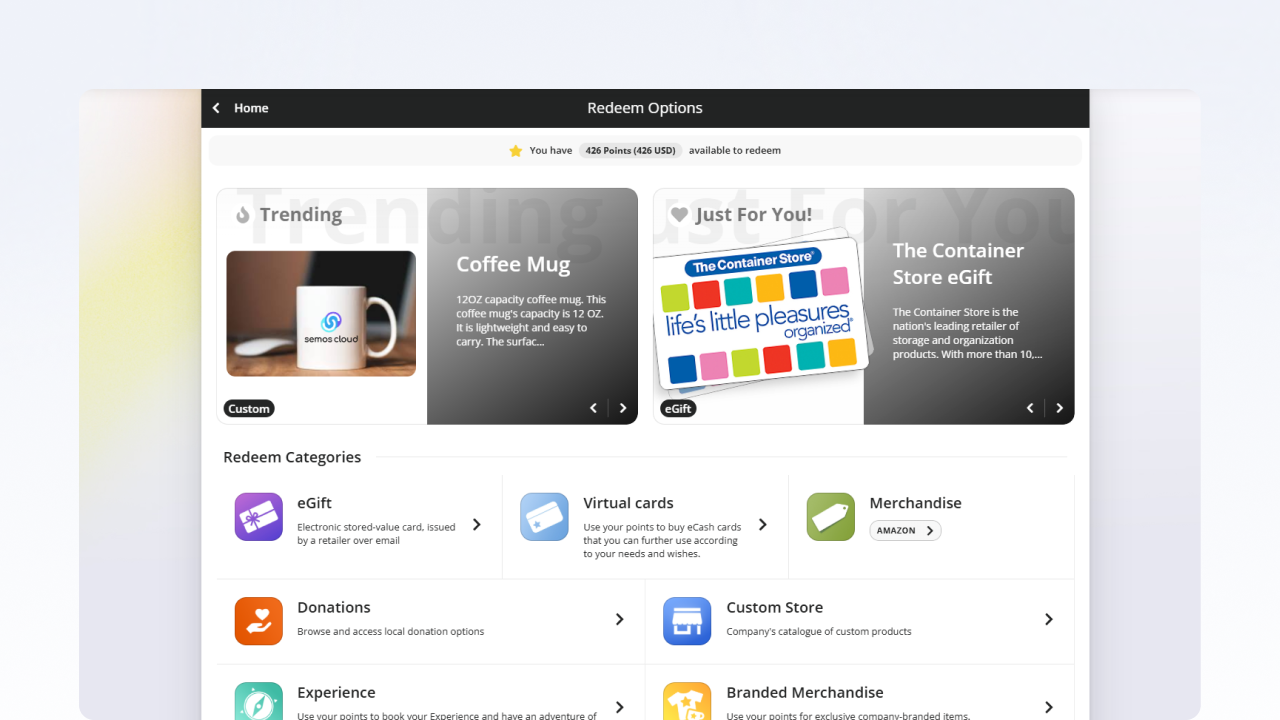
Semos Cloud is a People and Culture Intelligence platform, but when evaluating their rewards capabilities, what stands out is the operational infrastructure behind the program. This includes department-level budget allocation, approval workflows, spend forecasting, fraud monitoring, and global reward fulfillment across more than 170 countries. In other words, the catalog is one piece of a much larger enterprise control system.
Their genesis story reinforces that structure. Semos Cloud embeds directly into HRMS platforms like SAP SuccessFactors and Workday. Reward eligibility, point balances, redemptions, and reporting connect directly to employee records and organizational hierarchies. For large enterprises managing thousands of employees across multiple geographies, this reduces manual reconciliation and ensures financial oversight stays aligned with HR data.
Global fulfillment is another area where the platform feels enterprise-ready. Semos Cloud supports localized gift cards, merchandise, experiences, charitable donations, and custom company-branded rewards in more than 170 countries. Currency handling and regional vendor sourcing are built into the platform. The zero markup model also deserves mention. Organizations pay the face value of rewards rather than inflated catalog pricing, which can significantly impact total program spend at scale.
Governance is not an afterthought. Fraud Intelligence monitors suspicious point circulation, unusual redemption behavior, and favoritism patterns. Budget Intelligence allows leaders to allocate funds at the department level, enforce approval workflows before points are distributed, and track usage against forecasted spend.
Accessibility extends to rewards as well. SMS-based participation and workflows that do not require corporate email credentials ensure deskless employees can earn and redeem rewards without barriers. For manufacturing, retail, energy, and field-based organizations, that design choice meaningfully increases program reach.
Sephora, SAP, Japan Tobacco International, Colgate-Palmolive, Chevron Phillips, Coca-Cola entities
Semos Cloud offers subscription-based pricing:
- Monthly recurring license fee (based on user count)
- One-time implementation fee
- No markup on rewards (pass-through pricing)
- Pricing negotiable based on scope and geography
Semos Cloud does not publicly disclose pricing and does not generally offer a free trial.
Best For
Global enterprises already using SAP SuccessFactors, Workday, or Oracle that need a scalable, compliant, and deeply integrated rewards program with strong budget governance and international fulfillment capabilities.

Kudos
Kudos’ employee rewards storefront is highly configurable, allowing you to tailor rewards that speak to your brand and employees’ needs. Extra support is also provided during and after the tool’s launching phase.
PROS
- Kudos possesses a set of unique, company culture-oriented features that are present all across the platform.
- Users love how easy Kudos is to navigate.
- It has all the bells and whistles out-of-the-box, both on the web and mobile versions.
- Available in 11 languages.
- Recognition messages can include redeemable points, making appreciation both meaningful and actionable.
- Admins can offer gift cards, merchandise, experiences, donations, or company swag tailored by location, team, or budget.
- Combines data on morale, recognition, churn, and loyalty into a digestible culture score.
- Pulse Surveys automatically generate executive summaries, saving HR time and improving visibility.
- SOC 2 Type II and ISO 27001 certifications make Kudos viable for enterprise buyers.
- The platform is available in 11+ languages with regional reward options.
CONS
- An insider's help is needed to get a good idea of the Kudos app from the website, so a demo is necessary.
- The UX/UI could be improved: some users reported issues with attaching images, .gifs, and emojis.
- No free version and no trial version.
- No free trial or sandbox, so buyers must book a demo to access the platform.
- Average app store ratings of 3.2/5 and hasn’t been updated since mid-2024.
- Requires upfront configuration, making it not ideal for teams without internal admin capacity.
- If employees don’t use the recognition system regularly, culture insights lose depth.
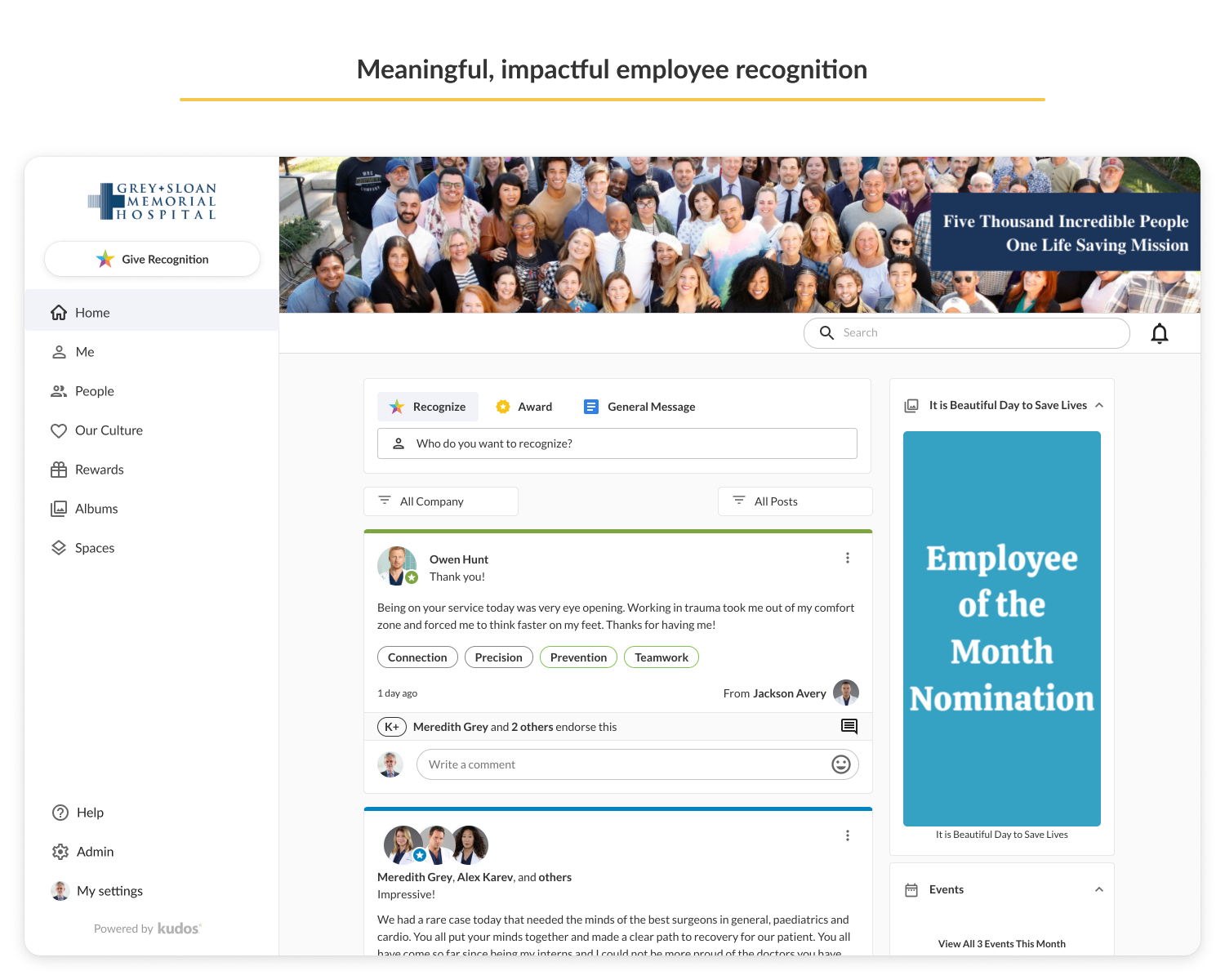
Kudos offers an engaging employee rewards platform that amplifies recognition and supports stronger company culture. One of the features that stood out for us is its customizable online storefront where employees can redeem their points. We’ve gone through the catalog, which includes popular rewards like gift cards, merchandise, charitable donations, travel experiences, and company swag. It’s also easy to add custom rewards to the storefront and tailor it to what your employees like.
As an employee using the system, it’s easy to rack up points through peer-to-peer shoutouts, manager recognitions, completing learning modules, hitting key milestones, and more. From the employee interface, it’s also easy to track points balance and redeem them for rewards.
Kudos also provides dedicated program management support to ensure seamless execution. Their team helps handle reward sourcing, point tracking, reporting, and communication to drive program success. With their help, you are guaranteed to run effective employee recognition and rewards programs that your people will love to be part of.
However, one of the pain points we noticed about this vendor is that the product’s website doesn’t provide a clear overview of the platform, which might slow down early evaluations.
We also found room for improvement in Kudos’ UI/UX. Some users have noted issues with attaching images, GIFs, or emojis when giving and/or interacting with shoutouts.
ATCO, Bulgari, Arch Insurance, KidsPeace
Kudos offers a starting price of $3.25 per user per month, catering to organizations with a minimum of 500 employees. The actual pricing is flexible and determined by factors such as the number of users and the duration of the contract.
Best For
Businesses with over 500 employees looking for a program that supports multiple languages and diverse forms of rewards and recognition, from shout-outs to gift cards, experiences, and charity.

We use the points to issue to team members. Team members can then send points to each other as a show of appreciation. This can be for providing good ideas during a meeting or helping out on a project. Employees can use the earned points for rewards like gift cards. We also use the awards feature for different company and department recognition across the board.
I like the awards feature because you can customize the categories to the company. The platform is easy to use and navigate, which makes the learning curve manageable. Recognition can be sent with or without points, so it doesn't limit employees in showing gratitude.
The client bought Kudos because they wanted a different way of recognizing and incentivizing team members. There wasn't a clear method for recognizing employees. We were also looking to find motivating initiatives to make recognition a part of the everyday culture. Kudos allowed collaboration and gratitude to be easy not only from a company standpoint but also by allowing team members to shout out to each other. We have a mixture of remote and on-site teams, so the platform makes it easy to navigate recognition.
I dislike that points expire after a certain period. I know it is to encourage giving recognition, but we also don't want to force it. The pulse survey feature is a bit limited in customization and analysis. Besides those two issues, I have no other cons.
I think they have really put time into ensuring the experience is top-tier. The platform structure compared to some of the others is what sold the company.
What do you want out of your recognition program? How do you want it to align with or enhance your culture? It's not just about points and getting rewards; it is about the specific outcomes you're hoping to see.
I am not sure, as I only used it for a brief period.
A medium or big sized company that want to reward and recognize their employees will find Kudos to be a good fit.
A startup or a small company that doesn't have an intentional plan around recognition will not get the most out of Kudos.

AdvantageClub.ai
We picked AdvantageClub.ai because it has everything one would need for employee rewards and recognition in one place, so you can ditch the multiple apps and streamline your process with this easy-to-use platform. Plus, if you want to create a rewards program that matches your company culture, you can customize it with the thousands of redemption options this vendor offers.
PROS
- AI-powered messaging feature streamlines the process of giving and receiving recognition.
- Extensive global rewards marketplace with 10,000+ brands across 100+ countries.
- Flex-Benefits program allows employees to customize how they use perks.
- AI-driven engagement assistant (ADVA) nudges employees to stay active in recognition programs.
- Seamless integrations with HRMS, Slack, Teams, and Outlook for workflow automation.
- AI-powered messaging feature streamlines the process of giving and receiving recognition.
- Extensive global rewards marketplace with 10,000+ brands across 100+ countries.
- Flex-Benefits program allows employees to customize how they use perks.
- AI-driven engagement assistant (ADVA) nudges employees to stay active in recognition programs.
- Seamless integrations with HRMS, Slack, Teams, and Outlook for workflow automation.
CONS
- No public pricing. No self-service free trial.
- Instead of self-configuration, users may require additional support to leverage the power of analytics and dashboard features fully.
- No public pricing. No self-service free trial.
- Instead of self-configuration, users may require additional support to leverage the power of analytics and dashboard features fully.
For those who are here for an employee rewards and recognition system that allows you to customize and use AI and has thousands of global redemption options, we highly recommend AdvantageClub.ai. This platform’s global rewards marketplace boasts more than 10,000 brands in over 100 countries and counting. And just as importantly, the redemption process is easy and smooth.
We gave the redemption process a test by selecting a Walmart gift card from the U.S. marketplace. Within seconds, we received our digital gift card, ready for use. From there, we could redeem the earned points through the system’s peer recognition program for shopping, dining, experiences, and even wellness benefits.

We tested AdvantageClub.ai’s redemption process by choosing a Walmart gift card from the US market
The Amazon Marketplace integration also came out really nice. We could convert points directly into purchases across various product categories without any issues.
If you like to give employees more control over how they use their perks, the in-app Flex-Benefits program has options for medical benefits, wellness plans, and fitness memberships— all configurable.
The flexibility is extended to the employer’s side, too. Instead of being a plug-and-play solution, AdvantageClub.ai allows companies to custom-brand their rewards program, from logos and colors to customized award categories.
Within its admin dashboard, we could set up custom award approval workflows, manage budgets, and configure different recognition programs per department or region. The system also worked well when we used bulk uploads for award distribution, which can be very handy for those looking to roll out incentives at scale.
And "ADVA," the AI-driven engagement assistant, impressed us with the gentle nudges to keep employees involved without being too pushy about it. For example, it reminded us that we hadn’t recognized a colleague in two weeks and suggested sending an appreciation message. Similarly, for wellness incentives, it notified us when we had points to use for a health check-up.
One downside of AdvantageClub.ai, however, is that this vendor isn’t upfront about their pricing. Costs can change depending on where your team is based and what features you need, so a talk with their sales is a must to get a quote for your business. Also, unlike some competitors such as Guusto and Workstar, the rewards platform doesn’t offer a free trial.
1,000+ companies, including EY, Concentrix, TARGET, Hexaware, BCG, and Turner.
AdvantageClub.ai has custom pricing.
Best For
Large enterprises, AI-first organizations.
Terryberry
Terryberry offers a comprehensive rewards platform with one of the industry’s largest rewards selections, including merchandise, gift cards, travel experiences, and custom-crafted awards. The platform’s flexible workflows and pay-upon-redemption billing help manage budgets effectively, while its hybrid-friendly design ensures easy access for all employees.
PROS
- Pay-upon-redemption billing model with multi-center cost allocation for better budget control.
- Global fulfillment capabilities with extensive international reward options.
- Flexible reward programs that can be tailored to company values and engagement goals.
- Advanced analytics to measure the impact of rewards on employee engagement and sentiment.
- HRIS integrations to automate and simplify reward management.
- Mobile-friendly features for deskless and hybrid workforces.
- Personalized support from implementation to ongoing customer success.
- Amazon Business is available for rewards in the US.
- Customized physical goods as employee rewards
- Wide range of employee engagement features, including rewards, incentives, and a wellness tracker.
- Customer support and account management at Terryberry are quite good. Their reps stand out for being very responsive and attentive, which is evidenced by some of the client testimonials we read.
- The implementation process, while six weeks long, is quite comprehensive, and you get tons of help along the way. For instance, the last two weeks consist of internal and customer testing, as well as user training.
CONS
- The platform’s interface design could benefit from a more modern look.
- No open API yet, although this feature is on the development roadmap.
- No free trial is offered at this time.
- While Terryberry is easy to use, its design could look more modern and sleek.
- No open API available as of this writing.
- No free trial at the moment.

Terryberry’s rewards platform offers a robust solution for companies looking to engage employees through meaningful and customizable rewards. During our demo, we explored Terryberry’s expansive rewards catalog, which includes merchandise, gift cards, travel experiences, company swag, and custom-crafted awards. This variety ensures that companies can provide rewards that resonate with diverse employee preferences.
We found that the platform’s flexibility in configuring reward programs stood out. Organizations can design reward workflows that align with their mission, vision, and values. For example, during our conversation with the product team, they highlighted how value-tagged rewards reinforce company culture by directly linking rewards to specific achievements and behaviors.
Terryberry’s pay-upon-redemption billing model was another standout feature. This approach helps organizations manage budgets more effectively by only paying for rewards when redeemed. Multi-center cost allocation further simplifies financial management for larger organizations.
The platform’s global fulfillment capabilities support rewards delivery in over 150 countries, making it ideal for international organizations. Additionally, the hybrid-friendly design ensures that office-based and frontline employees can participate. We saw how features like QR codes and mobile options make it easy for deskless employees to access and redeem rewards.
Despite its strengths, we’re quite disappointed in the platform’s interface: it’s not exactly user friendly but rather look dated. Additionally, the lack of an open API limits integration possibilities makes this option not the best bet for some enterprises.
Terryberry serves over 40,000 clients globally, including well-known organizations such as Tesco, Epsilon, General Motors, and Trilogy Health.
Terryberry's basic subscription plans start around $3 per rewarded employee. Pricing depends on subscription features and reward types, one-time setup fees, and annual administration fees based on employee count and reward redemptions.
Terryberry has made several notable updates to its rewards platform in the past year, enhancing its capabilities and user experience:
- Expanded global fulfillment: Rewards can now be delivered in over 150 countries, supporting diverse and international workforces.
- Advanced analytics: New tools to measure the impact of rewards on employee sentiment and engagement.
- Mobile enhancements: Improved mobile experience for easier reward access and redemption, especially for deskless employees.
- AI-powered features: AI-driven insights help refine reward strategies and personalize reward recommendations.
- Custom workflows: Enhanced options for configuring reward programs to align with company values and goals.
- Amazon Business was recently introduced to their rewards catalog, though it's currently available only to users in the U.S.
Best For
Hybrid or global companies seeking an all-in-one rewards system with expansive catalog options, including travel, swag, and custom-crafted awards.

I utilized Terryberry several times a week to set up recognition programs aligned with our company values and goals. Reviewing nominations and approving awards was a regular task, ensuring fairness and recognizing employee achievements. Tracking employment milestones and communicating with employees about their accomplishments and events was also crucial. Periodic surveys were conducted to gather employee feedback, and I frequently analyzed reports and analytics to identify trends and further engage employees.
The creation of rewards programs was straightforward, making it easy to align them with company values. The peer-to-peer "wow" program successfully encouraged employees to recognize one another, fostering a positive and engaging work environment. The wellness program was well-received by staff, indicating its success. Excellent customer service and the user-friendly app, especially for field employees not frequently at desks, were significant advantages.
Our organization was concerned about the high employee turnover rate, with exit interviews often highlighting a lack of morale due to employees feeling unseen and unrecognized. Increasing salaries as a reactionary measure to prevent departures did not effectively address the underlying issue of employees feeling unappreciated. We were also worried about engagement levels and the resulting dip in productivity from disengaged employees. Despite trying numerous team-building exercises and management retraining, the problem persisted. Terryberry seemed to offer a solution by providing ongoing recognition, encouraging exceptional work, boosting productivity, and reducing turnover by enhancing morale. I have personally used it for six months.
The many choices available for employees was somewhat overwhelming, potentially leading to decision fatigue and wasted time. The tool's integration with other HR systems could be smoother, and customization options were not as flexible as desired, particularly concerning integration with external programs.
Compared to other tools I've used, Terryberry stands out for its user-friendly interface and exceptional customer service. It focuses less on gamification, favoring a points system over cash rewards, which aligns better with our goal of providing added rewards rather than extra compensation. This approach seems more appropriate for recognition software.
It's essential to consider whether your employees are likely to adopt and appreciate this tool. High-income professionals with demanding roles may show less interest in the rewards, so understanding your staff's preferences is crucial. Implementation is straightforward, but launching the program requires commitment. Additionally, be mindful of potential issues like perceived favoritism and have strategies ready to address them.
Terryberry has enhanced its mobile app, making it more accessible for employees regardless of their location. Improvements to the interface's navigation have also made the tool more user-friendly over time.
Terryberry is well-suited for remote or geographically dispersed workforces, industries with high turnover at the entry-level, large companies, and any organization looking to boost employee engagement, especially in roles that are repetitive or routine. This tool can help employees feel more recognized and engaged.
For very small organizations with fewer than 20 employees, Terryberry might not be as effective due to a small pool of participants and potential repetition of rewards. Additionally, highly compensated employees with very busy roles may not find as much value in the type of rewards offered.

Vantage Circle
Vantage Circle offers a wide range of peer and manager rewards to boost engagement, with the flexibility to support global teams through localized redemption options in over 100 countries and in 16 languages.
PROS
- Vantage Circle features an excellent user interface that’s modern, clean, simple, and easy to navigate.
- There’s a wide selection of gift cards and shopping discounts to redeem points.
- The process for redeeming points for gift cards and vouchers is quick and straightforward.
- Users praise Vantage Circle’s support team for being quick to respond and resolve issues.
CONS
- There’s a learning curve due to the platform’s feature breadth. The clean and easy-to-navigate interface does make up for it though.
- The conversion rate of points to monetary rewards is low according to users.
- The mobile app can sometimes be slow or buggy. Reports include occasional technical issues with logging in or displaying points accurately.

Vantage Circle offers a comprehensive and user-friendly employee rewards platform that makes it easy to appreciate and engage your workforce.
The platform stands out for its massive rewards catalog, containing gift cards, merchandise, and curated experiences accessible in over 100 countries. What’s also great about it is that it takes the Standard of Living Index (SOLI) into account, adjusting reward points for international teams to redeem in a fair manner.
There’s a host of features around peer-to-peer recognition. Employees are empowered to recognize one another's accomplishments via custom awards and badges. There’s also a social feed that showcases all the recognition passed around and a leaderboard that not only tracks but gamifies everyone’s efforts.
Milestones like birthdays and work anniversaries are never forgotten with Vantage Circle’s automated messages. The platform also helps you create a digital yearbook and service catalog for long service awards.
However, we agree with most users that parts of the platform’s admin dashboard could be more intuitive, particularly when navigating advanced analytics or configuring complex workflows. Although we appreciate the broad catalog, we couldn’t help but found certain regions like APAC have significantly fewer localized options, which could limit choice for employees in those areas.
Lastly, Vantage Circle surprisingly doesn’t integrate natively with as many HRMS or communication tools as some competitors, meaning more manual work or custom integrations might be needed.
Vantage Circle is used by over 700 companies including Bosch, Tata, and DHL.
Vantage Circle’s pricing depends on the number of employees you have. SMBs with up to 1000 employees can access the Grow plan at a starting price of $200 per month. The other two plans, i.e. Transform and Enterprise have custom pricing. Contact Vantage Circle’s Sales team for an estimate based on the size and needs of your company.
Best For
Multinational organizations.
Vantage Circle is used for driving engagement, productivity, wellness, and staff retention. It provides real-time feedback, ensuring no surprises during performance evaluations and bonus allocations. We run many employee well-being initiatives through Vantage Circle, collecting data to evaluate their effectiveness. For example, we recently introduced virtual yoga sessions, which are tracked in the wellness tracker. The rewards and recognition platform allows employees to choose from a variety of rewards using a points system, giving them autonomy over their incentives. Vantage Circle helps us manage these services seamlessly.
- What I like is that it is very user-friendly. Most employees find it very easy to navigate and use.
- The customer support has been second to none; no inquiry is too difficult, and they are always happy to help - Paul has been such a massive help to us.
- Having one system that we can utilize for many different rewards, recognition, feedback, and wellness, as well as a consistent approach for the whole organization, made my job easier!
The organization I worked for had no recognition program or tools to monitor employee satisfaction. Some managers had their own processes for their teams, while others did nothing. This inconsistency became a noticeable issue, with employees leaving and citing this as a factor. I was brought in to review HR operations and found this was one of many areas needing improvement. We chose Vantage Circle for its ease of use, integration with our internal systems, and compatibility with our overseas virtual assistants. Vantage Circle has been in place for over three years and remains a critical part of the organization.
- We had to customize our rewards programs to suit Vantage Circle, which was challenging but ultimately beneficial.
- The gift card options are limited, requiring customization to match staff preferences.
- It can be costly, especially with the more expensive plan, but the benefits outweigh the costs in terms of staff retention and employer reputation.
Vantage Circle stood out for its seamless integration with our internal systems and overseas virtual assistants. Its user-friendly interface and ability to package wellness, rewards, recognition, feedback, and onboarding into one system were crucial. We preferred having all functions in one system rather than using multiple tools for different purposes.
Consider the need for a user-friendly system that staff can easily use and integrate with existing systems. Determine what specific functions you need to ensure consistency across the organization. Vantage Circle is ideal if you aim to stand out as an employer of choice.
Vantage Circle has been responsive to recommendations for improvement, such as adding more gift options. They keep up with technology changes and provide a user-friendly app with accessible podcasts and webinars.
Vantage Circle is ideal for organizations serious about employee retention and becoming an employer of choice.
Vantage Circle may not suit very small organizations with minimal employees due to the cost versus benefit factor. Smaller organizations might manage these functions more cost-effectively through other methods.

Mo
With Mo, you can design and automate your employee rewards program with its easy-to-manage peer-to-peer appreciation, budget controls, and reporting functionalities.
PROS
- User-friendly UI with a wide range of gift card options.
- Transparent and reasonable pricing, no rewards fees.
- Available in twelve languages and growing.
- Free software onboarding and implementation support for all plan users.
- Mobile apps are available for both Android and iOS users.
- UI is easy to navigate, and users seem to appreciate the varied choice of gift cards they can offer through the platform.
- Transparent pricing starting from $2.25/user/month with no rewards fees.
- Free onboarding and implementation support for all users.
- Robust and feature-rich mobile applications.
- Available in 12 languages and growing.
CONS
- Mo no longer discloses its pricing.
- There is no free plan (but a free trial is available upon request.)
- Customer support is limited to weekdays, 9 AM - 5 PM GMT.
- The system sometimes sends several notification emails to uninvolved users.
- HRIS integration absent in Base plan. Possible implementation fee for Slack and Microsoft Teams integrations.
- The customer support hours are limited to weekdays, 9 AM - 5 PM GMT.
Mo makes rewarding employees incredibly simple, meaningful, and fun. We put it to the test and found the UI quite intuitive. It’s easy to grant credits to deserving employees, which they can redeem from Mo’s extensive rewards marketplace of major brands like Amazon, Nordstrom, and Tesco.
Colleagues can post public or private appreciative “Moments” and react with comments, emojis, and GIFs, nurturing a culture of appreciation from the bottom up. Managers can also use Mo’s unique “Boosts” to regularly prompt team members to recognize one another for day-to-day wins.

We like a lot of things about Mo but if we had to choose just one, it’d definitely be their automated Assistant. The Assistant automatically reminds managers to recognize employees on their special days like birthdays, work anniversaries, and other special occasions. It also nudges managers and employees to share appreciation if someone has not been recognized in a while, which is something we’ve not seen on other platforms.
That said, Mo’s pricing is not friendly towards budget-conscious teams, with no pricing transparency and no free plan. The one consolation, though, is that you can request the vendor to provide you with a free trial.
Regarding customer support, the service is good, but do bear in mind that it is limited to weekdays during UK business hours (9 a.m. – 5 p.m. GMT), which can be inconvenient for global or U.S.-based teams needing timely assistance. Additionally, we found the platform’s notification settings lacking refinement. As reported by verified users, Mo tends to send too many emails, including to those not directly involved in a recognition moment.
Mo has more than 100,000 users. Some top customers are SGN, The O2, NHS, Aspen, William Hill, and SHL.
Mo offers custom pricing via a monthly subscription model based on the number of employees included in the program. Contact their sales team for a quote.
Best For
Distributed teams who want to connect and motivate employees within established internal communications platforms like MS Teams and Slack.

Bucketlist
With its vast experiential rewards catalog, easy fulfillment, collaborative team challenges, and more, Bucketlist boosts employee satisfaction and retention. The platform also offers dedicated support to help you optimize your incentive programs.
PROS
- Numerous rewards are available. Some users have even mentioned that it’s hard to pick one.
- Known for adding customer suggestions to its product roadmap and delivering on them.
- Integrates with ADP, BambooHR, HiBob, Dayforce, SAP, and over 80 other HR systems.
- Web and mobile versions are easy to use.
- A pilot program is available.
- Available in English, Spanish, and French.
- The interface is intuitive and easy to navigate on both desktop and mobile.
- The platform supports customizable rewards and peer recognition tied to company values.
- Dedicated onboarding and account managers are provided with every plan.
- Recognition can be automated for milestones like birthdays and work anniversaries.
- Leaderboards and competitions help gamify employee performance and engagement.
- Bucketlist supports English, Spanish, and French for multilingual teams.
- Integrations are available with 80+ tools, including Slack, Teams, Outlook, and BambooHR.
CONS
- Rewards in the form of experiences are quite limited compared to cash rewards.
- Some users found shoutouts, tokens, and goal setup features challenging to use.
- Points redemption time can be length at times.
- Though intuitive, the platform's interface is less attractive and modern than some competitors.
- The experiential rewards catalog is limited compared to cash and gift card options.
- The shoutout interface lacks a back button when browsing GIFs.
- Setup and per-employee fees may be too costly for small organizations.

Bucketlist’s rewards and incentives platform has an extensive list of features you’d need to boost employee satisfaction, engagement, and retention. For starters, it features a comprehensive catalog of over 2,500 rewards employees can choose from, many of which are unique experiences. Reward fulfillment is fairly simple, with no markup on rewards.
The UI was easy to navigate in our testing. It was also simple to create different competitions which can be tied to sales goals, community service hours, or any important metric. The progress team members make can be tracked on a leaderboard, and winning members or teams receive the incentives you’ve previously defined. There are also detailed analytics and reports that give you plenty of insight into which incentives or awards resonate most with your employees.
On top of its robust features, Bucketlist also offers dedicated support to optimize your setup and training for all users. The implementation process is quick and easy with seamless integrations with platforms your team already uses like G-Suite and Office 365.
Despite the platform’s promise of variety, we found the available rewards centered around experiences notably limited compared to the breadth of cash and gift card options. We also heard feedback that features like shoutouts, token distribution, and goal setup could feel clunky or unintuitive. Finally, while the platform generally handles redemptions well, we experienced some delays in redeeming bucket points.
The platform has over 470,000 users from 100+ countries. Some of them are First Bank, RBC, Interac, Chick-fil-A, 1-800-GOT-JUNK, Stamford Health, Danone, Majesco, and Applebee’s.
Bucketlist plans are priced on a tiered pricing model based on company size. Typically, the range is $2 - $4 dollars per employee per month.
Best For
Medium to enterprise-size businesses (200 to 5,000+ employees).

When I was using Bucketlist, it was a daily touchpoint for me because I wanted to make sure I was liking and commenting on the peer-to-peer shoutouts to keep the momentum going.
My main workflow happened on the first Monday of every month, where I'd jump into the admin dashboard to review the participation reports and see which departments were actually using their points and which ones were lagging behind.
I'd also spend time approving custom reward requests; back then, people loved redeeming points for things like a Friday afternoon off or lunch with the CEO, which I had to coordinate manually.
On top of that, I used the automated milestone workflow to double-check that every upcoming work anniversary had a personalized message attached so it didn't just feel like a bot was doing the talking. It was essentially the backbone of our office, and I used it as my primary pulse-check to see who was performing well across teams I didn't work with directly.
It was great for breaking down silos because it gave us a central social feed where employees could see and celebrate wins across different departments and satellite offices.
The automation of work anniversaries and birthdays was a huge relief because it meant I no longer had to manually track milestones in a spreadsheet or worry about someone being forgotten.
I really liked that the rewards weren't just boring company branded items, as it gave our team the flexibility to choose things they actually wanted, like local experiences or Amazon credit.
I used Bucketlist for about two years quite a while back, and at the time, we were mostly using it to solve the "invisible employee" problem in our satellite offices. We had a real issue where people outside of HQ felt disconnected from our company culture, so we bought Bucketlist to give everyone a central place to see and celebrate wins across the whole business.
Back then, it was a huge relief to move away from my manual "milestone tracker" spreadsheet, even though the platform itself felt a bit more basic than it does today. The primary benefit was that it automated the boring admin work of tracking work anniversaries, which meant I didn't have to spend my Friday afternoons chasing down managers for their team's birthday cards.
Even in its earlier form, it did a great job of making recognition feel more "social" and less like a top-down HR chore.
The initial setup for custom reward fulfillment was a bit clunky and required a lot of manual coordination on my end to make sure people actually got their "off-site" experiences.
I found the administrative dashboard to be a bit overwhelming at first because it wasn't immediately clear how to pull a simple report on point balances without clicking through several different menus.
The mobile app in the version I used was occasionally glitchy and didn't always sync in real-time with the desktop notifications, which frustrated some of our employees who worked on the go.
When I look at Bucketlist compared to some of the other platforms I've seen, the biggest difference is that it's much more "experience-focused" than just a simple points-for-gift-cards store. While some tools can be great for quick, high-frequency peer-to-peer shoutouts, they can sometimes feel a bit like a closed loop where people are just trading micro-points back and forth.
Bucketlist always felt more substantial to me because it allows employees to save up for actual bucket list items, like a cooking class, a weekend getaway, or a specific local activity, which makes the recognition feel much more memorable.
I also preferred Bucketlist because it gives you more control over different budgets and branding for various departments, which is a lifesaver if you're managing multiple locations. If you want a platform that feels like a social event rather than a transaction, this is the one I'd go with.
The first thing to check is whether the rewards are actually worth it. If it's just $10 Amazon cards and cheap plastic mugs, people will ignore the app after two weeks and it becomes a waste of money.
You also need to make sure it actually lives inside Slack or Teams; if your staff has to open a separate browser tab just to say thanks, they won't do it. My biggest piece of advice is to look at the admin side; if you're a small team, you don't want to spend your entire Friday manually chasing managers to approve a lunch or a half-day off.
Also, pay attention to the reporting, because you need to see which departments are being "quiet" so you can address it before one half of the office feels appreciated and the other half starts looking for new jobs.
I did not see many changes happening over the years I used Bucketlist.
Bucketlist is good for mid-sized companies where you have people in different offices or out on the floor who usually get ignored by HQ. If you're a one-person HR team, you need the automation just to keep your sanity.
Bucketlist is a poor fit for tiny startups or teams under 20 people where everyone already sits in the same room; at that size, a digital shout-out feels incredibly fake and it's much more meaningful to just take the team out for lunch.
It's also not the right choice for highly traditional, "old-school" corporate environments where leadership views employee recognition as a "fluff" expense rather than a priority, because without real executive buy-in, the platform just becomes a ghost town.
If your company doesn't have a dedicated monthly budget to actually fund the rewards, the whole thing backfires because employees get frustrated when they realize their points don't actually lead to anything tangible. I also wouldn't recommend it for organizations with a mostly offline workforce that doesn't use Slack or Microsoft Teams, as the friction of having to download a separate app just to say "thanks" usually kills participation before it even starts.
Finally, if you're looking for a "set it and forget it" tool with zero setup effort, this isn't it, because building out a custom model that actually works takes a fair amount of time and coordination at the beginning.
Other Employee Reward Systems Worth Considering
- Bucketlist: Automated employee recognition software with low HR lift
- Matter: Employee rewards system inside Slack and MS Teams
- Nectar: Expanding rewards features and SHRM partnership
- Kudos: Flexible rewards with full budget and catalog control
- Cooleaf: Great point-based employee rewards system for global enterprises
- Vantage Circle: Solid choice for multigenerational workforce rewards
- Mo: Ideal for building consistent employee recognition habits
- Reward Gateway: Reward system for employees with excellent mobile experience
Benefits of Corporate Rewards Programs
An effective employee rewards system strengthens workplace engagement, boosts morale and HR efficiency, and reinforces company's core values, all while cultivating a positive culture.
Improved Employee Engagement and Retention
With 77% of employees performing their best when engaged and appreciated, rewarding worker contributions has a tangible impact. That does not just stop at better staff performance; it also helps reduce turnover rates. Gallup found that organizations that prioritize rewards at work see a 56% decrease in the likelihood of employees seeking new job opportunities
You would also want to consider a program fostering peer-to-peer recognition, as recent data suggests that employees who feel recognized by their peers are five times more likely to feel valued and to invest in their work.
Increased Productivity and Innovation
Employee recognition statistics demonstrate that employees perform better and feel more motivated when their contributions are recognized. According to Gartner, a well-designed recognition program can lead to an 11.1% increase in average employee performance.
Also, when employees receive regular recognition, they are more likely to offer creative solutions and strive for higher performance. For instance, those recognized monthly are 36% more likely to report feeling productive and engaged compared to those recognized quarterly.
Higher HR Efficiency
Too often, HR professionals wear many hats and have multiple aspects they need to attend to, so any opportunity to streamline the processes should be seized. The best solutions have all manner of automation options to ensure that rewards programs are implemented consistently and fairly. These tools can automate everything from milestone celebrations, work anniversaries, and birthdays to onboarding—all in one user-friendly interface.
Strengthened Company Culture and Employer Brand
Implementing a well-planned rewards strategy with the help of employee rewards software is a surefire way to build positivity around your company brand.
Rewards don’t have to be financial, either: Plenty of well-known companies have received positive press coverage for the non-monetary incentives they offer to reward staff.
Types of Employee Rewards (with Examples)
There are generally two employee reward types:
- Monetary rewards are directly linked to an employee's performance, achievements, or contribution to the organization. Examples of monetary rewards for employees include bonuses that comprise a percentage of their salary, a commission on a sale, and a bonus allocated to reaching a specific metric target.
- Non-monetary rewards don’t involve direct financial compensation but aim to motivate and recognize individuals by gifting a specific item or experience. Some ideas for non-monetary rewards include an employee award title, peer nominations, an employee wellbeing program, paid days off to rest after hard work to celebrate a big achievement, and company-sponsored training opportunities that an employee wants to pursue.
You can use either one or both. The center point here is to ensure that the rewards initiatives (as well as the employee recognition programs) are: 1) meaningful to the recipients (your employees) and 2) aligned with your company values.
Employee Rewards Software Pricing
Most employee rewards software pricing runs $2–$6 per employee per month, but that headline price rarely reflects what you will actually pay.
- Pricing is usually billed annually with minimum commitments. Vendors may show monthly rates, but expect a yearly contract with a floor of about $2,500 to $8,750+. For larger teams, pricing shifts to custom quotes, often $40,000 to over $300,000 per year.
- Vendors use a mix of pricing models. Some stick to per-user pricing (Assembly at $2–$4; Nectar at $5–$6). Others layer on a base fee (Connecteam at $29/month plus $0.50–$3 per user). Modular platforms like Motivosity charge a low base ($0–$2 per user) and add fees for features (starting at around $1 per user). You will also see flat annual plans (Awardco at $2,500–$4,000/year) and limited free tiers (Bonusly, Connecteam).
- Expect extra costs beyond the subscription include setup fees, admin costs, and the rewards themselves are often separate. As your team grows, pricing increases with complexity, including more features, more configuration, and more support, not just more employees.
Employee Rewards Systems Trends
Our observations over the past five years of reviewing employee reward systems point to three clear developments: Enterprise platforms are folding rewards into larger employee experience systems; smaller vendors are concentrating on simple, habit-forming tools that fit naturally into daily workflows; and a growing number of HR platforms that started in other categories are now building rewards features of their own.
1. Enterprise platforms becoming broader employee experience tools
Across the employee rewards systems that serve midsize and large organizations, rewards have steadily shifted into a wider suite of capabilities. Many platforms now combine rewards, recognition, engagement surveys, learning tools, and performance management in one place. Over the past year, we have also seen a noticeable increase in AI investments. Most of the features we tested were built to personalize rewards, automate recurring programs, or identify engagement patterns that might otherwise be overlooked. These tools now function more like a central hub for several parts of the employee lifecycle, and the expanded functionality (unsurprisingly) often comes with a higher price point.
2. SMB-focused vendors refining niche use cases and prioritizing design
Smaller employee reward systems that cater to SMBs tend to focus narrowly on a few specific needs. Many of the tools in this segment work directly inside communication apps like Slack or Microsoft Teams, which makes it easier for recognition to become part of day-to-day interactions. Matter is one of the clearest examples. It fits naturally into the tools people already use and relies on clean, intuitive design that new users adapt to quickly. Some of these vendors have begun adding basic AI features, although most of what we have seen so far centers on simple tasks such as helping users craft recognition messages.
3. Broader HR platforms entering the rewards category (with varied results)
A growing group of HR software companies has entered the rewards space from the outside. These vendors usually start with something like scheduling, time tracking, or team communication and later add rewards to expand their suite. The results vary, though. Some features feel lightly built or secondary to the rest of the platform, but a few do show more promise. Connecteam is one example. It is best known for workforce management, yet its recognition and rewards features are simple, affordable, and practical for teams that want a straightforward solution.
How to Set Up a Staff Reward System
Best practices for implementing a successful employee reward system include ensuring smooth integration with your HRIS, monitoring outcomes closely, encouraging feedback from employees, and securing management and employee buy-in at all stages.
- Integration: Accessing employee data already stored in an HRIS, for example, makes tracking progress toward goals much smoother, while a team-up with team collaboration tools like Slack is a hugely effective way to encourage engagement.
- Monitoring: Rather than set-and-forget systems, reward programs require regular monitoring and optimization to ensure that rewards for staff are distributed as intended. The work does take time and effort, but the return will be worth it.
- Encourage feedback: The more engaged the employees are in your reward program, the more on-target it is likely to be. So, involve your people in sharing their thoughts about the tech. They’ll be able to tell you exactly which rewards motivate them (aka what to focus on) and which ones they don’t care for (aka what to cut).
- Management buy-in: The more that management knows about the upsides (actual and potential) of the software that they have signed off on, the easier it will be to obtain approval for scaling it up or improving it in other ways.
Employee Rewards System FAQs
What is an employee reward system?
An employee (points) reward system specializes in providing structured methods for companies to offer rewards, such as cash, gifts, or non-monetary incentives, to employees for their service and positive behaviors. When effectively implemented, this type of software can motivate, attract, and retain top talent and enhance employee performance.
How do I know if my team needs an employee rewards program?
A staff rewards system should be in place if you experience one of these circumstances with your team:
- Team members' productivity decreases significantly.
- Complaints become more frequent among workers.
- High employee turnover rates.
- Most engagement surveys and performance review answers suggest a need for better employee experience and retention.
You may also want to check out our experts' advice on what to consider before buying an employee rewards system to ensure success when exploring recognition solutions.
What is the best employee reward system for employees?
According to our experts’ evaluations, some of the best employee rewards systems are Bonusly, Guusto, Connecteam, C.A. Short Company, Achievers, Motivosity, Workstars, and AdvantageClub.ai.
What are the main benefits of employee rewards software?
Key benefits of employee rewards software include improved employee engagement and productivity, reduced employee turnover, better teamwork, plus the ability to build your work culture and automate various tasks to save time.
How much does an employee rewards program cost?
Many employee rewards platforms offer free trials. A basic rewards program for small businesses can start at as little as $1 per employee per month, while more comprehensive options can cost thousands of dollars or more, often with annual subscriptions required.
What are some examples of employee rewards?
Amazon gift cards, e-cards, and charitable donations are a few examples of employee rewards. However, rewards don’t have to be financial. Plenty of well-known companies have received positive press coverage for the non-monetary incentives they offer to reward employees.
What are the most effective types of employee rewards?
Research shows that rewards from managers are most memorable, but peer recognition is becoming more and more desired in the workplace. Non-monetary rewards such as thank-yous or personalized notes are often more meaningful, with 65% of employees preferring them over cash incentives.
How do companies motivate and reward employees?
Rewarding employees can come in different shapes and forms, but effective reward programs all have three things in common:
- They recognize employee contributions both publicly and privately.
- They balance out tangible and intangible rewards, and perhaps, most importantly,
- They are tailored to individual preferences.
How to implement an employee reward system?
To set up an effective employee reward system, you should:
- Set clear goals that define the behaviors and results you want to encourage.
- Gather employee input to make rewards fair, meaningful, and aligned with your culture.
- Design the program details, including reward types, frequency, budget, and tools.
- Communicate the program clearly so everyone knows how to earn rewards.
- Ensure fairness by creating a transparent system with equal opportunities for all.
- Keep the link between actions and rewards simple and direct.
- Deliver rewards quickly to reinforce positive behavior effectively.
- Review and update the program regularly based on employee feedback.
Final Advice on the Best Employee Rewards Programs
Last but not least, don’t forget to integrate your employee rewards and recognition tools with the rest of your HR tech stack (i.e., HRIS/HCM, employee engagement platforms, and performance management systems). Let that happen, and you will gain a more comprehensive grasp of your employee experience, which you can use to supercharge your organization's employee appreciation levels.
As a thank-you for sticking with us, let us share an expert session on creating recognition and reward programs that actually enhance retention, brand loyalty, and positive business outcomes. We hope you find it helpful!
About the Author


About Us
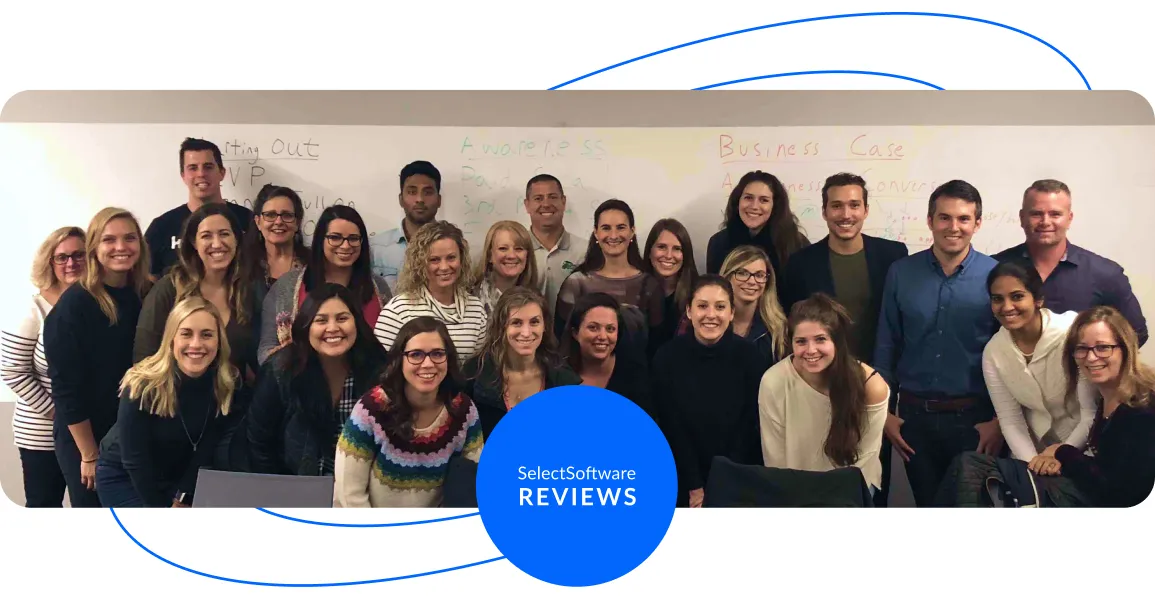
- Our goal at SSR is to help HR and recruiting teams to find and buy the right software for their needs.
- Our site is free to use as some vendors will pay us for web traffic.
- SSR lists all companies we feel are top vendors - not just those who pay us - in our comprehensive directories full of the advice needed to make the right purchase decision for your HR team.