20 Best Employee Rewards Platforms of 2026, Tested & Compared
The true standouts in a sea of self-claimed best employee reward systems.












The best employee reward systems help you motivate staff, strengthen your workplace culture, and attract new talent without burying your HR team in extra admin. We’ve tested more than 50 of these platforms, and we’ve seen firsthand how quickly the right one can build a culture of appreciation, especially when paired with employee recognition software.
This guide is for HR and People leaders choosing a rewards platform for the first time or replacing one that isn’t working. It covers which platform fits your team’s size and setup, what it will really cost, and the pitfalls and adoption mistakes we’ve seen companies run into.
We evaluated every platform on three criteria: flexibility and customization, reporting and analytics, and peer-to-peer engagement.
- Flexibility and customization: Not everyone wants the same employee perks and benefits. As humans, we want to feel seen and heard, valued for who we are and our contributions[1]. A strong employee reward system gives you the freedom to do so for your workforce. And to assess that capability, we investigated the system’s rewards catalog, including the number of available reward types, merchants, covered countries, and the option for custom company-branded swag.
- Reporting and analytics: After testing essential rewards features from both the employer's and employee's perspectives, we examined the system’s analytics dashboard. Let’s be honest: One of the best things about having technology by our side is its ability to diligently track data in real time and highlight critical points and trends that deserve our attention. We pulled standard and custom reports (if any), considering how easy (or hard) it was to get a set of data from the system and whether it’s helpful, actionable, and easy to digest for most users.
- Peer-to-peer engagement: Recent data shows that recognition from co-workers is 35.7% more likely to positively impact financial results than recognition only from managers. For that reason, we looked at features like milestone celebrations, kudos, shoutouts, and, really importantly, how easy they were to use.
At SSR, we test and review products with complete editorial independence. For this guide, we booked demos with vendors, used each tool ourselves as both an administrator and an employee, and gathered verified user feedback for a fuller picture of each option. We also interviewed HR leaders at companies using rewards systems to learn what works in practice. And we consulted industrial-organizational psychologists on how rewards affect motivation and culture. Read more about our editorial standards.


Awardco

Awardco helps you give thoughtful and personal reward programs to employees. Besides Amazon rewards, it features Bonus Boxes, digital MemoryBooks, and extensive redemption options, letting you appreciate people in creative ways.
PROS
- Easy to use and available in 16 languages
- Amazon integration for wide reward selection across many countries
- Native integrations with Slack, Teams and HubSpot
- Amazon Business integration, huge reward catalog for a multitude of countries.
- The platform is available in English, Spanish, French, German, Japanese, Portuguese, and Simplified Chinese.
CONS
- No free trial
- Some rewards priced above retail value
- Reward delivery delays reported by some users
- Actual pricing is not publicly available, so getting started won’t be a quick and self-service process like with other companies in the space.
- With Awardco, digital and physical gift cards are ineligible for refunds.
- Only Amazon-delivered products are available from Awardco. Goods sold by third-party vendors on Amazon are not available.
- The Awardco mobile app is only available as a Progressive Web Application, not from the App Store or Google Play, which might be less intuitive for some users.
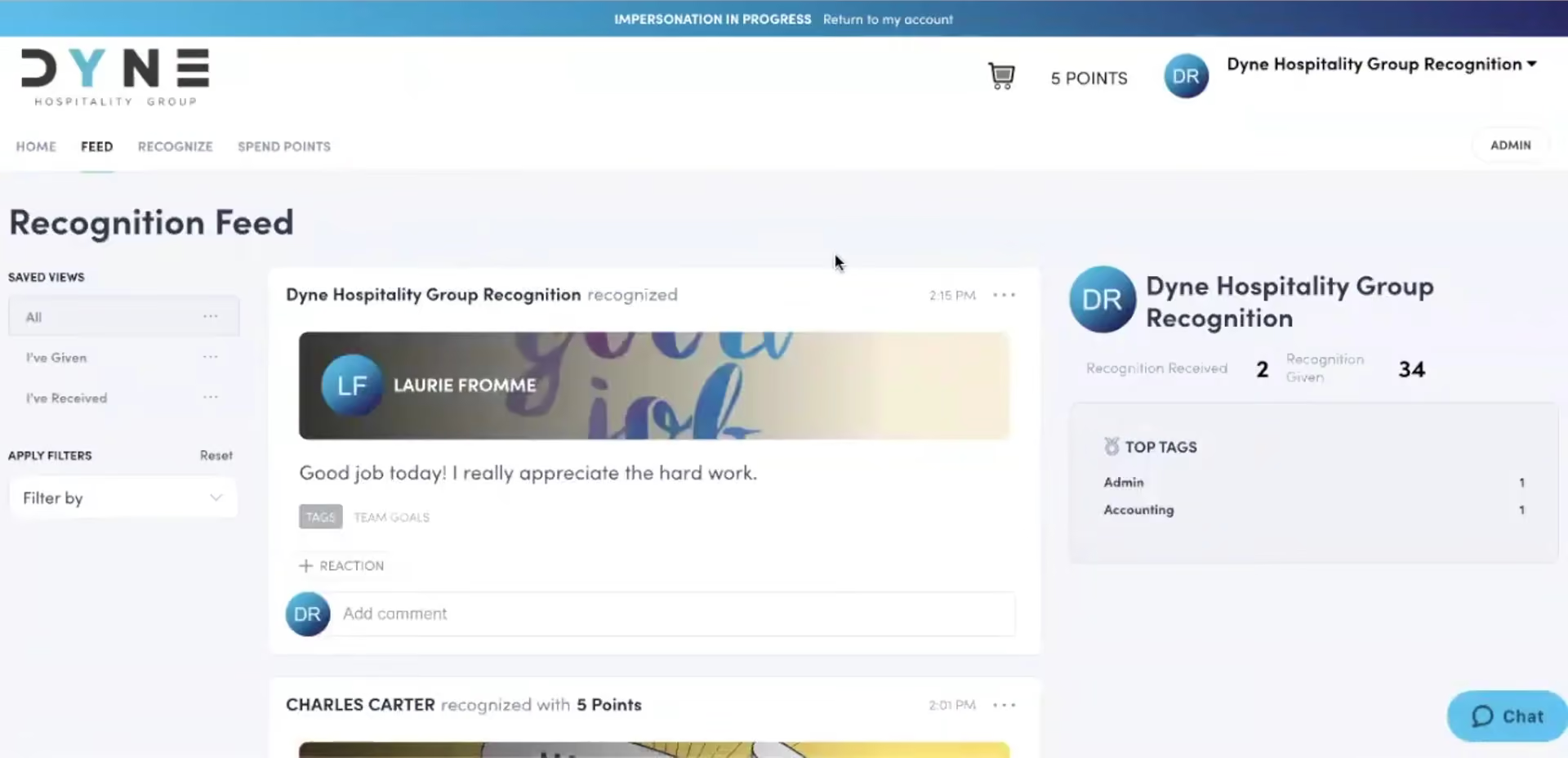
Awardco helps you appreciate your people in unique ways. We’ve not seen other corporate rewards program platforms offer the same degree of gift customization and personalization as Awardco.
For starters, you can create and give out Bonus Boxes, which are creative care packages filled with fun branded items suited to the recipient. Digital MemoryBooks are another way to honor employees' work anniversaries. These interactive books compile messages and photos from colleagues into a cherished keepsake.
The way Awardco automates the rewards process is a major time-saver. It sends automatic reminders about service anniversaries, birthdays, and other occasions, prompting participation from the team. The software also seamlessly integrates with communication tools like Slack and Microsoft Teams, making it easy to give timely shoutouts.
Robust incentive programs are another thing we liked about Awardco. Employees can earn points for achieving goals, then redeem them from an extensive catalog including top brands like Apple and YETI. For sales teams, Awardco partners with Amazon Business to provide the ultimate flexibility - earners can choose their own rewards without any friction.
Compared to Nectar, Awardco’s annual entry price is slightly lower — $2,500 vs. $4,000. However, some users we surveyed noted that certain reward items cost more than standard retail pricing, which can reduce perceived value. Additionally, while most redemptions are seamless, there have been occasional reports of delays in reward delivery.
Awardco has over 3 million users including known companies like Percepta, Paramount, Hertz, Pacific Life, and Aptive
Awardco has multiple plans and add-ons one can choose. New startups and small businesses (up to 100 employees) can access flexible packages starting at $3,000.
Awardco's recent updates focus on platform usability, gamified recognition, and expanded global functionality:
- Awardco 2.0 introduces redesigned navigation, a new recognition flow, customizable notifications and an admin adoption dashboard
- Gamified badges and achievements added to recognition and redemption workflows with the ability to pin standout recognitions
- AI updates refine recognition themes and quality scoring to better align with company values
- Expanded international support now covers 163 countries and 135 currencies with Amazon secondary fulfillment
- Updated EU and UK compliance workflows for stronger regional regulatory alignment

Best For
Growing teams and multinational businesses looking for a powerful and flexible rewards and recognition program for employees.


Awardco excels in employee recognition. One of its key strengths is that it creates a network for employees to express and demonstrate appreciation for their peers. This promotes more positive feedback and collaboration.
Awardco plays an integral role in performance and culture management by generating artifacts that HR personnel can reference during evaluations. This feature is particularly useful for performance reviews.
- Awardco has a sleek, user-friendly interface.
- Reward points provide structured recognition for employees and can be redeemed for various rewards.
- The customer service is excellent.
I worked with a client who needed to integrate Awardco with our Workday implementation. As a result, I was involved in their tech stack management workflow. I was part of this engagement for approximately 1.5 years.
The key benefits Awardco provides include a robust employee engagement system, culture management, recognition and rewards infrastructure, and dollar-for-dollar incentives.
Organizations seek this tool to establish a structured approach to recognizing and rewarding employees and peers in a meaningful way.
- Awardco offers multiple redemption options, but there may still be limitations when it comes to gift cards.
- The system can be expensive.
- It may not be practical for small organizations or teams that do not rely on positive feedback loops or collaboration.
Competitors like Culture Amp focus more on data insights rather than user interface. Integration can sometimes be more challenging compared to Microsoft Viva Engage, which offers strong social features within the Microsoft ecosystem. Budget and organization size are key factors to consider when choosing between these tools.
- Organization size—consider how large your workforce is and whether they will adopt a social-based interface.
- Budget—determine whether your organization is prepared to invest in employee recognition and if the expected ROI justifies the cost.
Awardco has not introduced any major breakthroughs in recent years, but they continue to focus on improving the user interface, making it more intuitive and visually appealing.
Awardco is good for mid-to-large enterprises with highly collaborative teams or team-centric workflows.
Awardco is not good for small enterprises with highly segregated employee workflows.
Motivosity
Motivosity lets employees choose personalized, exciting rewards; automates service awards and birthdays; and leverages gamification to drive engagement in company initiatives.
PROS
- Mobile-friendly across phones, desktops, Slack and Teams
- Free Connect plan with core engagement features
- Free trials available for all paid plans
- Easy peer shoutouts and recognition
- Built-in reporting on attrition risk, top recognized employees and performance
- Employees can access this system from their phones, desktop, and apps they are in at work such as Teams/Slack
- One platform that combines rewards, recognition, employee engagement, and more
- Built in reporting with insights around potential attrition, most recognized employees, managers that need coaching, etc.
CONS
- No controls to regulate point distribution between employees
- Performance management features like 1:1s and coaching no longer available
- Only has dollar (not points) based rewards. Their research shows dollars is more effective, but many companies want points.
- Some users claimed sometimes it can be a bit buggy connecting to Slack to notify people that an appreciation came through.
- It would have broadened the number of gift card options for users to choose from.
- There could have been an easier way to integrate the software with swag stores. For now, you have to transfer funds to a card and then link that card with the swag store, which slows down a bit the process to cash in funds.
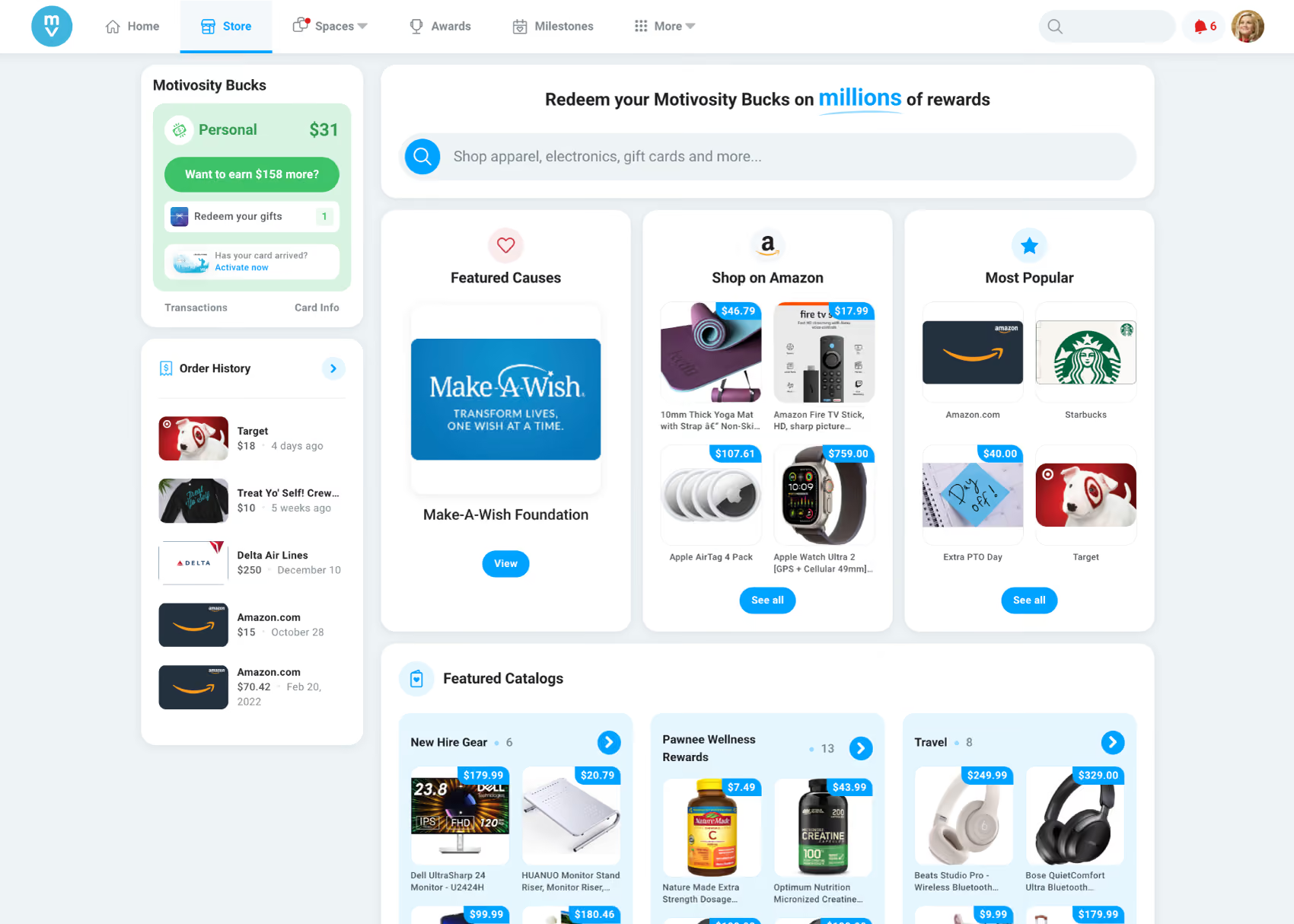
Motivosity is easy to recommend given how this vendor reinvents employee rewards by letting companies move beyond cookie-cutter gift cards to create recognition programs that truly resonate with their teams. Testing the platform, the first thing that sticks out is the rewards store. It’s so customizable, covering both digital or physical gift cards, from national retailers or local merchandise.
Adding custom rewards was straightforward. We liked how flexible the platform is in letting administrators set up unique competitions—anything from wellness challenges to book clubs—complete with badges and awards for winners. Impressively, you can set up the platform so that participants can upload proof such as step counts or book reviews to foster integrity and fairness to the process.
For milestones, Motivosity automates service awards and birthday celebrations with personalized gifts and shoutouts. These moments appear in a social feed, where colleagues can leave social recognition to amplify the celebration and build camaraderie.
However, we think you'd hesitate to make an investment in this platform if all-in-one solution with both recognition and performance management capabilities is what you’re eyeing. Motivosity has phased out its performance management tools, so features like one-on-ones and coaching are no longer available.
Another potential drawback is that the rewards platform lacks rules or limits on how employees distribute their points. This means someone could, in theory, send 100% of their monthly reward allocation to a close friend, which can hurt the fairness of the system if not monitored.
Health Catalyst, Cotopaxi, Health Equity, Instructure, Ivanti
Motivosity uses custom, volume-discounted pricing based on company size and chosen modules. The platform fee is approximately $0-$2 per employee per month (PEPM), with additional modules starting around $1 PEPM. Typical annual investment ranges, assuming an average of 2 modules, are:
- Small businesses (20–250 employees): $3,000-$10,000 per year
- Mid-market (250–5,000 employees): $7,500-$75,000 per year
- Enterprise (5,000+ employees): $40,000-$300,000+ per year
Final pricing is tailored to exact employee count, selected modules, and contract structure. Small business plans start at a minimal spend of $3,000 annually.
Best For
Organizations with 10 - 10,000 employees.

Motivosity for management and leadership development has been a major area we employ. We use this to facilitate one-on-one and small group meetings between supervisors and their teams. It's been extremely helpful in getting everyone to participate and as they can add agenda items and plan in advance.
Performance has improved as a result because staff receives guidance on problem-solving and prioritizing work from their supervisor and they receive acknowledgment afterward. Also, the leadership team can see the reports on how often these meetings are happening and get a sense of how well our supervisors are performing.
We also use the recognize feature to reward the daily achievements and allow staff to recognize coworkers. Great work that often went unacknowledged or just was easily forgotten/overlooked now gets the attention it deserves. We found that everyone responds to this feature and that these small, regular acknowledgments tied to tangible monetary and gift rewards have really increased overall employee motivation and satisfaction and made doing great work rewarding and fun for our staff. We also set it up to make sure major events like an anniversary are not missed.
We also benefit from the surveys and feedback that leadership can see as insightful and data-driven reporting. It has been critical in getting information that was mainly anecdotal, unpredictable, and sporadic in the past. We use this for departing employees' exit interviews and to track turnover. Handling and understanding employee turnover had been overly informal and a bit chaotic before this feature, but we use the exit interviews and data to get a better picture of areas we need to focus on.
It improved employee morale and performance by offering ways for them to connect better with coworkers and supervisors and allowed ongoing, regular, and routine recognition rather than just major things like salary increases and promotions.
Leadership has gained a better sense of how our management is performing and increased the effectiveness of our supervisors at every level.
It's given us valuable data about how our staff are performing, employee turnover, and management performance in reports.
We were concerned about employee engagement given the fact that a large number of employees were remote, and we have multiple worksites. Both factors created a sense of disconnect among the staff from both the company and their co-workers. It seemed to be harming employee morale and, consequently, employee productivity.
We were also very concerned about increased interpersonal conflict, declining employee retention and feedback that generally indicated dissatisfaction. We were also looking for a way to provide ongoing recognition and to attain ongoing feedback, because annual reviews and occasional surveys were not enough, and were not incorporated into the day-to-day culture.
We've used motivosity for about a year and a half. In that time, we've seen improvements in all these areas.
We were not thrilled with the customer support regarding questions about billing and technical errors.
The system seemed to have some technical issues and was sometimes really slow or even would crash.
Though it met our needs, there do appear to be products on the market that have more features for around the same cost.
Having used a few similar products, I think Motivosity does a better than average job creating personalized connections between coworkers and social media-like content for staff members and was very good at fostering a sense of empowerment by management to the employees.
It allows for employees to recognize each other, not just management recognizing employees as is typically the case. Also, the user interface is very straightforward, intuitive, easy to navigate, and easy to use.
A tool like this will very likely increase employee engagement and increase performance and retention, but people should consider the costs involved both in the product and in monetized rewards and recognition to staff.
Once you institute such rewards, taking them away may be poorly received by staff. Also, it requires leadership to support and endorse the efforts to use this product and without that, it may not be effectively deployed, especially if you do not have full participation.
From my understanding, they have refined the features to focus better on reporting and on management development.
Remote workers will especially benefit. It helps to replace some of the personal bonding and connection that usually happens through in-person interactions.
Organizations, where there is infrequent staff interaction, will also find a lot of benefits in both the sense of personal connection and regular recognition that can be lost when workers are not physically near each other often.
An organization that highly values a top-down style of relationships may find that they don't value the degree to which employees are empowered to give feedback and recognition.
C.A. Short Company
C.A. Short is a great option if you value high-touch support, deep customization, and a strong mix of digital and physical rewards and recognition programs for employees. Its peer-to-peer recognition features allow for both digital and physical forms of acknowledgment, while the dedicated support team makes sure the entire system is customized to your needs.
PROS
- Fully customizable rewards and recognition programs
- Digital and physical recognition in one platform
- Dedicated account managers and implementation team
- The rewards and recognition programs are coded to fully match each customer’s needs.
- Combines digital (peer-to-peer eCards, social feed-style recognition) and physical recognition (on-the-spot recognition cards.)
- Dedicated account managers, customer service reps, and an implementation team.
CONS
- Outdated UI compared to modern alternatives
- No self-service configuration, changes require support
- Reporting dependent on Power BI, not native
- The UI is not as modern as some competitors.
- Changes to the system require communication with support rather than self-service configurations.
- Reporting relies on Power BI rather than being embedded within the platform.
C.A. Short is not the most modern-looking or feature-rich employee rewards platform we’ve reviewed, but its white-glove, concierge-style support is among the best, especially for businesses that want hands-on guidance in designing and implementing a corporate rewards program.

We evaluate dozens of new vendors every month, and it’s clear that most platforms are moving toward a fully digital approach. However, C.A. Short is one of the rare few who embrace a hybrid model of peer recognition, combining digital tools with tangible, in-person acknowledgment. This unique approach adds a personal touch that sets it apart.
During our assessment, as employee users, we could send eCards with or without monetary rewards, celebrate achievements with peers in the social feed-style "Rec Room," and even receive on-the-spot recognition cards—physical cards handed out by managers for a job well done. The point redemption process was smooth, too: we scanned a QR code on the card, and our recognition points were redeemed almost instantly.
When it comes to customization, C.A. Short takes a highly personalized approach. In our tests, simply communicating our needs to the customer success team resulted in a system coded to our specifications, complete with fully tailored corporate rewards program packages. This makes for a less flexible, self-service experience, but it also significantly reduces the administrative burden—something many companies may prefer over off-the-shelf tools.
On the reporting front, C.A. Short offers a robust tool called C.A. Insights, which provides strong visibility into recognition engagement, usage patterns, and program effectiveness. However, a notable drawback is that the analytics are not built directly into the platform. Instead, they rely on Power BI, requiring users to leave the system to access data. The good news is that the vendor has confirmed full in-app reporting integration is on their roadmap, and we’ll be sure to keep you posted once it’s available.
Another thing to keep in mind is that while the employee rewards software excels in customization, the user interface is not as intuitive or visually appealing as solutions like Motivosity or Connecteam.
Key recent updates:
- Sales Incentives with Promotion Capabilities: Administrators can now set promotion details and target specific groups of sales reps or partners, ensuring that only selected participants can view and participate in each contest. This enables more granular control over recognition programs and better ROI measurement for sales-focused initiatives.
Dollar General, Penske, Sysco, and Tractor Supply are some of C.A. Short Company’s customers.
Custom.
Best For
Mid-sized to large organizations prioritizing hands-on support and a deeply tailored employee rewards program experience.

Nectar
Nectar's catalog covers an extensive range of reward programs for employees, from company swag to Amazon goods, gift cards, and charity donations. If that’s not enough, you also have the option to add custom rewards that are tailored to the relevant recipient(s), and save 10% on pricing with your SHRM membership.
PROS
- Transparent pricing with volume discounts for 500+ employee organizations
- Pay only for redeemed rewards, unused points cost nothing
- Regularly updated with user-driven features
- AI-powered internal communications tool with drag-and-drop editor
- 10% discount for SHRM members
- Regularly introduces new features and enhancements to its products.
- Volume discounts available for organizations with 500+ employees.
- You pay for the rewards that are claimed. Points and allowances that remain unused won’t cost you a dime.
CONS
- No free plan or trial available
- Limited rewards selection, particularly for experience-based rewards
- Minimum annual commitment of $4,000
- The priced plans are not available to start off as a self-service process. You’d have to book a demo and pay to access some of the premium features.
- The rewards selection could feel limited to some teams, especially those looking for more experiences in offer.
- No longer offer a free plan.
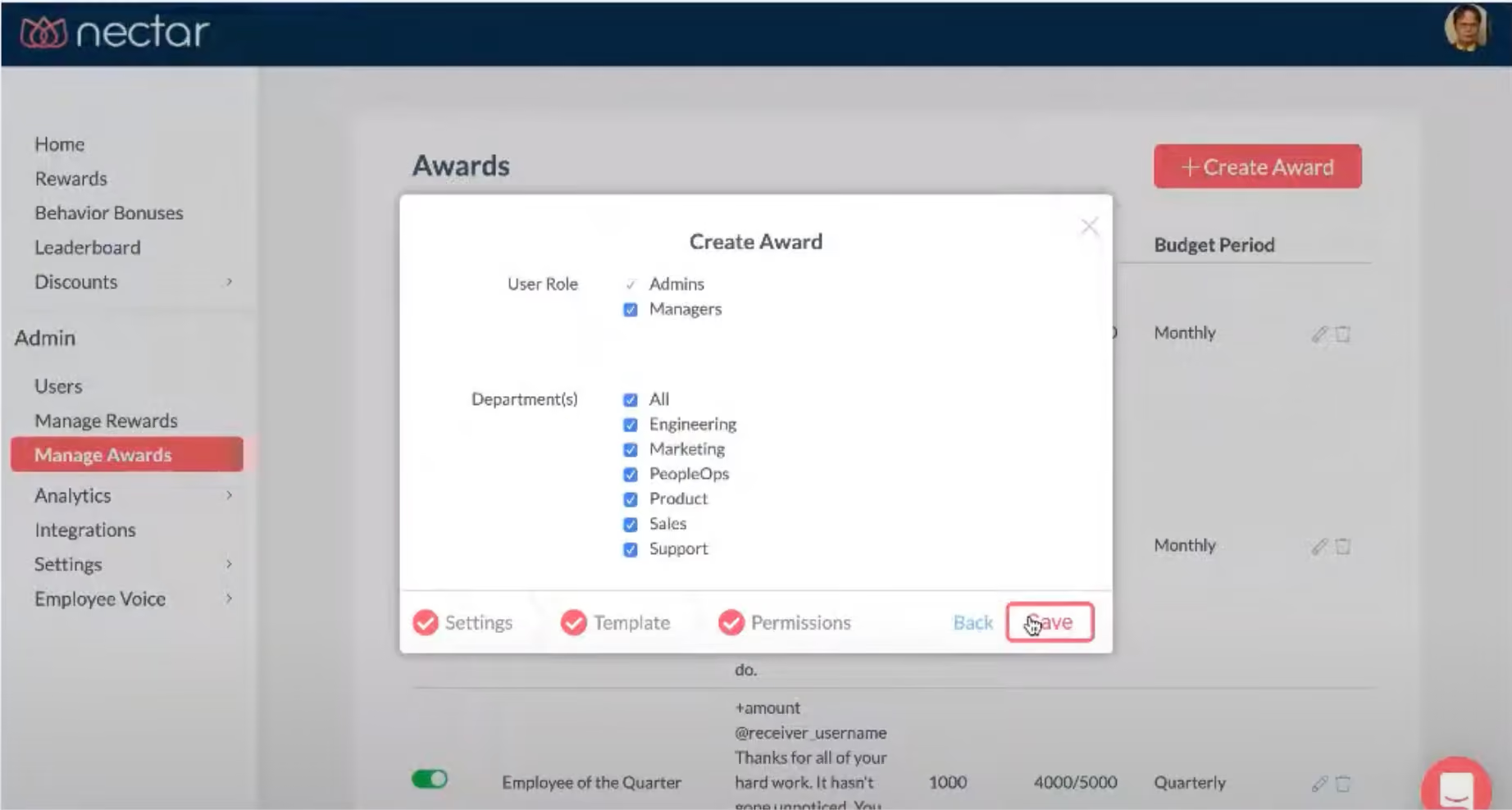
Nectar’s employee rewards platform is comprehensive, customizable, and easy to use. We were particularly impressed by its variety of employee reward options. Through a direct integration with Amazon Business, employees can choose from Amazon's vast product catalog for their rewards.
For those who prefer gift cards, Nectar offers access to ones from hundreds of different brands all over the world. Employees can also opt to receive company-branded swag shipped directly to their door or donate their rewards to charity. For a more personal touch, you can add custom rewards to Nectar’s catalog like tickets to local events or lunch with the CEO. With this many options, there’s definitely something for everyone and the best part is, if we haven’t clarified this already, employees get to pick their own rewards!
Nectar also automates service awards and birthdays, eliminating the need to manually send gifts for employee milestones. We were able to quickly set up automated birthday and anniversary point awards and social feed shoutouts. Another way to see upcoming events is through Nectar’s calendar, which we’ve found quite straightforward and tells you what’s happening on a given day if you hover over it.
Beyond corporate rewards, you can create challenges aligned with goals or values, have employees self-report completion, and approve submissions. Plus, a new feature for internal communication has been added to the platform, which lets you create an announcement within minutes right within Nectar.
If we were to point out any drawbacks of this employee rewards platform, it was that it no longer offers a free edition while requiring a rather pricey minimum annual commitment of $4,000. Additionally, although the rewards catalog is generally versatile, we felt that the experiential rewards like events or travel are less emphasized compared to material gifts or gift cards.
Nectar is used by many known brands including Redfin, Golden State Warriors, Major League Baseball, and SHRM.
Nectar offers three plans with an annual agreement of $4,000.
- Plus plan: $5 per employee per month when billed annually.
- Premium plan: $6 per employee per month when billed annually.
- Custom plan: Quote-based pricing.
Nectar's recent updates focus on making recognition more data-driven, equitable, and globally accessible:
- Multi-language translation for internal communications with audience breakdowns and side-by-side previews before sending
- Refreshed mobile app mirrors the web experience with shoutouts, Amazon and Axomo rewards, nominations, streaks and a discounts hub
- Shoutouts Report gives HR teams visibility into recognition trends, participation levels and unrecognized employees
- Custom Properties and Dynamic Lists enable tailored rewards and communications by role, region or language
- Purchasing Power Parity ensures equitable reward values for global teams
- Community Recognition updates add delegated admins, bulk approvals and live widgets for real-time visibility
- Advanced analytics track reward spend and point distribution for better program impact measurement
- SHRM partnership expands access to recognition tools for HR professionals globally
Best For
Companies of 50–2,000 employees who value flexibility in corporate rewards program choices and frequent product updates. Those with SHRM membership may also want to give this platform a go for its special pricing.

We have managers give recognition at least once a week. Employees use it to get items with their points. They also like to have another way to communicate with each other.
We like the user-friendly platform. They have great customer service. Our employees are able to use their points towards stuff they enjoy.
We purchased it to engage employees and give recognition. We love the idea of employees giving positive feedback to each other. Our employees wanted to be able to give each other recognition as well. We used it for 2.5 years.
Nectar took a while to implement. Our employees would like to see additional / new options to purchase with points. Notifications to employees didn’t always work.
They are very similar to competitors. Their gift selection seems smaller then others.
Consider time of implementation. Make sure that your team uses it on a regular basis. Give incentives for employees to give each other recognition.
They are always making updates to improve. They have improved the overall design of the app.
Larger companies that aren’t able to recognize and acknowledge every employee all the time.
Small companies that interact every day.

Bonusly
Bonusly’s specialty lies in its corporate reward catalog: it packs an impressive number of gift cards that work in dozens of countries. Teams with 50-5000 employees, remote or in-office, can make great use of the tool. Bonusly’s discounts also make it a sound option for nonprofits.
PROS
- Intuitive interface for both admins and employees
- 1,200+ gift cards redeemable in 120+ countries
- Available in German, English, French and Spanish
- Android and iOS apps for on-the-go access
- Discounted pricing for nonprofits and educational organizations
- 14-day full-featured free trial, no credit card required
- Intuitive user interface.
- Available in German, English, French, and Spanish.
- Supports Android and iOS.
- Discounts for nonprofit and education organizations.
- 14-day, full-featured free trial.
CONS
- Core plan capped at 50 users
- Limited analytics and reporting customization
- Reward options centered on gift cards and cash, limited experiences
- Unused bonus allowance does not roll over
- Analytics and reporting features are relatively underdeveloped.
- The reward catalog lacks in-person experiences and physical goods.
- All our plans are billed annually, and the vendor no longer discloses their pricing.

Bonusly’s full-featured and flexible employee rewards platform prioritizes choice, meaning, and connection. We’ve gone through their rewards catalog and liked what we saw: 1,200+ gift cards from popular vendors, redeemable in over 200 countries. Employees have abundant options to choose from across apparel, F&B, travel and more.
We find Bonusly’s approach to giving branded company swag quite unique. Through an integration with AXOMO, employees can browse and order company-branded items themselves. We also like how Bonusly gives employees the option to take their rewards in cash, with points redeemable for PayPal transfers, Visa gift cards, and prepaid Mastercards.
Customizable reward options are yet another advantage to Bonusly. You can get creative with experiential rewards like lunch with the CEO, local sports tickets, paid time off, and more. The platform is also connected to over 50 charitable causes, allowing employees to accept rewards in the form of donations to causes that matter to them.
Besides tangible rewards, Bonusly helps you set up automated awards for milestones like work anniversaries and birthdays to foster a culture of continuous appreciation. These public messages encourage social connections, praise, and gratitude between coworkers. You can also tie awards to business goals, driving performance and morale simultaneously.
One noticeable trade-off about Bonusly, though, is that its Core plan caps usage at 50 employees, which is definitely not ideal for fast-growing teams. Compared to some enterprise-oriented options, we found that Bonusly’s reporting and analytics are on the lighter side in terms of functionality and customization. The platform primarily focuses on gift cards, cash, and donations, so teams seeking travel or experience-heavy rewards may find the catalog less appealing.
We also should warn you that with Bonusly, unused bonus money doesn't roll over at the end of the period, so companies need to plan accordingly.
Key recent updates:
- Leaderboard Enhancements: Users can export top 5 givers and receivers by category and toggle between "Most recognized" and "Top givers" views for hashtags.
- Voting on Nominations: Nominations support structured voting periods with configurable voter settings.
- Nomination Custom Questions: Admins can configure up to 5 custom questions (text, single/multi-select, dropdown) for nominations. Admin results page redesigned for easier analysis.
- Custom Approval Messages: Admins can add personalized messages when approving incentive claims.
Bonusly is used by over 3,250 companies, including Cerebral, Baxter, Headspace, and InVision.
Bonusly has 3 plans, all of which are billed annually:
- Free: up to 8 users
- Team: $3 per seat per month
- Organization: custom
Best For
Companies ranging from 50 to 5,000 employees looking to build a culture of appreciation via employee points reward programs.

One of the most effective ways to use Bonusly is by tying it directly to company values. Attaching values to recognition helps reinforce what they look like in action. The tool also gamifies recognition, allowing employees to reward each other in a fun and engaging way.
Employees could redeem their points for rewards, donate to nonprofits, or even support coworkers in times of need—for example, we once set up a special donation fund when an employee's dog required expensive veterinary care. This flexibility made Bonusly a powerful tool for fostering both engagement and community support.
- It's easy to set up and use.
- Employees loved using it, and it was the most widely adopted recognition tool I’ve seen in my career.
- It provided visibility into employees' contributions, which was especially valuable in a remote work environment.
I administered Bonusly for over two years as our primary reward and recognition tool. We used it to celebrate employees, provide positive feedback, and reinforce company values and culture. As a predominantly remote company, we relied on Bonusly to foster connection and encourage behaviors we wanted to see more often.
Full disclosure: I worked for Bonusly when we used it, but I left the company two years ago. One of the reasons we implemented it was to "dog food" the tool—using our own product to better understand its impact.
- I wished it had broader functionality, so we didn’t need separate tools for other recognition-related needs.
- The reporting capabilities were limited, missing opportunities to provide deeper insights into employee engagement.
- They introduced an engagement survey tool, but it couldn't compete with more established solutions in that space.
Bonusly was extremely easy to use and integrate into workflows, especially for companies that rely on Slack. While other HR tools include recognition features, Bonusly’s gamification made it more engaging and widely used. However, it could be a harder sell to executives since some competing platforms bundle recognition with other HR functions.
Think about your goals and how your team works. Avoid traditional mindsets that limit recognition to managers or leadership—peer-to-peer recognition can be just as impactful. Consider how a tool like Bonusly can help amplify your culture and reinforce company values in a meaningful way.
Bonusly has always excelled at core recognition but struggled to expand its functionality beyond that. Recent updates suggest they are working on additional features, and I’m curious to see how those develop. If they continue to evolve, it could become an even stronger tool, particularly for smaller companies.
Bonusly works well for companies of any size, from small teams of five to large enterprises with 15,000 employees.
If a company does not prioritize employee recognition or struggles with engagement, Bonusly may not be the right fit. Without an existing culture of appreciation, adoption and impact would likely be limited.

Teamflect
Teamflect connects rewards to a broader employee experience inside Microsoft Teams, where recognition can be triggered by performance reviews, feedback, and development workflows. Because everything happens directly inside Teams, employees participate without leaving the platform where they already work. This removes the friction of standalone platforms and helps organizations achieve consistently high adoption and participation.
PROS
- Connects recognition with performance reviews, feedback, surveys, goals, and 1-on-1 meetings.
- Built into Microsoft Teams, allowing recognition within Teams chats and meetings.
- Allows customization of the rewards catalog, including reward types, images, and point values.
- Admins can review pending redemptions and add fulfillment details, such as coupon codes or messages.
- Provides employee accounts for tracking pending and approved reward redemptions.
- Supports customizable recognition badges aligned with company values.
- Includes optional leaderboards to display recognition activity across the organization.
- AI agent feature to assist managers with recognition workflows.
- Operates entirely inside Microsoft Teams; no separate login or interface required.
- Supports 30/60/90-day onboarding reviews, quarterly cycles, and exit interviews, and more with customizable templates.
- Pulls in real-time data like OKRs, 360 feedback, survey scores, and development plans into review workflows.
- Includes nine-box talent grid for potential vs. performance mapping.
- Enterprise-grade reporting and analytics via Power BI Connector for deep workforce insights.
CONS
- Limited value for organizations outside the Microsoft ecosystem.
- While fully accessible on mobile devices, Teamflect lacks dedicated mobile apps.
- Teamflect's rewards system is most valuable alongside its recognition and performance workflows rather than as a standalone rewards platform.
- No support for payroll, benefits, or core HRIS.
- While data is real-time with an API integration, in Power BI, it’s refreshed every 3 to 5 hours, meaning insights may not always reflect the most current information.
- Best value is limited to Teams-centric companies; not usable as a standalone platform.
Teamflect takes a different route to employee rewards by connecting them to the recognition and performance experience inside Microsoft Teams. The key distinction is not simply that employees can exchange points for rewards, as you may have already noticed—many recognition platforms offer that. Instead, Teamflect creates a workflow in which employee contributions can be identified through performance reviews, feedback, and development-related processes, turned into recognition, and then connected to tangible rewards.

That connection starts with Teamflect's recognition system. Organizations can assign point values to recognition badges, allowing employees to accumulate points when colleagues recognize their contributions. More importantly, Teamflect can automatically trigger recognition from Reviews, Surveys, and Feedback via People Picker questions. For example, a respondent can identify a colleague who contributed to a project, and Teamflect can automatically recognize that person upon form submission. Those recognition points can then become part of the employee's reward balance. This creates a more continuous link between performance and reward than a standalone employee gift catalog.
The Microsoft Teams focus strengthens that workflow. Employees can send recognition directly from Teams chats and meetings, while the broader Teamflect platform houses recognition, feedback, reviews, goals, and other employee workflows. For a Microsoft Teams-based organization, that means rewards don't have to live in a separate employee engagement system disconnected from where managers and employees already communicate. The reward is the final step in a workflow that can begin with feedback or a demonstrated contribution.
The catalog itself is flexible enough to support different reward strategies. Teamflect offers localized gift cards, food and beverage rewards, transportation, and other organization-defined rewards. We wouldn't however consider catalog customization or points-based rewards unique on their own. The more meaningful differentiator is how Teamflect connects those rewards to recognition within a Microsoft Teams-centered platform and, from there, to performance, feedback, and development workflows. Organizations outside the Microsoft ecosystem, or those looking primarily for a standalone rewards marketplace, may find less value in this approach.
In addition to integrations with more than 200 HRIS platforms, Teamflect meets the needs of enterprise organizations with SOC 2 Type II certification, GDPR compliance, and an Enterprise plan that offers dedicated cloud infrastructure, customer-managed encryption keys, data residency controls, advanced security logging, and tailored implementation support.
Securitas, DHL, Mitsubishi Motors, Yale University, Invacare, Maersk, Meyer Werft, Honda
Teamflect offers four pricing plans:
- Starter plan free for up to 10 users
- Essential plan at $7 per user per month (which adds analytics and premium support)
- Professional plan at $11 per user per month (which includes talent management features and advanced integrations)
- Enterprise plan is also available with custom pricing, advanced security and compliance features, dedicated infrastructure options, and tailored implementation support.
Nonprofits can receive discounts of up to 60% on annual subscriptions, and paid tiers come with a 30-day free trial.
Best For
Microsoft Teams-based organizations that want rewards to reinforce recognition generated through performance, feedback, and employee development workflows.

ITA Group
We picked ITA Group (formerly Cooleaf) for its ability to automate, personalize, and globally fulfill rewards as part of a broader employee engagement strategy. Unlike tools that focus purely on points or catalogs, this platform connects rewards to performance data, survey participation, and peer recognition—making the incentive system feel more intentional and aligned with company goals.
PROS
- Rewards tied to training completion, milestones and survey participation
- In-house fulfillment for physical merchandise and digital gift cards globally
- Seamless Slack integration for real-time recognition in team channels
- Analytics tracking redemption trends by team, location and role
- Dedicated onboarding sessions and personalized rollout plan
- Full platform for all things employee engagement, not just rewards and recognition.
- The Slack integration is very seamless. Challenges, posts, and recognitions can all be gathered within dedicated channels in your team’s Slack workplace, if you want to.
- Wide variety of rewards including a team store, donations, entertainment, travel experiences, merch, products, and restaurant coupons.
CONS
- Custom reward workflow setup may require onboarding support
- Enterprise-scale design may overwhelm smaller teams
- No transparent pricing, free plan or trial
- For some of the workplace culture-building features, like challenges and activities, you can’t create your own, so you rely on how often Cooleaf’s team makes them available.
- We found the support center’s documentation to be somewhat limited in comparison to similar tools. Also, it seems like support is only done through an online form, no other channels are available.

While many rewards platforms focus on gamification or catalog size, ITA Group takes a more strategic approach. It allows global organizations to design rewards programs that reflect their culture, reinforce key behaviors, and scale across distributed teams. In our demos, we’ve been particularly impressed with how rewards could be tied to performance metrics, participation in surveys, and learning and development initiatives.
ITA Group also supports a range of flexible program structures— from automated milestone incentives to nomination-based awards that include multi-layer approvals. This makes it suitable for both ongoing incentives and more formal recognition moments.
On the fulfillment side, ITA Group handles physical and digital reward logistics internally, which is a major plus for global teams. Whether it’s branded swag, gift cards, or high-value rewards, the company ships worldwide without the need for third-party coordination. Employees chan choose from 700+ brands, which provide access to thousands of rewards in the US and across the world.
Another area where ITA Group stands out is analytics. HR leaders can view reward redemption trends by team, geography, and department, helping them understand what's resonating with employees and where incentives may be falling flat.
The platform isn’t designed for small companies—ITA Group’s reward strategy, admin controls, and depth of configuration are geared toward enterprises with at least 2,000 employees. And while it doesn’t offer a free trial, their implementation support includes guided rollout, custom configuration, and post-launch check-ins to ensure success.
ITA Group is used by organizations like Acosta, Aprio, BlueLinx, Georgia’s Own Credit Union, Kids2, and Shipt.
Cooleaf offers custom pricing based on employee count and program needs.
- Subscription billed monthly
- Rewards budget is flexible and managed separately
- Implementation support and onboarding included
Recent ITA Group product updates include approval-based reward workflows, manager-facing usage insights, and robust analytics, making it easier for large organizations to build scalable, values-aligned incentive programs. International reward fulfillment and new nomination-based award options have also strengthened its appeal to global teams.
Best For
Global enterprises with with at least 2,000 employees.

We used Cooleaf to track employee milestones and recognition. We periodically conducted pulse surveys and used Cooleaf to track the results. We initially used it to manage our rewards program, but the organization changed its methodology shortly after implementation.
We hoped this would support greater employee engagement, but that did not happen. Overall, it did not solve the problem it was intended for.
I liked the variety of features. I appreciated the comprehensive approach to rewards, recognition, and engagement tracking. It was very user-friendly.
My company used Cooleaf for about six months. The tool was intended for employee engagement tracking and assessment. We used it to track and recognize employee milestones. We also conducted pulse surveys throughout the year.
We hoped it would lead to increased engagement, but we did not find it helpful.
It didn’t provide actionable suggestions for improving employee engagement. It was occasionally slow. Customer service was not responsive.
I have not used similar tools to Cooleaf to know about the differences.
I would consider the size of the organization. I would also recommend aligning the cost of the tool with the actual level of functionality needed.
We just used it for 6 months, so we did not see much changes during this time.
Cooleaf is good for a smaller organization without a complex employee engagement system.
Cooleaf was not a good fit for a larger organization like ours.

WorkTango
Employees can enjoy the freedom of choosing merchandise, gift cards, donations, and other custom rewards from WorkTango’s massive rewards catalog. The platform also ensures timely shoutouts for employee birthdays, work anniversaries, and other milestones via its robust automation features.
PROS
- Intuitive, easy-to-use platform
- Wide rewards catalog including gift cards and prizes
- Public and private recognition in any direction with company-wide activity feed
- Automated milestone recognition for birthdays and anniversaries
- Custom incentives tied to company values and objectives
- Real-time reporting and analytics dashboard
- Available in English, Spanish, German and French
- Unlimited surveys available in English, Spanish, Chinese, French, German, Italian, Japanese, Portuguese, and Korean.
- You can add modules as you go and these will be charged on a prorated basis.
CONS
- Annual billing only with 12-month minimum commitment
- Support turnaround needs improvement
- No free trial available
- Billing is only done annually and all plans require a minimum agreement for a 24-month subscription (see our FAQs for more and their pricing page for full details).
- Several users have complained about the rewards redeeming process being not very intuitive.
WorkTango’s all-in-one employee rewards platform makes appreciating and incentivizing employees easy and meaningful. We’ve peeked through their rewards catalog, and it is massive, packing over a million rewards from popular retail gift cards to charity donations.

We like how the rewards catalog covers different price ranges, meaning you can incentivize all behaviors and achievements, no matter how big or small. Another thing we like is its built-in search and filtering capabilities. Despite how big the catalog is, employees can still search and accurately find rewards that fit their interests best. WorkTango also provides personalized suggestions based on each employee’s past activity, offers wishlists, reward point trackers, and a group reward redemption option to build camaraderie.
What impressed us most during our evaluations, though, was WorkTango’s automation features, which helped give timely shoutouts for employees much more efficiently. It also lets you create incentives, gamifying and make it more fun for employees to reach performance goals, demonstrate certain values, or take positive actions. It’s a win for everyone.
That said, we wouldn’t recommend this employee rewards system to budget-minded teams. One big reason is that this tool’s billing, which is only offered on an annual basis. No short-term pilots, no monthly payment.
Finally, some users we talked to shared their experience with the customer suggest team, suggesting opportunities for improvement, as some of their requests weren’t fully implemented or lacked clear next steps.
Kia Motors, HUB International, Rexall, Accruent
A minimum annual contract length of 12 months is standard. Based on our research, the minimum cost for this contract is often $8,750.
Best For
Businesses with an automation-first culure, particularly those in tech, FSI, healthcare, and business services.

We use WorkTango daily, monthly, quarterly, and yearly. I find it most effective on a quarterly and yearly basis for performance tracking and rewarding. This tool is also beneficial during project integration, helping to focus and reward employees on specific tasks. For daily and monthly use, it can be applied for more immediate recognition and rewards.
This program's key attribute is its ability to recognize not only employees but also peer-to-peer recognition and reward.
These types of programs are especially useful for remote workers, as those in the office still get to be rewarded with special days, days off, etc. This is a way to reward those who are not able to participate in those times with the other employees who may not be remote.
Lastly, I think the automation aspect of this reward program is a great attribute. I say this because in the world of business, sometimes an employee's time of service can become 2nd sting to other things happening in the company.
However the need to look at why your business is running smoothly is due to the employees keeping your business afloat. So to be able to reward them on a yearly basis when their time of service comes about can be key in keeping those employees engaged and looking forward to the year ahead.
Our organization purchased WorkTango to monitor employee performance, recognize hard work, survey employees, and implement their feedback. It allows us to survey employees about ideas and workplace issues, then integrate their input into our company’s operations. Recognizing employees who excel and ensuring they are aware of their contributions was a key factor in choosing this product. Additionally, tracking employee performance and rewarding it through this tool has been invaluable. I have been using this tool for several months.
There are few cons to this program overall. The analytics could be improved, though this is a common issue with many programs. This tool is primarily a recognition tool rather than an analytics tool.
WorkTango offers more peer-to-peer recognition options than most competitors, which is valuable for building company and employee rapport.
If you need a peer-to-peer recognition program, this is an excellent choice. It’s also suitable for measuring employee performance. However, if you need extensive analytical features, you may need to look elsewhere.
WorkTango has improved its analytics features, though there is still room for enhancement in this area.
WorkTango is ideal for established companies looking to encourage employee progress and development.
Start up companies and those looking for a quick tool to reward their employees may not benefit as much from WorkTango.

Bucketlist
With its vast experiential rewards catalog, easy fulfillment, collaborative team challenges, and more, Bucketlist boosts employee satisfaction and retention. The platform also offers dedicated support to help you optimize your incentive programs.
PROS
- Extensive rewards catalog with 80+ HR system integrations
- Customer-driven product roadmap
- Intuitive web and mobile experience
- Pilot program available
- English, Spanish and French support
- The interface is intuitive and easy to navigate on both desktop and mobile.
- The platform supports customizable rewards and peer recognition tied to company values.
- Dedicated onboarding and account managers are provided with every plan.
- Recognition can be automated for milestones like birthdays and work anniversaries.
- Leaderboards and competitions help gamify employee performance and engagement.
- Bucketlist supports English, Spanish, and French for multilingual teams.
- Integrations are available with 80+ tools, including Slack, Teams, Outlook, and BambooHR.
CONS
- Limited experience-based rewards
- Shoutouts, tokens and goal setup reported as complex
- Slow points redemption
- Though intuitive, the platform's interface is less attractive and modern than some competitors.
- The experiential rewards catalog is limited compared to cash and gift card options.
- The shoutout interface lacks a back button when browsing GIFs.
- Setup and per-employee fees may be too costly for small organizations.
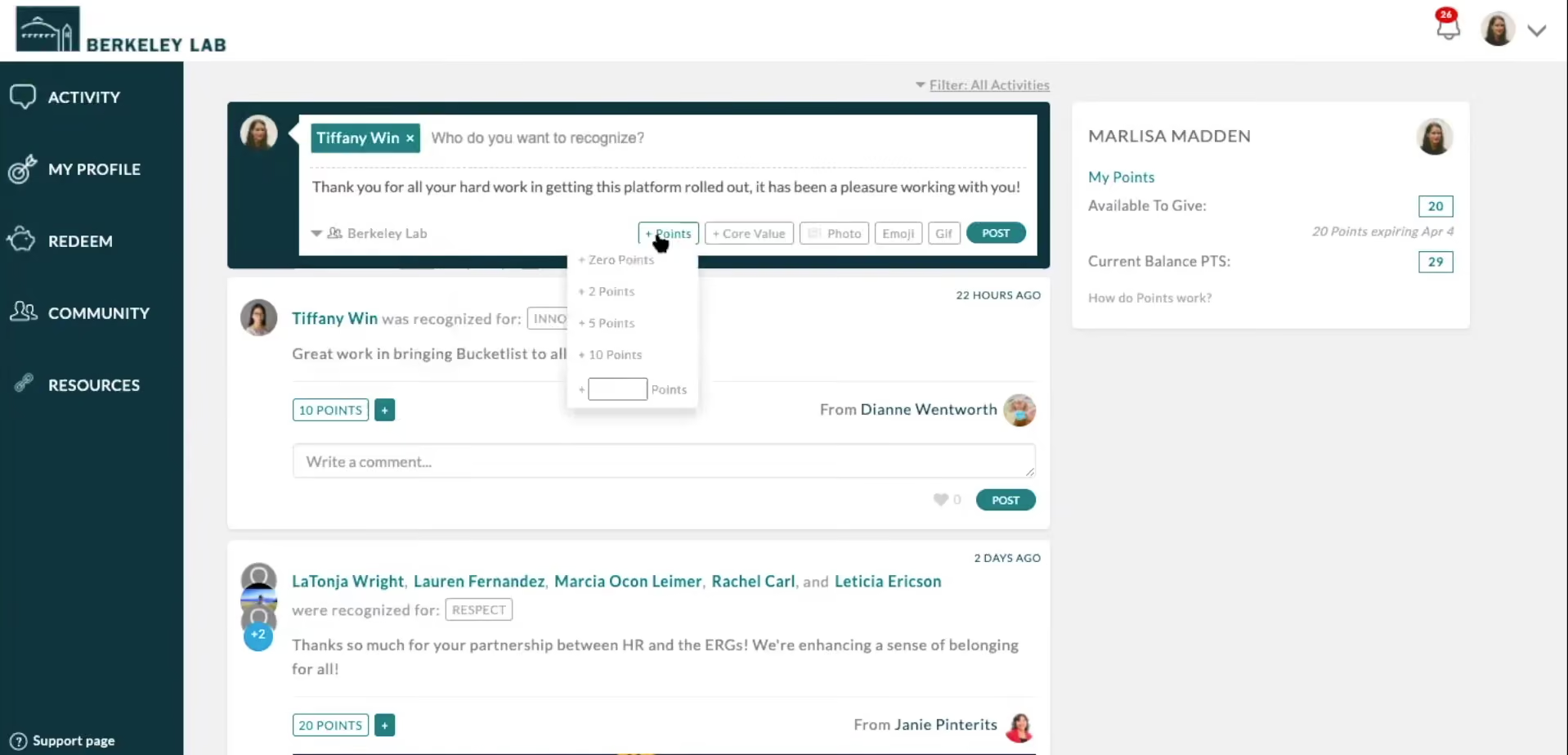
Bucketlist’s rewards and incentives platform has an extensive list of features you’d need to boost employee satisfaction, engagement, and retention. For starters, it features a comprehensive catalog of over 2,500 rewards employees can choose from, many of which are unique experiences. Reward fulfillment is fairly simple, with no markup on rewards.
The UI was easy to navigate in our testing. It was also simple to create different competitions which can be tied to sales goals, community service hours, or any important metric. The progress team members make can be tracked on a leaderboard, and winning members or teams receive the incentives you’ve previously defined. There are also detailed analytics and reports that give you plenty of insight into which incentives or awards resonate most with your employees.
On top of its robust features, Bucketlist also offers dedicated support to optimize your setup and training for all users. The implementation process is quick and easy with seamless integrations with platforms your team already uses like G-Suite and Office 365.
Despite the platform’s promise of variety, we found the available rewards centered around experiences notably limited compared to the breadth of cash and gift card options. We also heard feedback that features like shoutouts, token distribution, and goal setup could feel clunky or unintuitive. Finally, while the platform generally handles redemptions well, we experienced some delays in redeeming bucket points.
The platform has over 470,000 users from 100+ countries. Some of them are First Bank, RBC, Interac, Chick-fil-A, 1-800-GOT-JUNK, Stamford Health, Danone, Majesco, and Applebee’s.
Bucketlist plans are priced on a tiered pricing model based on company size. Typically, the range is $2 - $4 dollars per employee per month.
Best For
Medium to enterprise-size businesses (200 to 5,000+ employees).
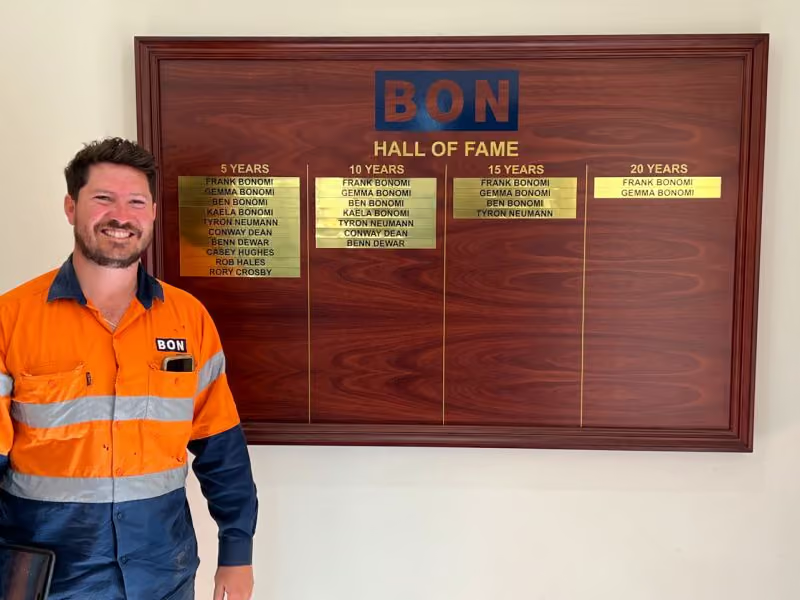
Our experience has been fantastic. We have a direct account manager who we speak with regularly and we work together to make any changes necessary. If we need help, I know I can reach out to them and will get a response very quickly. it is easy to create and have your account approved.
I appreciate several features of Bucketlist. The activity feed allows me to easily track the recognition others receive. The platform’s user-friendliness is impressive, and the customizable marketplace caters to our specific requirements. I also enjoy exploring the leaderboard and celebrating people’s achievements. Bucketlist’s customizability enables the platform’s look to mirror our brand and image. The web-based interface resembles a typical internet or intranet page.
Among various platforms, none matched the level of customization that Bucketlist provides for our company's Culture, Values, and Reward structure. Additionally, their service, which includes building our system and a hands-on approach during the launch, was unparalleled compared to others. Comparable features at a more budget-friendly price.
I have used the tool for three years and found the system working efficiently. Being able to share positive stories about colleagues’ good deeds in a way that doesn’t embarrass them but is accessible to all members of the company—especially those who wouldn’t typically hear about individual daily acts of kindness—is invaluable. In my experience, this recognition, whether through points or not, fosters a sense of appreciation and well-being.
Bucketlist could enhance its platform by introducing a few key features. Firstly, allowing users to save their location preferences would eliminate the need to repeatedly filter redemption options by location.
Secondly, a comprehensive recognition history page would be valuable, displaying all recognitions received by an individual.
Lastly, when a customer service query is raised, providing a reference number or saving a copy of the query would facilitate efficient follow-up, especially if customer support response times were not as prompt.
Although my suggestion may seem less enthusiastic, I still want to discuss it. When I search for 'Bucketlist' on Google, I encounter numerous unrelated results, with very few relevant to the features that Bucketlist provides. In my opinion, improving the SEO would help Bucketlist stand out in Google search results, making it more accessible.
I appreciate the user-friendly experience. The entire process, from sending recognition to redeeming points, is straightforward to navigate. I also enjoy the playful details like GIFs and emojis, which add a touch of whimsy and meaning to the words and points awarded.
It is easy to customize and use for all businesses and personal use. It is cheap and has no effects of overwhelming. We all want to give recognition and encouragement to our fellow teammates, and this makes it so easy while putting them in a running feed so that everyone can share in the positivity and motivation.
The admin page has been customized in many colors and this has changed many things.
Software companies
Software engineers

Semos Cloud
Semos Cloud stands out for enterprise reward programs that need to integrate directly into SAP SuccessFactors, Workday, or Oracle while maintaining global reward fulfillment, fraud monitoring, and budget intelligence at scale.
PROS
- Native integration with SAP SuccessFactors, Workday, and Oracle HCM eliminates separate logins and reward data sync issues.
- Global rewards catalog supports 170+ countries with local vendors and zero markup pricing.
- AI-powered Fraud Intelligence monitors suspicious point circulation and redemption behavior.
- Department-level budget allocation and approval workflows add strong governance.
- Frontline enablement through SMS access and no-email-required login expands reward participation.
- Native integration with SAP SuccessFactors, Workday, and Oracle HCM eliminates separate logins and sync issues.
- AI-powered Recognition Copilot and Message Quality Indicator improve message quality and inclusivity.
- Strong frontline enablement with SMS access and no-email-required login options.
- Built-in fraud detection monitors suspicious point circulation and favoritism patterns.
- Global rewards catalog supports 170+ countries with zero markup on rewards.
CONS
- Pricing is not publicly disclosed.
- Primarily designed for large enterprises; may exceed the needs of smaller teams.
- Comprehensive platform scope may feel complex for companies seeking a simple points-based rewards tool.
- No free trial available.
- No free trial available.
- Pricing is not publicly disclosed.
- Primarily designed for enterprises; may be too robust for small businesses.
- Broad platform scope (recognition, engagement, performance, AI agents) may feel complex for teams seeking a lightweight recognition-only tool.
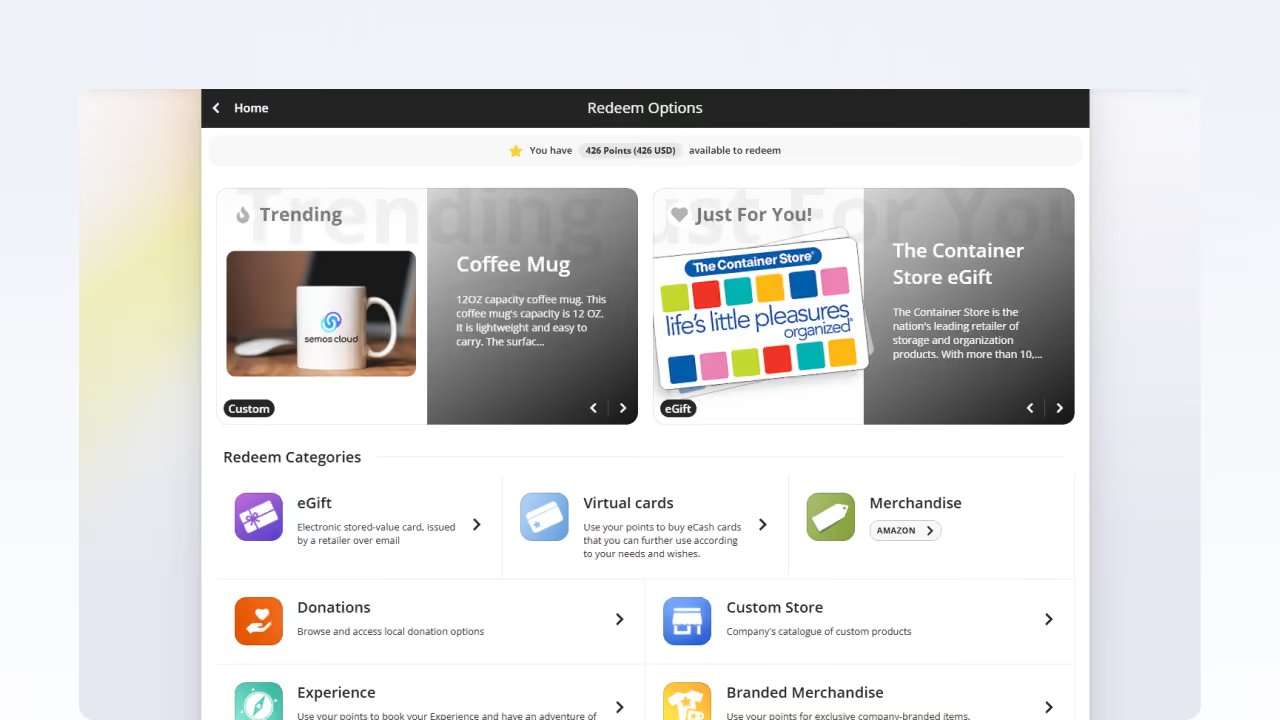
Semos Cloud is a People and Culture Intelligence platform, but when evaluating their rewards capabilities, what stands out is the operational infrastructure behind the program. This includes department-level budget allocation, approval workflows, spend forecasting, fraud monitoring, and global reward fulfillment across more than 170 countries. In other words, the catalog is one piece of a much larger enterprise control system.
Their genesis story reinforces that structure. Semos Cloud embeds directly into HRMS platforms like SAP SuccessFactors and Workday. Reward eligibility, point balances, redemptions, and reporting connect directly to employee records and organizational hierarchies. For large enterprises managing thousands of employees across multiple geographies, this reduces manual reconciliation and ensures financial oversight stays aligned with HR data.
Global fulfillment is another area where the platform feels enterprise-ready. Semos Cloud supports localized gift cards, merchandise, experiences, charitable donations, and custom company-branded rewards in more than 170 countries. Currency handling and regional vendor sourcing are built into the platform. The zero markup model also deserves mention. Organizations pay the face value of rewards rather than inflated catalog pricing, which can significantly impact total program spend at scale.
Governance is not an afterthought. Fraud Intelligence monitors suspicious point circulation, unusual redemption behavior, and favoritism patterns. Budget Intelligence allows leaders to allocate funds at the department level, enforce approval workflows before points are distributed, and track usage against forecasted spend.
Accessibility extends to rewards as well. SMS-based participation and workflows that do not require corporate email credentials ensure deskless employees can earn and redeem rewards without barriers. For manufacturing, retail, energy, and field-based organizations, that design choice meaningfully increases program reach.
Sephora, SAP, Japan Tobacco International, Colgate-Palmolive, Chevron Phillips, Coca-Cola entities
Semos Cloud offers subscription-based pricing:
- Monthly recurring license fee (based on user count)
- One-time implementation fee
- No markup on rewards (pass-through pricing)
- Pricing negotiable based on scope and geography
Semos Cloud does not publicly disclose pricing and does not generally offer a free trial.
Best For
Global enterprises already using SAP SuccessFactors, Workday, or Oracle that need a scalable, compliant, and deeply integrated rewards program with strong budget governance and international fulfillment capabilities.
Achievers
We chose Achievers because its international reward system performed more smoothly than most we’ve tested. Local vendor partnerships across 200-plus countries reduced friction for employees receiving rewards, and the platform’s real-time budgeting features kept things predictable at scale.
PROS
- Global reward fulfillment via localized vendor partnerships.
- The concierge redemption option lets employees choose virtually any legal reward.
- Swag, gift cards, cash-like options, and experiences available in a single platform.
- Budget controls and compliance tools support enterprise-wide reward governance.
- Highly flexible catalog that adjusts based on location, language, and user permissions.
- Native integrations with Workday, Slack, Outlook, and several other enterprise platforms.
CONS
- Reward catalogs vary by region, with some users wishing for more variety.
- Some users noted that the redemption layout could be confusing, or they experienced difficulty locating specific reward items.
- Targeting organizations with 500+ employees, Achievers may be too costly for smaller companies.

For large organizations that want to offer culturally relevant rewards across regions, we found that Achievers provides a solid global infrastructure, a flexible concierge option, and a clear no-markup pricing model.
What stood out most in our testing, perhaps, was the global fulfillment engine. Instead of steering everything toward Amazon gift cards or a small in-house catalog, Achievers works with local vendors in more than 200 countries through a drop-ship model. Seeing how this played out in sample flows, it felt more reliable than many systems we have tried. Employees in Canada and the U.K. generally receive rewards without the shipping delays or additional import fees that tend to frustrate users elsewhere. It is not perfect everywhere, but the consistency was noticeable.
The catalog itself is broad. We saw cash-like gift cards, charity options, travel and lifestyle perks, branded gear, and a wide mix of physical items. What gave the system a different feel was the concierge feature. Employees can request nearly any legal reward, and Achievers will attempt to source it using their vendor network. We have seen other platforms talk about flexibility, but this was one of the few cases where it actually came through in practice. Of course, how often employees use it depends heavily on internal guidance and manager discretion.
On the admin side, we found the budgeting tools straightforward to work with. Real-time visibility helps prevent overspending, and the no-markup pricing model keeps point values predictable. For organizations that need tight financial controls, this level of transparency can be useful. On the employee side, integrations with Microsoft Teams, Slack, and QR-based mobile access keep recognition close to where people already work. We appreciated that recognition did not require a separate login just to complete simple tasks.
There were also areas where the platform felt less strong, of course. In particular, users in less-supported countries often say the catalog feels thinner than in major markets. While that is not uncommon in global reward tools, it is still worth noting. We also saw comments that the redemption workflow felt a little harder to navigate, especially when users were looking for specific items rather than browsing. Additionally, because Achievers is built for organizations with 500 or more employees, smaller companies may find the platform heavier or more costly than they need.
Five Star Bank, General Motors, Sobeys, Wesley, Moxa.
Achievers uses custom pricing. A demo is required for an accurate quote.
Best For
We found Achievers to be a strong option for large, global organizations that need predictable pricing and a flexible reward model. Its strengths are most evident at enterprise scale, though companies in smaller markets or with leaner needs may want to weigh the trade-offs.

AdvantageClub.ai
We picked AdvantageClub.ai because it has everything one would need for employee rewards and recognition in one place, so you can ditch the multiple apps and streamline your process with this easy-to-use platform. Plus, if you want to create a rewards program that matches your company culture, you can customize it with the thousands of redemption options this vendor offers.
PROS
- AI-powered recognition messaging for streamlined giving and receiving
- 10,000+ brand rewards marketplace across 100+ countries
- Flex-Benefits program for personalized employee perks
- ADVA AI assistant nudges employees to stay active in recognition programs
- Native integrations with HRMS, Slack, Teams and Outlook
- AI-powered messaging feature streamlines the process of giving and receiving recognition.
- Extensive global rewards marketplace with 10,000+ brands across 100+ countries.
- Flex-Benefits program allows employees to customize how they use perks.
- AI-driven engagement assistant (ADVA) nudges employees to stay active in recognition programs.
- Seamless integrations with HRMS, Slack, Teams, and Outlook for workflow automation.
CONS
- No public pricing or self-service free trial
- Analytics and dashboard features may require additional support to fully utilize
- No public pricing. No self-service free trial.
- Instead of self-configuration, users may require additional support to leverage the power of analytics and dashboard features fully.
For those who are here for an employee rewards and recognition system that allows you to customize and use AI and has thousands of global redemption options, we highly recommend AdvantageClub.ai. This platform’s global rewards marketplace boasts more than 10,000 brands in over 100 countries and counting. And just as importantly, the redemption process is easy and smooth.
We gave the redemption process a test by selecting a Walmart gift card from the U.S. marketplace. Within seconds, we received our digital gift card, ready for use. From there, we could redeem the earned points through the system’s peer recognition program for shopping, dining, experiences, and even wellness benefits.

We tested AdvantageClub.ai’s redemption process by choosing a Walmart gift card from the US market
The Amazon Marketplace integration also came out really nice. We could convert points directly into purchases across various product categories without any issues.
If you like to give employees more control over how they use their perks, the in-app Flex-Benefits program has options for medical benefits, wellness plans, and fitness memberships— all configurable.
The flexibility is extended to the employer’s side, too. Instead of being a plug-and-play solution, AdvantageClub.ai allows companies to custom-brand their rewards program, from logos and colors to customized award categories.
Within its admin dashboard, we could set up custom award approval workflows, manage budgets, and configure different recognition programs per department or region. The system also worked well when we used bulk uploads for award distribution, which can be very handy for those looking to roll out incentives at scale.
And "ADVA," the AI-driven engagement assistant, impressed us with the gentle nudges to keep employees involved without being too pushy about it. For example, it reminded us that we hadn’t recognized a colleague in two weeks and suggested sending an appreciation message. Similarly, for wellness incentives, it notified us when we had points to use for a health check-up.
One downside of AdvantageClub.ai, however, is that this vendor isn’t upfront about their pricing. Costs can change depending on where your team is based and what features you need, so a talk with their sales is a must to get a quote for your business. Also, unlike some competitors such as Guusto and Workstar, the rewards platform doesn’t offer a free trial.
1,000+ companies, including EY, Concentrix, TARGET, Hexaware, BCG, and Turner.
AdvantageClub.ai has custom pricing.
Best For
Large enterprises, AI-first organizations.
Kudos
Kudos’ employee rewards storefront is highly configurable, allowing you to tailor rewards that speak to your brand and employees’ needs. Extra support is also provided during and after the tool’s launching phase.
PROS
- Strong company culture-oriented features throughout the platform
- Intuitive, easy-to-navigate interface
- Full-featured on both web and mobile
- Available in 11 languages
- Recognition messages can include redeemable points, making appreciation both meaningful and actionable.
- Admins can offer gift cards, merchandise, experiences, donations, or company swag tailored by location, team, or budget.
- Combines data on morale, recognition, churn, and loyalty into a digestible culture score.
- Pulse Surveys automatically generate executive summaries, saving HR time and improving visibility.
- SOC 2 Type II and ISO 27001 certifications make Kudos viable for enterprise buyers.
- The platform is available in 11+ languages with regional reward options.
CONS
- Demo required to fully evaluate the platform
- UX issues reported with images, GIFs and emojis
- No free plan or trial available
- No free trial or sandbox, so buyers must book a demo to access the platform.
- Average app store ratings of 3.2/5 and hasn’t been updated since mid-2024.
- Requires upfront configuration, making it not ideal for teams without internal admin capacity.
- If employees don’t use the recognition system regularly, culture insights lose depth.

Kudos offers an engaging employee rewards platform that amplifies recognition and supports stronger company culture. One of the features that stood out for us is its customizable online storefront where employees can redeem their points. We’ve gone through the catalog, which includes popular rewards like gift cards, merchandise, charitable donations, travel experiences, and company swag. It’s also easy to add custom rewards to the storefront and tailor it to what your employees like.
As an employee using the system, it’s easy to rack up points through peer-to-peer shoutouts, manager recognitions, completing learning modules, hitting key milestones, and more. From the employee interface, it’s also easy to track points balance and redeem them for rewards.
Kudos also provides dedicated program management support to ensure seamless execution. Their team helps handle reward sourcing, point tracking, reporting, and communication to drive program success. With their help, you are guaranteed to run effective employee recognition and rewards programs that your people will love to be part of.
However, one of the pain points we noticed about this vendor is that the product’s website doesn’t provide a clear overview of the platform, which might slow down early evaluations.
We also found room for improvement in Kudos’ UI/UX. Some users have noted issues with attaching images, GIFs, or emojis when giving and/or interacting with shoutouts.
Key recent updates:
- Qualities on Awards: Admins can require senders to select a quality tied to company values when giving awards.
- Custom Nomination Questions: Admins can configure up to 10 custom questions per nomination (1,000 characters each). All questions can be set as required.
- Bulk Sending Awards: Administrators can upload CSV files to send awards in bulk, with support for delegated access.
- Award Activity Report: A dedicated view of all awards sent across the platform with filtering and CSV export capabilities. Displays who is sending, who is receiving, and distribution trends.
- Mobile Experience Refresh: Updated mobile experience across the home page, app menu, recognition flow, settings, and views for awards, nominations, incentives, and reports.
ATCO, Bulgari, Arch Insurance, KidsPeace
Kudos offers a starting price of $3.25 per user per month, catering to organizations with a minimum of 500 employees. The actual pricing is flexible and determined by factors such as the number of users and the duration of the contract.
Best For
Businesses with over 500 employees looking for a program that supports multiple languages and diverse forms of rewards and recognition, from shout-outs to gift cards, experiences, and charity.

Kudos allows employees to publicly acknowledge peer accomplishments and contributions, often with a short message and the option to share it with the team or company. We also connected the recognition tiers to our company values. Overall, Kudos is a flexible tool that allows you to tailor recognition to the situation and the individual.
It is easy for employees to recognize each other's contributions, creating a positive and supportive work environment where people feel valued. Kudos helps with performance reviews, promotions, and development opportunities by showing who consistently goes the extra mile and exceeds expectations. A simple, heartfelt "thank you" through Kudos can make a big difference in employee satisfaction and engagement.
As an HR manager, one of the biggest challenges I faced was recognizing and rewarding employee achievements effectively. Traditional methods like annual reviews felt impersonal and didn't capture the day-to-day contributions that make a real difference. Kudos offered a solution to this pain point by providing a platform for real-time peer-to-peer recognition. Now, employees can easily acknowledge each other's hard work and celebrate successes big and small. This fosters a more positive and motivated work environment.
While Kudos offers some flexibility, I would like more options for customizing recognition categories to better align with our company culture and values. Kudos can become a bit gamified, and I’d like features that encourage more meaningful interactions. While I can see overall Kudos activity, it would be helpful to have more granular reports on manager recognition habits.
Kudos keeps point totals hidden, making appreciation the main driver. Many competitors integrate with just a few communication platforms like Slack and Microsoft Teams that we already use.
When considering Kudos, focus on your company culture. Does it align with your values and how you want to celebrate wins? Next, think about what matters more: genuine appreciation or a points-based system? Kudos prioritizes heartfelt "thank yous." Finally, ensure it integrates with your existing tools and offers data to track program impact.
There have been no major changes in the last year.
Kudos is a great fit for culture-focused companies, remote or hybrid teams, and large organizations with complex HR needs. Organizations looking for cost-effective solutions should also consider Kudos.
Kudos might not be the ideal fit for highly transactional or commission-based workplaces, or companies with a strong focus on individual achievement over teamwork. Teams under 10 people might find it introduces unnecessary formality to recognition and may benefit more from simpler, more direct communication channels.

Assembly
Assembly makes rewarding employees easy and friendly towards SMBs with a flexible pricing structure, good integration options, and support for both peer and top-down rewards.
PROS
- Feature-rich for the price point
- Customizable rewards and points system with automated incentives
- Flexible month-to-month or long-term contract options with custom deals for large teams
- Explore the platform for free, no need for a credit card or demo
- Great set of features for the price point
- Make your own rewards and even set up a points system with automated incentives
- You have the option to go with a month-to-month plan or a long-term contract. For the latter, you can reach out to their team for a custom deal if it’s a larger team. However, keep in mind that the minimum agreement is 12 months.
CONS
- Coins and points expire with no rollover
- SSO requires a paid add-on on some plans
- Mobile apps available but poorly surfaced on the website
- English only
- Coins and points do expire, so sometimes they’ll expire by the end of the month before you can use them, although you get more the next period.
- SSO is only included with some plans. For others, it can be purchased as an add-on.

Assembly makes rewarding and recognizing employees effortless. Its seamless integrations with Slack and Microsoft Teams mean you never have to leave your workflow to show appreciation. These social apps are also where team members can publicly nominate one another for recognition and rewards. The personalized points system enables employees to redeem rewards tailored to what makes them feel valued, whether that's gift cards, donations to charity, or experiences that enrich company culture.
With Assembly, you can align rewards to core values, ensuring they resonate with what truly matters to your team. Milestones like birthdays, work anniversaries, and achievements big or small are never missed. The software proactively surfaces these moments and prompts personalized messages of appreciation.
The wide variety of reward options ensures there’s something that’ll appeal to everyone, while the variety of built-in templates and automated reminders for milestones empower managers to turn recognition into a lasting habit, driving engagement and retention.
However, please note that coins and points earned through the platform expire and do not roll over. Another limitation is that Assembly is currently only available in English.
Over 4,000 companies use Assembly, including Casper, Keck School of Medicine, and Perforce.
Assembly customers are charged between $2 and $4 per employee per month, depending on the features and monthly vs. yearly pricing plan. There’s also a Enterprise plan available at a custom quote.
Assembly's recent updates focus on tightening rewards integrity and improving recognition usability:
- Point-swapping controls let admins cap point exchanges between employees within set time periods
- Custom groups enable more precise targeting of rewards, announcements and point deposits
- Filtered home feed helps employees surface the most relevant recognition activity
- Microsoft Teams integration pushes recognition alerts directly into Teams for real-time visibility
- Roadmap includes 1:1 tools, HRIS improvements and a redesigned Challenges experience
Best For
Growing SMBs.

Assembly is used for employee recognition and engagement, which therefore can serve as a retention tool. Assembly may be used to survey employees as well.
Assembly integrates with both Slack and Teams, and this also allows it to function as a great forum for announcements. These announcements included new hire welcomes, hiring notifications, team challenges, and shout-outs.
Assembly was our go-to tool for engaging our distributed workforce.
- Assembly was easy to install and launch, as it integrated with software we were already using for communication, like Slack.
- It was cost effective for an organization with 56 employees, and scaled easily.
- It allowed our managers and "staff" level employees to become more involved in recognition and more visible across the organization.
My organization bought Assembly as a means of recognizing employees. This included work anniversaries, project completions, new hires, and any other ad hoc achievement that was appropriate.
Additionally, we used Assembly to launch our first employee engagement surveys. We began with a "pulse," leveraging the Slack integration, and later did a lengthier survey, which we continued quarterly.
- Assembly didn't integrate with our ATS, though this wasn't unexpected, as the tool we used was a UK-based start-up (Pinpoint).
- It could be construed as noise or distraction due to the many Slack notifications, which led to some muting the tool/channel.
- It was a "point" solution and couldn't replace any of our other tools like HRIS or ATS.
Assembly allowed our employees to choose their own rewards, which we saw as a good advantage. It allowed the recognition to truly feel personal and meaningful. There was a competitor tool that included far more experiences, including ones that were region-specific.
We considered this competitor seriously, as we acquired a company with offices in other states within the US, and an office in India. The interface did remind me a bit of The Ladders and Glint, in that each employee had a personalized homepage where they could view their recognition and milestones.
People should consider the size of their organization and where employees are physically located. They should also consider if theirs is an organization which embraces communication via technology vs. in-person only.
They should ensure they have the buy-in from people managers, as their use of the tool makes all the difference. If some won't engage with the tool, it leaves an inequity across the employee population.
Even during the time we used it, Assembly added additional retailers to their list of available rewards, both online and physical locations at which to redeem points earned.
Assembly is very good for an engaged, distributed workforce. We chose such a tool because of a large remote population, to build connections as organically as possible.
Assembly would not be good for a company that doesn't embrace technology as a means for building connections and engaging cross-functionally. Additionally, an organization that heavily favors in-person meetings or has only one location would not likely have as much of a need.

Workstars
Workstarts gives you the choice to gift employees from its online rewards and prepaid cards or to create your own catalog of incentives and perks that meet your employees’ liking, redeemable at both a local and global scale.
PROS
- Simple to launch and navigate
- Transparent pricing with no setup fees
- Cost-effective compared to similar platforms
- Culturally aware with cost of living adjustments for global clients
- 30-day trial with dedicated support agent
- Custom rewards like service awards, top performer awards, nominations, voting, etc
- Cost-effective when compared to similar platforms.
- Culturally-aware; while based mostly in the UK and US, the Workstars team has been known to go the extra mile to adapt to the customs, expectations, and cost of living adjustments of clients in other parts of the world.
CONS
- No HRMS integrations, relies on XML/CSV or API for employee data
- No free plan
- The user interface appears less modern than some competitors.
- Support is limited to UK and US business hours, which could result in delayed responses for international users.
- Neither a free plan nor a free trial is offered.
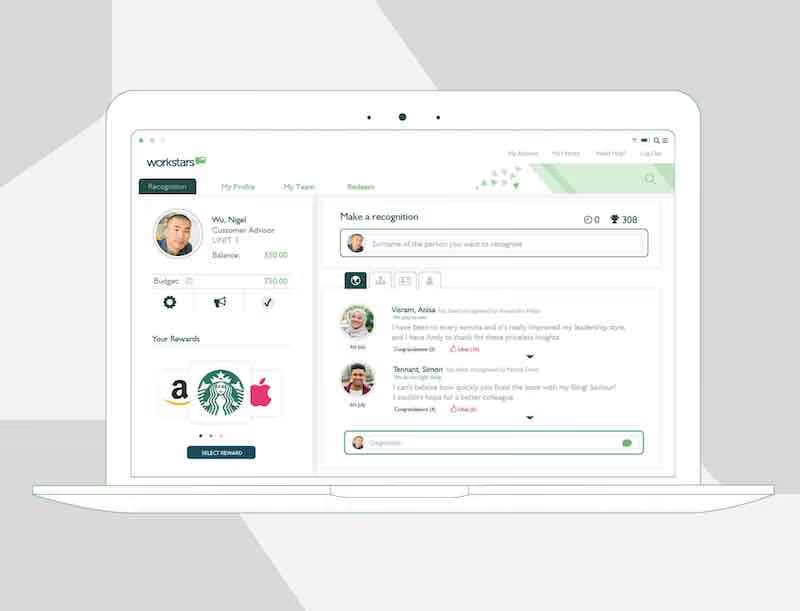
Workstars can help you deliver an exceptional employee experience with its global flexibility, seamless integrations, actionable insights, and strong security. Through the platform, you can access an online catalog of rewards and prepaid cards to incentivize employees, locally or globally. In our testing, we were quite impressed by how the platform let us add and change languages, countries, currencies, and cost of living adjustments without extra fees. It’s got a level of flexibility we’ve not seen on other platforms.
We are also fans of Workstars’ analytics capabilities, giving users valuable insights into workforce engagement trends, undercover achievers, and corporate value effectiveness. It also provides the reports you need for finance, IT security audits, and more.
Workstars also integrates with popular tools like Slack, Microsoft Teams, and Salesforce, and prioritizes security, with robust protocols around data storage, GDPR compliance, and penetration testing. To top it all off, the platform is fully responsive on mobile devices, ensuring employees can access Workstars anywhere.
Still, we wish Workstars offered pre-built HRMS integrations just like most of its peers. In order to connect the employee rewards program with your existing HR tech stacks, you must have to resort to XML or CSV uploads, or invest engineering resources into building out API connections. Similar to Guusto and Nectar, this vendor also doesn't offer a free trial.
Key recent updates:
The platform has recently been focused on improving HRIS integration stability, although major product announcements have been limited.
TT Electronics, Trac, and AstraZeneca are some of the many companies that use Workstars.
Workstars offers three subscription plans, billed monthly: Entry, Pro, and Global. The pricing for these plans ranges from £1.50 - £4 per user depending on the number of user seats you need and whether you need to use the platform in multiple languages/currencies.
Best For
Companies with a workforce ranging from 50 to 10,000 employees.
We use it to say happy birthdays. We use it to wish each other happy work anniversaries. We use it to create a positive environment for our employees. It has helped increase overall morale.
I really like the design of emails. I like that you can custom-make emails that are sent to employees. I like to provide employees with a fun tool.
They decided to use workstars as an additional resource for employee recognition for birthdays. They also wanted to recognize employees for anniversaries. They wanted to be able to give each other props on a regular basis.
Thought it was expensive for the platform. Wish it was more user-friendly. Wish we had one dedicated rep.
They are very similar to other platforms out there.
How often you plan to use it. How many employees you will have using it.
I haven’t noticed changes while we used it.
Hybrid organization that has employees all over the world.
It’s good for all organizations

Connecteam
Connecteam is an all-in-one workforce management hub for businesses, big and small with simple yet effective employee rewards program features. This vendor is also one the few rare in the space that provides a genuine free, functional option.
PROS
- Intuitive, mobile-friendly interface
- Customizable badges and recognition
- Purchased tokens never expire and are fully refundable
- All-in-one platform for rewards, scheduling, time management and communication
- Free for teams of 10 or fewer
- One of the only fully-mobile HR tech tools for deskless workers
- Very adequately-priced for all it entails, SMB-friendly
- Quite open to feedback, having implemented user suggestions as features in the past.
CONS
- Fewer reward options than specialized recognition platforms
- Limited peer-to-peer recognition features
- Third-party integrations limited to 4 payroll providers
- API access restricted to Enterprise plan
- No phone support
- In the communication hub, the app offers no confirmation that messages were sent and/or seen.
- Certain features that some teams consider essential, such as GPS-tracking, are only available in the higher-tier pricing plans.

Instead of taking the spotlight, Connecteam's rewards and recognition are designed to complement other features this workforce management software offers. And we must say, they totally nailed it.
Unlike Assembly, the tokens you buy from Connecteam never expire, and you can get a refund if you need to. There are fewer gift card options than with competitors like Bonusly or Motivosity, but popular brands like Amazon, Apple, and Best Buy are available.
Unsurprisingly, transaction fees are applied—10% for any purchased gift card in the U.S. and 15% for other countries. What we do appreciate here, though, is that the vendor has always been upfront about its prices. It always informs users about the cost of purchasing tokens and the price of the gift cards, so they know the difference before buying.
Connecteam gives you different ways to show appreciation for your employees. You can send recognition messages to individuals, select multiple users to send to everyone, or filter recipients based on specific criteria. Plus, you can create your own customized recognition badges to add a personal touch.
However, Connecteam doesn’t seem to give peer-to-peer recognition the attention it deserves. At the time of writing, there’s no way for employees to gift tokens to others. To give a colleague a shout-out, they either have to rely on the comment section on the admin’s recognition posts or use the chat feature.
Integration is another area in which this employee rewards software vendor falls short. It can connect natively with just 4 payroll solutions, while its API access is only available on the Enterprise plan.
Key recent updates:
- AI Text Enhancement: Administrators and managers can generate updates from prompts and refine them for style, wording, clarity, and formatting. This applies to recognition announcements.
- AI Translation: Messages can be translated directly within the conversation without switching between apps.
36,000+ companies, including Siteline, EnviroCon, and Copernicus.
- Small Business Plan: Free for up to 10 users.
- Basic Plan: $29 per month for the first 30 users, $0.5 per additional user.
- Advanced Plan: $49 per month for the first 30 users, $1.5 per additional user.
- Expert Plan: $99 per month for the first 30 users, $3 per additional user.
- Enterprise Plan: Custom pricing with features like personal account managers, SSO, 2FA, biometric lock, and API access.
Best For
Non-desk or distributed teams seeking to celebrate achievements and show employee appreciation.

I use Connecteam to schedule shifts, manage requests for days off, and allow team members to make schedule changes without requiring my direct involvement. It helps reduce back-and-forth communication and keeps the scheduling process more transparent.
Team members can access their schedules in real time, which limits confusion. It simplifies coordination and allows more autonomy for the team. Overall, it helps ensure shifts are covered with fewer administrative tasks for management.
- Connecteam makes managing schedules simple and efficient.
- Team members always have access to their schedules, which improves visibility and communication.
- It’s easy to keep track of hours and see who is working and when.
This tool is paid for by our corporate office, Pyramid Global, and is used across all properties. I have personally used it for a year and a half, while the company has been using it for approximately four years.
It was introduced to address issues related to managing printed schedules, such as team members trading shifts without notifying others, schedule changes going unnoticed, and general confusion.
These problems caused inefficiencies and miscommunication. Scheduling apps like this one are a significant improvement over the old printed methods.
- Occasionally, Connecteam loads the previous week's schedule, which confuses team members.
- Access permissions sometimes change without any action on my part—for example, a few weeks ago, the team was suddenly blocked from switching shifts, and it took 45 minutes to fix.
- Customer support response times can be slow, sometimes taking hours.
- I haven’t used many tools at the management level, but one limitation of Connecteam is that you cannot clock in or out within it.
- I’ve used another app for field work that included this feature, which was useful.
- Connecteam is primarily focused on scheduling and does not include payroll or time-tracking tools.
If you're looking for a simple, low-cost, stand-alone solution strictly for employee scheduling, Connecteam works well.
In the year and a half I’ve used Connecteam, I have not noticed any significant changes or updates to its functionality.
Connecteam is a good app for almost any team that only needs a basic scheduling solution.
Connecteam is not suitable for organizations that require a combined payroll and scheduling solution.

Guusto
We are big fans of Guusto’s inclusive approach to coporate rewards, with features that enforce a culture of appreciation across all employees - from the frontline to the executive suite. The platform is also easy to set up, has a straightforward redemption process and a free plan for SMBs.
PROS
- Digital-only gift cards with no plastic waste or shipping
- Real dollar value rewards with no confusing points system
- Android and iOS mobile apps
- Unlimited free recipients, subscription fee for givers only
- One day of clean drinking water donated per gift sent via One Drop Foundation
- 4,000+ reward options available worldwide
- Free plan available
- They partnered with the One Drop Foundation to donate 1 day of clean drinking water for every gift sent.
- All gift cards are actually digital, meaning there’s no plastic waste. This also makes it a very remote-friendly product.
- Guusto is not a points program. All the gifts within the platform are real dollar value.
- As of early 2023, their global rewards options have grown to the thousands.
- In the process of becoming more international, gift redemptions can now be done in almost any currency within the regions they operate in.
CONS
- Accounts funded in USD or CAD only
- Starting price increased from $40 to $125 per month
- Accounts can only be funded with USD or CAD
Guusto makes rewards and recognition seamless for dispersed workforces with its inclusive and automated software. We appreciate a simple approach to rewards, and Guusto offers just that.
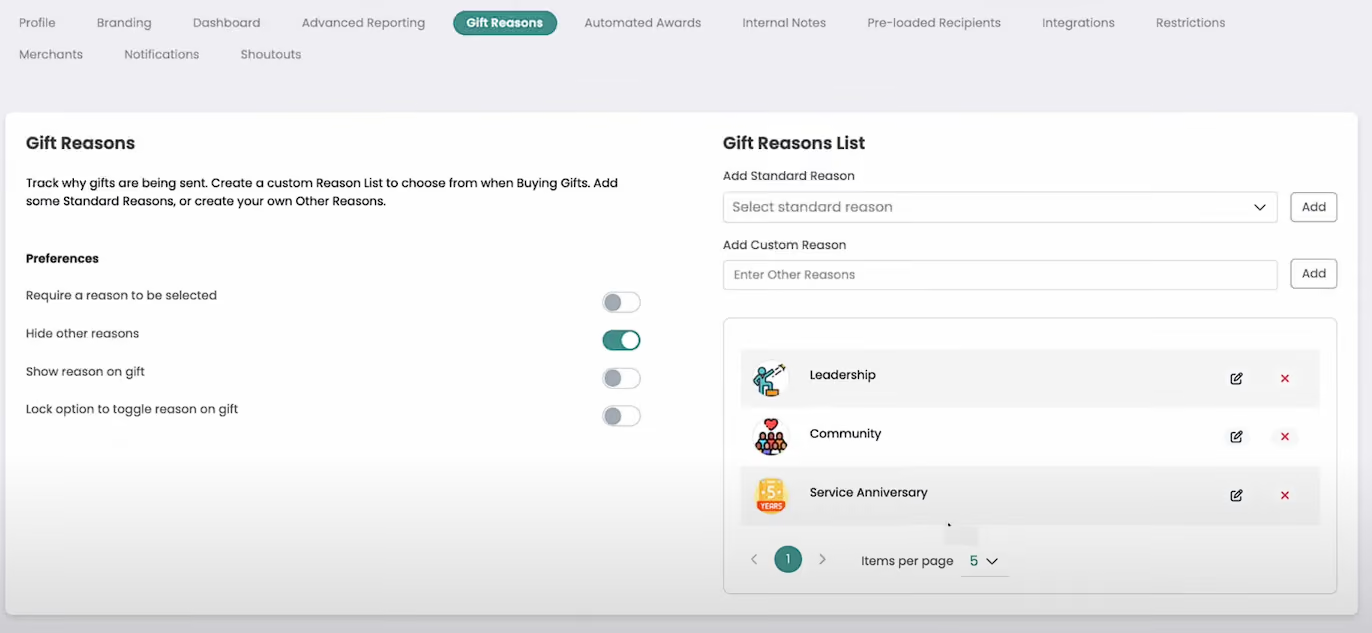
Rather than point systems, which can be confusing to understand, Guusto uses real dollar value rewards that can be sent to any employee, even if they aren't in the system yet. To make things even better, you only need to pay for users that send recognitions; recipients can be added for free, without any limit.
Another thing we love about Guusto is its focus on frontline and deskless workers, ensuring they’re not left out of any appreciation efforts. These employees are often on the move, and many of them don’t have corporate email access. Their rewards and shoutouts can be sent to them via SMS text messages and physical cards.
The software empowers managers with custom budgets to consistently recognize achievements, reinforce values, and automate milestone rewards. Peer-to-peer shoutouts boost morale across locations, automated drawings help randomly issue rewards and incentives, and employees can redeem their recognitions for hundreds of digital gift cards from top brands worldwide, company swag, donations, and more.
Unfortunately, the recent price change for Guusto left us a little disappointed. It used to start at an affordable rate of $40 per month. Now, the latest figure has tripled to $125 per month. And given that Guusto accounts can currently only be funded using USD or CAD, those operating across different currencies may find this restrictive.
Key recent updates:
- Direct Swag Integration: Employees can now redeem recognition points for branded merchandise without leaving the platform. Organizations can configure custom apparel, colors, designs, and milestone items such as anniversary jackets or onboarding kits—all within the main interface.
- Guest Redemption: This feature removes friction by allowing employees to redeem rewards instantly without creating an account. Whether the recognition is delivered through a QR code, text message, email, or printout, the experience remains simple and immediate, particularly valuable for frontline workers.
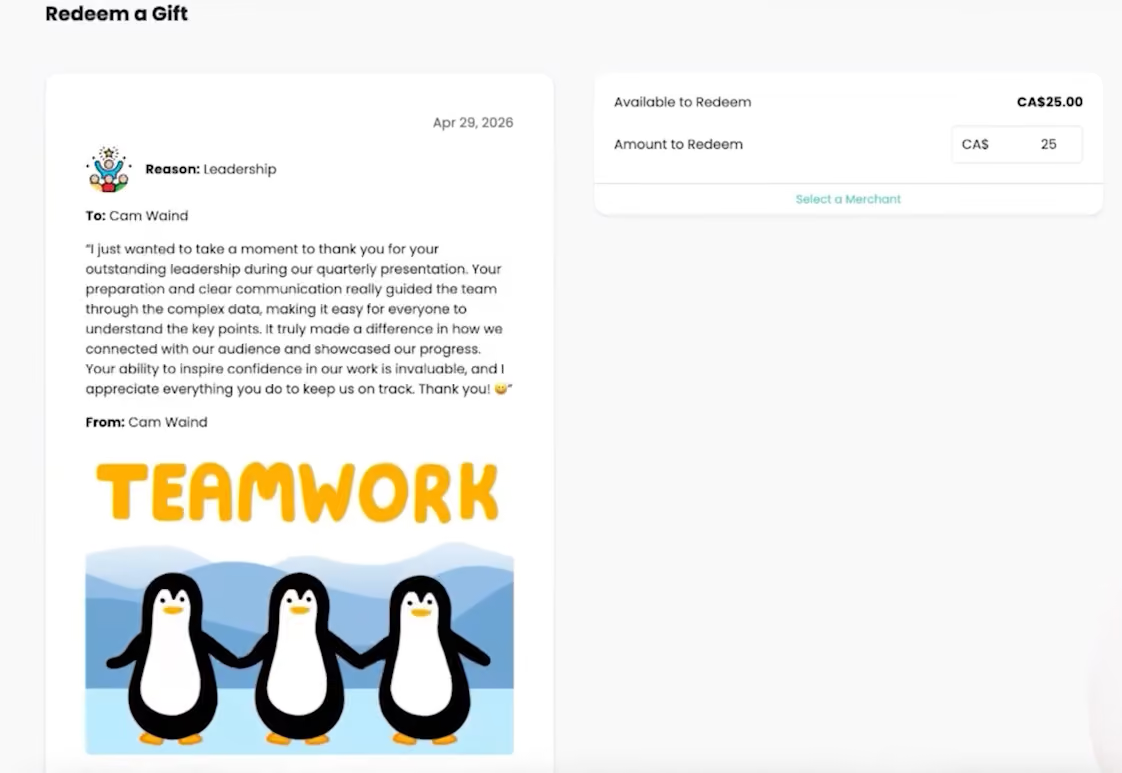
Staples, Compass One Healthcare, The Body Shop, Fairmont, Rexall Pharmacies
Guusto offers four pricing plans: a free plan for single users sending rewards, a Lite plan at $125 per month for single users who send and schedule bulk rewards, and Essential and Premium plans, priced per seat per month. Essential costs $4 per sender seat and $0.7 per recipient seat with a minimum contract of $200 per month, while Premium is $5 per sender seat and $1 oer recipient seat with a minimum contract of $500 per month.
Best For
Companies with frontline employees, particularly in the Healthcare, Retail, Financial Services, and Hospitality industries.
We use Guusto all the time for different reasons. Most of the time it is used to reward employees for milestones and customer referrals. Another way we use it is to reward customers that refer their friends or family to a specific service provider. We use Guusto all the time for these types of reasons.
- It's very easy to use making rewards easy to redeem
- customer support is very responsive and supportive, they try to find solutions as easily as possible.
- They offer many different ways to redeem rewards and are always adding more as time passes.
My organization bought Guusto to reward employees and customers for referrals and milestones in our company. I have personally been using Guusto for a little while but it's always been a very easy and painless process to redeem those rewards. For things like payroll, it makes it very easy for my organization to process payments without having to worry about it during tax season. It's easy to get started and the pricing is very appealing to many different types of small businesses. Would recommend Guusto to anyone!
- Some different reward options don't give you the choice for specific dollar amounts.
- There is no way to automatically pay people on payroll who aren't in the company.
- It's hard to pay out bonuses and have everything integrated into tax filing programs.
Other types of payroll programs are very hard to use and take a long time to get new users setup, and also make you pay for one year of service upfront without letting you try out the service for a short period. With Guusto you can try it out and if you don't like it you can stop your service. Also the ease of use of Guusto makes it way more appealing to many different companies.
When purchasing this type of service you should consider whether it can accommodate international payroll. Thinking of this before you purchase the service can come in handy when you need to go to the US or other parts of the world and be able to pay contractors or other employees abroad. Also the price of the service can be low if a very small number of employees or more expensive if you need to accommodate more people.
At first Guusto didn't have any type of features for the organization's employees. But as time has passed they have introduced different features like benefits for employees and even a HR type environment for employee reviews ETC.
I believe any type of user that has a small to mid size company can benefit from Guusto services. They make things for payroll easy to use and hassle free.
I feel like bigger companies like enterprises would not benefit as much as smaller companies would. With them needing more options for payroll they might find using bigger payroll services like ADP would be more effective.

Terryberry
Terryberry offers a comprehensive rewards platform with one of the industry’s largest rewards selections, including merchandise, gift cards, travel experiences, and custom-crafted awards. The platform’s flexible workflows and pay-upon-redemption billing help manage budgets effectively, while its hybrid-friendly design ensures easy access for all employees.
PROS
- Pay-upon-redemption billing with multi-center cost allocation
- Global fulfillment with extensive international reward options
- Flexible reward programs tied to company values and engagement goals
- Advanced analytics measuring reward impact on engagement and sentiment
- HRIS integrations for automated reward management
- Mobile-friendly for deskless and hybrid workforces
- Amazon Business rewards available in the US
- Customized physical goods as employee rewards
- Wide range of employee engagement features, including rewards, incentives, and a wellness tracker.
- Customer support and account management at Terryberry are quite good. Their reps stand out for being very responsive and attentive, which is evidenced by some of the client testimonials we read.
- The implementation process, while six weeks long, is quite comprehensive, and you get tons of help along the way. For instance, the last two weeks consist of internal and customer testing, as well as user training.
CONS
- Interface design lacks modern aesthetic
- No open API yet, though on the roadmap
- No free trial available
- While Terryberry is easy to use, its design could look more modern and sleek.
- No open API available as of this writing.
- No free trial at the moment.
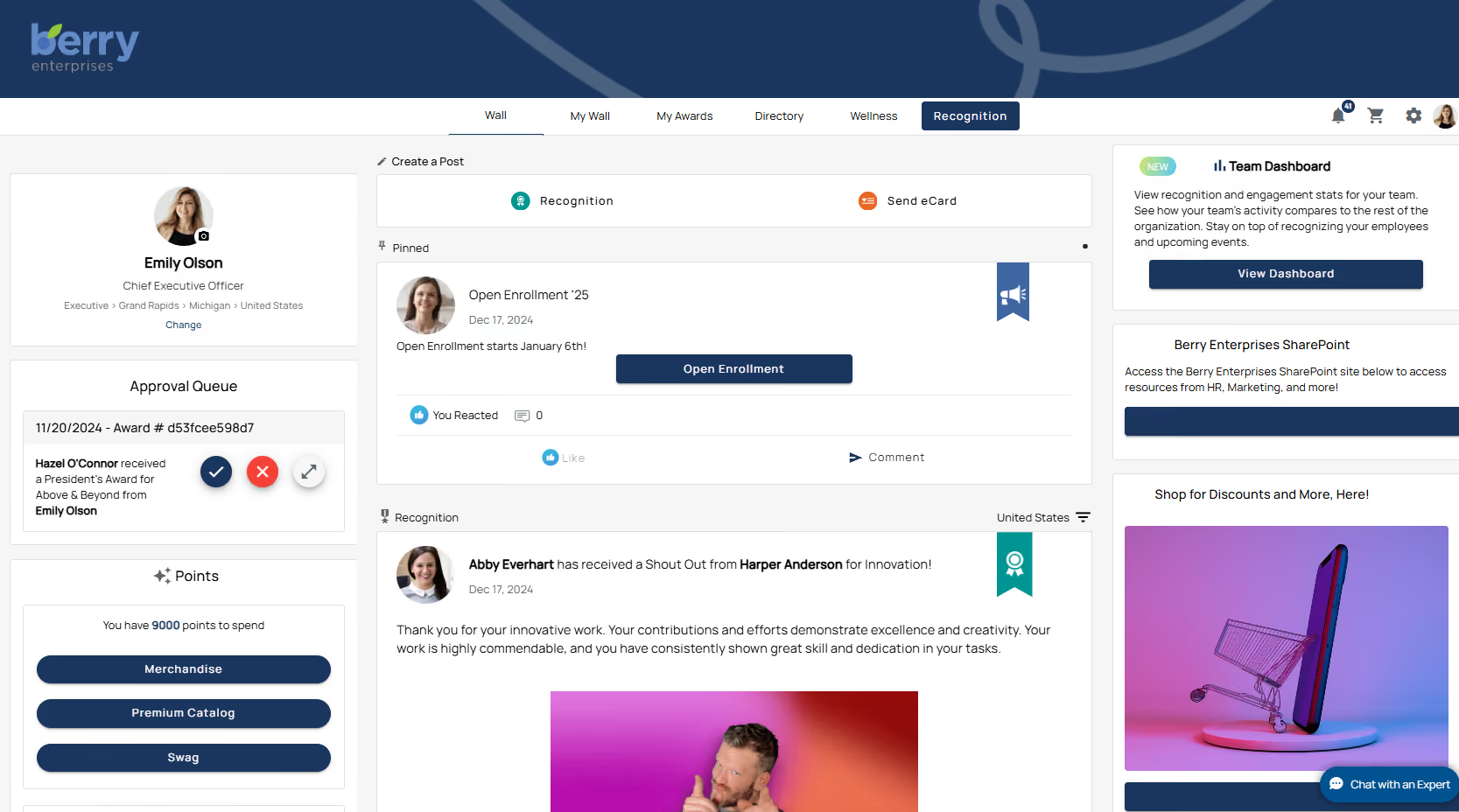
Terryberry’s rewards platform offers a robust solution for companies looking to engage employees through meaningful and customizable rewards. During our demo, we explored Terryberry’s expansive rewards catalog, which includes merchandise, gift cards, travel experiences, company swag, and custom-crafted awards. This variety ensures that companies can provide rewards that resonate with diverse employee preferences.
We found that the platform’s flexibility in configuring reward programs stood out. Organizations can design reward workflows that align with their mission, vision, and values. For example, during our conversation with the product team, they highlighted how value-tagged rewards reinforce company culture by directly linking rewards to specific achievements and behaviors.
Terryberry’s pay-upon-redemption billing model was another standout feature. This approach helps organizations manage budgets more effectively by only paying for rewards when redeemed. Multi-center cost allocation further simplifies financial management for larger organizations.
The platform’s global fulfillment capabilities support rewards delivery in over 150 countries, making it ideal for international organizations. Additionally, the hybrid-friendly design ensures that office-based and frontline employees can participate. We saw how features like QR codes and mobile options make it easy for deskless employees to access and redeem rewards.
Despite its strengths, we’re quite disappointed in the platform’s interface: it’s not exactly user friendly but rather look dated. Additionally, the lack of an open API limits integration possibilities makes this option not the best bet for some enterprises.
Terryberry serves over 40,000 clients globally, including well-known organizations such as Tesco, Epsilon, General Motors, and Trilogy Health.
Terryberry's basic subscription plans start around $3 per rewarded employee. Pricing depends on subscription features and reward types, one-time setup fees, and annual administration fees based on employee count and reward redemptions.
Terryberry has made several notable updates to its rewards platform in the past year, enhancing its capabilities and user experience:
- Expanded global fulfillment: Rewards can now be delivered in over 150 countries, supporting diverse and international workforces.
- Advanced analytics: New tools to measure the impact of rewards on employee sentiment and engagement.
- Mobile enhancements: Improved mobile experience for easier reward access and redemption, especially for deskless employees.
- AI-powered features: AI-driven insights help refine reward strategies and personalize reward recommendations.
- Custom workflows: Enhanced options for configuring reward programs to align with company values and goals.
- Amazon Business was recently introduced to their rewards catalog, though it's currently available only to users in the U.S.
Best For
Hybrid or global companies seeking an all-in-one rewards system with expansive catalog options, including travel, swag, and custom-crafted awards.
I utilized Terryberry several times a week to set up recognition programs aligned with our company values and goals. Reviewing nominations and approving awards was a regular task, ensuring fairness and recognizing employee achievements. Tracking employment milestones and communicating with employees about their accomplishments and events was also crucial. Periodic surveys were conducted to gather employee feedback, and I frequently analyzed reports and analytics to identify trends and further engage employees.
The creation of rewards programs was straightforward, making it easy to align them with company values. The peer-to-peer "wow" program successfully encouraged employees to recognize one another, fostering a positive and engaging work environment. The wellness program was well-received by staff, indicating its success. Excellent customer service and the user-friendly app, especially for field employees not frequently at desks, were significant advantages.
Our organization was concerned about the high employee turnover rate, with exit interviews often highlighting a lack of morale due to employees feeling unseen and unrecognized. Increasing salaries as a reactionary measure to prevent departures did not effectively address the underlying issue of employees feeling unappreciated. We were also worried about engagement levels and the resulting dip in productivity from disengaged employees. Despite trying numerous team-building exercises and management retraining, the problem persisted. Terryberry seemed to offer a solution by providing ongoing recognition, encouraging exceptional work, boosting productivity, and reducing turnover by enhancing morale. I have personally used it for six months.
The many choices available for employees was somewhat overwhelming, potentially leading to decision fatigue and wasted time. The tool's integration with other HR systems could be smoother, and customization options were not as flexible as desired, particularly concerning integration with external programs.
Compared to other tools I've used, Terryberry stands out for its user-friendly interface and exceptional customer service. It focuses less on gamification, favoring a points system over cash rewards, which aligns better with our goal of providing added rewards rather than extra compensation. This approach seems more appropriate for recognition software.
It's essential to consider whether your employees are likely to adopt and appreciate this tool. High-income professionals with demanding roles may show less interest in the rewards, so understanding your staff's preferences is crucial. Implementation is straightforward, but launching the program requires commitment. Additionally, be mindful of potential issues like perceived favoritism and have strategies ready to address them.
Terryberry has enhanced its mobile app, making it more accessible for employees regardless of their location. Improvements to the interface's navigation have also made the tool more user-friendly over time.
Terryberry is well-suited for remote or geographically dispersed workforces, industries with high turnover at the entry-level, large companies, and any organization looking to boost employee engagement, especially in roles that are repetitive or routine. This tool can help employees feel more recognized and engaged.
For very small organizations with fewer than 20 employees, Terryberry might not be as effective due to a small pool of participants and potential repetition of rewards. Additionally, highly compensated employees with very busy roles may not find as much value in the type of rewards offered.

Vantage Circle
Vantage Circle offers a wide range of peer and manager rewards to boost engagement, with the flexibility to support global teams through localized redemption options in over 100 countries and in 16 languages.
PROS
- Rewards catalog across 100+ countries with gift cards, merchandise and experiences
- Standard of Living Index ensures fair international reward redemption
- Peer-to-peer recognition with custom awards, badges and social feed
- Gamified leaderboard for recognition tracking
- Automated milestone recognition for birthdays and anniversaries
- All-in-one platform for rewards, recognition, wellness and feedback
- Available in 16 languages
CONS
- Admin dashboard complex for advanced analytics and workflow configuration
- Limited localized reward options in APAC
- Fewer native HRIS and communication integrations than competitors
- Higher-tier plans costly for smaller organizations
- Admin dashboard complex for advanced analytics and workflow configuration
- Limited localized reward options in APAC
- Fewer native HRIS and communication integrations than competitors
- Higher-tier plans costly for smaller organizations
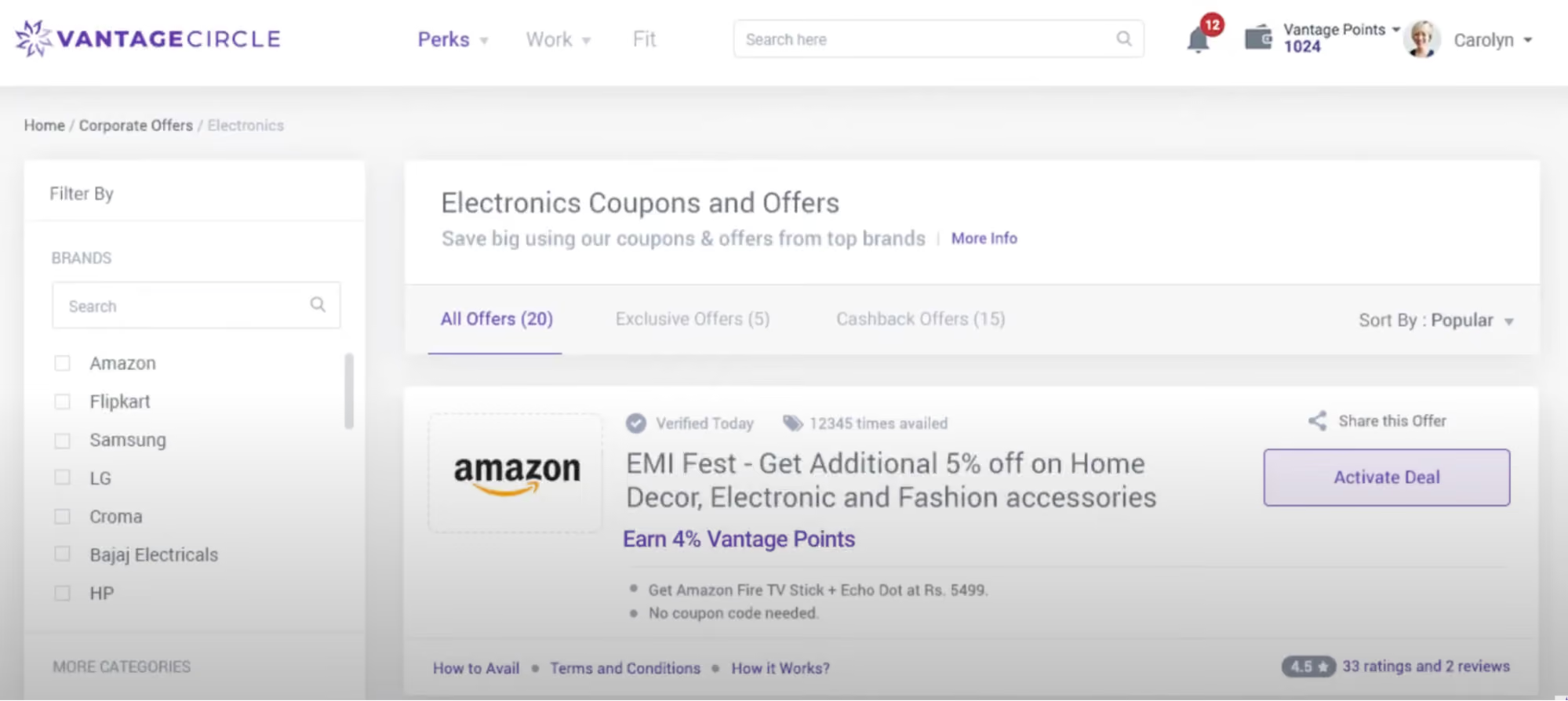
Vantage Circle offers a comprehensive and user-friendly employee rewards platform that makes it easy to appreciate and engage your workforce.
The platform stands out for its massive rewards catalog, containing gift cards, merchandise, and curated experiences accessible in over 100 countries. What’s also great about it is that it takes the Standard of Living Index (SOLI) into account, adjusting reward points for international teams to redeem in a fair manner.
There’s a host of features around peer-to-peer recognition. Employees are empowered to recognize one another's accomplishments via custom awards and badges. There’s also a social feed that showcases all the recognition passed around and a leaderboard that not only tracks but gamifies everyone’s efforts.
Milestones like birthdays and work anniversaries are never forgotten with Vantage Circle’s automated messages. The platform also helps you create a digital yearbook and service catalog for long service awards.
However, we agree with most users that parts of the platform’s admin dashboard could be more intuitive, particularly when navigating advanced analytics or configuring complex workflows. Although we appreciate the broad catalog, we couldn’t help but found certain regions like APAC have significantly fewer localized options, which could limit choice for employees in those areas.
Lastly, Vantage Circle surprisingly doesn’t integrate natively with as many HRMS or communication tools as some competitors, meaning more manual work or custom integrations might be needed.
Vantage Circle is used by over 700 companies including Bosch, Tata, and DHL.
Vantage Circle’s pricing depends on the number of employees you have. SMBs with up to 1000 employees can access the Grow plan at a starting price of $200 per month. The other two plans, i.e. Transform and Enterprise have custom pricing. Contact Vantage Circle’s Sales team for an estimate based on the size and needs of your company.
Best For
Multinational organizations.
Vantage Circle is used for driving engagement, productivity, wellness, and staff retention. It provides real-time feedback, ensuring no surprises during performance evaluations and bonus allocations. We run many employee well-being initiatives through Vantage Circle, collecting data to evaluate their effectiveness. For example, we recently introduced virtual yoga sessions, which are tracked in the wellness tracker. The rewards and recognition platform allows employees to choose from a variety of rewards using a points system, giving them autonomy over their incentives. Vantage Circle helps us manage these services seamlessly.
- What I like is that it is very user-friendly. Most employees find it very easy to navigate and use.
- The customer support has been second to none; no inquiry is too difficult, and they are always happy to help - Paul has been such a massive help to us.
- Having one system that we can utilize for many different rewards, recognition, feedback, and wellness, as well as a consistent approach for the whole organization, made my job easier!
The organization I worked for had no recognition program or tools to monitor employee satisfaction. Some managers had their own processes for their teams, while others did nothing. This inconsistency became a noticeable issue, with employees leaving and citing this as a factor. I was brought in to review HR operations and found this was one of many areas needing improvement. We chose Vantage Circle for its ease of use, integration with our internal systems, and compatibility with our overseas virtual assistants. Vantage Circle has been in place for over three years and remains a critical part of the organization.
- We had to customize our rewards programs to suit Vantage Circle, which was challenging but ultimately beneficial.
- The gift card options are limited, requiring customization to match staff preferences.
- It can be costly, especially with the more expensive plan, but the benefits outweigh the costs in terms of staff retention and employer reputation.
Vantage Circle stood out for its seamless integration with our internal systems and overseas virtual assistants. Its user-friendly interface and ability to package wellness, rewards, recognition, feedback, and onboarding into one system were crucial. We preferred having all functions in one system rather than using multiple tools for different purposes.
Consider the need for a user-friendly system that staff can easily use and integrate with existing systems. Determine what specific functions you need to ensure consistency across the organization. Vantage Circle is ideal if you aim to stand out as an employer of choice.
Vantage Circle has been responsive to recommendations for improvement, such as adding more gift options. They keep up with technology changes and provide a user-friendly app with accessible podcasts and webinars.
Vantage Circle is ideal for organizations serious about employee retention and becoming an employer of choice.
Vantage Circle may not suit very small organizations with minimal employees due to the cost versus benefit factor. Smaller organizations might manage these functions more cost-effectively through other methods.

Mo
With Mo, you can design and automate your employee rewards program with its easy-to-manage peer-to-peer appreciation, budget controls, and reporting functionalities.
PROS
- User-friendly interface with wide gift card selection
- No rewards fees with reasonable pricing
- Available in 12 languages and growing
- Free onboarding and implementation support for all plans
- Android and iOS mobile apps
- UI is easy to navigate, and users seem to appreciate the varied choice of gift cards they can offer through the platform.
- Transparent pricing starting from $2.25/user/month with no rewards fees.
- Free onboarding and implementation support for all users.
- Robust and feature-rich mobile applications.
- Available in 12 languages and growing.
CONS
- Pricing no longer publicly disclosed
- No free plan, trial available on request only
- Support limited to weekdays, 9AM to 5PM GMT
- Notification emails occasionally sent to uninvolved users
- HRIS integration absent in Base plan. Possible implementation fee for Slack and Microsoft Teams integrations.
- The customer support hours are limited to weekdays, 9 AM - 5 PM GMT.
Mo makes rewarding employees incredibly simple, meaningful, and fun. We put it to the test and found the UI quite intuitive. It’s easy to grant credits to deserving employees, which they can redeem from Mo’s extensive rewards marketplace of major brands like Amazon, Nordstrom, and Tesco.
Colleagues can post public or private appreciative “Moments” and react with comments, emojis, and GIFs, nurturing a culture of appreciation from the bottom up. Managers can also use Mo’s unique “Boosts” to regularly prompt team members to recognize one another for day-to-day wins.
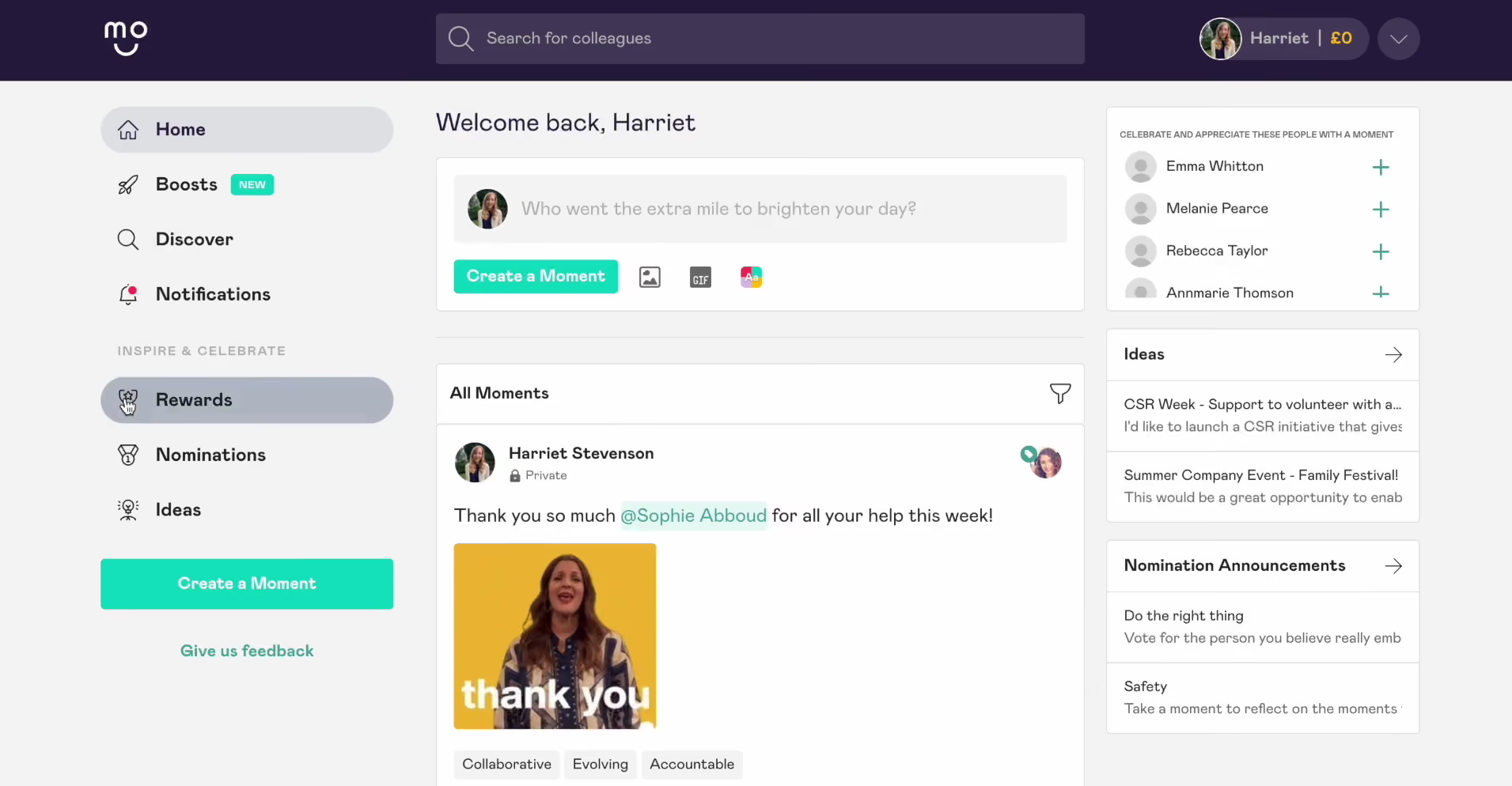
We like a lot of things about Mo but if we had to choose just one, it’d definitely be their automated Assistant. The Assistant automatically reminds managers to recognize employees on their special days like birthdays, work anniversaries, and other special occasions. It also nudges managers and employees to share appreciation if someone has not been recognized in a while, which is something we’ve not seen on other platforms.
That said, Mo’s pricing is not friendly towards budget-conscious teams, with no pricing transparency and no free plan. The one consolation, though, is that you can request the vendor to provide you with a free trial.
Regarding customer support, the service is good, but do bear in mind that it is limited to weekdays during UK business hours (9 a.m. – 5 p.m. GMT), which can be inconvenient for global or U.S.-based teams needing timely assistance. Additionally, we found the platform’s notification settings lacking refinement. As reported by verified users, Mo tends to send too many emails, including to those not directly involved in a recognition moment.
Mo has more than 100,000 users. Some top customers are SGN, The O2, NHS, Aspen, William Hill, and SHL.
Mo offers custom pricing via a monthly subscription model based on the number of employees included in the program. Contact their sales team for a quote.
Best For
Distributed teams who want to connect and motivate employees within established internal communications platforms like MS Teams and Slack.
Compare the Best Employee Rewards Software
PEPM = per employee per month. Prices are as verified on [date]; rewards budgets are usually billed separately.
Other Employee Reward Systems Worth Considering
Matter: Employee rewards system inside Slack and MS Teams
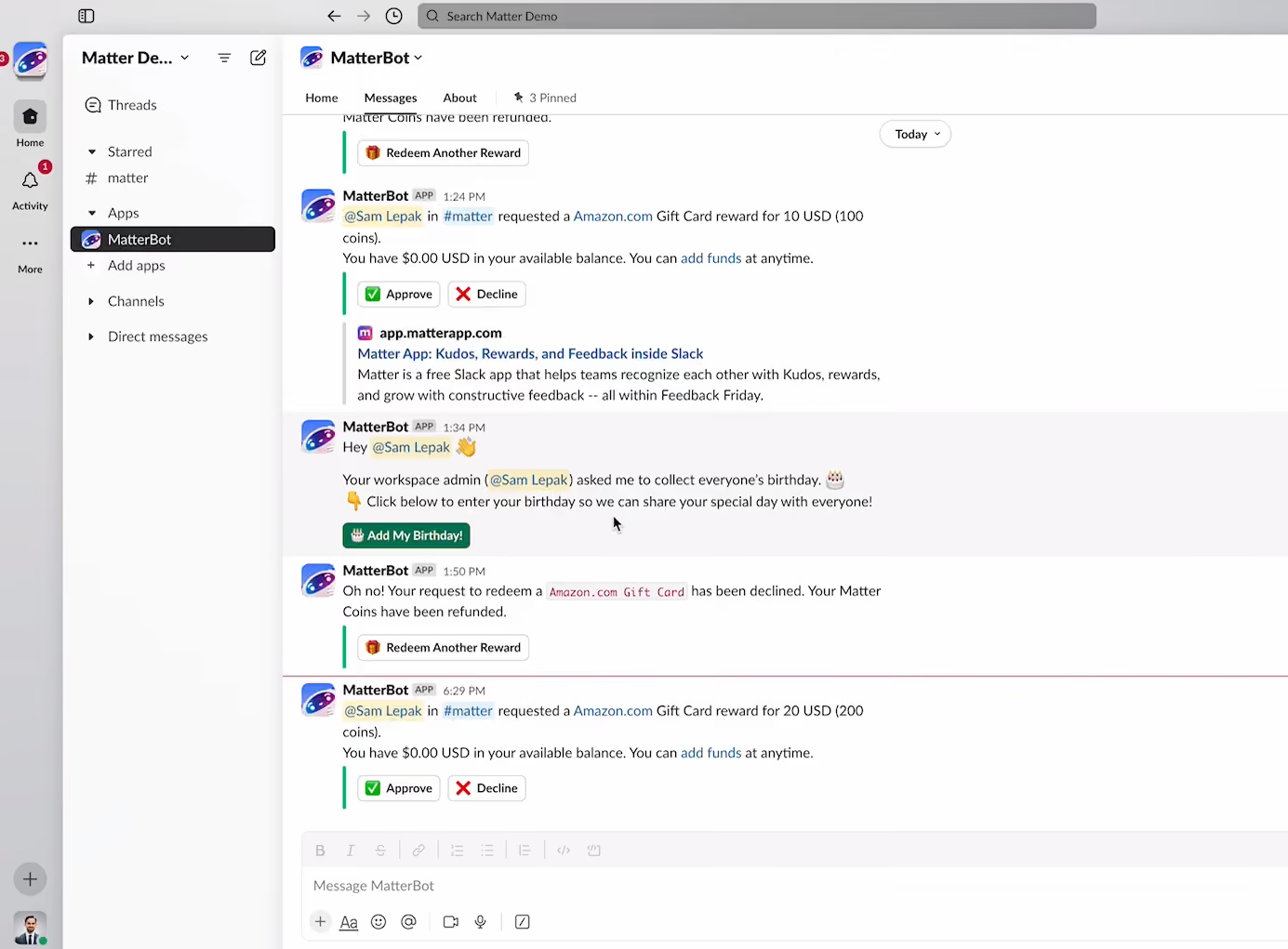
Matter fits seamlessly into Slack and MS Teams: setup took minutes, the UI is clean, and it handles rewards, birthdays, anniversaries, and surveys all in one place, with a built-in Rewards Calculator that made budgeting effortless. At $3/month with a free plan and 30-day trial, it's a low-risk try for small teams. That said, it's a non-starter if your team isn't on Slack or MS Teams, the free plan caps analytics at 30 days, and it doesn't match Connecteam's breadth of free HR tools, but for SMBs wanting a dedicated rewards experience inside their existing communication stack, it delivers.
Cooleaf: Great point-based employee rewards system for global enterprises
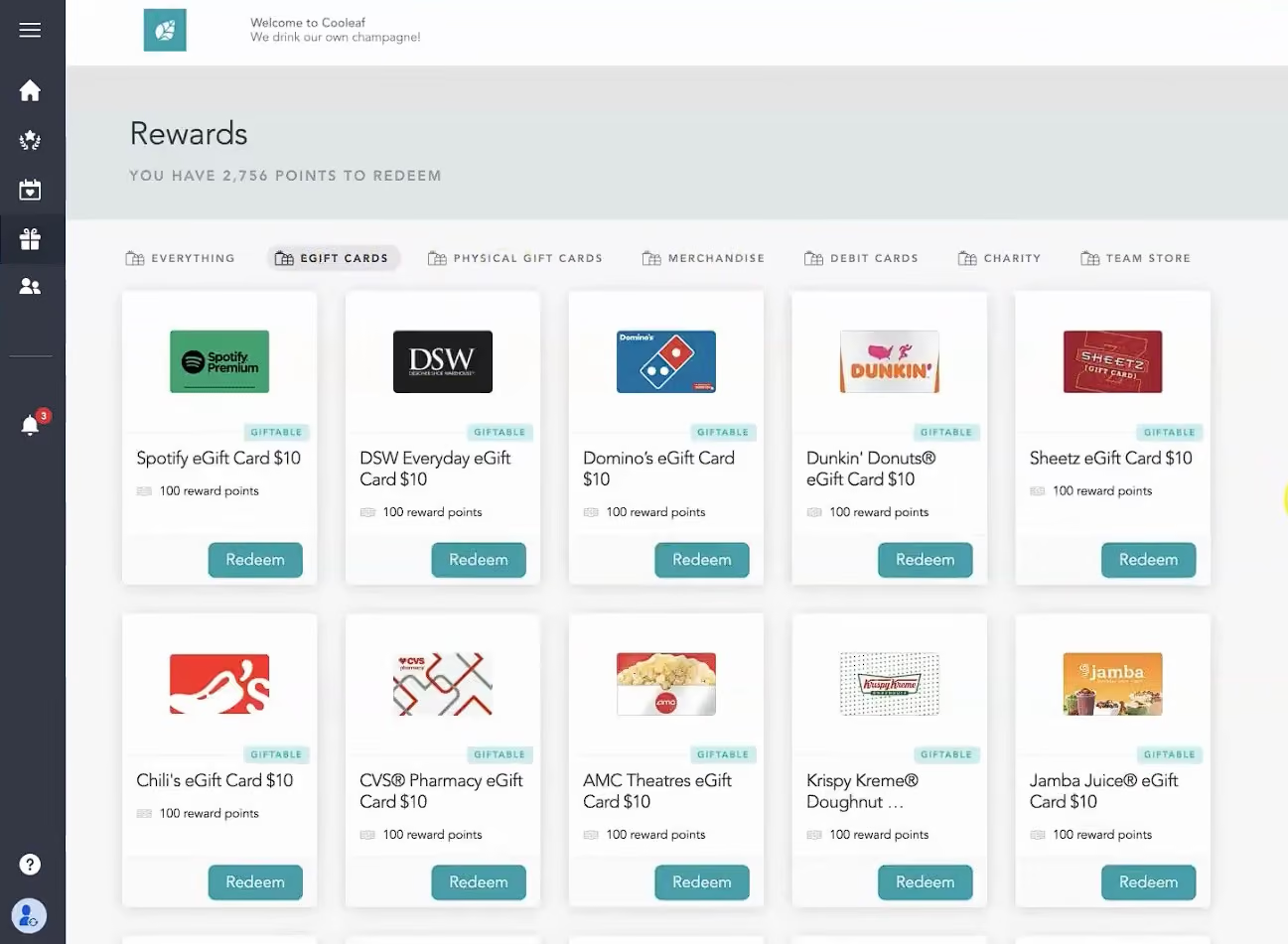
Cooleaf handles global fulfillment of both physical and digital rewards in-house, offers 700+ brands, and gives HR leaders solid analytics on redemption trends by team, location, and role. The catch is that this is firmly an enterprise platform. Setup requires onboarding support, the configuration depth can feel like overkill for teams under 500, and there's no free trial, free plan, or even disclosed pricing. For global organizations with 2,000+ employees looking for a strategically integrated rewards program, Cooleaf delivers; for everyone else, it's likely more than you need.
Reward Gateway: Reward system for employees with excellent mobile experience
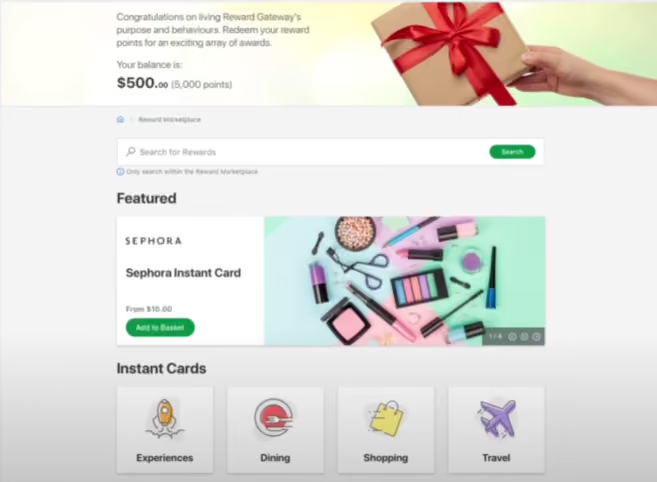
Reward Gateway impresses with a broad catalog spanning Amazon products and personalized ecards, plus modular add-ons like surveys and employee discounts so you only pay for what you need. Their 24/7 support across chat, email, and phone was consistently responsive throughout our testing. The drawbacks are that mobile experience is a weak spot, as users must log in separately rather than accessing rewards through existing tools and reporting lacks the depth needed to effectively measure program ROI. Pricing tends to start at £6 per employee per month. Best suited for mid-size companies of 51–500 employees wanting a retailer-rich rewards experience with strong admin flexibility.
Benefits of Corporate Rewards Platforms
A well-run rewards platform lifts engagement and retention, encourages better performance, takes recurring admin off HR’s plate, and reinforces the values you want your culture built on.
- Improved Employee Engagement and Retention: Recognition is one of the clearest drivers of whether people stay. Gallup and Workhuman tracked the career paths of nearly 3,500 employees from 2022 to 2024 and found that employees who received high-quality recognition were 45% less likely to have turned over after two years and 65% less likely to be actively looking or watching for another job [2] Peer-to-peer programs matter here too. Recent research suggests that peer recognition points systems increase engagement and motivation by meeting employees’ psychological need for recognition [3]. In our testing, the platforms that made peer recognition easiest to give, such as Matter and Assembly inside Slack and Teams or Guusto by SMS for frontline staff, were also the ones where participation was easiest to sustain.
- Increased Productivity and Innovation: Specific recognition improves performance. Gartner research found that recognizing high-performance actions increas[es] the likelihood of employees achieving optimal performance 5.7 times [4]. The key word is specific: the recognition has to name the action, not just offer general praise. This is why we favored platforms that let you tie recognition to company values or goals, such as Workstars, Kudos and Assembly. Just as important is frequency. Research from Achievers, one of the vendors reviewed in this guide, found that employees who receive monthly vs. quarterly recognition are 36% more likely to say they are productive and engaged [6]. The automated nudges in Mo, AdvantageClub.ai and Nectar help keep recognition on a monthly rhythm without anyone tracking it by hand.
- Higher HR Efficiency: Too often, HR professionals wear many hats and have multiple aspects they need to attend to, so any opportunity to streamline the processes should be seized. The best solutions have all manner of automation options to ensure that rewards programs are implemented consistently and fairly. These tools can automate everything from milestone celebrations, work anniversaries, and birthdays to onboarding—all in one user-friendly interface.
- Strengthened Company Culture and Employer Brand: Implementing a well-planned rewards strategy with the help of employee rewards software is a surefire way to build positivity around your company brand. Rewards don’t have to be financial, either: Plenty of well-known companies have received positive press coverage for the non-monetary incentives they offer to reward staff.
Employee Rewards Platform Pitfalls
Most rewards platform pitfalls don’t show up in a demo: hidden pricing, steep minimums, thin catalogs outside major markets, and integrations shallower than advertised. Here are the ones we ran into most often in testing, and which platforms they apply to.
- Pricing often isn’t public. Many vendors don’t publish prices, so you can’t compare costs without sitting through a sales call. C.A. Short, ITA Group, Mo, AdvantageClub.ai and Semos Cloud all require a quote. Even published pricing can come with steep minimums: WorkTango often starts around $8,750 a year, and Nectar requires at least $4,000.
- Free trials are uncommon. Awardco, Nectar, WorkTango, Kudos, ITA Group, Terryberry and Semos Cloud offer no free trial. Bonusly (14 days), Matter (30 days) and Workstars (30 days) do. Free plans exist but come with limits. Bonusly’s covers up to 8 users and Connecteam’s up to 10, and Matter’s keeps only 30 days of analytics history. Guusto and Motivosity also have free tiers. Bucketlist offers a pilot program, which is worth asking about.
- Catalogs aren’t equal everywhere. A catalog that looks deep in the U.S. or U.K. can feel thin elsewhere. Vantage Circle has noticeably fewer localized options in APAC, and Achievers’ catalog narrows in less-supported countries. Guusto accounts can only be funded in USD or CAD, which adds friction for teams paying in other currencies.
- Experiential rewards are often an afterthought. Most catalogs lean on gift cards and merchandise. Travel, events and activities are underrepresented at Nectar, Bonusly and Bucketlist. If your employees value experiences, check that part of the catalog before you sign.
- Points can expire or be gamed. Assembly’s coins and points expire without rollover, and Bonusly’s unused allowance doesn’t carry over either. At the other extreme, Motivosity sets no limits on how employees distribute points, so someone could send their whole monthly allocation to a friend.
- Some interfaces feel dated. We found C.A. Short’s and Terryberry’s interfaces dated compared with newer tools. Vantage Circle’s admin dashboard gets complex for advanced analytics and workflows. Users have reported problems attaching images, GIFs and emojis in Kudos, and shoutout and goal setup in Bucketlist can feel clunky.
- Integration depth varies more than vendors suggest. Connecteam connects natively to only four payroll providers and limits API access to its Enterprise plan. Workstars has no pre-built HRMS integrations, so employee data has to come in through CSV/XML uploads or a custom API build. Vantage Circle also has fewer native HR and communication integrations than competitors.
- Support has limits. Mo’s support runs on weekdays from 9 a.m. to 5 p.m. GMT, which leaves gaps for U.S. and global teams, and some Mo users report notification emails going to people who weren’t involved. WorkTango users told us feature requests don’t always get clear follow-through.
- Some platforms are built only for enterprises. ITA Group targets organizations with 2,000+ employees, and Semos Cloud is designed around SAP SuccessFactors, Workday and Oracle. For a company of 50–200 people, these offer more infrastructure than you’ll use, at a price to match.
Types of Employee Rewards (with Examples)
Most rewards fall into two groups, and most platforms support both.
- Monetary rewards have a direct cash value. They include performance bonuses, sales commissions and spot bonuses for hitting a target. In rewards software, they usually take the form of points or dollars employees convert into gift cards, prepaid cards or cash-like options. Bonusly offers PayPal and prepaid card redemptions, and Guusto and Motivosity use real dollar values instead of points.
- Non-monetary rewards recognize people without direct financial compensation. Examples include award titles, peer nominations, extra paid time off, wellness perks, training opportunities, and experiences like lunch with the CEO. Kudos, Bonusly and Nectar let you add custom rewards like these to the catalog, and Achievers’ concierge service can source requests outside the catalog.
You can use either type or combine them. Whatever you choose, rewards should be meaningful to the people receiving them and aligned with your company’s values.
A note on taxes: In the U.S., cash and cash-equivalent rewards are taxable to the employee no matter how small. The IRS states that cash and cash equivalent fringe benefits (for example, gift certificates, gift cards, and the use of a charge card or credit card), no matter how little, are never excludable as a de minimis benefit [9]. That includes the gift cards most platforms offer, so ask each vendor how it handles tax reporting and check the rules in every country where you’ll issue rewards.
Employee Rewards Software Pricing
Most platforms charge 2–6 per employee per month, but that headline rate rarely tells you what you’ll actually pay.
- Annual contracts with minimums are the norm. Vendors may quote monthly rates, but expect a yearly contract with a floor of roughly $2,500 to $8,750+. Large organizations usually get custom quotes. Motivosity’s enterprise range, for example, runs from $40,000 to over $300,000 a year.
- Pricing models vary. Some vendors charge per user (Assembly at 2–4, Nectar at 5–6). Others add a base fee (Connecteam from $29/month plus 0.50–3 per extra user). Modular platforms like Motivosity charge a low platform fee (0–2 per user) plus about $1 per user for each module. Some use annual minimums instead (Awardco from $2,500 [verify], Nectar $4,000). Guusto charges senders and recipients at different seat prices.
- The rewards themselves usually cost extra, and markups vary. Bucketlist, Semos Cloud, Achievers and Reward Gateway pass rewards through at face value. Connecteam adds a 10% fee on U.S. gift cards and 15% elsewhere, and some Awardco users told us certain items cost more than retail. Ask every vendor what share of your rewards budget actually reaches employees.
- Expect other costs beyond the subscription, including setup fees, admin fees and implementation support. As you grow, prices tend to rise with features, configuration and support, not just headcount.
Employee Rewards Systems Trends
Five years of reviewing employee reward systems point to three clear developments. Enterprise platforms are folding rewards into broader employee experience suites. Smaller vendors are focusing on simple, habit-forming tools that fit into daily workflows. And HR platforms from other categories are adding rewards features of their own.
- Enterprise platforms becoming broader employee experience tools: For midsize and large organizations, rewards increasingly come as one part of a larger suite. Vantage Circle combines rewards with wellness and feedback, and Semos Cloud adds engagement, performance and AI agents. Over the past year, we’ve also seen a clear rise in AI features built to personalize rewards, automate recurring programs, or surface engagement patterns, such as AdvantageClub.ai’s ADVA assistant and Awardco’s AI-based recognition scoring. The trend isn’t universal, though: Motivosity has gone the other way and dropped its performance management tools. Broader suites also tend to cost more.
- SMB-focused vendors refining niche use cases and prioritizing design: Vendors serving smaller companies tend to focus on a few needs and do them well. Many work directly inside Slack or Microsoft Teams, so recognition becomes part of everyday conversation. Matter is one of the clearest examples: it took us minutes to set up, and its clean design needs almost no training. AI in this segment is still basic and mostly limited to helping people write recognition messages.
Broader HR platforms entering the rewards category (with varied results): More HR software companies are adding rewards to products built for something else, such as scheduling, time tracking or team communication. Results vary. Some of these features feel thin or secondary, but a few are genuinely useful. Connecteam is best known for workforce management, yet its rewards features are simple, affordable and practical, although peer-to-peer recognition is limited.
How to Set Up a Staff Reward System
The programs we’ve seen succeed get four things right: they integrate with existing systems, they’re monitored after launch, they’re shaped by employee feedback, and they have management buy-in from the start.
- Set clear goals. Decide which behaviors and results you want to reward, such as retention, values, sales targets or safety, before you choose a platform.
- Integrate with your existing tools. Pulling employee data from your HRIS keeps eligibility and milestones accurate. Connecting to team collaboration tools like Slack or Teams puts recognition where people already work. Check integration depth early, because it varies widely (see Pitfalls).
- Ask employees what motivates them. They’ll tell you which rewards matter and which ones to cut. Keep collecting this feedback after launch, too.
- Design for fairness. Set clear budgets and earning rules, make sure frontline and remote staff have equal access, and keep the link between an action and its reward simple and direct.
- Deliver rewards quickly. Fast redemption strengthens the behavior you’re recognizing, which is why slow redemption shows up in our cons lists.
- Monitor and adjust. Review participation, redemption and budget data regularly. A rewards program isn’t set-and-forget.
- Keep leadership informed. The more management sees of the program’s results, the easier it is to get approval to expand it.
Employee Rewards System FAQs
What is an employee reward system?
An employee reward system is software that helps companies give employees rewards for their work and positive behaviors, whether cash, points, gift cards or non-monetary perks. Most platforms also automate milestone awards, track budgets and report on participation.
How do I know if my team needs an employee rewards program?
Common signs include falling productivity or engagement, more frequent complaints, rising turnover, and engagement survey results pointing to a lack of recognition. A rewards program won’t fix deeper problems like pay or management on its own. It works best as part of a wider retention strategy.
What is the best employee reward system for employees?
It depends on your team. In our testing, C.A. Short stood out for hands-on support, Nectar and Awardco for catalog flexibility, Guusto for frontline workers, Matter for teams on Slack or Teams, and ITA Group and AdvantageClub.ai for large enterprises. See our comparison table above for the full list.
What are the main benefits of employee rewards software?
Key benefits of employee rewards software include improved employee engagement and productivity, reduced employee turnover, better teamwork, plus the ability to build your work culture and automate various tasks to save time.
How much does an employee rewards program cost?
Most platforms cost $2-6 per employee per month, usually billed annually, with minimums from about $2,500 to $8,750 a year. Bonusly, Connecteam, Guusto, Matter and Motivosity offer limited free plans. Free trials are less common, and several major vendors don’t offer one. The rewards themselves are usually budgeted separately.
What are some examples of employee rewards?
Gift cards, prepaid cards, company swag, charitable donations, extra paid time off, experiences, and custom perks like lunch with the CEO.
What are the most effective types of employee rewards?
The most effective rewards are specific, timely and personal. Specific recognition that names what someone did has a measurable effect on performance [4]. Frequency matters too, so a monthly rhythm works better than occasional big gestures [5].
Cash isn’t always the preferred reward, either. In an Incentive Research Foundation survey, 65% of employees in a small reward scenario take non-cash incentives, rising to 80% for larger rewards [8]. Most companies get the best results by pairing everyday peer shoutouts with manager-led awards and a catalog that includes experiences and merchandise, not just gift cards.
How to implement an employee reward system?
Start with clear goals, choose a platform that integrates with your HRIS and communication tools, ask employees what motivates them, and review the results regularly. See How to Set Up a Staff Reward System section above for the full steps.
Sources
[1] SSR. (2025, May 14). Employee recognition on the front lines: Support retention, employer brand, and ROI [Video]. YouTube. https://www.youtube.com/watch?v=QL0JWb11mIs
[2] Gallup. (2024). Employee retention depends on getting recognition right. https://www.gallup.com/workplace/650174/employee-retention-depends-on-getting-recognition-right.aspx
[3] Rusin, N., & Szandała, T. (2025). The power of peer recognition points: Does it really boost employee engagement? Strategic HR Review, 24(1), 2–10. https://doi.org/10.1108/SHR-06-2024-0040
[4] Gartner. (2023, May 23). Gartner HR survey reveals less than half of employees are achieving optimal performance [Press release]. https://www.gartner.com/en/newsroom/press-releases/05-23-2023-gartner-hr-survey-reveals-less-than-half-of-employees-are-achieving-optimal-performance
[5] Incentive Research Foundation. (2024). Non-cash value perception: Identifying the tipping point. https://theirf.org/research_post/non-cash-value-perception-identifying-the-tipping-point/
[6] Internal Revenue Service. (2026). Publication 15-B: Employer’s tax guide to fringe benefits. U.S. Department of the Treasury. https://www.irs.gov/publications/p15b
About the Author


About Us
- Our goal at SSR is to help HR and recruiting teams to find and buy the right software for their needs.
- Our site is free to use as some vendors will pay us for web traffic.
- SSR lists all companies we feel are top vendors - not just those who pay us - in our comprehensive directories full of the advice needed to make the right purchase decision for your HR team.