Home
/
Reviews
/
Best Payroll and HR Software

Best HR and Payroll Software Systems in 2026

This guide reviews top cloud-based HR and payroll software, including pros, cons, pricing, ROI, implementation tips, and more.

Huda Idris
Written by
Huda Idris
Trusted Expert in Employee Experience and Productivity Tools
Contributing Experts
No items found.
We are a reader supported site with strict editorial standards, clicks may earn a fee which supports our testing. Learn More
Last Updated: Mar 09, 2026
TOP
Leading global payroll platform with native, affordable HR tools
Deel
4.4
Popularity Score
4.6
User Score
4.5
Product  Score
Visit Website
TOP
Leading global payroll platform with native, affordable HR tools
Deel
4.4
Popularity Score
4.6
User Score
4.5
Product  Score
Learn More
TOP
HR and payroll solution with great customer support
Paylocity
4.2
Popularity Score
4.3
User Score
4.1
Product  Score
Visit Website
TOP
HR and payroll solution with great customer support
Paylocity
4.2
Popularity Score
4.3
User Score
4.1
Product  Score
Learn More
TOP
Payroll HR system with hundreds of integration options
Rippling
4.2
Popularity Score
4.2
User Score
4.1
Product  Score
Visit Website
TOP
Payroll HR system with hundreds of integration options
Rippling
4.2
Popularity Score
4.2
User Score
4.1
Product  Score
Learn More
TOP
Top freelance management platform with AOR and payments in 190 countries
Worksuite
4.0
Popularity Score
4.6
User Score
4.3
Product  Score
Visit Website
TOP
Top freelance management platform with AOR and payments in 190 countries
Worksuite
4.0
Popularity Score
4.6
User Score
4.3
Product  Score
Learn More
TOP
Highly scalable payroll and HR for solopreneurs and SMBs
Paychex
4.1
Popularity Score
3.9
User Score
4.1
Product  Score
Visit Website
TOP
Highly scalable payroll and HR for solopreneurs and SMBs
Paychex
4.1
Popularity Score
3.9
User Score
4.1
Product  Score
Learn More
TOP
Best for making recognition feel immediate and effortless
Bonusly
4.1
Popularity Score
4.8
User Score
4.2
Product  Score
Visit Website
TOP
Best for making recognition feel immediate and effortless
Bonusly
4.1
Popularity Score
4.8
User Score
4.2
Product  Score
Learn More

Best Payroll and HR Software

NetchexHighly flexible HR and payroll management platform
UKGEstablished HRIS with payroll, onboarding, and ATS capabilities
NamelySMB payroll and HR with robust onboarding features
WorkDayHR, payroll, finance, and workforce planning for enterprises
BambooHRIntuitive HR and payroll tools for SMBs in the U.S.
OnPayEconomical payroll and HR software for small businesses
KekaIntegrated payroll and HR automation system for global SMBs
PaycorOne platform for payroll, HR, and benefits administration
GustoIntegrated payroll and HR software for small HR teams

Workforce

: Best for shift-based SMBs seeking a unified payroll and HR platform

HiBob

: Integrated payroll within modern HCM for scaling US/UK orgs

ADP

: Enterprise-centered solution for HR, payroll, and tax admin

APS

: Best HR and payroll system for education and service-based SMBs

TOP
Leading global payroll platform with native, affordable HR tools
Deel
4.4
Popularity Score
4.6
User Score
4.5
Product  Score
Visit Website
TOP
Leading global payroll platform with native, affordable HR tools
Deel
4.4
Popularity Score
4.6
User Score
4.5
Product  Score
Learn More
TOP
HR and payroll solution with great customer support
Paylocity
4.2
Popularity Score
4.3
User Score
4.1
Product  Score
Visit Website
TOP
HR and payroll solution with great customer support
Paylocity
4.2
Popularity Score
4.3
User Score
4.1
Product  Score
Learn More
TOP
Payroll HR system with hundreds of integration options
Rippling
4.2
Popularity Score
4.2
User Score
4.1
Product  Score
Visit Website
TOP
Payroll HR system with hundreds of integration options
Rippling
4.2
Popularity Score
4.2
User Score
4.1
Product  Score
Learn More
Over 3 million HR leaders trust our advice

Introduction to Payroll and HR Software

Whether it's small businesses or large corporations, one thing that's a must for every company is ensuring employees are paid accurately and on time. Good payroll software takes care of this. But what's even better is that some can even handle several HR tasks, from onboarding to time tracking, benefits, and workforce planning.

We put together this guide in 2022 and have been updating it ever since to help HR leaders find the best HR and payroll software for their needs. If you need help narrowing down your options to 2-3 of the best choices, simply request personalized help from our HR experts here (it's free).

Show More +
Show Less -

Our Criteria: Here's How We Chose The Best Payroll and HR Software

To bring you the best HR and payroll systems, we conducted extensive research and leveraged our expertise in the industry. We've been following and demoing numerous software solutions over the years. Combined with the help of our community of HR experts, who often share their experiences with each tool in various organizational settings, we were able to select the very best. Three of the most important criteria we used to evaluate these tools are workflow automation, payroll processing, and core HR features.

  • Payroll Processing: We filtered for payroll and HR software that excels in this area, ensuring robust yet user-friendly payroll processing for businesses of all sizes. The chosen solutions offer comprehensive payroll software features, including tax calculations, direct deposit capabilities, payroll reporting, and integration with accounting systems.‍
  • Core HR Features: These tools are great for payroll, but do they get HR right? We handpicked those offering the greatest range of core HRMS features to support your organization's needs. Most of these tools are fully-fledged HCM systems, enabling you to efficiently handle all aspects of employee management in one centralized platform.
  • Workflow Automation: We prioritized solutions that offer robust automation capabilities, enabling HR professionals to save time on repetitive tasks. The selected software options provide intuitive workflows and can automate key tasks such as onboarding, employee data management, PTO calculations, leave requests, and more.‍

To learn more about our comprehensive evaluation process and discover additional insights on selecting the best HR tech, we invite you to read our piece on how we select the best HR tech.

Show More +
Show Less -

Compare the Best Payroll and HR Software

Popularity Score
Best for
Key Differentiator
Pricing
Free Trial
Customers
Users Score
Product Score
4.4
Remote-first, global teams
Deel HR is free for Deel payroll users
Starts at $24/mo
Get pricing info
No
40,000+ companies
4.6
4.5
4.2
US-based mid-sized companies looking for payroll + HR platform
Comprehensive HR and payroll platform with great customer support
Custom Pricing
Get pricing info
No
40,000+ companies
4.3
4.1
4.2
SMBs looking for an HRMS + payroll & other IT tools
Packs payroll, EOR, HCM tools, and more in a single hub
Starts at $8/mo for the HCM suite
Get pricing info
No
Thousands globally
4.2
4.1
Phil Strazzulla
HR Tech Expert, Harvard MBA, Software Enthusiast

Need Help? Get Custom Recommendations for Best Payroll and HR Software

Talk to An Advisor

Detailed Reviews of the Best Payroll and HR Software

Deel

Visit Website
Deel
Learn More
Popularity Score
4.4 / 5
User Score
4.6 / 5
Product Score
4.5 / 5

Why we picked Deel

With its ability to process payroll in over 100 countries, Deel positions itself as an all-in-one system for managing global workforces. What’s more, their HRIS is quite affordable, starting at $5 per employee per month.

PROS

  • Global payroll supporting 100+ countries, 200+ currencies and 15 payment methods.
  • Deel Card allows contractors to receive payments in USD and use funds directly.
  • 200+ legal and tax experts ensure compliance with local labor laws and tax regulations.
  • Automated payroll and invoicing significantly reduce manual effort.
  • Integrates with 100+ HR solutions.
  • Excellent 24/7 customer service with fast onboarding (2-3 days) and local payroll experts in each jurisdiction.
  • Seamless integration with platforms like QuickBooks, BambooHR, and Greenhouse, plus custom integration options.
  • User-friendly, self-service features enable quick setup; identity verification often takes under 24 hours.
  • Automated invoices simplify payments, provided they're in English.

CONS

  • HR tool can be quite basic for some.
  • Lacks built-in time tracking features.
  • Invoice generation only available in English.
  • Key features like onboarding automation are add-ons, which may increase costs.
  • Limited flexibility in modifying contracts or service agreements; changes often require an addendum.
  • Invoices cannot be generated in languages other than English.

Deel Review

One of Deel’s most impressive capabilities is its ability to run payroll in over 100 countries with just a few clicks. The platform supports payments in over 200 currencies, and with 15 different payment methods, including bank transfers, Wise, PayPal, Payoneer, and even cryptocurrency, it felt like Deel had thought of every possible way to pay employees and contractors.

Deel HR and payroll software platform screenshot

As a team with global contractors, the Deel Card was a particularly useful feature. It allowed our contractors to receive payments in USD and use the funds directly for purchases, eliminating the hassle of currency conversions.

What also gave us peace of mind was Deel’s in-house compliance expertise. The payroll platform has an in-house team of over 200 legal and tax experts who ensure companies meet local labor laws and tax regulations. Plus, payroll can be fully automated: Once contracts were set up, payroll and invoices ran themselves, which significantly reduced the manual workload.

For companies already using Deel for payroll, the fact that this vendor provides a native HR module at a fair price makes it a compelling choice for managing a global workforce. The platform provides a single system of record with basic HR tools like employee profiles, performance management (1:1s and pulse surveys), and integrations with over 100 HR software solutions. So if you’re a smaller business or startup that needs a lightweight, cost-effective HR solution, this is a solid option.

But that also means Deel’s HR suite lacks the depth of more established HRIS systems like BambooHR or Bob, particularly in areas like workforce analytics and benefits administration. Companies needing a more full-fledged HR solution may find Deel’s HRIS too limited and might need to supplement it with additional software.

Pricing is another area where Deel may not be the best fit for every company. While Deel U.S. Payroll starts at $19 per employee per month, global contractor management costs $49 per month, and its EOR service is priced at $499 per employee per month, which is quite higher than some other employers of record services. Additionally, the platform lacks built-in time tracking, which could be an issue for businesses needing to monitor working hours.

Deel Customers

35,000+ organizations, including Andela, Makerpad, and Brex.

Deel Pricing

Deel's global payroll and HRIS starts at $19 and $5 monthly, respectively.

How has Deel Changed Over Time?

Best For

Companies with a remote-first workforce are well-suited for Deel HR and payroll offerings.

Deel in action
Reviewer's Rating
9/10

From an HR perspective, it's like moving from chaos to calm.

  • Empowerment: The platform feels like a strategic partner, allowing us to focus on what truly matters in HR.
  • Single Source of Data: Deel serves as a central hub for employee data—eliminating the need to open multiple sheets to gather information such as periods, employee records, and performance. It’s professional, organized, and aligned with leadership needs.
  • Confidence: Deel provides a sense of relief and assurance. As an HR professional, I don’t need to worry about international labor laws, especially during onboarding processes.
What do you like about Deel?
  • Deel supports faster growth by minimizing legal risk and enabling lean, efficient HR operations.
  • For C-level leaders, it’s a strategic solution that supports the achievement of company goals.
  • It reduces waiting time for global expansion efforts.
  • Its easy access to data helps predict trends, analyze scenarios, and support timely decision-making.
Why did your organization buy Deel, and how long have you used it for?

Our organization was struggling with complex HR processes such as recruitment, onboarding, and paying international contractor employees while ensuring compliance with each country’s labor laws.

After implementing Deel, a key improvement has been the consolidation of our entire international workforce management into one tool.

This is a fully automated platform, which eliminates the need for manual administrative tasks.

With the full interface in place, the platform ensures compliance with labor laws in every region. Deel allows our HR teams to focus on strategic work instead of administrative activities.

What do you dislike about Deel?
  • Report customization is limited. While the data exists, additional work is needed—such as pivoting—to extract certain valuable insights.
  • It currently works only on PC and lacks a mobile-friendly version, unlike other apps.
  • It can be expensive for smaller startups.
  • Deel’s support channels are primarily AI bots, which can delay urgent responses when quick answers are needed.
How is Deel different than their competitors?
  • Deel offers greater flexibility in currencies and allows contractors to choose their payment methods.
  • It has better infrastructure and operates in over 100 countries.
  • It provides a unified dashboard for managing and viewing data.
What Instructions should people think about when buying this type of tool?

For HR teams, focus on integration, compliance, and risk mitigation. For the IT team, consider pricing, especially if it comes from the IT budget, and whether the platform offers strong global support.

How has Deel changed or evolved over time to meet users needs?

Deel has evolved from a payroll solution to an all-in-one infrastructure. It now includes robust IT equipment and can scale into an HRIS for both global and domestic teams. Recently, it has introduced AI support to assist with in-process tasks.

What specific type of user or organization is Deel very good for?

Deel is well-suited for tech startups and software development companies, especially those with more than 50 employees.

What specific type of user or organization would Deel not be a good fit for?

Deel may not be ideal for domestic small businesses with limited budgets.

Paylocity

Visit Website
Paylocity
Learn More
Popularity Score
4.2 / 5
User Score
4.3 / 5
Product Score
4.1 / 5

Why we picked Paylocity

Paylocity streamlines payroll and HR processes with user-friendly tools, automation, compliance support, and more. Its comprehensive features, accessible platform, and expert resources make it a standout choice for managing your workforce efficiently and effectively.

PROS

  • Paylocity offers a feature-rich platform that simplifies the management of payroll, HR, benefits, and other related tasks.
  • It features a user-friendly interface and offers extensive online documentation to guide users through the various features and functionalities.
  • There’s a mobile app that both employees and managers can access to perform several processes on-the-go.
  • Paylocity’s customer support is highly rated for always being available to answer questions.
  • Global payroll support for 100+ countries.
  • Provides free and unlimited training modules on the website.
  • Paylocity’s mobile app has a good UI and functionality
  • The tool is easy to use for both employees and employers.
  • Has 350+ pre-built integrations.

CONS

  • Pricing information is not publicly available, and there isn’t a free trial or a free plan at this time.
  • Paylocity's comprehensive feature set can create a learning curve for users.
  • The report customization options in Paylocity could be enhanced.
  • Undisclosed pricing.
  • It doesn’t have a free trial or free plan.
  • Support is available in English only.
  • It isn’t the best solution for remote teams looking for a tool to manage payroll and benefits for their contractors.
Paylocity Payroll and HR software

Paylocity Review

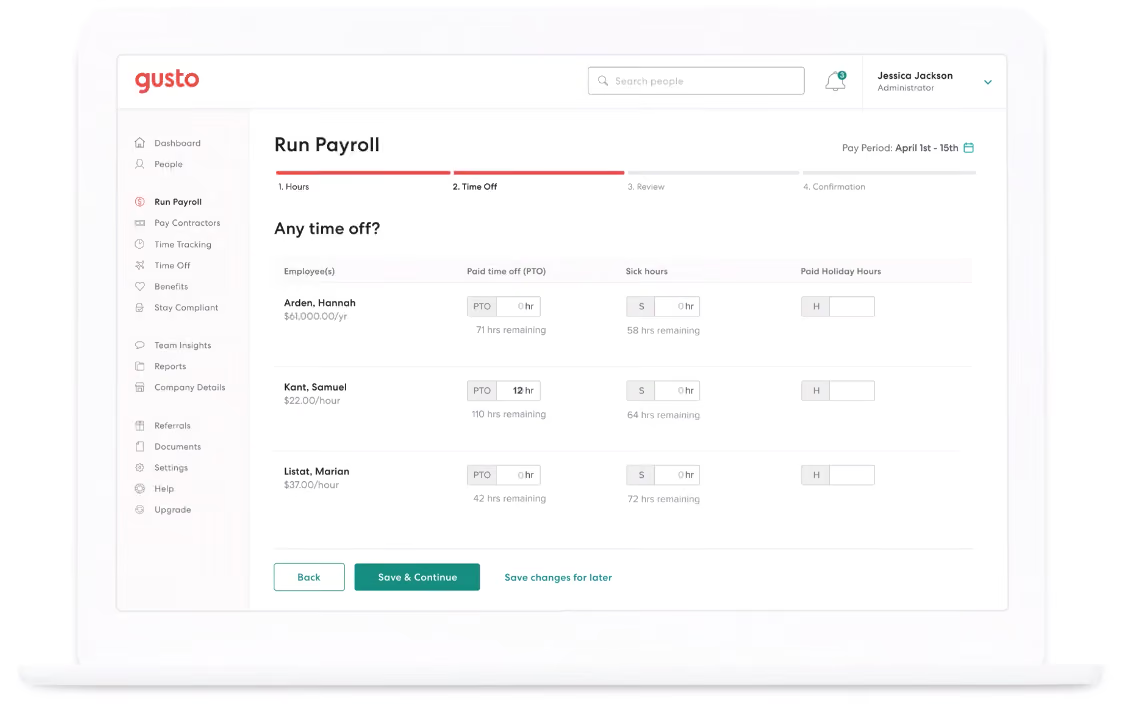
Paylocity offers a comprehensive and user-friendly platform with features for payroll, people, benefits, time off, and compliance management. We love how easy and quick it is to process payroll, thanks to Paylocity’s intuitive three-step navigation flow: you enter the necessary payroll info, review and hit Submit. Paylocity also minimizes manual data entry by automatically transferring information from Time & Labor, flagging employees who need prorated or retro pay, and showing the calculations for your review.

To ensure payroll accuracy, you can make use of Paylocity’s Payroll Readiness Dashboard, which gives you a comprehensive overview of your critical payroll tasks well ahead of your processing day. The system also features over 40 configurable pre-submit audits that flag irregular occurrences, such as an employee receiving double their typical pay.

Beyond payroll management, Paylocity provides a solid HRIS that helps you stay on top of several employee-related processes. For starters, it excels at data management and task automation across multiple users and workspaces. Whether it's confirming employee addresses, collecting certification proofs, or managing employee onboarding, Paylocity simplifies these processes through automation and centralization.

Accessibility is another strong point of Paylocity. Employees can securely access their payroll and HR data from anywhere, on any device. They can retrieve important information such as offer letters, paystubs, tax forms, benefits info, and make changes to their personal information. Managers and HR professionals have full visibility into employee data, enabling them to manage positions, assign skills and certifications, predict vacancies, and manage budget changes effectively.

Paylocity also prioritizes compliance, offering a user-friendly dashboard with swift access to work authorizations, EEO, and FLSA compliance data, as well as industry news. For additional support, Paylocity's HR Edge service provides expert resources, including an account manager, to assist in minimizing risk and implementing optimal practices. Furthermore, Paylocity's reporting and analytics capabilities provide deeper insights into the workforce through real-time, visually presented data. This data enables the monitoring of key metrics, recognition of patterns, enhancement of HR strategies, and the advancement of business goals.

Paylocity Customers

Paylocity’s solutions are used by over 40k organizations including CRP Industries, Wagstaff, and Powerhouse.

Paylocity Pricing

Paylocity’s pricing isn’t disclosed upfront. We recommend scheduling a demo with their Sales team to get a breakdown of all associated costs.

How has Paylocity Changed Over Time?

Best For

Paylocity's solutions are designed for businesses of all sizes across diverse industries, with a primary emphasis on medium and large enterprises. These companies possess the necessary resources and infrastructure to fully utilize the platform's functionalities, allowing them to effectively maximize its benefits.

Paylocity in action
Reviewer's Rating
8/10

We use Paylocity every day. It is integral to our recruiting process, allowing new employees to apply and enabling us to send offer letters through the platform. We also use it for onboarding new employees, where they complete tasks like filling out I-9 forms, tax forms, direct deposit information, and signing off on policies.

Employers complete their portion of the onboarding process before employees are moved to HR and payroll. Paylocity is also used for timekeeping and scheduling, with employees punching in and out through the time clock, allowing us to track attendance and tardiness.

Additionally, we use it for payroll and benefits management, including open enrollment and eligibility tracking. It serves as our primary communication tool, with a community page for announcements and chats with employees. The survey module is another valuable feature, helping us conduct satisfaction surveys.

What do you like about Paylocity?

I like it is an all in one system and is easy to use. I have used a few other payroll systems and this one is by far the easiest to use.  I also like that there is an app for employees to use. Most of the functions are available through the app and Paylocity is constantly improving the app and system to meet our needs.

I also like that I have one main customer service contact with any issues. There is an email to our dedicated rep and a phone number.  If our rep is unavailable there is a team that can help assist.

Why did your organization buy Paylocity, and how long have you used it for?

We needed an all-in-one system, and this was the best option. It includes all the tools we required, such as onboarding, recruiting, timecards, schedules, payroll, and benefits. It is user-friendly and easy to use. We have been using it for three years. When I first joined the company, HR and payroll were outsourced, and we used at least two different programs.

Paylocity provided an excellent solution by integrating all the systems we needed into one login. It was also cost-effective since Paylocity charges per employee per month, and we can run as many payrolls as needed without incurring additional charges.

What do you dislike about Paylocity?

We recently experienced issues with PTO not calculating correctly, which took some time to resolve, requiring manual adjustments for employees. Some onboarding documents are not readily accessible, as they should automatically transfer to the HR and payroll profiles for easy access.

Paylocity is actively working to resolve this issue. We also encountered problems with double-time payments, which removed some regular hours, but this was addressed with Paylocity’s assistance.

How is Paylocity different than their competitors?

I have used ADP and Paycom in the past. Paylocity stands out by providing a dedicated customer service contact, whereas ADP only offers a general number to call. I also find Paylocity to be more intuitive and easier to use than both ADP and Paycom. Overall, I prefer Paylocity over other systems I’ve used.

What Instructions should people think about when buying this type of tool?

Some key questions to consider include whether the tool will meet most or all of your needs, how long the company has been in business, and whether similar industries use the software. Evaluate its ease of use and affordability to ensure it fits within your budget.

I recommend asking for references from current users to gain insight into their experiences. Watching a demo can also confirm whether the software aligns with your company’s requirements.

How has Paylocity changed or evolved over time to meet users needs?

Paylocity has introduced new modules, such as the rewards and recognition module, which consolidates anniversaries, birthdays, and employee achievements in one place. The app has also been significantly improved since we started, offering more features and functionality than before.

What specific type of user or organization is Paylocity very good for?

I think any organization could benefit from using Paylocity. My industry is healthcare, and it works exceptionally well for us. I am part of an HR group where members from industries like manufacturing and professional services also use Paylocity successfully.

What specific type of user or organization would Paylocity not be a good fit for?

I can’t think of any. Having worked in various organizations, I believe Paylocity would be a good fit for all.

Rippling

Visit Website
Rippling
Learn More
Popularity Score
4.2 / 5
User Score
4.2 / 5
Product Score
4.1 / 5

Why we picked Rippling

Rippling is geared toward SMBs with its intuitive UI, automation, and 500+ integrations. Besides features like US/global payroll and self-service, the benefits administration tool lets you work with your chosen broker and select the benefits packages for your team from over 4,000 plans.

PROS

  • Rippling payroll automatically updates work hours, deductions, and tax filings.
  • Ability to process payroll in multiple countries and currencies.
  • Can connect with 500+ apps.
  • Enables users to work with their chosen broker.
  • Ability to purchase modules separately or as a full suite.
  • All-in-one platform for employee management + PEO services offered, and even a suite of other IT products 
  • With 500 integrations, it’s very likely that they integrate with other key tools from your tech stack.
  • Operates globally with any currency
  • Workflow automation
  • Analytics opportunities
  • Provides a holistic view of company outflows—headcount costs included

CONS

  • Undisclosed pricing. No free trial.
  • Phone support costs extra.
  • Not the best option for teams with 2,000+ employees.
  • The mobile app has limited features compared to the web browser version.
  • Total buy-in to Rippling is essential 
  • Very SMB-oriented, in case you’re a larger company. 
  • New features tend to be buggy in ways that tech teams are not accustomed to fixing

Rippling Review

Rippling is a competent solution for growing teams looking to handle their HR and payroll more efficiently. Though the software is quite new in the space, we appreciate how fast the platform has evolved since it debuted.

One of the standout features of Rippling is its exceptional integration capabilities. With over 500 app connections available, it surpasses most tools in the market.

Rippling offers feature-rich capabilities that simplify payroll and HR management for global teams. With its integrated platform, users can pay employees and contractors worldwide within minutes. The built-in time tracking app automatically updates work hours, deductions, and tax filings, eliminating the need for manual tasks. This allows users to focus on reviewing numbers, approving payroll, and letting the system handle the rest.

We are impressed with Rippling's benefits management tool, allowing users to collaborate with preferred brokers, select from 4,000 plans, and offer the hires a self-service portal and mobile app. However, we hope for enhancements in the mobile app's performance and features, as it can be laggy at times and lacks certain functionalities compared to the web browser version.

Rippling's pricing starts at $8 per employee per month, but obtaining an accurate quote requires a demo with a sales representative. It's important to note that the actual cost may be higher due to the software's purchase model. The Unity module is mandatory for purchasing any other modules. Additionally, if you require phone support from HR specialists, additional fees apply.

Rippling Customers

Vox, Maximum Games, Superhuman, Compass Coffee, Highnoon.

Rippling Pricing

Rippling's Core HR platform starts at $8 per employee per month. Contact Sales for more details.

How has Rippling Changed Over Time?

Best For

Rippling is most useful for SMBs, ideally with 50 to 2,000 employees. It doesn’t matter whether they are US-based, global, remote, office-based, or distributed teams.

Rippling in action
Reviewer's Rating
7/10

I used Rippling frequently as an HR administrator, accessing the platform daily to manage personnel data and support HR operations.

Much of my time in the system was focused on maintaining employee records, assisting staff with system access, and guiding them through self-service workflows.

Rippling was used to route employee requests to the appropriate managers or departments, ensuring approvals followed the correct reporting structure.

I also supported workflows related to employee information changes, such as address updates, tax elections, and direct deposit details, some of which required review or approval by payroll or finance.

The platform served as a centralized space for onboarding tasks and ongoing employee data management.

What do you like about Rippling?

Rippling offers a user-friendly employee self-service experience, allowing staff to update personal information, submit requests, and complete tasks through the mobile app, which helps reduce the administrative burden on HR.

The platform was accessible for employees with varying levels of technical comfort, making it easier for a nonprofit transitioning from paper-based processes to adopt a digital system.

Rippling’s interface is clean and modern, which made it easier to navigate menus and locate basic HR information compared to more cluttered or outdated systems.

Why did your organization buy Rippling, and how long have you used it for?

My organization selected Rippling to centralize employee data and move away from fragmented or paper-based HR processes.

As a small nonprofit, the goal was to implement a platform that was functional without being overly complex, allowing HR to manage records while offering employees access to basic self-service features.

Rippling provided a single location for core personnel information and supported common HR tasks such as requests and employee data updates. From an employee perspective, the system was accessible through both web and mobile platforms, which supported usability across varying levels of technical comfort.

I personally used Rippling as an HR administrator for approximately 30 days, during which time it aligned with the organization’s immediate needs and scale. My experience reflects use within a limited configuration rather than a fully built-out enterprise implementation.

What do you dislike about Rippling?

From an administrator's perspective, certain workflows and settings were not immediately intuitive, and locating specific functions sometimes required additional exploration compared to other HRIS platforms I’ve used.

The version of Rippling used by the organization felt fairly basic, and functionality appeared limited depending on the selected package, which may not meet the needs of organizations seeking more robust or layered HR capabilities.

There was limited visibility into built-in user guides or onboarding resources, and notification effectiveness seemed highly dependent on configuration, which could impact timely approvals if not carefully set up.

How is Rippling different than their competitors?

Compared to other HRIS platforms I’ve used, such as Paycom, Kronos, and ADP, Rippling felt more streamlined and basic in its interface and overall functionality.

While this simplicity can work well for smaller organizations, especially those transitioning from paper-based processes, it offered fewer layers and visual tools than some competing systems.

Other platforms I’ve used provided more interactive dashboards, quick links, and real-time notifications, which can be helpful for both administrators and employees managing frequent requests.

Rippling’s effectiveness appeared highly dependent on how it was configured and which modules were selected, which may limit flexibility for organizations seeking a more robust, all-in-one solution.

I tend to prefer platforms with more intuitive, visually driven interfaces and stronger automated reminders, as these features can significantly reduce administrative workload, particularly in lean HR environments.

What Instructions should people think about when buying this type of tool?

When selecting an HRIS like Rippling, organizations should consider their size, internal HR resources, and how much system complexity they actually need.

Smaller or nonprofit organizations may benefit from a more streamlined platform that supports core HR functions without overwhelming users or budgets.

Buyers should evaluate administrator usability, employee self-service capabilities, and how configurable workflows and notifications are based on organizational structure.

Understanding which modules are included and how easily the system can scale over time is important before making a long-term investment.

How has Rippling changed or evolved over time to meet users needs?

My direct experience with Rippling was relatively short, so I did not personally observe major platform changes or feature evolutions during that period.

From my perspective, the system appeared stable and already configured to meet the organization’s existing HR needs at the time of use.

What specific type of user or organization is Rippling very good for?

Rippling is well suited for organizations looking to centralize core HR information and streamline basic administrative processes in a single platform.

It can be a strong fit for smaller or growing organizations, including nonprofits, that need reliable HR functionality without requiring a highly complex or visually intensive interface.

What specific type of user or organization would Rippling not be a good fit for?

Rippling may be less suitable for organizations that require highly complex, deeply layered HR workflows or a more visually driven and customizable user interface out of the box.

Based on my experience, organizations with very large or highly complex workforces that rely heavily on advanced automation, extensive reporting, or robust approval hierarchies may find other platforms better aligned with those needs.

Workforce

Visit Website
Workforce
Learn More
Popularity Score
4.1 / 5
User Score
4.2 / 5
Product Score
4 / 5

Why we picked Workforce

We selected Workforce.com for its comprehensive all-in-one scheduling, time tracking, and payroll capabilities, particularly in shift-oriented industries. Although its modularity can be more flexible, the platform offers solid features for HR operations and payroll continuity.

PROS

  • Full-service, in-house payroll engine with tax filing and wage garnishment support.
  • Centralized employee profiles housing HR data, documents, and compliance logs.
  • Automated time-to-payroll workflows reduce manual intervention.
  • Onboarding and offboarding steps are trackable, with document bundling and digital forms.
  • Employee self-service tools (mobile and web) for leave requests, profile updates, and shift management.
  • Full-service, in-house payroll engine with tax filing and wage garnishment support.
  • Centralized employee profiles housing HR data, documents, and compliance logs.
  • Automated time-to-payroll workflows reduce manual intervention.
  • Onboarding and offboarding steps are trackable, with document bundling and digital forms.
  • Employee self-service tools (mobile and web) for leave requests, profile updates, and shift management.

CONS

  • No standalone access to payroll or HR modules.
  • No free trial or sandbox access to test payroll workflows without speaking to a Workforce.com representative.
  • Recruitment components are basic compared to specialized ATS systems.
  • Their payroll system lacks international tax/localization support.
  • No standalone access to payroll or HR modules.
  • No free trial or sandbox access to test payroll workflows without speaking to a Workforce.com representative.
  • Recruitment components are basic compared to specialized ATS systems.
  • Their payroll system lacks international tax/localization support.

Workforce Review

Workforce is an HR and payroll software tool designed for shift-based employers who need to tightly coordinate scheduling, time tracking, payroll, and HR from a single system.

Workforce’s payroll and HR platform

Starting with payroll processing, the platform offers a full-service, internally developed payroll engine. It handles gross-to-net calculations, tax withholdings, garnishments, and direct deposit, all without relying on third-party systems.

During our demo, we were particularly impressed by how time data from clock-ins and schedules flows directly into payroll runs. Admins can run payroll, preview deductions, and post pay runs directly from within the platform. Since the platform is built on a single codebase, the connectivity is also extended to HR recordkeeping, where wage data is housed in the same employee file that tracks qualifications, incidents, and shift history. From an SMB’s perspective, we believe this unified experience saves a significant amount of time and reduces payroll errors.

The only con here is that payroll functionality is currently limited to the U.S. and U.K., meaning international organizations or those expanding abroad may not find the necessary tax infrastructure or localization support.

In terms of workflow automation, Workforce excels in operational contexts. Its AI-driven scheduler automatically builds labor-efficient rosters based on forecasted demand and POS data. Rules can be configured to automatically approve timesheets within specified grace periods, prompt staff with shift-related questions, or restrict scheduling based on certification status.

When it comes to core HR features, Workforce does a respectable job of covering the essentials. It includes digital onboarding with document bundling and task tracking, a built-in applicant tracking system with pipeline views and resume scoring, and a centralized employee profile with audit logs, certifications, and forms. The system also allows for storing warnings and incident reports, providing a full employment history in one location, which definitely makes it easy to keep operational and compliance data in sync.

We do believe, though, that Workforce is not a complete replacement for your existing ATS and onboarding systems, considering their basic features. Moreover, these recruiting tools are included as part of the platform, meaning you need to purchase the entire package to use them.

On a similar note, although the initial price is quite affordable at $5 per employee per month, the inability to sign up for a free trial without speaking to a Workforce.com representative makes the platform less inviting for some cautious SMBs.

Workforce Customers

Domino’s Pizza, Altitude Trampoline Parks, Louisiana State University, Pinnacle Live, Cedartown Foods, Winnipeg Jets.

Workforce Pricing

Workforce pricing ranges from $5 to $24 per employee per month.

How has Workforce Changed Over Time?

Best For

Workforce’s payroll and HR platform is best for U.S.- and U.K.-based SMBs managing hourly workers.

Workforce in action
No items found.

HiBob

Visit Website
HiBob
Learn More
Popularity Score
4.5 / 5
User Score
4.4 / 5
Product Score
4.3 / 5

Why we picked HiBob

We found HiBob compelling for U.S.- and UK-based SMBs that want payroll tightly embedded within a modern HRIS. While it might not be the best choice for large enterprises or businesses that need payroll coverage beyond the supported regions, for growing teams within its reach, the integrated design really helps minimize operational hassles.

PROS

  • U.S. payroll is fully integrated within the HCM platform.
  • Supports multiple worker types, pay types, and pay frequencies.
  • Automatic federal and state tax filings in all 50 states.
  • UK payroll ensures HMRC compliance with automated tax code sync.
  • Strong security standards including ISO 27001 and SOC 2 Type 2.
  • HR, payroll, benefits, and time data live in one unified system.
  • They have tons of modules, which makes them a real one-stop shop. Beyond Core HR, they have modules for most things People Ops-related.  
  • Bob is a fast-growing company and their product looks the part, as it has one of the sleekest-looking platforms in the HRMS space right now. 
  • Their payroll hub allows you to connect all your payroll systems, which works great if you want to pay people in multiple locations without switching providers.

CONS

  • Payroll currently available only in the U.S. and UK.; organizations with broader global payroll may require additional integrations.
  • Custom pricing requires engagement with sales before cost comparison.
  • Customer support is only offered via a chatbot and email. 
  • As to implementation, several users commented that they felt there could be more attention via personal walkthroughs provided at the beginning. Many had to resort to reading documentation and watching videos or just figuring things out by themselves. 
  • Pricing is only custom and available upon request, so you can’t just sign up, pay, and start using the tool.

HiBob Review

We liked that HiBob’s payroll does not require a separate interface, and we did not have to batch-sync data from HR records before running a pay cycle. The unified data layer is where this system makes its strongest case. All the employee updates, compensation adjustments, time tracking, and compliance details are kept in one place, which means less hassle with the reconciliation. When we tested the compensation changes and status updates, everything flowed directly into payroll processing without any duplicate entries.

Screenshot of HiBob Payroll dashboard

U.S. payroll is powered by an embedded payroll engine while remaining fully integrated within the Bob platform experience. As a payroll administrator, you can customize various worker types, pay types, and pay frequencies, which is quite convenient. One feature that stood out to us is the flexible payroll commitment window; it gives teams a bit of breathing room to review and make any necessary adjustments before finalizing pay runs.

Those who pay close attention to security standards will appreciate what this platform offers. HiBob checks all the boxes for SOC 2, ISO 27001, GDPR, data encryption, access controls, and takes a privacy-first approach to AI. This alignment really puts them on par with established payroll providers in terms of governance and security.

UK payroll follows a similar integrated model. It automatically syncs employee tax codes and student loan details, and also flags compliance risks, such as minimum and living wage thresholds. The tool supports multiple payroll schedules and can also accommodate different worker types, including IR-35 contractors, part-time employees, zero-hour staff, seasonal workers, and those with overtime variations. What’s really impressive, though, is that since the benefits, time, performance, and compensation records are already stored in Bob, any updates are reflected in payroll right away.

That said, HiBob’s payroll is currently only available in the U.S. and the UK, so those with employees in other regions will need to use third-party solutions to handle payroll. And while the platform itself is built for scaling mid-sized organizations, companies with highly complex global payroll footprints may need additional localized payroll solutions alongside Bob.

HiBob Customers

5,000+ organizations, including Huel, JIMDO, riseUP, and VaynerMedia.

HiBob Pricing

HiBob offers custom pricing based on workforce size and selected modules.

How has HiBob Changed Over Time?

Best For

U.S. and U.K. scaling mid-market companies seeking an integrated payroll and HCM solution without siloed systems.

HiBob in action
Reviewer's Rating
9/10

I use Bob for storing and using employee data, and it is primarily used for onboarding and offboarding employees. I also use it for generating a monthly dashboard for the SLT which includes number of new starters, number of leavers, turnover, percentage of days worked and time to hire. One of the main features I use is the 360 performance review workflow, which allows me to roll out a seamless and simple process which encapsulates reviews from every angle (individual, manager, direct reports and peers). It binds everything including career history, goals and achievements into one place, so there's no need to search for previous conversations or documents in long-forgotten folders. The Your Voice tool is also a powerful tool which generates rich feedback in a safe, anonymous environment. The feedback received from this anonymous tool is then fed into the monthly and annual people strategy.

What do you like about HiBob?

Unlike other HRIS's Bob allows the user to personalise, analyse and manipulate data to suit the business, rather than using a packaged up system that doesn't fully align to the business. The user experience on both the employee and employer's side is intuitive and engaging, meaning that even reminder emails are never ignored. Bob's built-in templates enable the business to measure Employee Net Promoter Score, along with other survey questions, which can then be accessed in a simple, easy to use dashboard with visual heatmaps to analyse findings instantly.

Why did your organization buy HiBob, and how long have you used it for?

As our business grew, from 70 people to over 200, we wanted something that was able to organise personal data, generate detailed reports for analysis and run automated processes such as annual performance reviews. I would say that one of Bob's key benefits is its user experience for both the employer and the employee. Bob's self-service function is really easy to use, employees are able to input annual leave and sickness within a few clicks. From an employer perspective, it is simple to pull together reports based on personal data - for example, number of sick days taken in a year, or the average turnover of a segment of employees. Bob attempts to make the system somewhat "fun" at the onboarding stage by asking new starters what their hobbies are, and displaying that on their profile for other employees to view.

What do you dislike about HiBob?

Whilst Bob's ability to use data to generate specific reports is great, workflows can be complex to set up, with many drop-down lists and options to select, so if it's quick data driven results that you're looking for, this could take a while to set-up. Another con is that Bob does not have a customer support team that is accessible by phone call, it is always an email or live chat system and sometimes it's just easier to chat to a real human and solve the problem. Like any robust system, it can take a while to initially set-up and get it working to what the business needs and not every business has that time to dedicate to rolling it out and there is little upfront training to support with this.

How is HiBob different than their competitors?

Bob is way ahead of the curve in terms of HRIS's on the market. Throughout my career I've always said that there's not a one-system-to-rule-them-all in the HR world, but Bob certainly comes close. For example, CharlieHR is great from an employee data-entry perspective and basic data storage, but there is very little it can do in the way of generating reports for analysis. Very few HRIS's on the market are able to link workflows and processes in the way that Bob can, for example, I can conduct a full recruitment process, hiring process and onboarding all within the same flow, seamlessness, whereas with other systems this can be really clunky.

What Instructions should people think about when buying this type of tool?

Firstly, it's important that it covers core needs such as storing employee records, tracking annual and sick leave entitlements, communicating with payroll systems and software as well as benefits admin. Simple and visual data analysis is also essential for this type of tool - important metrics should be only a few clicks away. HRIS tools should be able to assist with recruitment processes and ideally offer an ATS which integrates with a solid employee onboarding process. The ability to run performance reviews and engagement surveys is also key to consider.

How has HiBob changed or evolved over time to meet users needs?

Bob is continually being updated, for example, Your Voice has been a new addition that we have added to our package which has proven to be an excellent way of gaining anonymous feedback, especially for a business of our size.

What specific type of user or organization is HiBob very good for?

Bob is very good for organisations with 50+ employees, and ideally, someone within the HR department would have specific responsibility for this tool to get its full benefit.

What specific type of user or organization would HiBob not be a good fit for?

Businesses smaller than 50, without a dedicated HR resource would probably not benefit from all of Bob's features.

ADP

Visit Website
ADP
Learn More
Popularity Score
4 / 5
User Score
4 / 5
Product Score
4.1 / 5

Why we picked ADP

Easy to use, 24/7 support from payroll experts, seamless integrations, – ADP is packed with interesting features that will elevate your business like nothing else.

PROS

  • Native, all-in-one technology suite for recruitment, payroll, and compliance.
  • 17 RPO service centers in 14 countries and provide services in 42 different languages.
  • Dedicated team of AIRS-certified recruiting professionals.

CONS

  • Technology options outside ADP’s dedicated HR tools are limited.

ADP Review

Instead of obfuscating a first-time user with unnecessary details about their HR services, ADP asks you a few simple questions and fetches you a customized HR solution that would best suit your organizational needs.

ADP’s payroll and HR software known as RUN is easy to use, has a clean user interface, and yet contains so much depth in terms of features. From personalized payroll to AI-powered error detection features for tax compliance, ADP lets you seamlessly run payroll, track time & attendance, helps you with workforce management, and much more.

ADP Customers

ADP Pricing

How has ADP Changed Over Time?

Best For

ADP in action
Reviewer's Rating
1/10

ADP is used to process our US payroll and enroll in US benefits. It is also used for ADA compliance and generating 1095 forms for our employees. Since payroll is processed through ADP we also generate W2s for our full time employees. ADP helps to streamline benefits enrollment as we are able to have carrier connections with our carriers and ADP

What do you like about ADP?

I like ADP's ADA health compliance features, I like their payroll processing features, and I like their report-generating tools

Why did your organization buy ADP, and how long have you used it for?

West Monroe has used ADP for 10 years now. We moved to ADP to streamline benefits enrollment and to process payroll. ADP was purchased to help West Monroe grow to scale. When it was first purchased we were at 300 employees. As of today, we are at 2000 plus employees who we process payroll and benefits for

What do you dislike about ADP?

I dislike their open enrollment platform, customer service is sorely lacking, and their employee benefits profile always has problems

How is ADP different than their competitors?

ADPs reporting is intuitive and one of the only features i like and would recommend

What Instructions should people think about when buying this type of tool?

People should think about how they want to grow with ADP. For example, West Monroe is now an international company, and ADP payroll and benefits only works well for those in the US

How has ADP changed or evolved over time to meet users needs?

The updates in their reporting abilities have helped with our company's needs

What specific type of user or organization is ADP very good for?

ADP is good for payroll and tax admins

What specific type of user or organization would ADP not be a good fit for?

ADP is not good from an employee perspective. The way benefits enrollment is done is confusing as are the pay statement reviews

APS

Visit Website
APS
Learn More
Popularity Score
4.1 / 5
User Score
4.5 / 5
Product Score
4.4 / 5

Why we picked APS

Throughout our test, APS impressed us with a reliable, unified approach to managing the entire employee lifecycle. From the moment we began using the platform, it became clear that it’s designed with a strong emphasis on customer support and personalization—qualities that make it stand out in a crowded marketplace.

PROS

  • Personalized customer service with a dedicated account team for hands-on support.
  • Payroll management covers all 50 U.S. states, with specialized knowledge of state-level compliance.
  • Automated benefits administration with integration to hundreds of benefits carriers.
  • ACA compliance tools simplify employee tracking and IRS reporting.
  • User-friendly self-service portal for both employees and managers.
  • Well-suited for service-based industries like healthcare, hospitality, and non-profits.
  • APS is very cost-effective. Although the pricing is custom and depends on your business size, we’ve heard current users speak of its affordability. Jackie R, who is a HR Director for a small-sized company says, “I love that APS offers all aspects of an HRIS system at an affordable price. We are a small business and can't afford the big name payroll vendors, but get everything they offer at APS for a price we can afford as a small business.”
  • Their customer service is remarkable. As testified by multiple users, the customer service team at APS is prompt and there for you every step of the way, right from implementation to anytime you get stuck using the software. They’ll likely resolve your issue within the same day. 
  • APS is very easy to navigate and everything is updated and saved in real-time. Despite its complex features, you would likely not find it confusing. They also have how-to guides that come in very handy.

CONS

  • No free trial and lack of transparent pricing.
  • Payroll services must be purchased to access other products (e.g., HR, workforce planning.)
  • Exclusively designed for the U.S. market, with no international payroll capabilities.
  • The reporting feature is limited in functionality. Sometimes, there will be missing information that you may require. 
  • Although their customer support is prompt, you can’t directly reach their team via phone. Customer service answers your queries via email and if you wish to talk to someone on the phone, you’ll have to mention it.

APS Review

APS offers a comprehensive and unified solution for managing payroll, HR, benefits, and workforce planning.

APS payroll and hr software screenshot

One of the standout aspects of APS is the dedicated account team assigned to each client. Compared to solutions like Paycor whose support often requires self-service or involves some delay, APS was consistently responsive, with most issues resolved within the same day during our tech test.

Comparable to other major payroll solutions, APS’s payroll tool provides coverage of all 50 U.S. states. Yet, what truly sets APS apart is its specialized focus on service-based industries like healthcare, hospitality, and non-profits. We got in touch with some users from these industries, and heard lots of good words about the expertise of APS’s payroll specialists, describing them as “responsive” and noting that they “clearly understood the complexities of state-level payroll requirements.”

Benefits administration became one of our favorite features during testing. The platform automates everything—from eligibility tracking to benefits enrollment—and makes all of this easily accessible through an employee self-service portal.

ACA compliance is a critical feature of workforce management technologies, and we’re glad APS’s is implemented thoughtfully. The platform includes tools that automatically track eligible employees, pre-populate forms, and even file reports directly to the IRS.

And the self-service portal didn’t disappoint, either. It allowed us to delegate tasks while maintaining accountability across teams. In manager roles, we could easily track action items, approve time-off requests, and see who was on vacation, while accessing the platform as employees gave us full control over our pay stubs, available PTO, and benefits.

Unfortunately, pricing transparency is quite a concern, as APS does not disclose its pricing, and there is no free trial available. We also found that you cannot purchase APS's HR and workforce planning modules unless you have already purchased the payroll solution, which limits flexibility and may be a barrier for businesses looking for only specific HR functionalities.

Another limitation is that APS is designed exclusively for the U.S. market, unlike platforms like Rippling and Zenefits, which offer both domestic and international capabilities.

APS Customers

3,500+ companies, including Wahlburgers, Rainbow Sandals, Grayson College, and Hillside Christian Church.

APS Pricing

APS's payroll software has a minimum monthly billing of $250, while the pricing for APS's HR and workforce planning tools is undisclosed.

How has APS Changed Over Time?

Best For

U.S.-based service industries seeking a comprehensive HR and payroll solution with designated support.

APS in action
No items found.

Netchex

Visit Website
Netchex
Learn More
Popularity Score
4.2 / 5
User Score
4.5 / 5
Product Score
4.4 / 5

Why we picked Netchex

Netchex is a standout in the payroll category thanks to their stellar customer support, described often as prompt, courteous, and knowledgeable. It’s the rightful complement to their comprehensive, single-source solution which integrates HR, time and attendance, benefits management, and payroll processing.

PROS

  • Grows with your team: With Netchex, it’s very easy to opt for a new plan and keep all your data in the same place even if you outgrow your current pricing plan. Other vendors require a switch to a new service in that kind of event.
  • Dedicated support team: Netchex are note-worthy for their award-winning and often lauded customer service. It’s all US-based and provided in real-time through email, live chat, and phone calls.
  • Pre-payroll reports: Allows for critical error checks before submission.
  • Flexible payroll grid: Easy to make changes or correct errors on the fly.
  • Versatile payment options: Includes paper checks, direct deposit, and pay cards.
  • Grows with your team: With Netchex, it’s very easy to opt for a new plan and keep all your data in the same place even if you outgrow your current pricing plan. Other vendors require a switch to a new service in that kind of event.
  • Dedicated support team: Netchex are note-worthy for their award-winning and often lauded customer service. It’s all US-based and provided in real-time through email, live chat, and phone calls.
  • Pre-payroll reports: Allows for critical error checks before submission.
  • Flexible payroll grid: Easy to make changes or correct errors on the fly.
  • Versatile payment options: Includes paper checks, direct deposit, and pay cards.

CONS

  • Requirement of payroll: Users must use the payroll module to access other functionalities, so it wouldn’t work as stand-alone HR software.
  • No free trial: Potential users can't test the software without committing to a purchase. The demo with a sales rep is the closest thing.
  • Requirement of payroll: Users must use the payroll module to access other functionalities, so it wouldn’t work as stand-alone HR software.
  • No free trial: Potential users can't test the software without committing to a purchase. The demo with a sales rep is the closest thing.

Netchex Review

Netchex is a comprehensive HR and payroll management platform tailored for small and mid-sized businesses (50-500 employees). The platform stands out with its single-source solution that combines payroll, time and attendance, benefits, HR information, and more into a single tool, thereby reducing the need for multiple spreadsheets and manual data entries. One of our favorite things about Netchex is their flexibility. For example, payroll administrators can effortlessly make adjustments and correct errors directly from the payroll grid.

We also love and hear great things about their detailed pre-payroll reports. As stated above, these can be reviewed before payroll is processed, allowing managers to spot any abnormalities, such as terminated employees receiving paychecks or overpayments. The system comes with full garnishment integration, multiple pay rate solutions, and complete federal, state, and local tax filings, making it a robust and versatile tool for any business.

Additionally, Netchex recently introduced several innovative features, such as AskHR for immediate answers to employee questions, Netchex AI for data analysis, and Community for fostering employee engagement. In our view, these enhancements demonstrate Netchex's commitment to evolving its platform based on user feedback and emerging industry needs.

Netchex Customers

Netchex is used by companies like Xpressdocs, BK Corrosion, Regal Hospitality, and The Colony ER Hospital.

Netchex Pricing

Netchex follows a per-Employee-per-Month pricing model. Pricing varies according to the company's size and the specific products used. Detailed pricing information can be found on their website.

How has Netchex Changed Over Time?

Since we first became familiar with the tool, Netchex has evolved significantly. As said before, they recently introduced features such as AskHR for automatic employee support, NetChex AI for smart data analysis, and Community to enhance employee engagement and recognition.

Best For

Netchex is best suited for small and mid-sized businesses in various industries, such as restaurants, hospitality, manufacturing, healthcare, professional services, and auto. As of 2024, their sweet spot is organizations with less than 500 employees, but they are perfectly capable of working with larger teams.

Netchex in action
No items found.

UKG

Visit Website
UKG
Learn More
Popularity Score
4 / 5
User Score
4.2 / 5
Product Score
4.1 / 5

Why we picked UKG

Easy to navigate and customizable to your business needs, UKG’s Payroll and HR Software provides you with all the HR services under one roof. Their customer support team that’s available on a payroll hotline and chat are worth mentioning.

PROS

  • Super robust product, packing years of experience with HCM and Workforce Management technology 
  • Since they offer UKG Pro for HRMS and UKG Ready for workforce management, you could arrive at a combination of products that suits many of your HR needs from the same set of tools.

CONS

  • Compared to newer tools, UKG Pro and UKG Ready tend to miss a unique selling point or a specific focus on a certain type of business. While they work great for bigger companies in all sorts of industries, very niche operations might have a hard time adapting to the tool. 
  • Similarly, ​​UKG offers many solutions under one umbrella, so it's not the best fit if you're looking for only a handful of specific use cases.

UKG Review

UKG has a variety of HR product suites. If you’re looking for an HR software that combines transformative HR technology with robust payroll functionality, then UKG Pro is their HCM solution you should keep an eye on.

UKG Pro takes care of four key areas and those are payroll processing, talent acquisition, learning, and employee voice. One of its most coveted aspects is its intuitive navigation. You can get all your information on the very first page, with just a single click. 

It also has a mobile app that your employees can use to do a variety of things such as being able to request time off or pulling old pay stubs.

UKG Customers

UKG Pricing

How has UKG Changed Over Time?

Best For

UKG in action
Reviewer's Rating
5/10

I use UKG daily. It serves as our ATS, onboarding, full HRIS, and payroll system. Our applicants apply on our career page, and we can process the applications, complete the offer letters, and conduct initial onboarding all within UKG. The system also functions as our timekeeping and payroll system, allowing our staff to use the mobile app to clock in and out. Their timesheets are approved in UKG and submitted to payroll for processing.

What do you like about UKG?

Some of the pros of UKG are that we can easily transfer information from the applicant profile to create the employee profile with no additional steps. Another pro is the ability for our employees to clock in and out easily from their mobile devices. Lastly, our benefits and payroll are also processed within UKG, making it a more convenient process for our organization.

Why did your organization buy UKG, and how long have you used it for?

We purchased UKG in 2019 to help streamline our hiring process, onboarding, and payroll system. Some of the benefits of UKG include being an all-in-one hiring, onboarding, and payroll system. I am one of the administrators of our UKG system, so I use it extensively. I am very proficient in what the system can offer, along with its downsides. The tool has significantly improved our operational efficiency since its implementation.

What do you dislike about UKG?

Some cons we have found with UKG include not being fully HR compliant; for a couple of years, we have not been able to properly run our EEO-1 reports. We use UKG to complete our I-9s and E-Verify, but that is not without constant issues. Some reporting capabilities hinder us from gathering information conveniently, often requiring us to manually maneuver the reports. Lastly, the system undergoes quarterly updates; however, each update often causes another issue in UKG, which we are not notified about until we submit a ticket. This causes many problems and makes us lose faith in new updates.

How is UKG different than their competitors?

Many of their competitors are now all-in-one systems, so there isn't much difference in that aspect. Some improvements are needed to make it a perfect system, but the mobile ability for employees makes it very convenient for our staff to clock in and out from various work locations, differentiating it from its competitors.

What Instructions should people think about when buying this type of tool?

The criteria that people should think about when buying this tool include the price; it is not an inexpensive tool, especially if purchasing all of the extended platform options such as the advanced scheduler and the leave or training modules. If a full HR compliance system is needed without manipulating the data, this system may be problematic.

How has UKG changed or evolved over time to meet users needs?

UKG consistently updates its system to make improvements. They try to listen to their customers and work on ensuring they meet our needs.

What specific type of user or organization is UKG very good for?

UKG is best for an organization that needs a basic HRIS system.

What specific type of user or organization would UKG not be a good fit for?

UKG would not be suitable for an organization that needs to do extensive HR reporting or extensive compliance procedures.

Namely

Visit Website
Namely
Learn More
Popularity Score
4.7 / 5
User Score
4.1 / 5
Product Score
4.6 / 5

Why we picked Namely

What makes Namely stand out from its competitors is that it’s highly customizable, easy to implement, and has unmatched customer service. Namely is also very scalable and would smoothly grow with your team.

PROS

  • Navigating Namely poses minimal challenges for most users, with an intuitive and notably clean UI despite its extensive feature set.
  • Users commend Namely's employee onboarding module, which employs a user-friendly wizard to facilitate swift and clear onboarding for new hires.
  • In addition to its inbuilt data management, recruiting, onboarding, time off tracking, payroll, and benefits administration features, Namely offers managed payroll and benefits administration services, relieving internal teams of heavy burdens.
  • The majority of users are able to navigate Namely without any issues. They find the UI to be intuitive and clean, despite the fact that the platform has lots of features. 
  • Namely’s employee onboarding module gets a alot of praise from users. It features an easy-to-follow wizard, which helps new hires get on quickly and be clear on what they need to do. 
  • Besides the platform’s built in features for data management, recruiting, onboarding, time off tracking, payroll and benefits administration, there are also managed payroll and benefits administration services you can opt for to reduce the burden on your internal teams. 

CONS

  • Namely predominantly caters to the U.S. market, limiting its suitability for international businesses.
  • While users applaud its user-friendliness, implementing Namely can be time-consuming, with an average implementation period of 6-8 weeks, as reported by the platform.
  • Lacking features for employee development like skill training, career pathing, and succession planning, Namely falls short in this area given its scope.
  • Prior to adoption, verifying compatibility with your existing benefits provider is essential, as some users have reported instances of Namely encouraging them to switch providers, sometimes resulting in increased costs.
  • Namely primarily operates in the U.S., which means if you’re looking for a global payroll and benefits provider, this platform isn’t for you.
  • Though many praise the platform’s ease of use, it does take long to implement it. Namely’s own team says that an average implementation takes between 6-8 weeks.
  • For a platform of Namely’s size, there currently aren’t any features that focus on employee development such as skill training, career pathing, succession planning etc. 
  • You’ll need to check beforehand if Namely can work with your existing benefits provider, if you have one. There have been a few reports (but not few enough to ignore) about Namely’s team convincing customers to change their benefits provider to providers that charged them more. 

Namely Review

Namely aims to help you stay on top of your job and free up your time to focus on innovative people strategies. This cloud-based HR software consists of enhanced payroll services, compliance tools, benefits insurance expertise, and tools for employee engagement. 

Apart from handling your core HR needs, Namely also offers pre-built integrations with an ever-growing list of partners. But what’s even more compelling is that if you don’t find an integration you need, you could build your own integration through Namely’s secure API. 

Namely also has an amazing and active client community you could reach out to if you want an insight into the best practices.

Namely Customers

Namely Pricing

How has Namely Changed Over Time?

Best For

Namely in action
Reviewer's Rating
8/10

We used Namely primarily for departmental reporting, allowing each team to access the data they needed without complication. It was also our central platform for posting internal announcements, which helped keep communication streamlined across the organization.

Our non-exempt employees frequently used the timekeeping module, and they appreciated how easy it was to transfer between job roles within the system. From an HR perspective, managing payroll was straightforward, which saved us significant time during each payroll cycle.

What do you like about Namely?

Creating reports in Namely is straightforward, even for users with limited technical experience. The time and labor module is intuitive and easy to demonstrate to employees. The visibility and layout of the homepage make navigating the system fast and user-friendly.

Why did your organization buy Namely, and how long have you used it for?

I worked for a small FinTech company that used Namely. They picked Namely because it was an easy-to-use tool and was perfect for our business structure. We (the HR Team) liked how it was easy to enter new employees and update existing employees' information.

We also had a few nonexempt employees, so we used their timekeeping system, which was also simple. We also used announcements like our social media, so we didn't have to design an Intranet.

What do you dislike about Namely?

The system lacks innovation and hasn’t kept up with some newer HR platforms in terms of features and design. The interface feels a bit outdated, especially compared to more modern alternatives. Customer support was sometimes difficult to reach, which could be frustrating when time-sensitive issues arose.

How is Namely different than their competitors?

Namely is a smaller and more simplified platform compared to other tools like UKG or ADP. It works well for small companies that need a streamlined system without too many bells and whistles. While I prefer UKG or ADP for their broader functionality and scalability, Namely stands out for being approachable and easy to manage for less complex HR operations.

What Instructions should people think about when buying this type of tool?

When evaluating this kind of tool, it's important to consider the size and complexity of your organization. Namely works best for small businesses that don’t require highly advanced features or custom-coded reports. If you're expecting rapid growth or need to manage complex data, you may quickly outgrow it. Simplicity and ease of use should be top considerations if you're leaning toward Namely.

How has Namely changed or evolved over time to meet users needs?

One noticeable improvement has been quicker service request response times. The company seems to have made an effort to address support speed, which enhances the overall user experience, especially during critical periods.

What specific type of user or organization is Namely very good for?

Namely is ideal for HR teams and general employees in small to mid-sized companies. It suits organizations that need an easy-to-use system without requiring extensive setup or ongoing technical support.

What specific type of user or organization would Namely not be a good fit for?

Namely is not well-suited for finance departments or organizations with complex financial and reporting needs. Larger enterprises that require deep integration and advanced functionalities may find it limiting.

WorkDay

Visit Website
WorkDay
Learn More
Popularity Score
4 / 5
User Score
3.9 / 5
Product Score
4 / 5

Why we picked WorkDay

Trusted by the world’s leading companies, Workday runs on automation and innovation to help you save time and money. Its advanced analytics tools can benefit HR teams at even the largest companies.

PROS

  • Accessible customer support from the community, live chat, and telephone.
  • Compatible with 300 HR systems such as ERP/GL, CRM, HR, and PSA.
  • Configurable dashboard with AI and ML-driven insights.
  • Ability to maintain real-time alignment of budgets and workforce plans.
  • SOC 2 Type 2 compliance.

CONS

  • Undisclosed pricing.
  • No free trial for its talent management software.
  • Time-consuming implementation period (average 4.5 months).
  • Challenge navigating for first-time users may require training.
  • Issues with logging in were reported by users.

WorkDay Review

Designed to fuel your acceleration in a changing world, Workday aims to overcome the limitations of an Enterprise Resource Planning system, commonly referred to as an ERP. Workday has many products and solutions but if you’re on the lookout for a payroll and HR solution that would help you optimize the time, talent, and energy of your people, their Human Capital Management system is worth checking out. From creating customized compensation programs to augmented people analytics that give you insights from vast data sets – Workday’s HCM suite is packed with extremely powerful tools.

WorkDay Customers

WorkDay Pricing

How has WorkDay Changed Over Time?

Best For

WorkDay in action
Reviewer's Rating
8/10

The key workflows that we use Workday for include employee electronic files, running reports, keeping attendance, performance processes. We have over 320,000 employees and the employee electronic file needed to be customized to our needs. Certain elements such as the performance of an employee, rehire status, offer letter, and other employee related data needed to be located in one place. Strategic reports such as location data, performance trends, flight delays and hundreds of other reports are neatly stored. Attendance is vital, this feature is important in keeping up with vacation time used, earned, and sold. The connection between the time clock and Workday saves the company money because of its ability to cross check automatically.

What do you like about WorkDay?

I love that Workday is set up to have administrators who cross check local changes, hold all employee data, keep historical data and maintain who made changes in the employee file. The cross checking minimizes mistakes that can’t be figured out except by a manager who no longer works for the company! With such a large employee base, the ability to be able to keep up with everyone is paramount.

Why did your organization buy WorkDay, and how long have you used it for?

My company was really trying to get organized, and we felt that Workday was the ideal product we needed! We needed to be in a position where different individuals could access employee files. Different authorizations needed to be granted to different levels of managers. This tool offered organization and a tremendous amount of adaptation to what we needed as a global company. We have had Workday for three years and we are super happy with it!

What do you dislike about WorkDay?

The cons of Workday are that it can only give the information that you input into the system. Workday does not blend reports; the user has to tell Workday what to do. The best way for the Workday system to improve I think is for back office imaging to have a more active role in the information that is programmed into Workday.

How is WorkDay different than their competitors?

Workday is different from its competitors because it has the ability to build files. As technology changes any software that is going to remain effective has to have a stacking component.

What Instructions should people think about when buying this type of tool?

For anyone considering to purchase Workday, i’d recommend having full time programmers to enhance the core of the software. This product is extremely sophisticated and requires a lot of programming. Workday is not for the small business!

How has WorkDay changed or evolved over time to meet users needs?

Workday is fantastic because the software is forever evolving. Workday knows what the end user wants and that is the ability to export files to excel, and add and subtract components to create a more accurate document.

What specific type of user or organization is WorkDay very good for?

Workday is designed for very large companies that survive off of statistics. Workday's strong suit is its ability to build on other reports.

What specific type of user or organization would WorkDay not be a good fit for?

Small businesses

BambooHR

Visit Website
BambooHR
Learn More
Popularity Score
4.5 / 5
User Score
4.5 / 5
Product Score
4.4 / 5

Why we picked BambooHR

BambooHR comes with an interface that’s remarkably calming to the senses for a workplace tool. They’re one of the top HR products of all time. Their payroll product, while acclaimed, is only available for paying US-based employees.

PROS

  • BambooHR offers flexible packaging and custom pricing, allowing you to select packages and additional modules as needed.
  • Renowned for its simplicity and user-friendliness, BambooHR stands out as an easy-to-use tool.
  • Flexible packaging and custom pricing is the way they roll. You can pick out one or two packages and pick other modules as add-ons based on your needs. 
  • Very simple and straightforward tool, easy to use.

CONS

  • Payroll functionality is limited to US-based employees, restricting its global reach.
  • Similarly, customer support is confined to US business hours, potentially inconveniencing international users.
  • Certain modules, including time tracking, performance management, and surveys, are only accessible as add-ons, which would mean an extra investment.
  • Payroll is only available for US-based employees 
  • Customer support is only offered during US business hours.
  • Some modules like time tracking, performance management, and surveys are only available as add-ons.

BambooHR Review

BambooHR refers to itself as an “HR Software with heart” and rightly so. This all-in-one HR software takes care of the entire employee lifecycle by focusing on five key areas which are compensation, culture, people & analytics, hiring, and onboarding.

By keeping customer experience at the center of everything, BambooHR lets you access all your employee records in one place and dramatically reduces your paper usage.

From a robust payroll software that lets your employees quickly access their pay stubs or direct deposit to a highly accurate applicant tracking system that lets you find people who match your company culture, BambooHR has most that you could ask for in an HRIS and more.

BambooHR Customers

BambooHR Pricing

How has BambooHR Changed Over Time?

Best For

BambooHR in action
Reviewer's Rating
9/10

We used BambooHR for all of our HRIS needs. It served as a secure place to store employee data, and accessing information was simple, as were the reporting features.

One of my favorite functions was the connection between recruitment and onboarding, which allowed a seamless transition from candidate to employee. This included contract signing and benefits enrollment.

I also used it to collect acknowledgments for annual agreements, such as the employee handbook. This workflow was especially useful, as I could easily track who had completed their tasks and who had not.

What do you like about BambooHR?
  • I liked the clean design of the platform and the ability to edit the individual homepage.
  • Their customer service was excellent, with support available via chat, phone, or email—even for general HR issues.
  • I appreciated the workflows that allowed documents to be signed, tracked, and stored in one place.
Why did your organization buy BambooHR, and how long have you used it for?

This was at a previous organization where I worked—Crossroads Charter Schools—where I used BambooHR.

We transitioned from Paycor and decided to use BambooHR solely as our HRIS system, not for payroll. I appreciated the design of the platform and how easy it was for employees to find and access information related to their employment.

Paycor had become increasingly difficult to use, especially when processing payroll with the specific needs of a school district. Customer service was inconsistent—our account representatives frequently changed, or we didn’t have one at all.

The system felt disjointed, with each feature incurring additional monthly costs and implementation fees, without a more affordable bundled option.

I personally used BambooHR for two years and still attend their free HR sessions to earn credits toward my certifications. If I work at an organization in the future that could benefit from their platform, I would use it again.

What do you dislike about BambooHR?
  • Editing features were sometimes limited when creating documents for employees to sign or acknowledge; having full editing access would be beneficial.
  • I would have liked more customization options to better match our organization’s branding.
  • It would be helpful if they also offered a PEO service.
How is BambooHR different than their competitors?

I believe that if you’ve used one HRIS/payroll system, you’ve used them all, but BambooHR’s platform felt more seamless and even enjoyable to use. This may come down to personal preference. I also liked that they frequently add new features.

What Instructions should people think about when buying this type of tool?

Consider what your organization actually needs. BambooHR can be customized whether you require just a few features or a more comprehensive setup. I think this platform is especially well-suited for smaller companies or non-profits.

I'm not sure how well it would scale for organizations with over 500 employees compared to those with 200 or fewer.

How has BambooHR changed or evolved over time to meet users needs?

Yes, I believe so. They’ve added new features regularly and are working toward becoming a standard in the HR field. They are also more widely recognized now than they were a few years ago. Their free virtual HR events are a valuable resource.

What specific type of user or organization is BambooHR very good for?

Smaller organizations, companies, or non-profits will find BambooHR a great fit. It worked well for a staff of around 200, though I haven't used it in a larger setting.

What specific type of user or organization would BambooHR not be a good fit for?

BambooHR would not be a good fit for organizations that need a PEO, as that is not a service they currently offer.

OnPay

Visit Website
OnPay
Learn More
Popularity Score
4.3 / 5
User Score
4.8 / 5
Product Score
4.7 / 5

Why we picked OnPay

With best-in-class integrations and built-in HR, OnPay is extremely user-friendly and has top-notch customer support. Its USP is the way it combines simplicity with a wide range of features.

PROS

  • Free tax form handling for W-2 employees and 1099 contractors.
  • Some HR services included within the plan at no additional cost.
  • 30-day free trial available (starts after OnPay verification).
  • Well-developed online help resources.

CONS

  • Poor functioned employee mobile app.
  • Requires payment four days before payday for direct deposit.
  • Doesn’t support automatic payroll.
  • Customer support sometimes hard to reach.

OnPay Review

Fast, precise, and backed by payroll experts, OnPay is a payroll software with all the HR tools embedded in it. OnPay’s goal is to enhance the productivity of individuals and teams. This is reflected both in their simple yet intuitive user interface and extensive features such as multi-state payroll, single sign-on, employee-self service, or automated onboarding flows.

One of the best things about OnPay is that when you buy it, you get the help of trained experts every step of the way. They also provide one month of a free trial.

OnPay Customers

OnPay Pricing

How has OnPay Changed Over Time?

Best For

OnPay in action
Reviewer's Rating
8/10

We paid employees biweekly and onboarded at least one new hire per month. Onboarding was essential for document management. OnPay supported this workflow by simplifying the employee setup process.

Payroll was run on a regular schedule, and we used the platform to calculate taxes and manage direct deposit. Employee access to the system reduced manual inquiries about pay.

What do you like about OnPay?

I liked the payroll model. It was extremely simple and straightforward. It handled tax calculations and direct deposit with no errors. Employee access to the platform reduced the workload related to distributing payslips.

Why did your organization buy OnPay, and how long have you used it for?

We purchased OnPay to try out their payroll and onboarding software. We had a small organization and wanted a simple solution to manage new hires and remain in compliance. The payroll features were solid and provided exactly what we needed for our U.S.-based team.

The system was easy to use and handled our immediate payroll needs. We used the platform for two months before switching to another program that offered more robust features.

What do you dislike about OnPay?

The direct deposit timeline took longer than expected, which caused delays in issuing timely payments after each payroll cycle.

The platform did not support tax and state setup, and compliance management was minimal. Some onboarding features, such as document signing, were not available at the time.

How is OnPay different than their competitors?

OnPay is relatively similar to newer systems currently available. The pricing is comparable. There are no major differentiators between this and other platforms.

What Instructions should people think about when buying this type of tool?

Consider compliance support, tax management capabilities, direct deposit timelines, and the number of payroll runs allowed. At the time we used it, the system didn’t support onboarding document signatures.

These features may now be available, but they are important to check before committing.

How has OnPay changed or evolved over time to meet users needs?

The debit card feature was not available during our use. Benefits management was also missing. They are still in the process of improving integrations.

What specific type of user or organization is OnPay very good for?

Companies with fewer than 50 employees. Reporting becomes limited, which is common with smaller payroll providers.

What specific type of user or organization would OnPay not be a good fit for?

International teams would be better suited to look for more robust tools than OnPay.

Keka

Visit Website
Keka
Learn More
Popularity Score
4.2 / 5
User Score
4.5 / 5
Product Score
4.3 / 5

Why we picked Keka

Keka offers SMBs a single system that handles employee records, compliance, time tracking, and payroll without separate contracts or integrations. Payroll is included in every plan, from the entry-level Foundation tier to the fully loaded Growth tier, making it easy to run salaries, track benefits, and file taxes without switching tools.

PROS

  • Federal and state tax filing is included at all tiers.
  • Flexible pay schedules with direct deposit support.
  • Overtime and leave policy automation to match local labor laws.
  • Benefits, loans, and expense tracking in one place.
  • Built-in dashboards and reports to monitor payroll trends.
  • Accounting integrations for streamlined finance workflows.
  • Federal and state tax filing is included at all tiers.
  • Flexible pay schedules with direct deposit support.
  • Overtime and leave policy automation to match local labor laws.
  • Benefits, loans, and expense tracking in one place.
  • Built-in dashboards and reports to monitor payroll trends.
  • Accounting integrations for streamlined finance workflows.

CONS

  • “Free Trial” access is gated behind a sales demo and disclosed only after signup.
  • Implementation fees for setup, tax configuration, and data migration.
  • Advanced tools (custom reports, asset tracking, engagement surveys) only available in higher tiers.
  • Multi-entity payroll and API access require add-on fees.
  • Slow load times in the demo raise usability concerns about payroll deadlines.
  • “Free Trial” access is gated behind a sales demo and disclosed only after signup.
  • Implementation fees for setup, tax configuration, and data migration.
  • Advanced tools (custom reports, asset tracking, engagement surveys) only available in higher tiers.
  • Multi-entity payroll and API access require add-on fees.
  • Slow load times in the demo raise usability concerns about payroll deadlines.

Keka Review

For teams with 20 employees and way up to a few thousand, and are looking for a payroll system that’s compliant, configurable, and tied directly to HR data, Keka delivers the fundamentals well.

Keka HR and Payroll software

In our demo, Keka’s payroll workflow started at the very first step of HR: onboarding. Once an employee’s profile was created with personal details, role, pay structure, and tax info, the data was automatically available in the payroll module. The system pulled in attendance and leave information daily, so approved overtime or time off was reflected in pay runs without manual updates.

Keka supports multiple pay cycles (weekly, biweekly, monthly) and lets you configure rules for overtime pay, shift differentials, or compliance with regional labor laws. We also like that the benefits management is built in, covering health plans, allowances, and reimbursements, along with loan tracking for salary advances or deductions. For those wondering whether expense claims are handled in the same system, they are, and actually can be tied to payroll for quicker reimbursement.

From an HR perspective, Keka centralizes employee data with an interactive profile for each worker, storing contracts and ID proofs, and other documents. In testing, in the manager role, we could easily track lifecycle events from hiring to promotions to exit, and trigger payroll adjustments automatically. The time tracking is also well-built, with a range of supported inputs: biometric devices, GPS or selfie punches, and continuous location tracking for field teams.

We do wish, though, that the vendor were more upfront about their free trial offer. From what we saw on their platform, they advertise a “Free Trial,” but in reality, you can’t actually access the software until you’ve gone through a sales demo. It felt a bit misleading to us.

Another thing we became aware of is that there might be some additional fees you may initially overlook. For example, there are implementation fees for setting up payroll and transferring historical salary data. Plus, some features like multi-entity payroll and custom payroll reports either require upgrading to higher-tier plans or purchasing as add-ons.

During our demo, we also experienced slow page loads. While it’s not a deal-breaker for small payroll runs, it can be pretty frustrating when you're processing payroll for larger teams.

Keka Customers

Over 10,000 organizations, including ONEPLUS, eBay, and Randstad.

Keka Pricing

Keka Foundation charges $9/month per employee for payroll, benefits, automation, and onboarding. Strength costs $16/month with advanced permissions, custom reports, GPS attendance, asset tracking, and Slack/MS Teams integration. Growth is $22/month, including analytics, reviews, OKRs, skill matrix, and engagement tools. Additional features include multi-entity payroll, shift scheduler, distance calc, API/webhooks, and helpdesk.

How has Keka Changed Over Time?

Best For

Small to mid-sized businesses that want payroll and HR workflows in a single system, with compliance, attendance, and benefits management handled automatically.

Keka in action
No items found.

Paycor

Visit Website
Paycor
Learn More
Popularity Score
4.1 / 5
User Score
4.2 / 5
Product Score
4 / 5

Why we picked Paycor

Paycor not only takes care of your payroll management and HCM needs but goes over and beyond by providing predictive HR analytics to help you understand your employees’ trends and behaviors.

PROS

  • Paycor payroll solution and mobile app are both straightforward to use.
  • Intuitive self-service employee portal.
  • Offers multiple modules for small businesses and custom plans for teams with 50-1000 employees.
  • Unlimited payrolls.
  • Offers discounts frequently. Though not listed on their site, a free trial is available to those who contact the support team directly.
  • On-demand pay is available for all plans.
  • With the acquisition of the people development platform Verb, it has improved its employee learning experience.

CONS

  • Undisclosed pricing.
  • Customer support is reported to be slow at times.
  • It is not a good fit for teams with 1000+ employees or those requiring advanced customization to meet their unique requirements.

Paycor Review

Trusted by more than 29,000 businesses, Paycor’s HR + Payroll Software is made up of three HR management tools: A payroll system, an HR platform, and analytics. The payroll solution is laden with many incredibly useful features such as OnDemand Pay, AutoRun functionality, employee self-service, and tax compliance to name a few. 

There’s also a mobile app that helps you make real-time changes at the tip of your fingers.

Similar to its payroll processing counterpart, Paycor’s HRMS tool is driven by automation and also comes with features that let you view employee records, edit employee data, optimize performance reviews, and improve internal communication.

Paycor Customers

Paycor Pricing

How has Paycor Changed Over Time?

Best For

Paycor in action
Reviewer's Rating
8/10

I used Paycor daily when I worked as a Human Resources Business Partner. The workflows I frequently used included editing timecard punches, updating shift schedules, reporting absences, reviewing timecards, approving time off requests, processing payroll, enrolling and updating direct deposits, and making personnel changes.

Paycor is especially effective in industries with high turnover, as ending a contract can be completed with just a few entries. The tool was most useful when managing our contingent staff. I regularly approved time off requests, timecards, initiated payroll, and audited for missed punches.

What do you like about Paycor?
  • Paycor is one of the simplest tools to use and is easy to navigate.
  • It efficiently organizes the sequence of actions needed to process changes for multiple employees, saving time.
  • The system includes an edit window for making last-minute changes before the system is locked, which is a helpful feature.
Why did your organization buy Paycor, and how long have you used it for?

Paycor was already in place when I began my employment, so I am unsure why the purchase was initially made. I do know there were issues with communication and limitations in updating employee records, which required making multiple entries across different systems.

Paycor helps solve that by allowing users to process several changes—such as time card edits, profile updates, schedule changes, and vacation entries—directly from the home dashboard. Users can also customize their dashboard by adding frequently used features as favorites, making it more efficient.

I used Paycor for approximately two years while working in the manufacturing industry.

What do you dislike about Paycor?
  • Paycor is strong in payroll functions, but it does not integrate well with other HR activities.
  • The reporting features could be more customizable and user-friendly.
  • There are occasional system slowdowns during peak processing times, which can impact efficiency.
How is Paycor different than their competitors?

I would compare Paycor to Kronos, and in my experience, Paycor performs better. It requires minimal manual entry, which helps reduce the risk of errors.

What Instructions should people think about when buying this type of tool?

When considering Paycor, organizations should think about their long-term needs. If payroll is the only immediate need, it may be a good fit, but for those planning to expand into broader HR activities, it may be worth reviewing other tools.

How has Paycor changed or evolved over time to meet users needs?

Paycor is a good fit for beginner to intermediate computer users and mid-sized companies that process payroll on a weekly basis.

What specific type of user or organization is Paycor very good for?

Paycor may not be suitable for small organizations with primarily exempt employees, as its features are more geared toward frequent payroll processing and time tracking.

What specific type of user or organization would Paycor not be a good fit for?

Paycor would not be a good fit for a small organization with primarily exempt employees.

Gusto

Visit Website
Gusto
Learn More
Popularity Score
4 / 5
User Score
4 / 5
Product Score
4.1 / 5

Why we picked Gusto

Gusto offers an affordable basic plan that is suitable for budget-conscious startups. At the same time, their premium plan is a good bet for companies that want to invest more in their employees’ skills. This is especially true in companies whose HR departments are very small.

PROS

  • Gusto has an eye-catching UI and multi-device compatibility.
  • Easy payroll for U.S.-based W-2 folks, domestic and international contractors.
  • Supports online signatures and automated tax filing.
  • Flexible payroll options for different schedules and unlimited pay runs.
  • Automatic deductions streamline benefits administration.
  • Streamlined hiring and onboarding process between HR and new hires.
  • Integration with CorpNet and Checkr for post-offer tasks.
  • Person-to-person phone support, email, and customer service resources. Licensed benefits advisors available for all plan users.
  • Transparent pricing and no long-term contracts. Free account setup.
  • Ability to create onboarding checklists send offer letters, and store documents online.
  • The dashboard feature keeps tabs on compliance tasks
  • The hiring and onboarding sequence is nicely streamlined between HR and the new hire
  • Post-offer, pre-start tasks are made easy with integrations like CorpNet (state tax set up) Checkr (background checks)
  • Easy payroll for U.S.-based W-2 folks, domestic, and international contractors
  • Person-to-person phone support, email, and other customer service resources
  • The business model is responsive to customer needs

CONS

  • Limited support for international employees.
  • No native accounting feature for tracking earnings and spending.
  • Simple plan lacks native time tracking and online signatures, requiring third-party integrations.
  • Simplistic analytics dashboard.
  • Premium plan or add-ons required for federal/state compliance alerts and existing broker/health insurance integration.
  • No free trial available.
  • Gusto can support payments for international contractors, but not employees
  • No native accounting feature to keep earning and spending under the same roof
  • Analytics dashboard is simplistic

Gusto Review

Gusto UI is both aesthetically pleasing and user-friendly. The platform doesn’t offer mobile apps (except for its Wallet app), but being browser-based means it can “play nice” on all devices.

It supports online signatures and automated tax filing, streamlining essential administrative tasks. It also offers flexible payroll options, helping businesses accommodate varied pay schedules and perform unlimited pay runs.

Another notable advantage of Gusto is that it effectively syncs payroll with deductions. This feature saves time and ensures compliance with relevant regulations. Moreover, its integration with CorpNet and Checkr enhances post-offer tasks — a plus for those seeking better employee onboarding.

Gusto strongly emphasizes customer satisfaction through responsive phone and email support, live chat, and licensed benefits advisors for users of all plans. Plus, the setup is free!

Though it can manage payments for international contractors, full support for international employees is unavailable. Additionally, the software lacks a native accounting feature for tracking earnings and spending, so users must rely on external accounting solutions.

If you’re checking out  Gusto’s Simple plan, a heads up: it doesn’t have native time tracking or online signatures, so third-party integrations are needed. Advanced features like compliance alerts and integration of existing brokers are reserved for the Premium plan or offered as add-ons for the Plus plan. Simple plan users do not have the option to purchase these add-ons, which may limit their access to comprehensive compliance support and insurance integration.

Gusto Customers

Gusto powers payroll and HR for over 400,000 businesses across the U.S.

Gusto Pricing

Gusto’s HR and payroll software bundles several key workflows into a single platform. Pricing starts at:

  • Simple: $49 per month, plus $6 per employee. Add-ons such as HR Resources ($50 + $5 PEPM) and Priority Support ($30 + $3 PEPM) are available.
  • Plus: $80 per month, plus $12 per employee. HR Resources ($50 + $5 PEPM) and Priority Support ($30 + $3 PEPM) can also be purchased separately.
  • Premium: $180 per month, plus $22 per employee.
  • Contractor Only: $35 per month.

How has Gusto Changed Over Time?

Best For

Gusto offers an affordable basic plan that is suitable for budget-conscious startups. The top-tier Premium plan is highly recommended for companies willing to invest more in their human capital, particularly for those with a single-person HR department.

Gusto in action
Reviewer's Rating
8/10

I use Gusto approximately every day. Some key workflows are onboarding users (employees) and storing important demographic information and compensation information, paying users (we used to pay employees on the platform, now it's just contractors), and staying in payroll compliance - Gusto gives you a to-do section that shows you all of the things you need to do to stay in compliance.

What do you like about Gusto?

It's very intuitive, the UX/UI and design features are really amazing. It's also very well liked by our employees because of its ease of use. It's built to keep small companies in compliance -- Gusto really takes it a step further than most other Payroll platforms and gives you a bunch of compliance features and help. Gusto also has "next-day pay" features on some of the more premium tiers of membership; this is a really solid SLA and turnaround for payroll platforms, as this process (sending money to folks) isn't the easiest thing to do at scale.

Why did your organization buy Gusto, and how long have you used it for?

We onboarded onto Gusto when the company first started back in 2016/2017. We didn't have a way to pay people, and Gusto offered an intuitive, small-business solution to pay employees, help us stay in compliance, and do all the heavy lifting for us in the Payroll and HR world. We've used Gusto for approximately 6 years and we still use it today to pay contractors, which is another benefit it provides.

What do you dislike about Gusto?

Gusto is built for small companies so if your company grows quickly, it could easily outpace the features that Gusto provides. It doesn't integrate well/if at all with other softwares it doesn't already have a partnership with. It also has pretty limited reporting capabilities; the reports you can pull are nice, but there are limited types that you can choose from and building reports doesn't include all fields you might need.

How is Gusto different than their competitors?

It’s more intuitive, but not as scalable for large companies. I'd prefer the more intuitive tools to start with, and then once I wrap my head around how payroll works then I think switching to a larger, more scalable tool helps with understanding the big picture.

What Instructions should people think about when buying this type of tool?

If you have a small finance/payroll/HR team, and want a tool to do a lot of the work for you, get Gusto. If you're a large team with a large company, I wouldn't recommend it.

How has Gusto changed or evolved over time to meet users needs?

For the most part, it's really improved its contractor payment system and also its compliance features. It still needs to work on allowing for more integrations with third-party tools.

What specific type of user or organization is Gusto very good for?

Small organizations (1-100)

What specific type of user or organization would Gusto not be a good fit for?

Midsize to large companies (100 - 1000+)

Payroll and HR Software Benefits

While it may not seem like a necessity early on, contemporary payroll and HR solutions offer so much more value than meets the eye. Here are some of the reasons why you should consider investing in payroll and HR software:

  • Streamline your workflows: Instead of buying two separate software for your core HR tasks and payroll, you would immensely benefit from buying an all-in-one payroll and HR software in a plethora of ways. Not only would a consistent user interface give you more clarity about your work, but you would also be able to easily map out an employee’s compensation and PTO based on their attendance, performance, and other such metrics – all of which would be accessible in one single place if you choose a unified HRIS.‍
  • Save time: The biggest advantage of using modern HR tools is that they focus on automating redundant tasks and freeing up your bandwidth for more creative and strategic thinking initiatives. A good HR and payroll system would help you save time on recurring tasks like payroll processing, time and attendance, and applicant tracking.
  • Avail expert advice: Dealing with the nuances of payroll processing can get complicated pretty quickly. Although integrated payroll and HR software would have a user-friendly interface, most such software comes with a robust support team that’s not only there with you for implementation and weekday support but also for intimating you with regulations that keep changing frequently. You could also avail of the service of these payroll experts for understanding best practices and making important business decisions.‍
  • Improve employee retention: Modern Payroll and HR solutions come with tools for employee benefits ranging from retirement benefits to health, vision, and dental insurance. This not only is an effective employee retention strategy but also helps you save money and stay compliant.‍
  • Transparency: Makers of HR and payroll software know that they have many stakeholders. So, while HR managers have access to employee records, employees can access a portal that lets them see their own time and attendance, request time off, avail of benefits, and stay up-to-date with any changes. This kind of transparency builds trust, saves time, and helps employees improve their performance.‍
  • Stay compliant: Payroll and HR software companies take compliance very seriously because they know that in today’s world of ever-changing regulations, no company wants the stress of lawsuits or fines looming over their heads. From unlimited access to expert HR advisors to law alerts and compliance resources, a good payroll and HR system would help you stay compliant and up-to-date with regulatory changes.
  • Identify trends and patterns: Modern HR technology is equipped with analytics tools that give businesses a holistic overview of their company. From getting an insight into your diversity patterns to seeing your attrition trends in a visually digestible form, you can make use of a payroll and HR system to formulate new HR strategies and bring change.

Pro Tips on Payroll and HR Software

ROI Of Payroll and HR Software

HR and payroll systems are often not free and the cost only escalates as the organization scales up. In the early stages of a company, tasks like time tracking and running payroll can be managed with the help of spreadsheets, although you have to consider that the opportunity cost is your precious time and sometimes even your peace of mind.

But when your organization grows, it’s clear as day that you’re better off outsourcing menial payroll and HR tasks to a software tool.

Consider this simple stat: The average salary of a payroll administrator in the U.S. is $50,000 per year. The average annual salary of an HR administrator is approximately the same as a payroll administrator. If you compare the amount of money you’ll spend on payroll and HR software vs. what it costs to hire a couple of administrators for such jobs, you’ll see that it’s completely worth buying a good payroll and HR system.

Besides, unquantifiable features such as accuracy, elimination of duplicate entries, or compliance risks, however easy to overlook, can make a substantial difference at the end of the day.

Payroll and HR Software Pricing

The cost of payroll and HR software varies based on the provider, company size, and features included. Most vendors use a pricing model that includes a monthly base fee plus a per-employee-per-month fee, with the per-employee cost typically around 25% of the base fee. Vendors also offer differently priced packages based on feature requirements and company size, and many require custom quotes instead of listing standard prices publicly.

Here’s what you can expect from some of the top payroll and HR software providers:

  • APS: Minimum monthly billing of $250, additional HR tools cost extra.
  • Paylocity: Pricing is not publicly disclosed; custom quotes are required.
  • Rippling: Starts at $8 per user per month, but costs increase based on the selected modules.
  • OnPay: Offers transparent pricing with free setup and data migration.
  • Gusto: Base plan starts at $40 per month + $6 per employee.
  • Deel: Payroll options start at $19 to $29 per employee per month.
  • Patriot: "Basic" plan is $17 per month + $4 per employee; "Full Service" plan is $37 per month + $4 per employee.
  • QuickBooks: "Core" plan is $45 per month + $4 per employee.

HR and Payroll Software Features

After spending countless hours in the HRMS vendor universe, we’ve found that the highest-rated payroll and HR solutions are laden with features that surpass the basic requirements of HR teams.

While some vendors go over and beyond in terms of the add-ons they provide, below is a list of features that you must look for while selecting a payroll and HR solution.

  • Automated, unlimited payroll runs: It’s always good to go with software that aims to eliminate repetitive work. You’d want to choose an HRMS that not only lets you schedule when to pay different employees but also lets you run payroll as often as you’d like, as opposed to solutions that only allow you to run payroll a limited number of times in a month.‍
  • Tax filing and payments: Managing taxes on your own can add unnecessary risk and burden on your shoulders. Top-tier HRMS vendors withhold all your taxes each pay run and file all the necessary annual and quarterly forms on your behalf.‍
  • Multiple pay rates: Vendors are aware that a lot of companies have employees who perform multiple tasks, for which they’re remunerated differently. This adds another level of complexity to payroll processing. It’s in your best interest to go with a vendor who provides such a feature, otherwise, you’ll be wasting your time matching different pay rates to the different number of hours worked; a task that’s best left for automation.‍
  • Employee self-service: A feature that lets employees access their own information not only fosters a culture of transparency and trust but also frees up the HR department’s bandwidth to focus on more high-level, people-centric tasks.‍
  • Benefits administration: Vendors who have a benefits administration platform can rid you of the hassles that come with the open enrollment process in addition to enhancing your employee experience. The biggest advantage of going with a vendor that comes with a benefits tool however is that the benefit deductions automatically flow into payroll for processing, saving you potential hours of manual work.‍
  • Attendance & time tracking: You’d want to choose an HRMS that has an attendance tool that’s fully integrated with the payroll. This would eliminate duplicate data entry and improve the overall accuracy of the payroll system.‍
  • Automated onboarding flows: The process of onboarding usually comes with a lot of paperwork, especially if it’s done manually. Automated onboarding flows let employees onboard themselves with features that allow them to enter their own details, e-sign documents, and self-check all the tasks.
  • Employee database: An HRIS with an employee database lets you view all your employee records and information in one single place, making it easy to find any employee’s performance history, salary, position, training records, and more.

Questions To Ask On Demos

Most HR tech vendors either provide a live demo or a recorded one to their potential customers. Think of this as a simulation of what it’s going to be like after you get this product onboard. Lest you get carried away by the number of features or a beautiful user interface, it’s imperative that you prepare a list of questions beforehand that will address your core HR needs.

Although not exhaustive, below are such questions that we think HR professionals should definitely ask to get the most out of a demo:

  • How does this HR software integrate with other systems that we already use?
  • How do you go about transferring data from our current system to your solution?
  • Do you provide training after implementing this software in our organization?
  • Can you tailor your software for our specific needs?
  • How long does it typically take to resolve any issues we may face?
  • What are your security measures like? How do you protect our sensitive data?
  • Can you give a product walkthrough from the point of view of different kinds of users?
  • Will your solution help me manage contractors and other people who are not full-time employees?
  • How will our pricing change as we scale?
  • Is your solution cloud-based and mobile-friendly?
  • Do you have a team that would help me stay up-to-date with regulatory changes that are relevant to my organization?
  • Do you handle international payroll?
  • How do you go about handling benefits for employees in different states or remote workers in different countries?
  • Is there an in-built tool that helps the HR team communicate with employees?
  • What kind of HR processes will be automated?
  • What are your key features? What differentiates this solution from its competitors?

HR and Payroll System Implementation

Depending on whether you’re buying payroll and HR software for the first time or switching to a new one, your implementation process would slightly differ.

There are also variables such as your organization size, training requirements, and the vendor you choose that would dictate your timeline and process. Thus, implementation of a new payroll and HR software could take as little as a day to a couple of weeks.

Most vendors start with an installation, which is followed by data migration (if you’re switching from another vendor), configuration, testing, employee training, and finally officially bringing the software on board. Later, the vendor may follow up for feedback.

In most cases, the implementation team would ask you for the following information:

  • Basic company information such as your EIN (employee identification number)
  • Basic employee information such as their name, SSN, address, compensation, etc.
  • Payroll and information about already paid taxes, if you’re switching vendors mid-year

Do note that although this is the typical process, it’s best to ask the vendor you’re interested in about their implementation process and timeline before proceeding with them.

Payroll and HR Software FAQs

What is payroll software?

In 2022, when someone says payroll software they typically mean a SaaS solution that manages, records, organizes, and automates a company’s payments to its employees. That being said, payroll software could be cloud-based or on-premise.

What is HR software?

HR software is a suite of tools that helps a company’s human resources department carry out everyday HR tasks in an efficient manner. 

What is an all-in-one HRMS software?

An all-in-one HRMS software enables a company’s HR department to carry out a wide range of core HR tasks such as payroll processing, onboarding, recruiting, benefits administration, applicant tracking, and more from one centralized location.

Do companies provide both payroll and HR software together?

Yes, many vendors in the HR space provide a combined solution that takes care of payroll and core HR needs.

What does HRIS stand for?

HRIS stands for Human Resource Information System.

What does HCM stand for?

HCM stands for Human Capital Management.

What does HRMS stand for?

HRMS stands for Human Resource Management System.

What’s the difference between HRIS, HCM, and HRMS?

These terms are often used interchangeably because, on the surface, there isn’t a huge difference between HRIS, HCM, and HRMS. The definition varies from vendor to vendor and even among HR professionals. While all three are people management tools, the differences lie in their features and use cases.

An HRIS takes care of your core HR needs and is limited in that sense. An HRMS has the same use case as an HRIS but goes beyond the core HR needs in terms of features, especially if it adds performance management and payroll. Strategic planning is the epicenter of an HCM while having most of the HRMS features all the same.

What are the benefits of using HR and payroll software?

There are many benefits of using HR and payroll software, some of which are:

  • Helps you save time by automating repetitive tasks
  • Improves the overall employee experience
  • Increases compliance
  • Better organization and everything in one place
  • Analytics, reporting, and key business insights
  • Workforce management.

What is the best payroll and HR software?

While we’ve spent a lot of time researching and coming up with this list of best payroll HR software, what is best for one company might not be for some other. Hopefully, our comprehensive yet brief vendor reviews help you shortlist what would be the best HE and payroll software for your particular case.

Last Advice

To wrap things up, we hope that the information on this page helped you get an overview of the best HR and payroll systems, their features, pricing, and how to go about implementing them.

Using a top payroll and HR solution will help you save a lot of time and money, but what would truly elevate your experience is partnering with a vendor that specifically caters to your company’s needs.

Our advice to you is that instead of looking for a one-size-fits-all solution, you should narrow down your specific HR requirements and base all your demos around that. Dive right into demos with 2-3 vendors and ask them to show specific functionality. If a vendor checks the majority of your boxes, you can then evaluate them on other factors like ease of use and overall user experience.

Lastly, if you're an internationally distributed team, consider coupling this guide with our roundup of the best global payroll software.

About the Author

Huda Idris
Trusted Expert in Employee Experience and Productivity Tools
LinkedIn logoTwitter logo

Trusted Expert in Employee Experience and Productivity Tools

Huda Idris is an expert content strategist and editor with over 12 years of experience specializing in employee experience and workplace productivity. Holding a bachelor’s in English Literature and a master’s in Marketing Communications (MarCom), she combines deep industry knowledge with sharp analytical insights to craft content that guides HR leaders, tech buyers, and business professionals toward smarter software decisions.

Huda’s work has been featured in respected industry outlets, including HCM Technology Report, SmartRecruiters, RecruitingDaily, Guusto, Hireflix, and Mo.work, and she has authored comprehensive reviews and guides on employee engagement software, help desk tools, performance management systems, and more for SelectSoftware Reviews. Her writing is known for blending hands-on research, practical recommendations, and clear, accessible advice.

In her spare time, she enjoys reading mystery novels and discovering cool spots in her city.

About Us

  • Our goal at SSR is to help HR and recruiting teams to find and buy the right software for their needs.
  • Our site is free to use as some vendors will pay us for web traffic.
  • SSR lists all companies we feel are top vendors - not just those who pay us - in our comprehensive directories full of the advice needed to make the right purchase decision for your HR team.

Get expert advice on

Get in touch with

Step 1 of 2

How many employees are in your company?

Thank you!
We'll get in touch with you shortly.

Oops! Something went wrong while submitting the form.
100% free service
Customized recommendations
1 on 1 help
No items found.