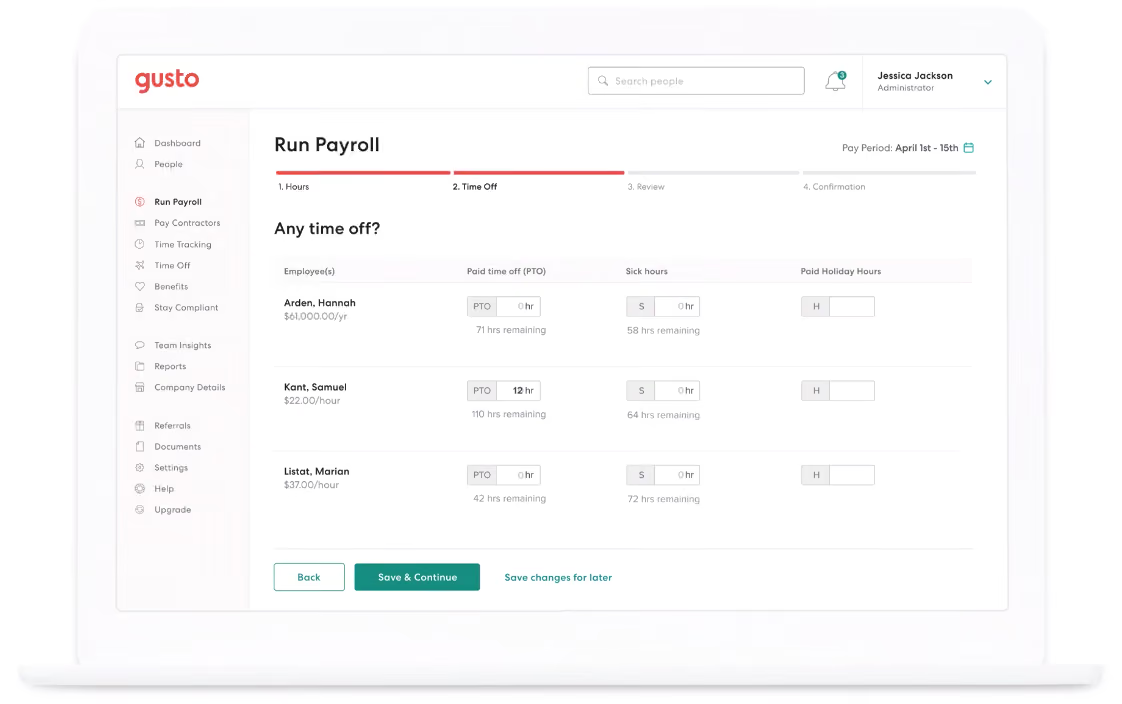
Gusto sells payroll and HR at affordable and transparent prices, built for U.S. teams that stay under 50 people. ADP sells similar small-business payroll, but pricing is always behind a sales quote, and has a second, larger system to move you to the moment you pass 49 employees.


Choose Gusto if…
You run a U.S. team of fewer than about 25 people, want to know what you will pay before talking to sales, and would rather set payroll up yourself. You prefer to keep the same system even if you grow past 50 employees, making a platform switch a decision rather than a headcount-triggered event.
Choose ADP if…
You expect to grow past 25 employees and want one vendor from your first hire through midsize, or you want the option of a PEO later. You accept a quote-based price, a sales process, an interface small teams often find dated, and a move to ADP Workforce Now once you pass 49 employees.
Customer Reviews
Gusto

We used Gusto to manage payroll, streamline benefits administration, and centralize HR tasks. The platform simplifies payroll processing, ensures compliance with tax regulations, and automates various HR functions. Additionally, Gusto facilitates employee self-service, allowing individuals to access their pay stubs, tax forms, and benefit information conveniently. Its reporting tools provide valuable insights for strategic decision-making. Overall, Gusto plays a pivotal role in enhancing our HR efficiency and employee experience.
ADP

I use ADP weekly to provide employees with resources they might need. It could be for a pay stub, to calculate how much they make in 2 weeks, or to check their right to work. I especially like the feature that links to e-verify. That has been very helpful to us. We also use ADP for benefits and open enrollment. I also often point employees or former employees to the tool for self-service options.
Gusto and ADP RUN both may top out near 50 employees, but only ADP has a bigger system to move you to
ADP draws the line itself: RUN is for businesses with one to 49 employees, and ADP Workforce Now is for 50 and up. Our advisors put Gusto's practical limit in the same place. "Probably once you get to about 50, that would start to push it," Zach Mason, Team Lead of HR Software Advisors at SelectSoftware Reviews, told a six-person company already on Gusto.
That is why our advisors present ADP as the alternative even to very small teams. ADP "can scale with you as big as you possibly need," Mason told a three-person startup choosing its first payroll system, for example. On the other hand, buyers who start on Gusto and grow past its range may end up shopping again. An HR consultant told us one of her clients, a manufacturer with 60 to 70 W-2 employees, had moved from ADP to Gusto and ended up having to seek out another system. “I’ve never actually worked with one that was gusto and at that size,” she said.
Growing with ADP still means changing systems. Workforce Now is a separate product with its own packages, pricing, and implementation, and RUN customers usually move once they pass about 50 employees. Users who have made the switch report mixed results, and some have gone back to RUN. Staying with ADP saves you a vendor search at 50 employees, but you should still budget for a migration.
Gusto feels modern to small teams, and buyers we talked to agree ADP can feel antiquated
During our Advisor calls, several small-business buyers have described ADP the same way. A 10-person biotech company on ADP RUN told us the product "basically is payroll right now," and the rest of HR happens around it. Its time-off tool sends each request to every supervisor, "even though not the same department, they will receive time off, because that's how the system is set up." Updating benefits means logging in to separate websites for COBRA, health insurance, and other coverage, and when a COBRA notice failed to go through after a termination, the team had to handle it by hand in another platform.
A person running HR at a 45-employee company expressed a similar complaint, calling the system, in her view "very clunky and not very user friendly". Her payroll does not sync with the benefits platform her company uses, so benefit deductions go in by hand: "I have to manually do it all." In both cases, ADP runs payroll and the HR work around it falls to the buyer.
ADP's service draws similar complaints. An HR consultant said her client's CEO wanted to avoid a repeat of the company's ADP experience, which involved constant emails and requests for meetings while "nothing was getting fixed."
Gusto gets the opposite description, with its own catch. The HR lead at a 20-year-old company on Gusto called it "very intuitive, very easy, but there's a lot of limitations," and was looking for broader HR and benefits tools. The ADP complaints have limits too: the time-off routing may reflect how that account was configured, the sync gap is with a third-party benefits tool, and neither buyer said which RUN package they used. To be fair, RUN's higher tiers do add more HR features.
Gusto costs less for teams under about 15, and ADP RUN's estimated pricing catches up as you hire
Gusto publishes its prices, so you always know what you're getting. ADP, as mentioned above, does not publish prices for RUN, its payroll product for businesses with one to 49 employees. Each of the four RUN packages shows a "Get pricing" button, and the price comes from a sales rep, and may be based on your headcount and contract duration. Third-party reports put RUN's entry package, Essential, at about $79 a month plus $4 per employee. A phone quote published in 2026 came in higher, at $150 a month plus $3.25 per employee for a 10-person company.
Applying those two formulas against Gusto Simple:
ADP charges a higher base fee and a lower per-employee fee, so the pricing gap with Gusto shrinks as you hire. On the lower estimate, RUN Essential costs less than Gusto Simple from about 15 employees.
The buyers we hear from at the SMB end of the spectrum feel the difference. A studio manager running payroll for a three-person team told our advisors that ADP worked fine, "except I just think it's too expensive for running payroll for three people." The owner of a two-person training business, who had already spoken with ADP, put it "towards the more expensive end when it comes to payroll software."
That said, neither vendor's price holds still. Gusto's per-person fee doubles from Simple to Plus, and Simple covers payroll in a single state only. ADP's estimates leave out add-ons such as time tracking, and quotes move with payroll frequency and promotions.
Worth mentioning, ADP's site has been known to offer up to six months free to businesses that switch. The bigger difference is timing: you know Gusto's price before you sign up, and you learn ADP's only after a sales call.
ADP offers a PEO through TotalSource, while Gusto helps you buy a small-group plan on your own
For small teams, the PEO question usually comes down to health insurance math. For example, a person leading HR at a 35-employee consulting firm on Gusto told us a PEO would run about $120 per person per month, roughly $70 more than his HR software. "So how do I make that $70 back up has to be through savings from health insurance," he said.
Cost is not the only hesitation. The COO of a five-employee practice on ADP worried that co-employment would leave staff feeling "kind of split" between the practice and the PEO.
ADP sells a PEO, ADP TotalSource, alongside RUN. A PEO becomes the co-employer of your staff and pools them with other clients' employees, which gives a small company access to large-group health plans. Gusto acts as a licensed insurance broker instead, so a Gusto customer buys a small-group plan in its own name. Gusto announced its own PEO in October 2026 for eligible customers "in the coming months," without pricing, so check its status before choosing. ADP does not publish TotalSource pricing, and the PEO rates our buyers report seeing run from about $110 to $150 per employee per month.
That makes the choice a break-even calculation. TotalSource is a separate ADP product, so moving to it from RUN is a change of service, and the PEO fee only pays for itself if the large-group plans cost enough less than your current premiums. If health insurance is your main problem, get a TotalSource quote and a small-group quote through Gusto (or a Gusto PEO quote, once it launches), and compare the totals per employee.
Final Words on Gusto vs. ADP
The choice comes down to visibility against continuity. Gusto shows its price, feels built for small teams, and fits well until about 50 employees. ADP asks for a sales call up front, but it is the vendor you will not outgrow, even if growing means moving between its products. Under about 15 employees, both the pricing estimates and our buyers favor Gusto. Between 15 and 49, get an ADP quote before you decide.
If you are already past 50, the comparison shifts to ADP Workforce Now. An HR consultant who had used it told our advisors the product "was pretty good." At the other end, ADP also sells Roll by ADP, a payroll app with a published price of $39 a month plus $5 per employee, for very small teams that want ADP without a quote.
To test either vendor against your own requirements, ask the HR Tech GPT, or book a call with our advisors for two or three recommendations matched to your team.
More Gusto comparisons:
Review Methodology
We take our research process seriously and want to make sure we are presenting our readers with the very best solutions in a given software category. Check out this guide to learn how we evaluate vendors before featuring them in our buyer guides.
Learn MoreYou might also be interested in the following buyer guides:
Join 85,000+ HR Tech Nerds who get our weekly insights