

10+ Best Employee Management Software in 2026
Our experts reviewed and rated the best employee management tools on the market in 2024. Read on to learn about their capabilities, pros, cons, pricing, and more.











Employee management software solutions store and retrieve employee data, track time and attendance, manage leave requests, schedule shifts, monitor performance, and much more. When such tasks are automated, you can save money, boost productivity, and increase employee satisfaction whether you’re a small business or a large company.
Our expert researchers have compiled a curated list of the best employee management systems, including must-have features, key benefits, pricing info, and other considerations to help guide your selection process.
To choose the best employee management software, we conducted demos with vendors, sought the expertise of HR tech leaders, tested the products ourselves, and chatted with other end users. Factoring all that in, we think the features that make an employee management system stand out are easy onboarding and self-service, data management and security, and reporting and analytics.
- Easy onboarding and self-service: The best employee management systems provide a strategic onboarding process, including a self-service portal, to create a positive employee experience. New hires can quickly complete paperwork, access key documents, and learn company policies. There’s often an employee self-service portal too, enabling employees to access and update their personal information, view pay stubs, submit time-off requests, and more.
- Employee data management: This is perhaps the most important function of an employee management system, and getting it right is vital. Your employee management software should act as a centralized repository for storing and organizing employee information. It should also protect that information with a host of security measures such as authentication, role-based permissions, encryption, and compliance with data protection regulations.
- Reporting and analytics: We’ve looked for employee management tools with robust reporting and analytics capabilities. Besides pre-built reports, the best tools in this space let you customize your own and give you insights on various HR metrics, including employee turnover, attendance patterns, and performance trends and stats.
The above is just a summary of what our team does. If you want to learn more, we have a detailed guide explaining our editorial guidelines and review methodology.


.png)
Deel

We selected Deel HR due to its highly praised modular architecture and a robust, globally compliant employee portal that addresses complex international HR needs. Furthermore, the platform's practical analytics integrations, especially the Power BI connectivity, are excellent for users who require advanced, customized HR reporting capabilities.
PROS
- Modular pricing allows teams to scale HR features without reimplementation.
- Clean employee portal with strong self-service functionality.
- Built-in people analytics dashboards with API sync to Power BI.
- Slack and Teams plugins enhance HR workflow collaboration.
- Strong security framework including SSO, encryption, and monitoring.
- Integrates HR, payroll, and IT data under one system of record.
- Excellent 24/7 customer service with fast onboarding (2-3 days) and local payroll experts in each jurisdiction.
- Seamless integration with platforms like QuickBooks, BambooHR, and Greenhouse, plus custom integration options.
- User-friendly, self-service features enable quick setup; identity verification often takes under 24 hours.
- Automated invoices simplify payments, provided they're in English.
CONS
- Performance and development tools are bundled into higher-tier plans.
- Customization of analytics dashboards may require consulting support.
- Pricing increases quickly as modules are layered.
- Key features like onboarding automation are add-ons, which may increase costs.
- Limited flexibility in modifying contracts or service agreements; changes often require an addendum.
- Invoices cannot be generated in languages other than English.
What we liked most about Deel HR is that it’s built as a modular system that grows with you. You can start with Core HR and layer in recruiting, performance, or compensation tools when you’re ready, without migrating data or reimplementing the platform.
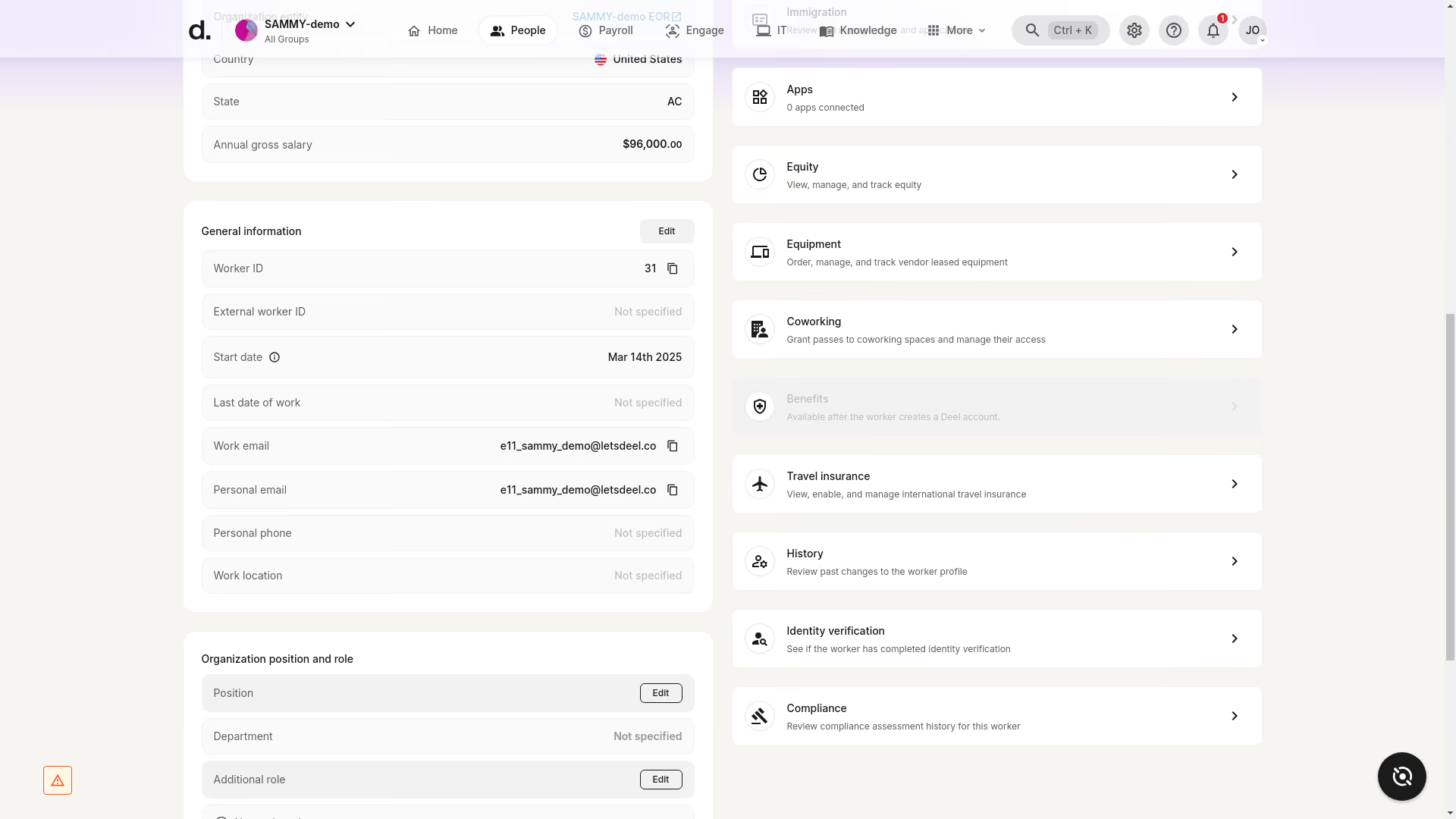
The employee portal apparently is where we landed first and where we ended up spending most of our time, since that’s usually where people management systems either succeed or fail. Luckily, Deel’s portal leans toward the former. The interface was clean both on our computer screens and smartphones. We also appreciated that multiple matters, such as personal updates, time-off requests, contract access, and pay stub retrieval, can be resolved directly in this portal without involving HR. Additionally, the collaboration software plugins help reduce the hassle of switching between platforms by surfacing notifications, such as time-off approvals and payroll, right inside Slack and Teams.
Another positive in our assessment is how Deel handles security controls. It's quite reassuring to see multiple layers in place, including encryption, secure storage, password management, and SSO. Plus, Deel’s recent partnership with Albert to provide cybersecurity training resources signals the vendor’s proactive stance on comprehensive operational risk management.
Analytics-wise, Deel HR’s lowest-priced module, Core HR, already includes people analytics dashboards. But what differentiates the platform is its ability to connect directly with Microsoft Power BI via API. Once integrated, live Deel data automatically feeds pre-configured KPI dashboards, which can be particularly convenient if you want workforce metrics embedded in executive reporting. Of course, it also means you need Power BI and may need to rely on HR Metrics for consulting support to configure advanced dashboards.
We appreciate that Deel’s structure is modular, with modules running on the same HR data foundation, so no migration is required as companies scale. Core HR starts at $5 per employee per month and includes foundational HRIS tools. Speaking from a remote startup perspective, this is a pretty good start for most SMBs. To be fair, though, the total cost can increase quickly once multiple modules are combined.
40,000+ companies, including Intuit, Canva, Ramp, and Klarna.
Deel HR provides its modules at various monthly per-employee costs: Core HR for $5, Recruit for $14, Develop for $22, the Recruit & Develop Bundle for $30, and the Full HR Solution, which includes all features plus advanced functions, for $56.

Best For
Globally distributed organizations.

Connecteam
As an all-in-one platform for deskless employees, Connecteam covers communication, scheduling, task management, core HR, and more. Its aim is to connect unanchored workers at small and large companies alike with an easy-to-use mobile app.
PROS
- Connecteam offers a user-friendly, mobile-first platform that’s tailored for deskless employees.
- With a variety of features for team management, communication, training, and engagement, the platform provides a comprehensive solution.
- Connecteam offers transparent pricing for all modules, including free plans for small businesses.
- A 14-day free trial without requiring a credit card allows potential users to test the platform's capabilities.
- One of the only fully-mobile HR tech tools for deskless workers
- Very adequately-priced for all it entails, SMB-friendly
- Quite open to feedback, having implemented user suggestions as features in the past.
CONS
- There’s a bit of a learning curve simply because of the many features there are on the platform.
- While the platform's scalability is commendable, several important features are only accessible on higher pricing plans.
- We would have liked to see more integration options with third-party tools such as calendar sync. Payroll integrations are also limited at this time to just Paychex, Xero, Gusto, and Quickbooks.
- In the communication hub, the app offers no confirmation that messages were sent and/or seen.
- Certain features that some teams consider essential, such as GPS-tracking, are only available in the higher-tier pricing plans.
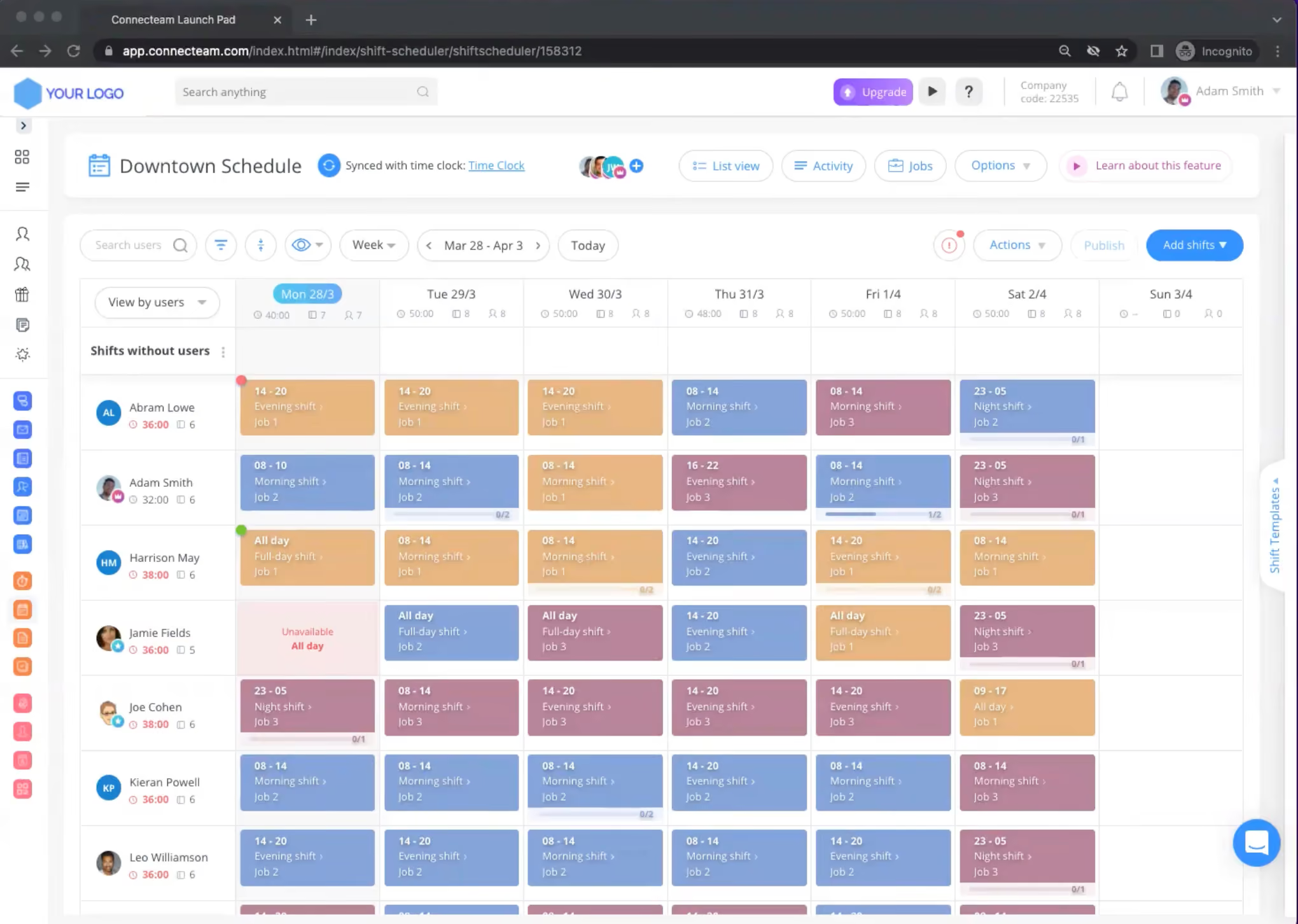
Connecteam offers comprehensive employee management software that stands out for its mobile-first approach - everything inside is built with non-desk workers in mind. We’ve had a tour of its HR & Skills hub and were particularly impressed by the training and onboarding features within. The software allows managers to create custom courses tailored to each position within the company, and these courses can be completed directly from employees’ mobile devices. The addition of quizzes ensures that trainees have a solid grasp of the material, while progress tracking provides managers with real-time insights into each employee's development.
Another notable feature is Connecteam's ability to digitize and centralize employee documentation. By gathering all paperwork in one secure location, the platform simplifies the onboarding process and ensures compliance with expiration date reminders for important documents and certifications. This not only saves time but also reduces the risk of regulatory issues.
Connecteam also excels in managing time off requests. Employees can easily submit absence requests through the app, while managers gain a clear overview of these requests and can effortlessly update balances. The software further simplifies the process by allowing the creation of policies for various types of absences and automating notifications to prevent compliance issues.
Recognizing and rewarding employees is yet another thing made easy with Connecteam's built-in features. Managers can publicly or privately acknowledge individual and team achievements, fostering a culture of appreciation. The platform also offers the ability to reward employees with their favorite gift cards, providing a tangible incentive for going above and beyond.
Lastly, Connecteam's employee lifecycle tracking is also worth highlighting. The timeline view provides a comprehensive picture of each employee's journey, from onboarding to performance reviews and salary raises. This information, along with the ability to attach related files to each event, empowers managers to make informed decisions based on a holistic understanding of their team members.
Over 35k businesses use Connecteam’s solutions, including Chick-fil-A, Ihop, and The UPS Store.
Connecteam’s pricing ranges from free-for-life to up to $99 per month for up to 30 users. The final amount will depend on how many users and modules you choose. Visit Connecteam’s pricing page for the full breakdown of each plan.
Best For
Companies of all sizes looking for a mobile-first employee management platform.

BambooHR
With over 20,000 active clients and 1.8 million employee users, BambooHR is a top provider in the HR tech space. Their Employee Management features include time & attendance, leave requests, and employee wellbeing tools.
PROS
- Customizable packaging and flexible pricing options, allowing you to select one or two packages and add modules based on your specific requirements.
- Known for its simplicity and user-friendliness.
- Straightforward tool, easy to navigate and use.
- Flexible packaging and custom pricing is the way they roll. You can pick out one or two packages and pick other modules as add-ons based on your needs.
- Very simple and straightforward tool, easy to use.
CONS
- You can only run payroll for U.S.-based employees.
- Customer support is limited to U.S. workdays and business hours.
- Several modules such as time tracking, surveys, and performance management are available exclusively as add-ons, meaning you do need to pay more to use them.
- Payroll is only available for US-based employees
- Customer support is only offered during US business hours.
- Some modules like time tracking, performance management, and surveys are only available as add-ons.

Here’s a company that is a must-consider when it comes to various types of HR tech, including, of course, employee management systems. BambooHR is a well-known vendor in this space, with a host of HR tools to help companies manage employees throughout their lifecycle, from hiring and onboarding, to payroll and day-to-day management.Of course, employee management tools like time tracking and a performance module are available, but only offered as add-ons within one of the HRIS plans.
BambooHR has over 20,000 customers, including major companies such as the University of Maryland, Quora, Reddit, Universal Group, Asana, and Wistia.
BambooHR's per-employee, per-month pricing tiers for employee management are:
- Core ($10): Essential HR.
- Pro ($17): Core features plus performance and engagement.
- Elite ($25): Pro features plus compensation management, advanced analytics, and premium services.
Best For
BambooHR is great for companies wanting a customizable HR product with pricing tailored to their needs. It's especially popular with partial or fully remote teams.


I was first tasked with ensuring that all employee information in the system was accurate. I used BambooHR daily for recruiting by entering open positions, posting jobs, and reviewing candidates.
We recruited for various roles, including entry-level data clerks, social workers, and a few supervisory positions. The long-term goal was to use the system for timekeeping, benefits administration, and payroll integration.
Although we didn’t reach that stage, the daily use for recruiting was consistent and critical to our hiring process.
I liked the ATS aspect of BambooHR. It was easy to view all candidates at once and assign a star rating, which made it simple to identify top applicants at a glance.
The reporting and analytics tools were strong, offering insights such as turnover rate and applicant volume per open position. There were multiple graphic options to display data clearly.
I believe the timekeeping feature would have been useful, but I didn’t get to use it before my position was eliminated.
The company did not have an HRIS at the time, so the owner purchased BambooHR despite not knowing how to use it. I used it primarily for recruiting and reporting purposes. The ATS was easy to use, and the reports were robust in displaying results.
One function we did not use was payroll processing. I used BambooHR for approximately nine months.
I had only used BambooHR briefly before this role, and the owner was unfamiliar with the system, so there was limited guidance. It takes time to learn how to use BambooHR efficiently, but once you understand it, the platform is comprehensive.
I wish there were more reporting options; while the existing ones are strong for analytics, other platforms like ADP and Paylocity offer more variety.
One advantage of BambooHR is its lower cost compared to systems like ADP.
It can manage everything from HR to payroll, benefits, performance management, and reporting.
I prefer BambooHR because it allows multiple administrative users, such as HR and payroll staff, to work in the same system.
In most of my previous roles, payroll and HR operated in separate systems that didn’t integrate, which was inefficient.
Cost is always a major factor and should be considered carefully. Companies should assess whether it's important for all administrative functions to operate within a single system.
If that's a priority, BambooHR is a strong option.
If not, and if HR and payroll are fine using separate tools, a company may find it more cost-effective to use two less expensive systems.
Other platforms offer automation in areas like recruiting and performance management, which BambooHR may not fully support—such as automatically routing applicants to hiring managers. This should be reviewed depending on the company’s specific needs.
I believe BambooHR has introduced some AI functionality. Since I am no longer using it, I can’t confirm the current features, but I would expect them to innovate to remain competitive.
I think BambooHR can work well for organizations of all sizes. When I used it, we had fewer than 100 employees. It’s especially useful for companies with remote or mobile staff due to the timekeeping functionality.
Non-profits could also benefit from its reporting capabilities, which would be helpful when presenting administrative data to a board of directors.
BambooHR can work in any size organization, but it's important that more than one person knows how to use it. If the HR professional is the primary user, there should be a trained backup.
It does take some time to learn, but once the basics are understood, it's easy to use—especially for ATS and reporting functions. Due to the learning curve, having only one trained user could be a risk.

Paylocity
Paylocity combines employee self-service, payroll, time tracking, recruiting, onboarding, performance management, and HR administration in one platform. Its broad workflow coverage makes it particularly compelling for mid-sized U.S. companies that want employees and managers to handle more HR tasks without relying on administrators.
PROS
- Employee self-service covers pay, time off, documents, personal information, and HR tasks.
- Mobile and desktop access supports time tracking, scheduling, onboarding, and employee self-service.
- Performance tools combine goals, feedback, journals, and formal performance reviews.
- Recruiting and onboarding connect hiring workflows with employee records and preboarding tasks.
- Payroll can combine recurring salary and deduction data with timekeeping information.
- Paylocity’s customer support is highly rated for always being available to answer questions.
- Global payroll support for 100+ countries.
- Provides free and unlimited training modules on the website.
- Paylocity’s mobile app has a good UI and functionality
- The tool is easy to use for both employees and employers.
- Has 350+ pre-built integrations.
CONS
- Pricing is not publicly disclosed, making total cost hard to assess before a sales conversation.
- The breadth of functionality may be more than smaller organizations need.
- International coverage is narrower than global-first vendors like Deel, though Paylocity does offer global payroll.
- Reporting in the time and attendance product may require spreadsheet-based analysis to create custom views.
- Undisclosed pricing.
- It doesn’t have a free trial or free plan.
- Support is available in English only.
- It isn’t the best solution for remote teams looking for a tool to manage payroll and benefits for their contractors.
We find it remarkable that Paylocity connects employee self-service, payroll, time tracking, recruiting, onboarding, performance management, and administrative tools through the same environment.
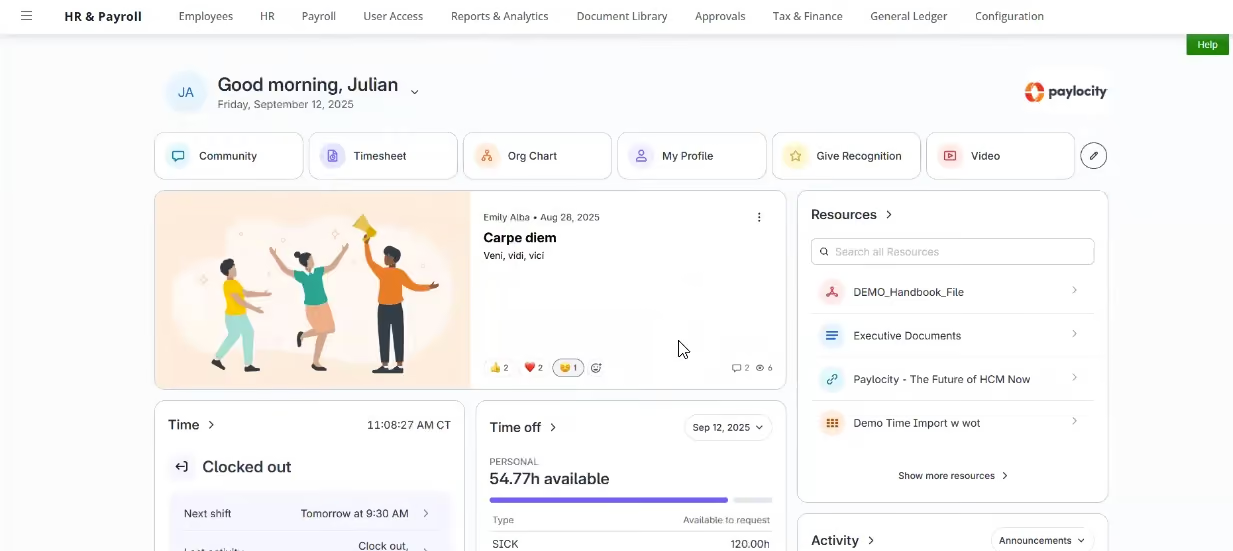
The employee homepage is the strongest part of the experience. Employees can view current and past pay, download pay stubs, check time-off balances, submit requests, complete tasks, access company resources, and find colleagues via an org chart and directory. They can also update addresses, emergency contacts, direct deposit, and tax details themselves, cutting the routine changes HR has to process.
In our last Paylocity demo, employees could access pay, time off, scheduling, clocking in and out, tasks, and onboarding on both phone and desktop. Time can be tagged to jobs or projects, allowing employers to allocate labor to specific work.
Performance management is comprehensive, combining employee journals, individual and team goals, feedback, and formal reviews. Journaling supports recurring check-ins, performance improvement plans, and general notes, while feedback can come from managers, direct reports, or peers.
Paylocity also offers recruiting with applicant tracking, job distribution, interview scheduling, and candidate lifecycle management, all tied to employee records and payroll, so payroll batches automatically pull salary, earnings, deductions, and timekeeping.
For smaller organizations, this breadth can add complexity and overhead versus more focused tools. The custom pricing model also limits cost evaluation before a formal sales process.
40,000+ organizations, including POLYWOOD, The Kennedy Group, and Hathaway Brown School.
Custom pricing.
Best For
Paylocity is best suited to mid-sized U.S. companies that want to bring payroll, HR, employee self-service, time tracking, recruiting, onboarding, and performance management together in one platform.

For onboarding, I get to create a profile for candidates so they can receive the onboarding package, also, I love how we can send it in Spanish as well. I’m able to help the HR team complete the tasks, which is not hard to use. Also, we get access immediately, when we submit it, making the whole process breezy. Regarding Payroll, I have heard great things about how convenient it is. I haven’t had the opportunity to try it firsthand though.
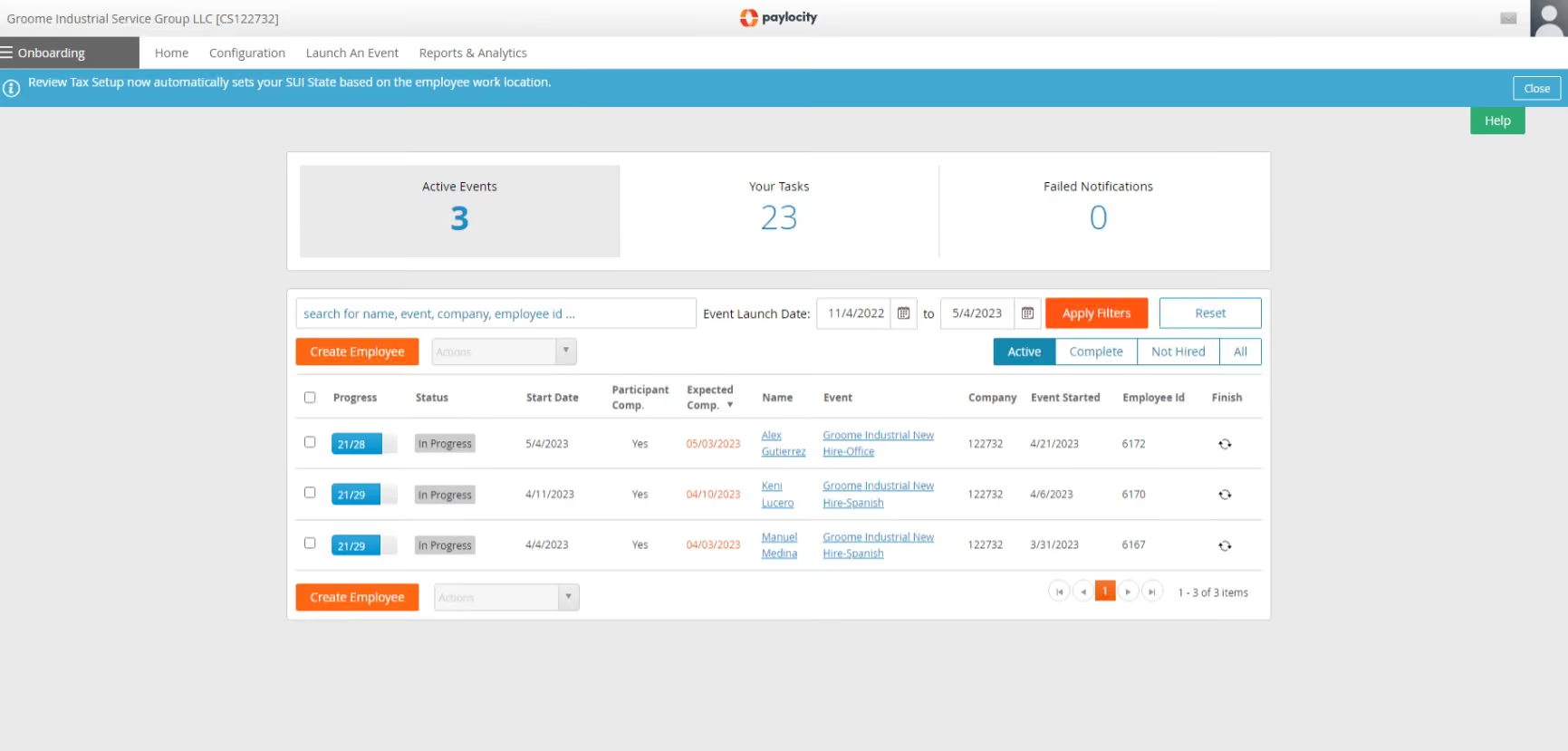
- It’s a useful tool for onboarding and payroll.
- I like the app, the design is very nice and it's easy to use.
- I have used other onboarding platforms and they are quite difficult to understand or process.
For over 3 years, our company has been using Paylocity for onboarding and payroll purposes, but not their ATS feature. This system has been extremely helpful to keep track of the onboarding activities, which helps to keep everything organized and in one place. Also, for Payroll, the app is easy to use and very clear from what I have heard from my teammates.
- I would say, the platform is not modern enough.
- They need to update it quite often. I haven't seen many changes since I started using it a year ago. Usually, I hear that they are launching new things, but I haven't seen it personally.
- The ATS platform is not good. That's why we didn't get on it. It was not suitable, pricing-wise.
Well it's efficient for what is needed. It is quite similar to when I was using Greenhouse in the past, but I believe Paylocity’s app is better than what I have seen before.
It has the right tools for what is needed, I would say the cost is worth it for what they offer. Also, Paylocity has been in the market for a while and a lot of companies are using them. That’s key to keep in mind. The external reviews are good as well! However, it is vital to thoroughly examine using demos and trials to see if it’s the right fit for your company’s specific needs.
It has helped the business as we didn't have a system like this before. That said, I haven't seen many changes since I started using it a year ago.
For small businesses that are growing/expanding or any company that has over 50 employees.
Well, for a company with less than 50 employees, the price wouldn't be worth it.

Gusto
SMBs can use Gusto to manage employees in all states, 1099 workers, and contractors worldwide. The platform offers full-service payroll, plus HR and benefits administration, at budget-friendly pricing.
PROS
- Premium plans give you access to workflows, performance reviews, and development resources.
- The UI is modern-looking and easy to use.
- Payroll deductions are automated.
- You can process payroll for U.S. W2 employees as well as domestic/international contractors.
- The customer support team is responsive both via phone and email.
- All plan users can reach out to Gusto’s team of licensed benefits advisors for help.
- Employees can access a self-service portal to check information and perform tasks on their own.
- The dashboard feature keeps tabs on compliance tasks
- The hiring and onboarding sequence is nicely streamlined between HR and the new hire
- Post-offer, pre-start tasks are made easy with integrations like CorpNet (state tax set up) Checkr (background checks)
- Easy payroll for U.S.-based W-2 folks, domestic, and international contractors
- Person-to-person phone support, email, and other customer service resources
- The business model is responsive to customer needs
CONS
- No international employee payroll, only contractors.
- No native accounting for financial tracking.
- The analytics dashboard is rather basic, compared to similar platforms.
- No native time tracking for the Simple plan.
- Compliance alerts and insurance integration can only be accessed by Premium plan users.
- No free plan or trial.
- Gusto can support payments for international contractors, but not employees
- No native accounting feature to keep earning and spending under the same roof
- Analytics dashboard is simplistic
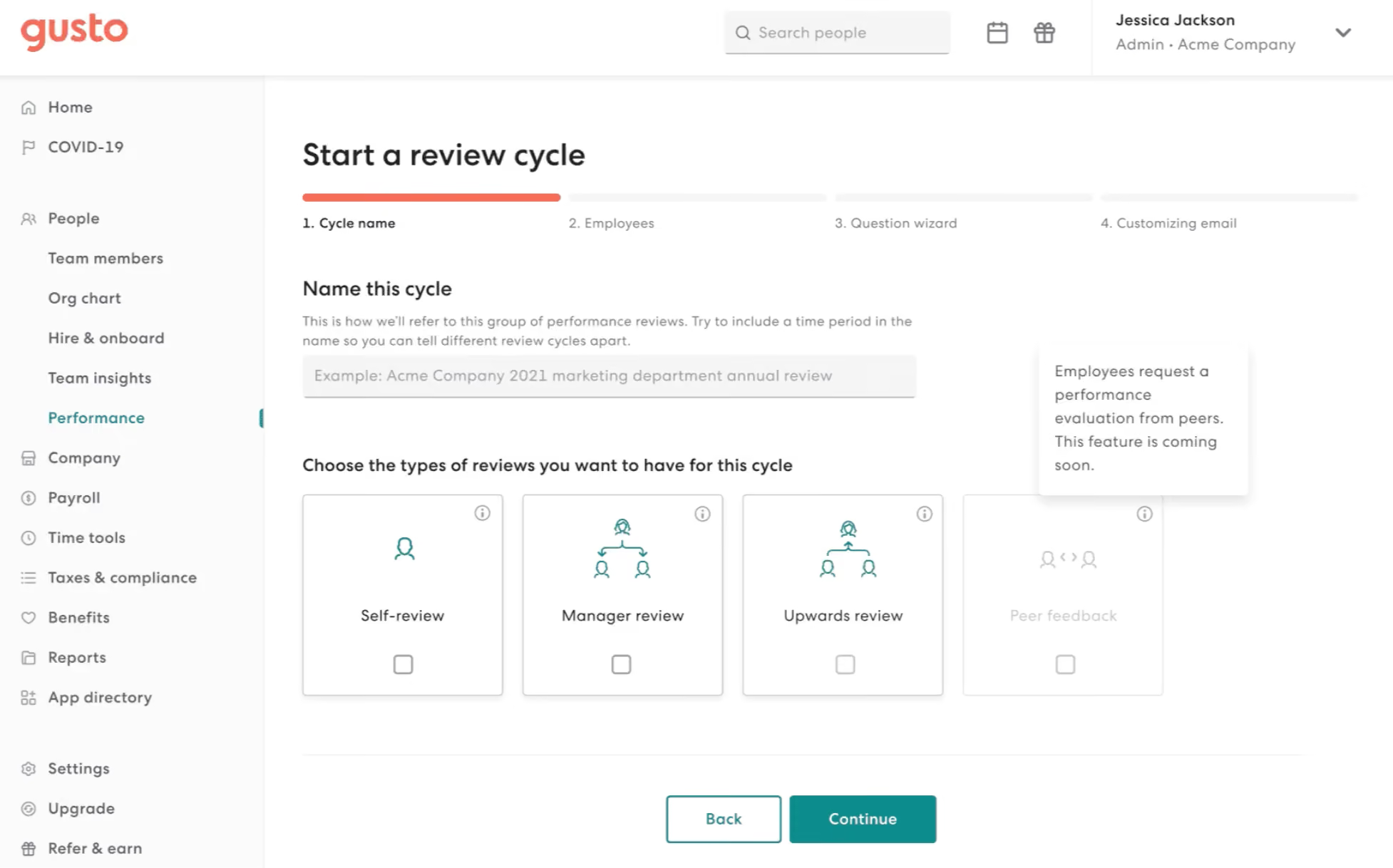
We have tested Gusto's employee management software and found it a comprehensive solution for SMBs. With the ability to manage employees across all states, 1099 workers, and contractors worldwide, Gusto offers full-service payroll, HR, and benefits administration at affordable prices.
The Premium plan (the highest tier) provides additional value with access to performance features like automated workflows, self-evaluations, manager reviews, and career development resources for better employee engagement and professional growth.
In addition to its functional capabilities, Gusto boasts an eye-catching interface that is visually appealing and user-friendly. Navigating through the platform is intuitive, making it easier for users to manage employee-related tasks efficiently.
We also found automatic payroll deductions and payroll services available for U.S.-based W-2 employees and domestic and international contractors. Gusto's employee self-service portal is also available, reducing administrative burdens and allowing employees to handle tasks independently.
However, we couldn’t help but notice Gusto doesn’t support payments for international employees. Native accounting for comprehensive financial tracking is missing. We also found that the Simple plan lacks several features, such as time tracking, compliance alerts, and broker integration. And regrettably, Gusto does not offer a free trial option.
Gusto supports over 400,000 businesses across the U.S., many of which rely on the platform for core HR workflows like employee onboarding, benefits management, time tracking, and compliance.
Gusto offers four pricing plans: Simple ($49/month + $6/employee) for core payroll, Plus ($80/month + $12/employee) for multi-state payroll and HR tools, Premium ($180/month + $22/employee) for the full HR suite and dedicated support, and Contractor Only ($35/month) for managing independent contractors. Add-ons HR Resources ($50 + $5 PEPM) and Priority Support ($30 + $3 PEPM) are available for Simple and Plus plans.
Best For
Gusto's basic plan is budget-friendly, making it accessible even for cash-strapped startups. The premium plan is highly recommended for companies that have the funds to invest in human capital, especially those with just one HR employee. The premium features are worthwhile for such companies.
We use Gusto for applicant tracking, onboarding, offboarding, HR documentation, and expense tracking. We were using Gusto's benefit brokerage, FSA, and COBRA options as well, but we recently changed to our own broker in March 2024. Some of the workflows we use are "to-do" type lists for onboarding and offboarding. We set these up so that tasks will send to each individual (manager, admin, or employee) when it is time to action the task in the onboarding process. Gusto does not have any advanced workflows, and even their basic workflows mentioned above are more similar to email reminders than typical HRIS workflows. The main benefit of these types of workflows is that they are very beginner-friendly. The main drawback is that there is little to no customizability.
Gusto is a great beginner HRIS with basic functionality that is easy to use. Gusto is a cost-effective, affordable HR and payroll solution for small businesses. Gusto's document functions are very customizable, allowing for check mark boxes along with basic and more common features like signature boxes and text boxes.
Our company originally bought Gusto in 2020 and has been using it for four years. I have personally been using it for six months and have used it in the past while working contracts for other start-ups. We use Gusto as a solution for small businesses that need an HR and payroll system. The key benefits it provides include a time tracking system, payroll system, HR storage system, ATS, benefits solution, and more. When originally buying the tool, the company aimed to use it mainly for payroll purposes and to move off of QuickBooks for payroll and paper copies of documentation. Gusto provides document signing as well.
Gusto's customer service lacks urgency and has put us into very difficult situations regarding compliance around our benefits. While Gusto is very beginner-friendly, this means it also lacks the workflows and customizability that most experienced HR professionals are accustomed to when setting up and using an HRIS. Gusto does not have many options for custom reporting, which can be difficult for HR personnel and business operations.
I prefer a more customizable HRIS, even if it is a little more expensive. I think Gusto is a good start solution, but once you grow past 25+ employees, you will need to look into more advanced HR and payroll solutions. I would not recommend Gusto to anyone that has over 25 employees due to this.
Businesses should consider their projected growth and hiring plans. You do not want to implement an HR system if you will need to switch to another HR system further down the road. If you plan on keeping your business small or do not plan on hiring a dedicated HR person, then Gusto might be the solution for you.
I have not been with Gusto long enough to see any change or evolution.
Gusto is good for small businesses with under 25 employees and/or businesses looking for a very cost-effective solution.
Gusto is not a fit for teams larger than 25 employees. Gusto is not a fit for a team in high growth stages. Gusto is not a fit for anyone with a dedicated HR person who likes the functionality of advanced workflows and custom reporting.

Leapsome
With easy onboarding, customizable performance reviews, employee training, recognition, and engagement features as well as OKRs setting and tracking, Leapsome has everything you need for you to manage your employees, listen to their feedback and keep them happy and productive.
PROS
- Leapsome offers a comprehensive range of features, including modules for employee onboarding, learning management, engagement, performance management, and goals tracking, among others.
- Users find Leapsome's user interface (UI) to be friendly and easy to navigate.
- The platform provides numerous third-party integration options, such as Slack, which users appreciate for enhanced connectivity.
- Leapsome's pricing is flexible, allowing users to pay only for the modules they require.
- Besides English, Leapsome is available in 12 additional languages, catering to a diverse user base.
- Leapsome is quite feature-rich; the platform packs modules for employee onboarding, learning management, engagement, performance management, goals tracking and much more.
- The majority of users find Leapsome’s UI to be friendly and easy to navigate.
- There are lots of third party integrations options to choose from, including Slack, which many users appreciate.
- The platform has transparent pricing, and you only pay for the modules you need.
CONS
- There currently isn’t a way to post or upload images or files within your feedback.
- Due to the platform's extensive capabilities, users may need some time to adapt to its various functionalities, and the implementation process can also be time-consuming.
- Leapsome currently lacks a dedicated mobile app, limiting on-the-go access for users.
- While a free 14-day trial is available, users need to schedule a demo with the sales team to sign up, as self-registration is not possible.
- There is currently no way to post or upload an image or file into your feedback.
- Since Leapsome can do so many things, you may need some time to get used to it. The implementation process can also take some time.
- There currently isn’t a mobile app that users can download and access Leapsome quickly on-the-go.
- Free 14-day trials are available but you need to book a demo with the sales team first to sign up for one; you can’t do so on your own.

Besides hosting your employee data, Leapsome gives you several tools to manage your employees, from performance tracking to sentiment analysis and skills development.
Managers can provide performance feedback to their team members either publicly or privately. The platform also enables peer-to-peer reviews and for employees to provide feedback back to their managers on what can be done to improve leadership styles and collaboration.
The employee engagement and training tools help you pay even more attention to the experience of your employees. You can routinely do surveys and pulse checks to gauge employee sentiment and take necessary actions to improve the workplace environment, while the training module helps you create and deliver learning content, unique to what skills your employees want to be better at.
Leapsome is used by many well-known companies, including Spotify, +Babbel, Unity, PayFit, Learnerbly, Modus Create, Spryker, DCMN, and more.
The pricing of Leapsome starts from $8 per user per month, which varies depending on the specific modules chosen. They also provide multi-module and volume discounts. For an exact estimate, we recommend that you contact Leapsome's Sales team directly.
Best For
Companies of all sizes can use Leapsome, though medium and large-sized companies are more likely to get the most value out of it.
We use Leapsome daily as a comprehensive tool for managing performance and increasing employee engagement. It is especially helpful for the leadership and HR teams, allowing us to align personal goals with the company's broader objectives through OKRs and goal management. The platform supports performance reviews, 360-degree feedback, and real-time feedback, which help enhance communication and development. Leapsome’s customizable features make processes like surveys and one-on-one meetings more efficient by allowing us to adapt the platform to our needs. Overall, Leapsome has streamlined how we engage with and support employees.
- Leapsome’s user-friendly design makes it easy to recognize colleagues and boost morale with positive feedback.
- The platform functions as both a learning management system and an organizer for meetings, reviews, and surveys.
- It’s intuitive and quickly adopted by employees, improving morale by encouraging shared feedback and appreciation.
My organization adopted Leapsome to centralize and improve multiple HR functions within a single platform. We wanted a solution that could integrate goal-setting, OKRs, performance reviews, employee learning, and engagement into a cohesive system. Leapsome’s all-in-one design has been key in enabling streamlined performance tracking and employee development. It has also helped promote better communication and engagement with features like 360-degree feedback, surveys, and recognition tools. I have personally used Leapsome for two years, and it has consistently proven valuable to our team.
- The platform’s workflows could be better optimized for smoother use.
- The UI/UX for completing a learning path could be improved to provide a more seamless experience.
- Some internal management processes still rely on outdated methods.
Leapsome differentiates itself with customizable performance and 360° reviews that are straightforward to use. It supports goal alignment and tracking across the organization, fostering transparency and accountability.
Through employee engagement surveys, it provides insights into company culture that help in strategic decision-making. Leapsome also encourages a culture of continuous growth with real-time feedback and praise.
These features create a holistic approach to performance management, employee development, and engagement that stands out from competitors.
I recommend researching the platform’s functions to ensure it aligns with your organizational needs. Leapsome offers many valuable features, though some may require further development.
Leapsome has remained relatively consistent, though there is room for further updates to meet evolving user requirements.
The platform’s versatility makes it suitable for various types of organizations and industries.
Currently, I believe Leapsome could be beneficial for almost any organization looking to streamline HR functions.
Workday
Workday is robust and quite comprehensive. It can cover all of your HR and payroll needs without needing to combine it with other tech solutions.
PROS
- Workday has an intuitive, easy-to-use interface that makes it simple for employees to navigate and find what they need.
- You can integrate Workday with an impressive number of HR systems and tools.
- Users appreciated that Workday consolidates HR information into a single system, eliminating the need to access multiple platforms.
- Customers can get the support they need from Workday’s community of users, or the support team via live chat and telephone.
- Accessible customer support from the community, live chat, and telephone.
- Compatible with 300 HR systems such as ERP/GL, CRM, HR, and PSA.
- Configurable dashboard with AI and ML-driven insights.
- Ability to maintain real-time alignment of budgets and workforce plans.
- SOC 2 Type 2 compliance.
CONS
- It can take a long time to initially set up and implement Workday (avg 4.5 months).
- The reporting functionality has room for improvement, particularly with regard to customization and search.
- Workday’s pricing is on the expensive side, making it less feasible for smaller companies.
- No free plan or free trial.
- Undisclosed pricing.
- No free trial for its talent management software.
- Time-consuming implementation period (average 4.5 months).
- Challenge navigating for first-time users may require training.
- Issues with logging in were reported by users.
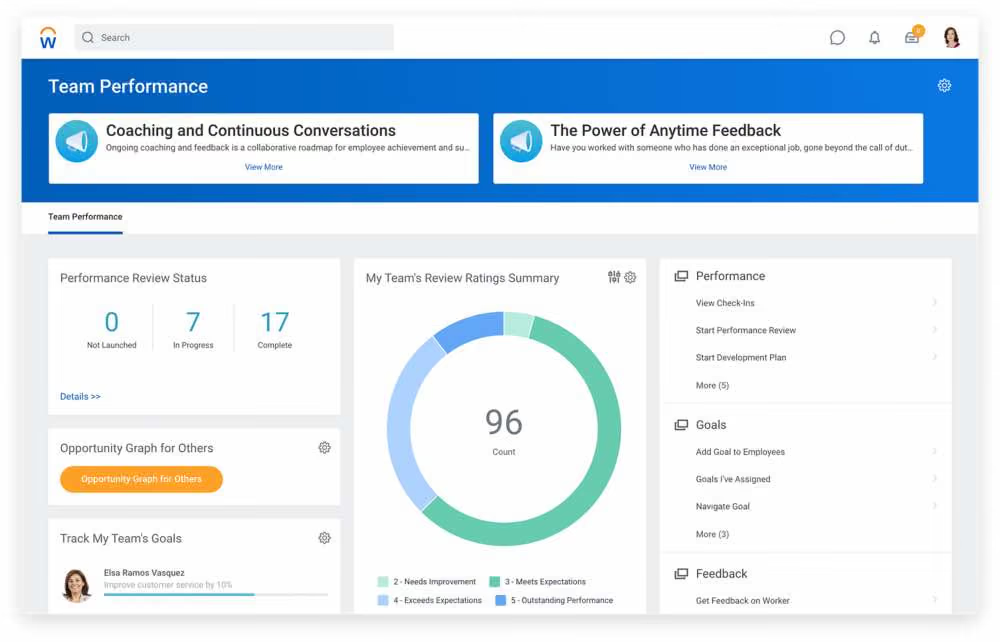
Despite mixed reviews on the user-friendliness of Workday from teams that have implemented it, it is still a robust provider of a wide range of Finance, HR, and Planning solutions, made specifically with enterprises in mind. So if you’re looking for an all-in-one solution that can easily scale, checks the necessary data compliance measures, and can be implemented across large global companies, Workday is worth checking out.
- Target
- Patagonia
- Bank of America
The pricing of Workday’s solutions isn’t disclosed on their website. Contact their sales team to get a custom quote.
Best For
Large-sized companies and enterprises.

I used it for recruiting, internal mobility, onboarding, and reporting. It was an excellent tool for internal mobility because it gave visibility into information like compensation, leveling, and performance reviews. This helped ensure that candidates had eligibility to apply to roles internally. The onboarding workflow was also very straightforward and configuring the to-do tasks was easy. Reporting took a little bit of time to learn and I would recommend taking the Learn Workday course if you have no experience with it because you will learn Workday's logic.
The ATS portion of Workday is a struggle. It is difficult to schedule candidates and build structured interviews.
Pros:
- The information you can get access to is extremely helpful
- The UI/UX is very clean
- All-in-one type solution
Workday was selected because it offered a comprehensive people solution. Instead of having different portals for compensation, performance management, recruiting, and people analytics, Workday allowed everything to live in one system of record. This reduced costs and ramp time in some ways because it allowed everyone to be in one place.
I've used it for a combined 2-2.5 years in my career in all facets from selection to design and then every day use for reporting and recruiting.
Cons:
- The Recruiting module for recruiters and recruiting coordinators is not intuitive and user friendly
- The Recruiting module for candidates is lengthy and miserable. It does a terrible job of parsing resumes
- Job management versus position management makes data funky in some instances (for example, if you were hired into a position, it can look like you hired your whole team unless you put in specific calculated fields)
- If you don't have the right access controls, it is borderline impossible to do your job effectively.
The Workday Recruiting Module (their ATS) is one of the most reviled in the Recruiting space. It doesn't compare well to other ATS like Greenhouse, Lever, or Ashby because the latter offers better functionality, controls, and ease of use.
- Ease of use. Workday has the ability to be so much but you have to know exactly what to look for and how to configure it.
- Implementation time. Workday requires a focused implementation and testing period. Without it, you will run into a number of problems. If you need to roll out something quickly, Workday isn't the tool for you.
It is difficult to tell because they release big updates every 6 months so requests for solutions might be forgotten by that point.
HR Business Partners, HR Operations, Finance, Compensation, and C-Suite
Recruiting, Analytics, Interviewers, Candidates
UKG
From paying your employees to managing them, developing them, and everything in between, UKG is a robust HRMS suite that can cover all of your people management needs.
PROS
- Super robust product, packing years of experience with HCM and Workforce Management technology.
- Administrators can configure the visibility settings for managers, employees, and themselves.
- The Ultimate Community provides on-demand information about all UKG Pro products and their usage.
- The mobile app is available in the Apple and Android app stores.
- Offers UKG Pro for HRMS and UKG Ready for workforce management, you could arrive at a combination of products that suits many of your HR needs from the same set of tools.
- Super robust product, packing years of experience with HCM and Workforce Management technology
- Since they offer UKG Pro for HRMS and UKG Ready for workforce management, you could arrive at a combination of products that suits many of your HR needs from the same set of tools.
CONS
- Compared to newer tools, UKG Pro and UKG Ready have not configured their offering to work for smaller or niche teams.
- Employees can encounter log-in issues at times with the Android app.
- Not a very budget-friendly option for small businesses.
- Similarly, UKG offers many solutions under one umbrella, so it's not the best fit if you're looking for only a handful of specific use cases.
- Compared to newer tools, UKG Pro and UKG Ready tend to miss a unique selling point or a specific focus on a certain type of business. While they work great for bigger companies in all sorts of industries, very niche operations might have a hard time adapting to the tool.
- Similarly, UKG offers many solutions under one umbrella, so it's not the best fit if you're looking for only a handful of specific use cases.
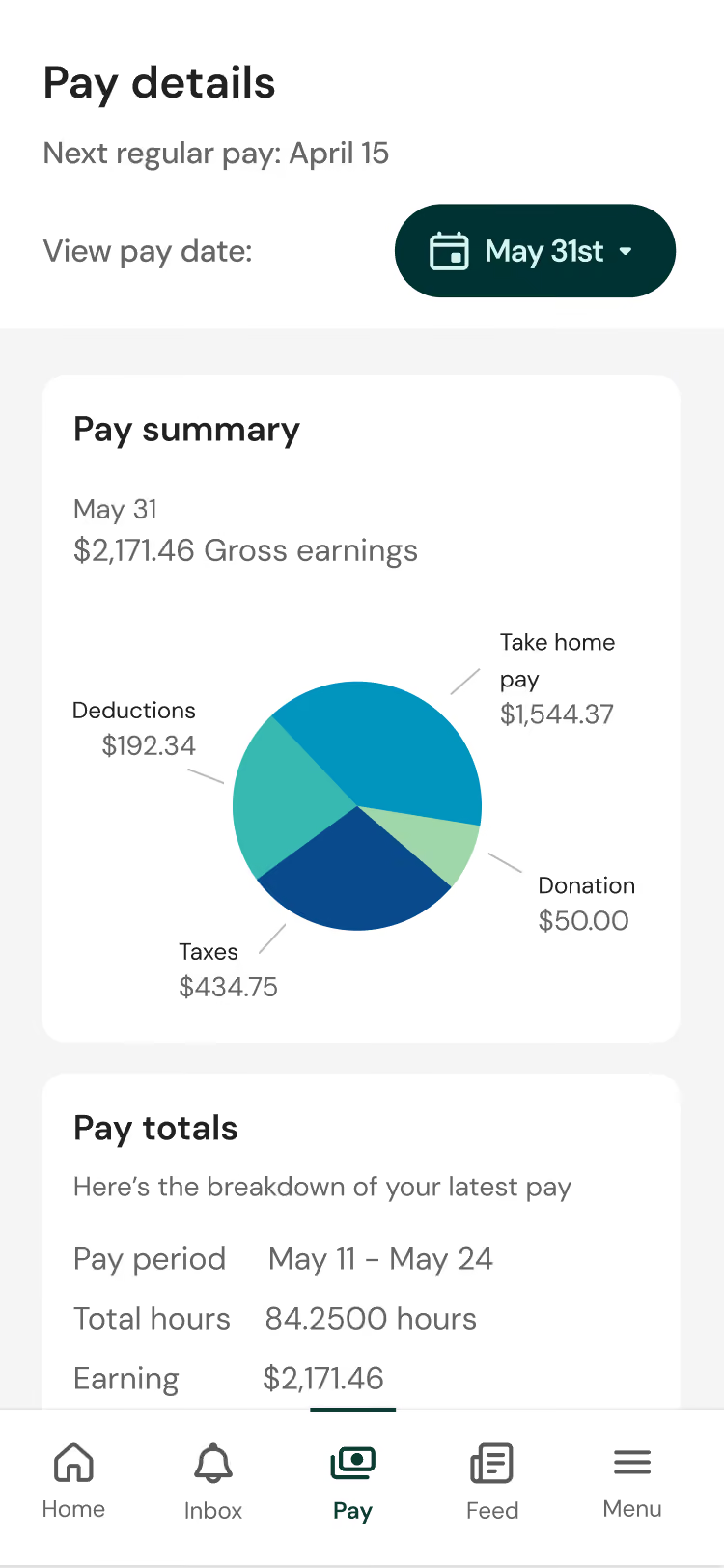
UKG Pro is a comprehensive employee management solution for midsize to large enterprise companies. HR departments at companies like MGM Grand and the Miami Dolphins use it to hire, onboard, pay, and manage employees. This all-in-one tool also features performance management, engagement, and succession planning, so it eliminates the need to purchase additional products to fulfill such needs separately.
UKG also offers UKG Ready, a workforce management solution developed with Kronos, a well-known time and attendance tool. This partnership adds time keeping, attendance, scheduling, and Affordable Care Act (ACA) compliance to the broader UKG offering.
Tesla, Marriott, Yamaha, Aramark, Puma, Sony Music, Samsung.
- Pricing for UKG Pro or Ready is not available on their website. However, it is usually on a per-employee-per-month basis, either billed annually or monthly.
- You’d need to contact a sales representative for an accurate quote.
- Our research has shown that licenses tend to start at around $600.00 per year for every 5 users.
Best For
UKG goes beyond payroll and offers a comprehensive suite of features tailored for enterprise-level organizations. Its robust capabilities serve as an exceptional payroll + HR solution, well suited for large teams with a global headcount, but also smaller businesses with over 50 employees.

I use UKG daily for timecard approvals, running reports, and for auditing benefit invoices. Additionally, I utilize the system on a quarterly basis to initiate quarterly employee performance review check-ins, that facilitates the overreaching annual compensation review cycle.
UKG is very easy to navigate. The UKG system interfaces easily with other carriers so that benefit elections easily flow into the system. The system has a robust library that allows for self-study and learn-as-you-go training.
My company's HR Department was spending countless hours physically trying to collect sheets of paper for employees' performance reviews. Many managers were reviewing their employees on different criteria that was not aligned with our overall mission, nor using consistent department goals that aligned with our company core values.
Paperwork was messy and difficult to read due to handwriting and typos. We needed a consistent, easy to use, electronic system that would streamline not only the content of our employees' performance reviews, but the methodology of how our HR Team collected the data.
The system sometimes would be slow or stagnant. Having a dedicated account representative would have been appreciated. The system was extremely cumbersome when initially trying to set up company-wide performance reviews.
It would have been very helpful to have templates within the system, rather than be required to build out competencies by job position from scratch.
UKG is certainly a strong competitor for a small-medium sized company's HRIS, compared to larger providers such as ADP's Workforce Now. I preferred UKG because the system itself was much more intuitive to use.
Consider what you plan to use the system for and how many employees you have in your company to determine whether the system will accommodate your needs. Consider your industry as well, for example whether your employees will need remote, self-service options in the field or will be at a desk all day. What training is offered and how difficult the system is to navigate and learn is also worth evaluating carefully.
UKG constantly comes out with new versions and options. They are excellent at adapting to new laws and regulations, as well as advancing their technology alongside their competitors.
Human Resources Administrative Leaders, line managers, and payroll administrators will find UKG a great tool to use.
Someone not comfortable using SaaS and people who are not willing to take training and build out their performance reviews and set up their tailored company profiles properly won’t find UKG good to use.

15five
15Five’s Perform module comes with employee management tools to conduct performance reviews, check employees’ role clarity, identify strengths, and help them have a career vision. A unique thing managers can through this module is adjust employee scores in real-time during a calibration session.
PROS
- 15Five helps HR leaders run their performance programs from start to finish and make talent decisions based on a 360-degree view of each employee.
- With the help of visual dashboards, HR leaders can access colorful and easy-to-comprehend insights that will make their talent decisions easier.
- The platform is fairly easy to use, comes with a mobile app, has transparent pricing, as well as a 14-day free trial so users can try before they buy.
CONS
- Some users reported experiencing difficulty creating new objectives or connecting existing objectives to parent objectives in the objectives section.
- When you create an engagement survey using 15Five's template, you can only choose from a selection of pre-made categories rather than creating your own.
- The out of the box integration options are quite limited, and a Zapier integration used to be available but is now sunsetted. As an alternative, 15Five does have a public API for users to plug-in custom tools but that requires a bit more work.

15Five enables managers to have a better understanding of their team members through a host of tools for communication, performance tracking, and goal setting. For starters, managers conduct regular check-ins, performance reviews, and pulse surveys to stay informed about their team's progress and identify areas for improvement. They can also set goals, track progress towards those goals, and provide feedback to employees as needed, fueling a culture of continuous growth.
15Five’s customer base includes Hubspot, Spotify, American Red Cross, Clearbit, Pendo and more.
- Engage: $4 per user per month. Its features include Core engagement surveys, Topic-based assessments, Custom topic-based assessments, Filterable heatmap & analytics, Enterprise-grade security, an Action plan dashboard, and more.
- Perform: $8 per user per month. Its features include Performance reviews, 360º feedback, Talent Matrix, Data insights, Career Paths & Plans, and more.
- Focus: $8 per user per month. Its features include Goal setting with OKRs, OKR chart view, Data insights, Jira & Salesforce Integration, and more.
- Total Platform: $14 per user per month. Its features include everything in other plans, plus DPAs and security questionnaires.
Best For
15Five is a good bet for both growing companies and enterprises. It particularly benefits organizations seeking a holistic feedback system that ensures input from all employees throughout the company.
For feedback on my current role. We use 15five weekly, on Fridays we must answer the questions provided by our manager and we submit high 5’s to peers if any of us have done something good, we show appreciation. I personally love to check weekly the responses from other peers or who is getting appreciation. I think that helps to motivate everyone!
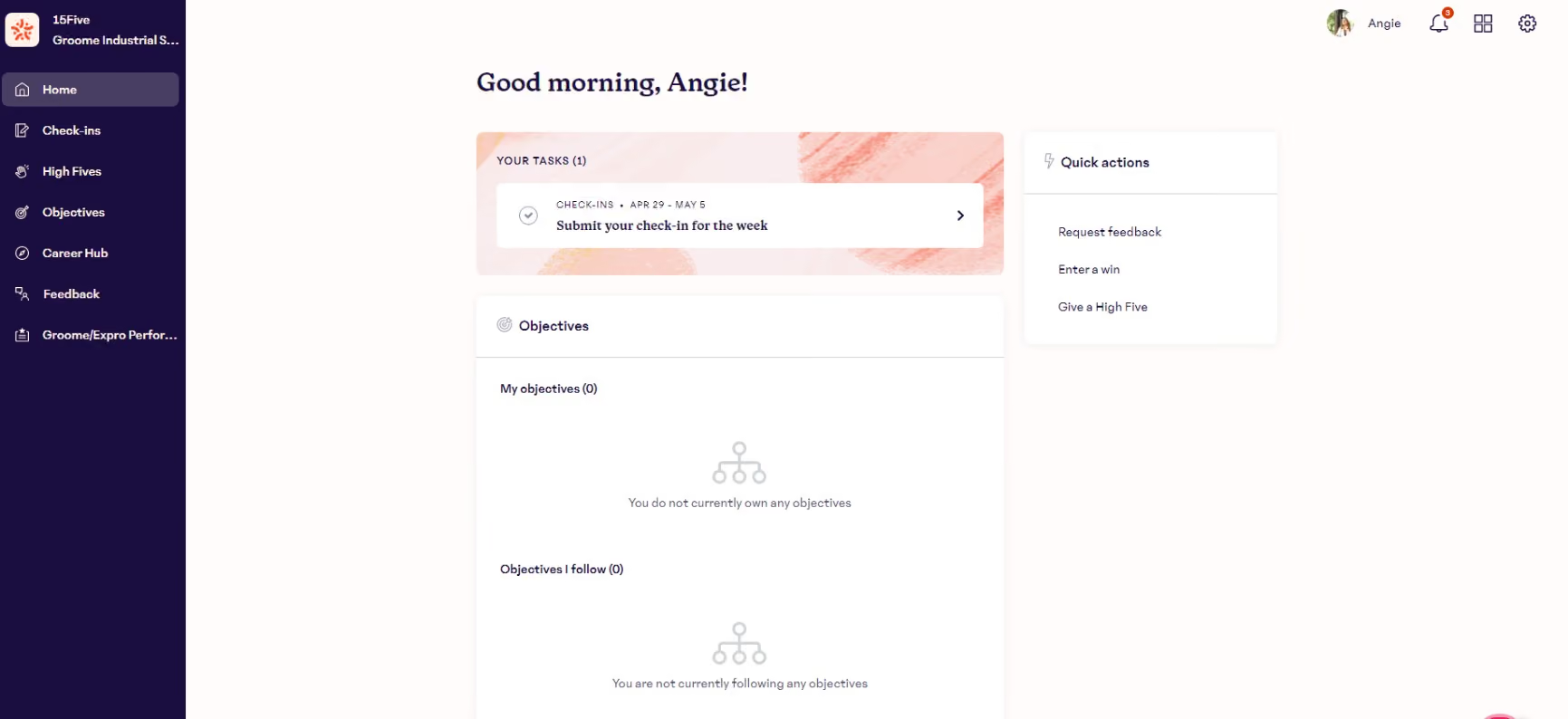
- I like it because it helps us with accountability, we can support and appreciate our coworkers. We can communicate easily. I like it overall.
- It’s a great tool to keep track of the performances of employees.
- I like the fact I can create objectives and goals to work on
Our organization saw a need to have this tool because it helps to track our employees and their progress. As you can provide feedback to your manager or peers, there is transparency in the process and the employees can be heard. We have used this tool for over a year and it has impacted us in a positive way. When our employees feel appreciated, we see better results, we can show appreciation weekly and it’s noticed by everyone in the company.
- Well, I would say sometimes employees like privacy and as shown to everyone on the appreciation piece, some people might not like it.
- Also, the responses to questions, are not anonymous, and sometimes people won't be honest to the fullest, fearing they would lose their job.
It's the first time I use a tool like this. So, I can’t really comment on the competitors.
They need to think about how this tool will improve the culture, and environment and also understand that the business will be impacted in a positive way as the employees are being heard. If someone has an idea, they can communicate via 15five.
It has helped me to share my thoughts on how I feel or for any new ideas that can help the business.
Any company wanting to give feedback and appreciation to employees.
For a company that is not focused on its employees.

Namely
Namely powerful HR suite streamlines how you manage your people. It covers onboarding, attendance tracking, performance management, payroll, and benefits administration. It also provides valuable insights into market trends so you can stay competitive.
PROS
- Namely offers a user-friendly interface that allows seamless navigation of the platform, even with its extensive features.
- The employee onboarding module has an easy-to-use wizard, facilitating a smooth onboarding process for employees and new hires.
- Besides Namely’s payroll and benefits administration features, you can opt for their managed payroll and benefits administration services to reduce your team's workload even further.
- The majority of users are able to navigate Namely without any issues. They find the UI to be intuitive and clean, despite the fact that the platform has lots of features.
- Namely’s employee onboarding module gets a alot of praise from users. It features an easy-to-follow wizard, which helps new hires get on quickly and be clear on what they need to do.
- Besides the platform’s built in features for data management, recruiting, onboarding, time off tracking, payroll and benefits administration, there are also managed payroll and benefits administration services you can opt for to reduce the burden on your internal teams.
CONS
- Namely caters mainly to the U.S. market, which means it’s not quite suitable for organizations that need it to handle payroll and benefits for employees in other countries.
- If you’re looking for quick implementation, Namely may not be for you as on average, 6-8 weeks are needed to get your instance up and running.
- Currently, Namely lacks employee development features such as skills training, career pathing, and succession planning.
- Users should look into whether Namely is compatible with their existing benefits provider, as a few users have reported instances where Namely's team encouraged them to switch to providers with higher fees.
- Namely primarily operates in the U.S., which means if you’re looking for a global payroll and benefits provider, this platform isn’t for you.
- Though many praise the platform’s ease of use, it does take long to implement it. Namely’s own team says that an average implementation takes between 6-8 weeks.
- For a platform of Namely’s size, there currently aren’t any features that focus on employee development such as skill training, career pathing, succession planning etc.
- You’ll need to check beforehand if Namely can work with your existing benefits provider, if you have one. There have been a few reports (but not few enough to ignore) about Namely’s team convincing customers to change their benefits provider to providers that charged them more.
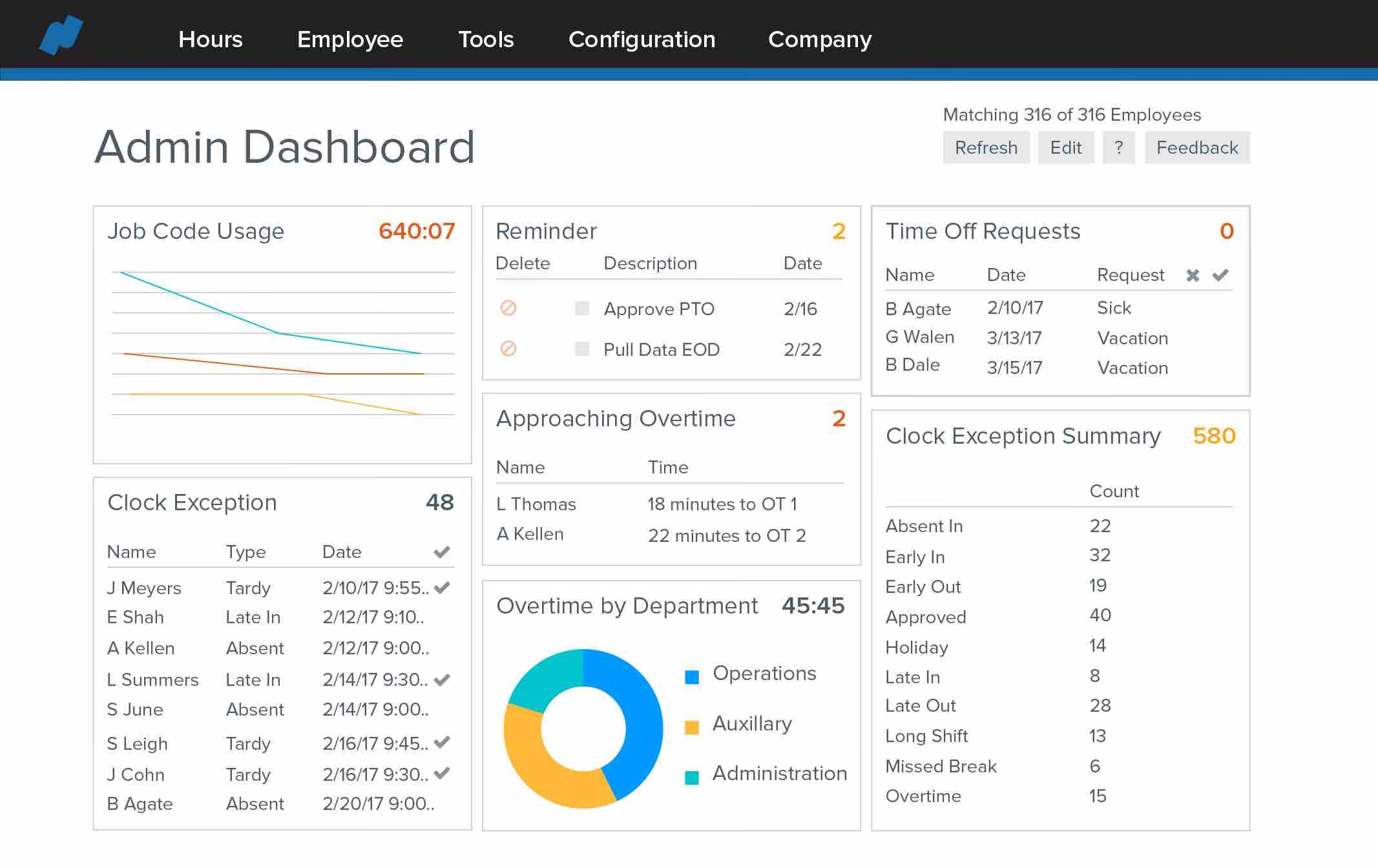
Namely offers a range of features to help you with day-to-day employee management. A fundamental one is employee profiles, which you can create from scratch or upload from existing sources. You can access these profiles whenever you need to view employee data, including personal details, job roles, performance history, and benefits information. Namely also packs payroll management capabilities, optimizing how you process payroll and helping you with calculations, tax filing, direct deposits, and more.
You can use Namely’s time and attendance tracking module to ensure accurate recording of work hours and payroll processing. You can stay on top of things even further with Namely’s performance management module, which can help you set goals, conduct evaluations, and provide feedback to employees among other things.
Namely is used by several growing companies including Greenhouse, Vita Coco, Life is Good, and OneLogin.
Custom pricing is available upon request of a demo. It will vary depending on which package you choose. They start with a basic HR package and then sell extensions or enhanced services for things like payroll solutions and employee benefits.
Best For
Mid-sized companies across different verticals will make the most out of Namely’s offering.
I use Namely daily to manage a wide range of HR features. One major way I utilize the system is to process payroll, ensuring that employee reimbursement is accurate and timely. I also manage benefits, including updating employee enrollments and answering insurance-related questions.
Another critical workflow is performance management, where Namely helps track employee goals, feedback, and reviews. I use it to maintain worker information in a database, updating it as needed to comply with legal and internal requirements. Overall, Namely provides a single, efficient platform for managing all essential HR tasks.
Namely has an extremely user-friendly interface that helps manage HR tasks efficiently. It integrates payroll, benefits, and performance management into one platform, simplifying key processes. The tool offers customizable reporting capabilities that provide insightful personnel data while maintaining compliance with regulations.
Namely, an automated HR solution preferred by our management after a long history of inefficient HR processes, has proven its relevance as all operations have been streamlined. Switching and gathering information from different platforms was difficult, especially when accustomed to one system's workflow.
Before introducing Namely, completing payroll, personnel records, and other internal processes was time-consuming and prone to errors. We aimed to implement automation to allow a focus on tasks like performance management rather than correcting discrepancies. Namely’s user-friendly interface, creative report design, and working tools played a crucial role in its successful implementation.
I have been using Namely for [insert your time of use], and it has made our human resource processes more efficient, improving workforce management. It has also eliminated the problem of waiting for reports, a common issue in many companies that wastes valuable time.
Customer support at Namely is slow, especially when handling urgent issues. Some customization options, like those for reports, are limited and should be more flexible. Occasional system glitches or downtimes can disrupt important HR workflows and reduce productivity.
Namely's key differentiator is its all-in-one platform, featuring an intuitive user interface that combines payroll, benefits, and performance management in one system. This reduces the need for multiple tools. Compared to platforms like ADP or Workday, Namely is much easier for non-technical users. While competitors may offer more in-depth functionality in specific areas, Namely strikes the best balance between features and simplicity, making it ideal for midsize companies seeking a full-service solution.
When investing in an HR tool like Namely, key considerations include scalability—ensuring the platform can grow with your company—and integration capabilities with other systems such as payroll and benefits providers. Ease of use is critical, as a user-friendly interface leads to higher adoption and minimal training. Additionally, it's important to assess the level of customer support provided and how responsive the vendor is when issues arise. Customization options are another important factor, as the platform’s ability to adapt to your specific HR needs can significantly impact day-to-day operations.
Namely has evolved significantly over time, enhancing its platform to meet user demands with better integration features. Originally focused on core HR management, it has expanded to include payroll management, benefits administration, and compliance tools that help companies align with regulations.
The user experience has improved with a more intuitive interface, and customizable reporting has become more robust to extract meaningful data. Namely has also responded to customer feedback by improving its customer support and onboarding processes, addressing concerns about response times and implementation smoothness.
Namely is ideal for mid-sized organizations, typically with 50 to 500 employees, that want a user-friendly HR solution covering all key HR functions. It is especially suited for companies seeking an easy way to manage payroll, benefits, and performance management without the complexities of large enterprise systems.
Namely also works well for organizations that value employee engagement and want to use data-driven insights to improve HR practices continuously. Its intuitive design makes it accessible for HR teams with any level of technical expertise.
Namely is likely not the best fit for very small organizations with fewer than 50 employees, as they may not need the full range of features and could find more affordable, simpler solutions.
Similarly, large enterprises or organizations with complex HR needs, such as extensive compliance requirements or highly specialized workflows, may find Namely’s functionality insufficient compared to larger systems like Workday or SAP SuccessFactors.
Companies requiring highly customized solutions or with industry-specific needs may also find Namely too rigid or limiting.

kissflow
Kissflow Digital Workplace gives you all the tools you need to optimize, manage, and track all of your work. It has five core modules to handle any type of work that moves your way: processes, projects, cases, datasets, and collaboration.
PROS
CONS
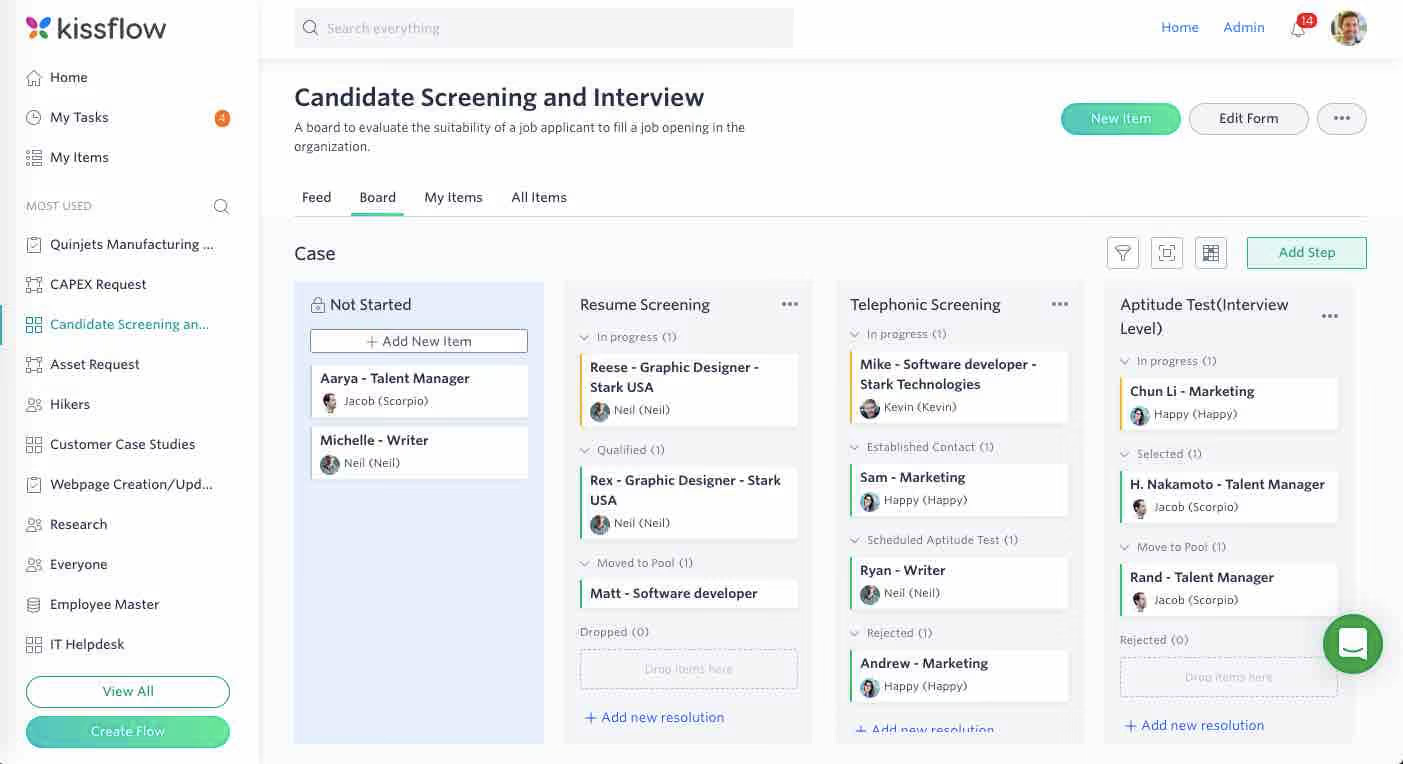
Kissflow is designed for both managers and their employees. It lets individuals know exactly what tasks are assigned to them and lets them track work as it moves along a flow. It allows team leaders to create and control codeless workflows and forms. It helps the entire organization digitize their work and creates an operational system of record to know the status of what work was completed.
- Domino’s
- Pepsi
- Sears
- Hubspot
- Casio
- Basic: $16/user/month (Starts at 10 Users)
- Advanced: $22/user/month (Starts at 10 Users)
- Fully Loaded: $30* /user/month (Starts at 50 Users)
Best For
Kissflow has plans for companies of different sizes.

Zoho People
Zoho People is a solution for HR teams looking for an affordable or even free workforce management tool. It administers core HR activities, like onboarding, time off management, attendance, performance, LMS, engagement, and database management. It also includes an employee self-service portal with security-conscious permission controls and more.
PROS
- Comprehensive core HR features consolidated in a single platform.
- Offers a wide array of integrations.
- Available in multiple languages, catering to users across the globe.
- Provides a free version and a free trial.
- All core HR features in a single dashboard
- Wide array of integrations
- User-friendly UI, constantly updated
- Available in multiple languages
CONS
- Some modules may lack the depth of comparable products. For example, some users found the payroll offering to be relatively basic.
- The mobile app does not mirror the features of the web version.
- The platform's responsiveness is unpredictable – users have reported occasional loading delays.
- Since they offer so many modules, some may be not as robust as other products that have been more specific about covering certain needs. For instance, some teams have found their payroll offering to be quite basic.
- Not all that’s available in the web platform is available in the app
- Some users reported that the platform can be slow to load every now and then.

Zoho People is a 360-degree HR solution that amazes us with its rich features. Depending on the plan purchased, users can get some or even all of their employee management needs covered, from onboarding and attendance management to time tracking, appraisals, and learning.
One standout feature is Cases. The feature lets users post their support questions under specific HR categories to receive prompt responses from assigned agents. It's a simple, effective, time-saving solution.
Zoho People features real-time access control. It allows administrators to assign access permissions for select members, promoting better collaboration while ensuring data security.
Another nice touch is Announcements: managers can use this to keep employees posted on company news using various content types, formatting options, and location-specific visibility.
In our testing, the self-service elements worked well in the Chrome browser. The web version contains numerous tools like employee records, leave requests, timesheets, and policy documents.
However, we did encounter some challenges with the mobile app. It occasionally lagged, particularly when using functions like check-ins and facial recognition. Additionally, certain tools, such as the payroll feature, are less fleshed out than in similar tools in this space.
ZPE Systems, Cloudfronts Technologies, Zomato, SpiceJet, Foresight CFO.
Zoho People is free for up to five users. After that, the platform offers four plans with the following pricing:
- Essential HR: $1.25/user/month billed annually.
- Professional: $2/user/month billed annually.
- Premium: $3/user/month billed annually.
- Enterprise: $4.5/user/month billed annually
Best For
This tool is particularly well-suited for SMBs who can make use of its multilingual capabilities.

I initially signed up for a free trial of the plan that I thought suited our organization’s needs best. After checking its suitability, I created my account as an HR partner and uploaded all employees’ data into the system. The platform has helped us automate a lot of our daily HR processes. I used Zoho People to manage employee records, track their attendance, monitor their performance as per KRA, and generate various reports. It streamlines the recruitment cycle starting from job posting to onboarding new talents. The tool has great features in terms of processing employees’ payroll. It has also helped us follow compliance, labor laws, and regulations by providing tools to manage legal documents, track compliance, and generate compliance reports.

- Zoho People helped us manage all employee data in a single location and made it easier to track employee records.
- Zoho People has features for employee self-service, performance tracking, and goal setting, which have helped our employees stay engaged and motivated in their work.
- Zoho People automates a lot of HR processes we used to do manually including attendance tracking, leave management, and payroll processing.
There are many reasons why my organization chose Zoho People: it has customizable features, it’s easy to use, and also cost-effective. It helped us to improve our HR operations and create a more engaged and efficient workforce. I must say Zoho People is worth buying as it streamlines all HR processes. I have been using the tool for 8 months.
- Zoho People could benefit from a more intuitive interface to make it easier to use.
- While Zoho People does have a strong mobile app, there’s room for improvement in functionality and speed.
- Zoho People does offer online documentation and support but it doesn’t cover everything so we do end up reaching out to the support team now and then.
While there are several competitors in the HR software space, Zoho People has several advantages that set it apart from the competition in my opinion.
- Zoho People integrates seamlessly with other Zoho apps, such as Zoho CRM, Zoho Projects, and Zoho Books, which is great if you happen to use their other products too, and can keep virtually all of your employees on a single platform.
- It is competitively priced and quite affordable for businesses of all sizes.
If anyone wants to buy a subscription to Zoho People, here are a few points to take into consideration:
- Determine business requirements and the features you need from the HR management software to choose the appropriate subscription plan.
- Check the pricing plans and select the one that fits the budget.
- Before subscribing to Zoho People, take advantage of the free trial to test the software and its features to evaluate whether it meets your requirements or not.
When Zoho people was first released, it was only used by small-size organizations as this software was limited to employee database, leave, and time tracking. Zoho People has evolved over time to become a comprehensive HR management software that offers a wide range of features to businesses of all sizes. The software's integration with other Zoho applications and its focus on mobile accessibility and analytics have helped it stand out in the crowded HR management software market. It also added a few features recently like an onboarding management system and integration with Zoho Analytics.
Zoho People is a cost-effective HR management software that is ideal for small and medium-sized businesses that may not have fully staffed HR departments. Zoho People is also a great choice for remote-working employees to collaborate, track time, handle scheduling, and more.
Large organizations: While Zoho People is suitable for small and medium-sized businesses, it may not be robust enough to meet the needs of large organizations with complex HR requirements. Zoho People's reporting capabilities may not be as advanced as other HR management software so it is not suitable for those organizations or businesses looking for advanced reporting capabilities.
Key Features of Employee Management Software
“Employee management” is an umbrella software category; hundreds of different HR management software solutions (HRMS) can be labeled under it. While that may be the case, the following are features you can safely expect from employee management software.
- Storing employee records: An employee management software effectively functions as your employee database. It stores employee information such as names, addresses, designations, salaries, and start dates. You can even store custom employee info such as skills, education, birthdays, emergency contact details, and more.
- Time and attendance tracking: Manually updating timesheets is a tedious task that’s time-consuming and almost impossible to perform without error. Incorrectly inputting employee time and attendance data leads to incorrect payroll. With the help of employee management software, you can cut down on human errors and ensure that your payroll is always accurate.
- Employee scheduling: Employee management software can help you schedule and move around shifts for your employees to ensure that the working hours of your business are sufficiently covered. Depending on what product you use, employees may also be allowed access to the same system to adjust availabilities and request shift changes.
- Employee self-service portal: Most employee management solutions provide employee self-service portals. Employees may use these portals to handle a number of human resources-related tasks that would otherwise require the attention of an HR employee. Most self-service portals allow employees to update personal details such as contact details, addresses, bank account info, and more. Some employee self-service portals also allow employees to put in time-off requests and adjust availabilities.
- Employee performance monitoring: Most employee management systems allow employers to define goals and productivity metrics and monitor employees’ progress towards those goals and metrics from a single dashboard. Accessing such data enables employers to make informed decisions that drive performance, e.g., identify where certain employees could use some training or if their skills are perhaps more suited for a different role.
- 3rd-party integrations: The majority of employee management software solutions offer integration options with your existing business tools, such as those for recruiting, payroll, enterprise resource planning (ERP), team collaboration, and more to extend the functionality of your software, have your data synchronized automatically and eliminate duplicated effort.
- Additional features: In addition to the above, some employee management systems may also carry features for applicant tracking, onboarding, payroll management, benefits administration, learning management, employee rewards, and employee recognition.
Common Mistakes Made When Buying Employee Management Software
You can easily make mistakes when choosing an employee management solution if you don’t carefully research and compare what’s available on the market while factoring in the needs and budget of your business. Here are a few mistakes you should avoid:
- Buying an all-in-one employee management software when all you need is one or two HR functions covered: For example, if you only need a system for performance management or attendance tracking, then buy a product that does just that. An all-in-one HR cloud can be quite costly if you’re not putting it to good use. We recommend that you always invest carefully and selectively to make the most out of your budget.
- Choosing an employee management system that isn’t scalable: Your business may see exponential growth within just a matter of months. It may also experience financial hardships, requiring you to downsize your team. No matter what the future holds for your business, you’ll definitely need your employee management software to grow or shrink accordingly.
- Not aligning internally with all departments that could benefit from an employee management system before buying one: Many top employee management systems offer features extending beyond your HR department’s scope. For example, employee management software can have project management capabilities, which means different managers across your company can use it to stay organized and keep track of their team members’ progress. It is also quite common for an employee management system to have payroll processing and benefits administration features, which are typically the responsibility of the finance department and not HR. Since other departments/managers can benefit from your employee management system, make sure you factor in their feedback in your product selection process.
- Making long-term commitments before thoroughly testing a solution: Most software vendors will offer discounts if you get into an annual contract. Some will even try to tempt you to get into a two-year commitment. While such deals can save you significant money over time, you should only commit to a vendor after thoroughly testing their software and verifying that it’s the one for you. Otherwise, you will end up going back and forth with them regarding their refund policy and likely incurring a considerable cancellation fee.
Pricing Models of Employee Management Software
The majority of employee management software vendors offer tiered pricing to accommodate different business needs and financial capabilities. Those tiers vary in features and either cost a flat monthly/annual subscription fee for an unlimited number of employees or have a per-employee-per-month pricing structure, which could cost anywhere between $1.25 - $30 per employee per month.
Do keep in mind that in all cases, additional fees may still apply for on-demand services such as product training, customization, compliance services, dedicated account management, and cancellation. Consult your selected employee management software vendor on the exact breakdown of their recurring fees as well as the pricing of all on-demand services that are billed separately.
Benefits of Using Employee Management Software
Using employee management software allows you to:
- Secure employee information: Paper files and spreadsheets are not a secure way to store sensitive employee data, as they could easily fall into the wrong hands. You can mitigate such risks by using an employee management system instead. The majority of employee management systems are highly secure, with measures such as data encryption and multi-factor authentication to keep your employees’ information safe at all times.
- Increase productivity: Using an employee management system helps you automate many processes that are otherwise quite tedious and take up a great deal of your team’s time. When different departments across your company aren’t manually dealing with employee data maintenance, time and attendance tracking, shift scheduling, and leave management, they’re able to reinvest that time in other tasks that contribute to your bottom line.
- Improve employee satisfaction: Good HR tech has an impact on employee experience and retention. When employees are managed through outdated channels and processes, it is easy for them to get frustrated and dissatisfied with your company. Employee management software gives your employees a channel to easily update their information, request time off, adjust their shifts, track their performance, communicate with you when needed, and much more - all in an effortless manner.
Questions to Ask During Your Employee Management Software Demos
As you’re researching different employee management software, we always recommend that you schedule demo sessions with the top vendors on your list to make sure their solution is compatible with the needs of your business. Here are a few questions you can ask during your demos:
- What HR functions does your software cover? Can your solution replace other products in my HR tech stack?
- Can you walk me through what employees see through their self-service portal (if any)?
- Does your platform feature Artificial Intelligence (AI) to automate certain processes?
- How easy is it to implement your solution, and would I be able to do it myself?
- What business solutions does your software integrate with?
- What metrics have you used to prove the effectiveness of your solution, and where can I see these in my analytics dashboard?
- What data protection laws are you compliant with?
- How much does the software cost for my team size?
- How will our pricing change as our team grows or shrinks?
- Will I be assigned a dedicated account manager?
- What are your Customer Support SLAs?
- Do you have a help center with articles and other documentation for self-service?
Implementing an Employee Management Software
Implementing employee management software is fairly easy, especially since the majority of them are cloud-based, delivered through a software-as-a-service (SaaS) infrastructure. Getting started with a cloud-based solution is relatively quick. Once you’ve purchased a subscription that meets your needs, you can create an account and start configuring it and importing your employee data.
On the other hand, some employee management software solutions are self-hosted (on-premise). Self-hosted solutions generally take longer to set up, and depending on your chosen vendor, you may need to consult them regarding their solutions’ compatibility with your current hardware and installation process or better yet, have them do the installation for you.
Note: Most of the vendors we’ve listed in this guide provide step-by-step video tutorials and help docs that assist customers in getting up and running quickly. For more information, you can reach out to your chosen vendor’s support team.
Employee Management Software FAQ
What is employee management software?
Employee management software allows companies to carry out different HR functions, including time and attendance tracking, new hire onboarding, shift scheduling, leave management, employee engagement, and performance management. It may also have features for payroll processing and benefits administration.
What should you look for in employee management software?
Besides making sure that employee management software covers the HR/finance functions that you need, see that it is user-friendly, scalable, can integrate with favorite products, and has an employee self-service portal.
Who needs employee management software?
All businesses, regardless of size and industry, can benefit from employee management software to streamline how they store employee information, onboard and offboard employees, as well as drive up employee engagement and performance.
Final Thoughts
No matter what industry you’re in and regardless of the size of your company, an employee management system is quite useful to streamline different functions across your HR department and beyond. All of the solutions we’ve listed in this guide would make a great addition to your tech stack. All you have to do is:
- Align with your HR, Finance, and other team managers regarding their needs and expectations before selecting a product;
- Carefully consider those needs as well as your budget and choose a product that meets them;
- Request a trial account to test the platform’s features first-hand;
- Schedule demo sessions with different vendors to get all of your questions answered.
About the Author


About Us

- Our goal at SSR is to help HR and recruiting teams to find and buy the right software for their needs.
- Our site is free to use as some vendors will pay us for web traffic.
- SSR lists all companies we feel are top vendors - not just those who pay us - in our comprehensive directories full of the advice needed to make the right purchase decision for your HR team.


