

Best EOR Companies in India: A Comprehensive Review for 2026
Some of the best employer of record services for hiring in India are Native Teams, Remote, Deel, Papaya Global, and G-P.











Hiring in India opens the door to a deep, highly skilled talent market, but the mechanics of employing people there can be more challenging than they seem. The country’s talent market spans IT, BPO, engineering, manufacturing, and pharmaceuticals, each with its own hiring patterns, compliance quirks, and operational expectations. What works for a software team in Bengaluru may fall short for a manufacturing workforce in Pune or a pharma operation in Hyderabad.
An Employer of Record (EOR) exists to absorb that complexity. This guide breaks down how EORs in India operate, what to look for across industries, and which providers are best equipped to support compliant, scalable hiring without the overhead of setting up a local entity.
While the providers reviewed here vary in scale and specialization, all were assessed against the same core criteria. In some cases, platforms were very close. When that happened, I used secondary factors such as pricing transparency, product usability, and operational depth to help break the tie.
- Compliance Expertise: Compliance was the non-negotiable starting point. Any EOR operating in India must demonstrate a working, up-to-date understanding of local labor laws, including the Industrial Disputes Act, Employees’ Provident Funds and Miscellaneous Provisions Act, Employees’ State Insurance Act, Payment of Gratuity Act, and Minimum Wages Act. I looked closely at how providers manage statutory requirements like income tax withholding (TDS), Provident Fund (PF), and Employee State Insurance (ESI), as well as how they handle audits, filings, and regulatory changes over time.
- Service Scope and Offerings: Here, consistency mattered. Strong providers handle the full employment lifecycle, including compliant onboarding and offboarding, benefits administration (PF, ESI, gratuity, and health insurance), local employment policies, and ongoing employee support. For companies hiring non-Indian nationals, visa and work permit support was also factored in.
- Technology and Platform Capabilities: I paid close attention to how each platform actually works in practice. The best EOR tools are intuitive for administrators and employees alike, reduce manual intervention, and integrate cleanly with existing HRIS or accounting systems. As a polished interface means little if the underlying safeguards are weak, I also vetted the security layer. Given the sensitivity of payroll and employee data, providers were evaluated on their data protection practices, access controls, and alignment with Indian data protection requirements.
- Pricing Structure and Transparency: I prioritized providers that offered straightforward, transparent pricing with clearly defined inclusions. Core services like standard onboarding, compliance support, and statutory filings should not appear later as surprise add-ons. When providers were otherwise evenly matched, transparent pricing and predictable cost structures helped distinguish those built for long-term partnerships from those optimized for quick wins.
SSR's editorial standards ensure independent recommendations, free from sales team influence. We never accept payment for inclusion, nor do we allow advertisers to affect our rankings or assessments. Learn more about our HR tech vetting process.


.png)
Deel

Deel handles employee benefits, payroll, and tax obligations under Indian law right out of the box, making it one of the most turnkey EOR options for global companies hiring in India. Their 24/7 global support and ability to onboard employees in as little as three days also helped secure their place in my top picks.
PROS
- Covers all mandatory Indian benefits: PF, pension, and optional healthcare.
- Onboards employees in India within three business days.
- Fully self-serve platform with streamlined setup and ID verification.
- 24/7 in-app support with access to local payroll experts.
- Integrates with 100+ HR platforms and offers custom APIs.
- Central dashboard for managing Indian payroll, taxes, and contracts.
- Excellent 24/7 customer service with fast onboarding (2-3 days) and local payroll experts in each jurisdiction.
- Seamless integration with platforms like QuickBooks, BambooHR, and Greenhouse, plus custom integration options.
- User-friendly, self-service features enable quick setup; identity verification often takes under 24 hours.
- Automated invoices simplify payments, provided they're in English.
CONS
- Additional fees apply for features like onboarding automation.
- Benefits packages are standardized, limiting customization flexibility.
- Contract edits typically require legal assistance or add-ons.
- Invoice generation is only available in English.
- No free trial or sandbox environment for testing workflows.
- The self-service model may feel too hands-off for some teams.
- Key features like onboarding automation are add-ons, which may increase costs.
- Limited flexibility in modifying contracts or service agreements; changes often require an addendum.
- Invoices cannot be generated in languages other than English.
Deel is often described as a sound option for distributed teams to access global talent, so I went in expecting speed and consistency more than depth. In practice, their India EOR does handle the basics well. Statutory requirements like Provident Fund, Employees’ Pension Scheme, and optional healthcare are baked in, and onboarding moved quickly in clean scenarios. In my testing, employees were active in about three business days, with identity checks often completed within the first 24 hours.
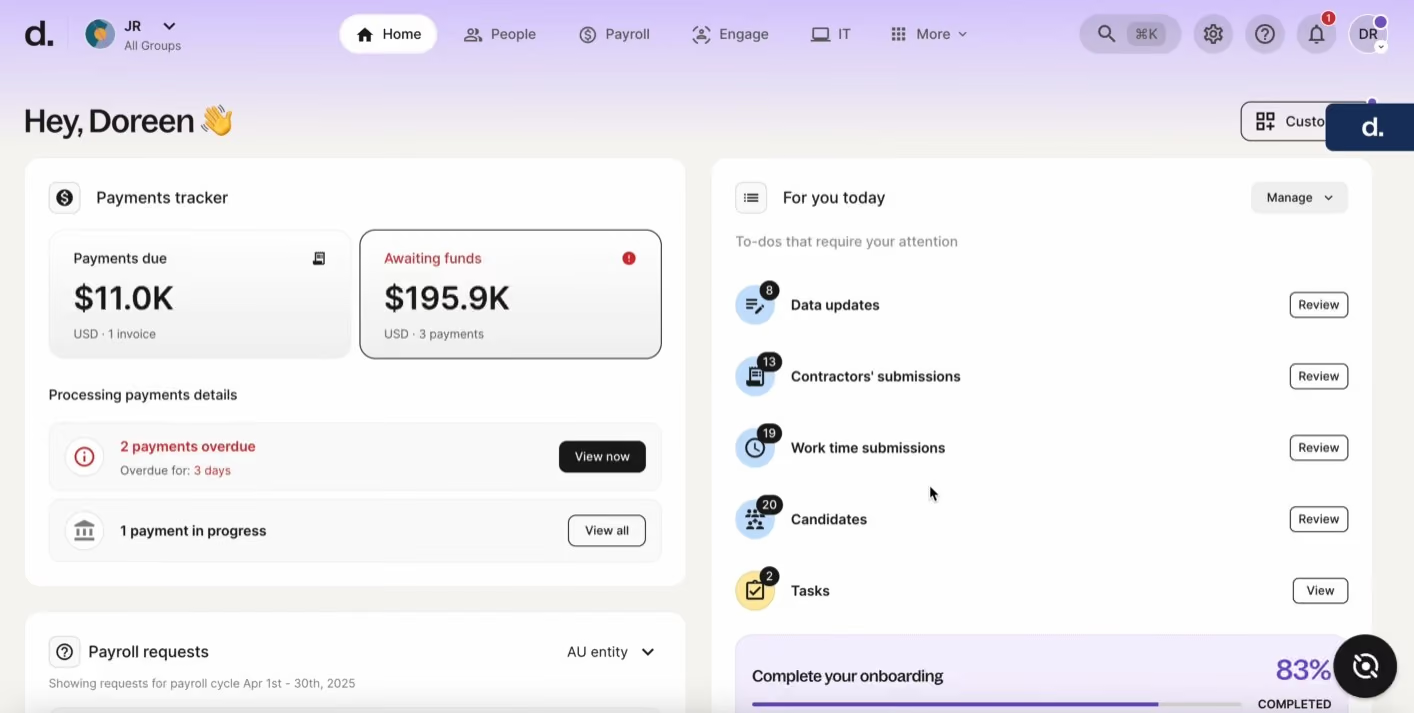
Using the platform felt straightforward and largely frictionless. The dashboard is clean, and once employees are live, payroll, tax deductions, and benefits are easy to track in one place. I didn’t have to hunt for key information or second-guess where something lived. Compared with some India-focused EORs that feel heavier or more manual, Deel behaves more like a plug-and-play system, which I can see being appealing for teams hiring at scale.
That said, the simplicity only works up to a point. Deel’s benefits are mostly pre-packaged, and while that keeps things moving, it limits how much you can tailor plans or perks. I also found contract customization to be less flexible than expected. More nuanced or frequently updated agreements typically require legal add-ons, which introduce both cost and delay. This won’t be a dealbreaker for everyone, but it stood out when compared with more hands-on providers.
Pricing starts at $599 per employee per month, plus an estimated 12.5% of gross salary to cover employment costs. The management fee itself felt in line with competitors like Remote, but some advanced capabilities, such as onboarding automation and workflow testing, come at an additional cost. Overall, I see Deel working best for teams that prioritize speed and standardization. For companies that expect to customize heavily as they grow in India, it may feel more limiting over time.
Deel provides its Employer of Record services in two distinct pricing tiers:
- Standard: Begins at $599 per employee per month.
- Enterprise: Begins at $899 per employee per month.
These services are offered as a component of the broader Deel Hire platform.

Best For
Deel Hire’s EOR offerings are ideal for fast-scaling companies that want to hire full-time employees in India with minimal operational friction and a fast onboarding process.


We use it to track our contractors, pay their invoices, collect W9s. As our EOR, it allowed us to bypass the financial and time costs with establishing a subsidiary overseas. It keeps us in compliance with international labor laws, includes global payroll, offers benefits/participates in local social welfare programs and ultimately retains key employees we would have lost as 1099 contractors.
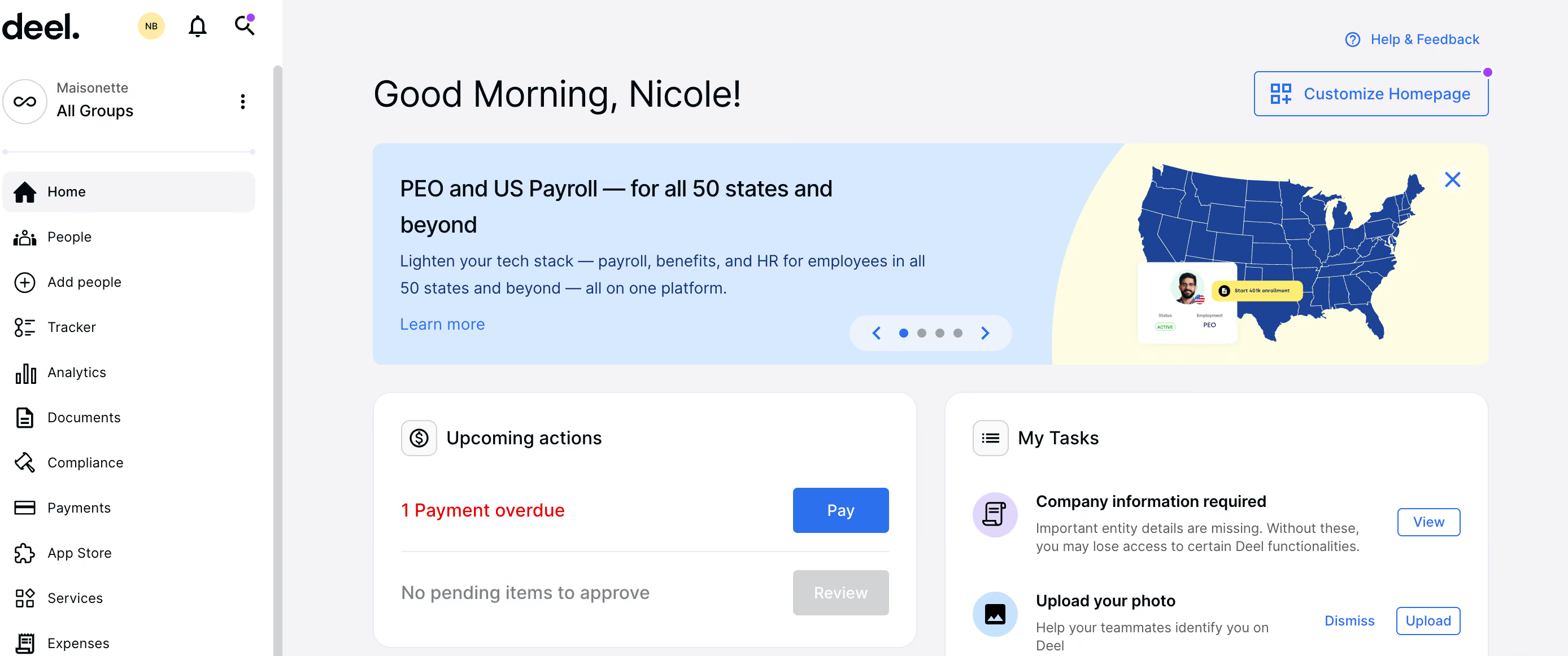
I like that the process and layout is very similar regardless of which product and service you use from them - quite intuitive. It supports employers ability to maintain compliance by listing out requirements and flagging missing items or expired items. Lastly, being able to file 1099s digitally is a luxury I hadn't had previously. A total time saver.
We implemented Deel initially as a way to pay our onshore 1099 contractors, track their contracts and contact information outside of our HRIS. After two years, we had a new problem to address and changed our Deel platform to include an EOR. We had offshore contractors that we wanted to bring on as full-time employees to retain them and ensure compliance with the IRS. The change was seamless and the EOR is intuitive, informative and our offshore employees have been satisfied with the service from their end.
I think there is room to improve the connection between employer and the EOR service representatives in that a dedicated point-of-contact that is in house with Deel and not an international partner. Another consideration for EOR is having to pay a month's salary deposit up front for payroll is not ideal for cash flow. Lastly, I would love to see more employee and contractor features that you might find on a traditional HRIS because I believe it would be a better and more enriched experience for them.
For 1099 contractor management, oftentimes you use an ERP or accounting SaaS which has limitations. Deel bridges the gap between accounting SaaS/ERPs and an HRIS. For EOR, Deel is middle of the road in value. It is a great option for smaller OPEX budgets, but there are other EOR companies who offer more desirable features and better in-house service partners.
Consider the number of contractors or employees you would need for the upfront and annual costs to be justified. Whether or not you are familiar with global payroll, consider how much compliance support you need or is desirable for you. Lastly, consider whether you are up to converting your local currency to the international currency. Deel does not currently offer this in the employee profile, they only show the employee's local currency.
There is better customer service and help tutorials. Further, I have found there is an increase in the amount of educational materials available through Deel in order to stay current on contractor and global payroll trends and compliance.
I have known it to be used by HR and Finance professionals alike. Payroll administrators, regardless of where they fall organizationally, will find this tool beneficial. I believe organizations where these contracts or payrolls are relatively straightforward can benefit. Running payroll and paying invoices takes 10 mins or less per pay period.
I believe complex and large organizations may not find Deel to be scalable to their needs. At volume, Deel is not the best for tracking or reporting. For smaller teams, these features are acceptable and function appropriately.

Papaya Global
Papaya Global’s 72-hour guaranteed payroll payouts, support for over 160 countries, and direct INR payments through global banking partners are built to meet the demands of complex, distributed teams. For India specifically, I like its end-to-end compliance coverage and multi-currency workforce wallet, which ensures accurate, on-time payments.
PROS
- Serves 160+ countries, including full India EOR support.
- Pays in 100+ currencies with INR support via global bank partnerships.
- Guarantees payroll payouts within 72 hours.
- Includes supplemental benefits and immigration support for Indian employees.
- Modular platform includes EOR, payments, compliance, and analytics.
- Dedicated support team with India-specific payroll expertise.
- Papaya Global packs the EOR services you need to do global payroll and employment compliantly in over 160 countries.
- Automated payments in over 100 currencies, 80 of them directly to the worker's bank account through its global banking partners.
- Dedicated customer support providing locations-specific knowledge regarding employment and payroll.
- End-to-end payroll guaranteed payouts in 72 hours.
- Offers four standalone solutions: data and insights, supplemental benefits & immigration support, payment services, and employee data management, making the platform more affordable and scalable.
CONS
- Requires setup fees, onboarding charges, and a refundable deposit.
- BI reports, immigration services, and tax filings cost extra.
- Built-in integrations are limited and requires custom API or SFTP setup.
- No free trial or free plan.
- Doesn’t own entities in all the countries it serves. The platform forms relationships with existing local in-country partners to handle employment in a specific region on the client’s behalf.
- BI analytics reports and global immigration services cost additional fees.
- Charges extra fees for setup, onboarding, employee cycle, and tax filing. Also requires a refundable deposit.
- Built-in integration options aren’t very robust. However, the platform does offer pre-built APIs, SFTP, and custom API integrations for free.
Papaya Global feels engineered for teams that care about execution speed more than anything else. From the outset, the platform leans heavily on automation, and that bias shows up quickly in how payroll and payments are handled for India. What stood out most to me was the guaranteed 72-hour payout window. After dealing with EORs where payment timing can feel opaque or overly cautious, that kind of commitment removes a lot of uncertainty for both employers and employees.
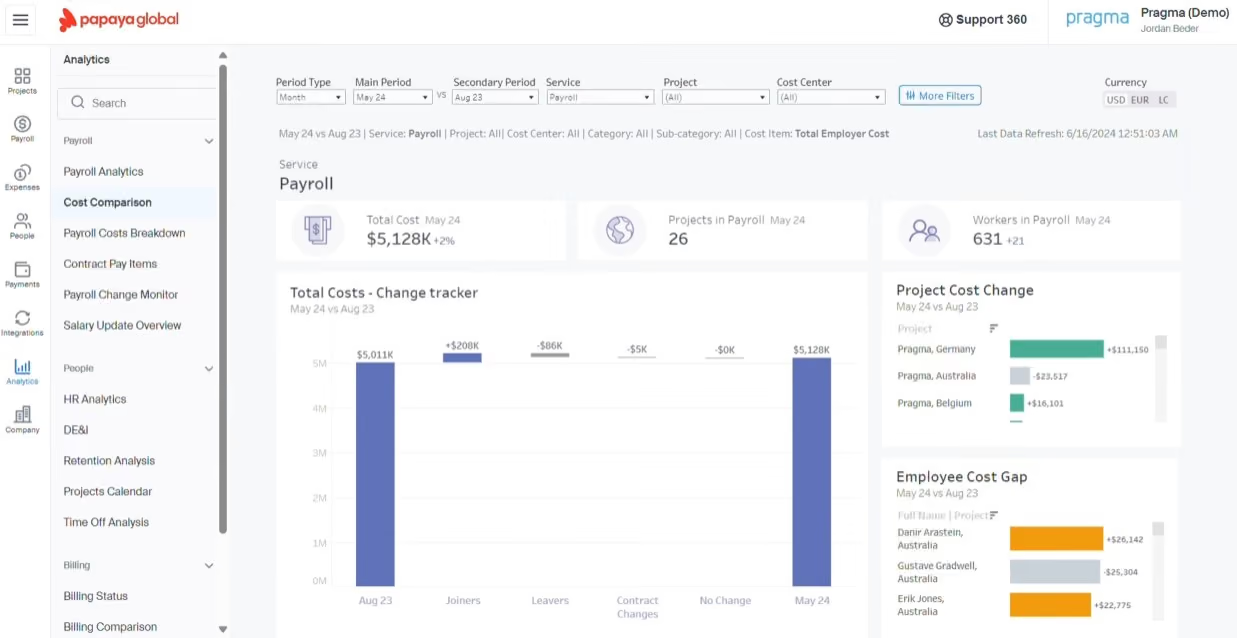
Where Papaya really separates itself is in how it handles money movement. The multi-currency workforce wallet is more than a convenience feature. It supports INR payouts while also helping manage currency exposure, which I found especially useful for U.S.-based companies paying Indian employees from abroad. Compliance requirements like Provident Fund, gratuity, tax withholding, and notice periods are covered by an automated rules engine. Once configured, much of this runs quietly in the background, with fewer checkpoints than I’ve seen on more compliance-heavy platforms.
The trade-off shows up when you look closely at pricing. While the headline fee starts at $599 per employee per month, core services like setup, onboarding, analytics, and tax filings come with additional charges. In practice, that means the total cost can be harder to predict upfront. This isn’t necessarily a flaw, but it does push Papaya toward buyers who are comfortable with modular pricing rather than all-in simplicity.
Starts at $599/employee/month.
Best For
Papaya Global is best suited for enterprises that need fast, accurate India payroll with advanced currency management and strong automation at scale.

We used Papaya Global to manage payroll across our international entities in Israel, Belgium, Germany, and the UK. The platform allowed us to centralize and standardize our payroll processing for these regions.
Beyond payroll administration, we also used Papaya for detailed reporting and analytics. This helped us maintain transparency and oversight across countries. Overall, Papaya was intended to serve as a key tool in managing our global payroll operations.
While I don’t have anything positive to say about Papaya Global specifically, the concept of the platform is a great idea if executed correctly.
One thing that was done adequately was that the implementation was relatively smooth on the company’s end. The website itself was easy to navigate.
We needed a payroll platform that supported our global entities. At the start of the merger, we were managing multiple payroll providers across regions, which created complexity and inefficiency.
Our goal was to streamline operations by consolidating everything into a single, unified system. We wanted better visibility into payroll processing worldwide.
We ultimately sought one platform that could handle compliance, accuracy, and scalability across all of our locations.
Inconsistent billing practices—we were constantly billed for services we never used or requested. We haven't used Papaya Global in over two years and still receive invoices for services rendered, even though none have been provided.
Customer service was poor; when we had an issue, it was always bounced around with no accountability or resolution. Reporting functions were inadequate. Payroll reporting was frequently incorrect, with continuous errors in paychecks and tax deductions.
Papaya Global falls significantly short of expectations and failed to deliver on its promises. Throughout our use, we encountered numerous limitations that hindered efficiency rather than improving it. The lack of flexibility and overall reliability made the platform a burden instead of a solution.
Watch for hidden fees. Papaya Global may seem inexpensive compared to some competitors at first, but costs can add up over time. You’ll also need to have someone on staff who is proficient in global payroll to double-check their records.
Papaya Global hasn't evolved. We canceled the service in 2023.
Papaya Global can work for someone very small, with fewer than 10 employees.
Anyone who relies heavily on their assistance for compliance or has many employees in any given country will not find Papaya Global adequate.

G-P
For companies hiring in India who prioritize legal precision, local expertise, and regulatory peace of mind, I see G-P as a sound option, showing via its fully owned local entity, decade-long experience, and high client satisfaction with onboarding and HR compliance.
PROS
- Fully owned Indian entity enables compliant contracts and benefits.
- G-P Gia AI engine flags compliance risks and automates employment workflows.
- Trusted by enterprises for reliable global payroll, including crypto support.
- Offers benefits, contract, and tax management under one roof.
- 180-country reach enables consistent global expansion beyond India.
- Strong legal and HR support.
- Their G-P Meridian platform is heavily focused on the EOR space, but it’s offered in several plans that can cater to varying needs, even those that might only need to hire people as contractors.
- Using their tool also implies access to a team of HR and legal professionals with significant experience in each country they operate in.
- Their UX has evolved continuously and gotten more intuitive and modern each time we delve into the product.
CONS
- No public pricing, and a per-country pricing model can increase total costs.
- Integrations and reporting tools lag behind more modern EOR platforms.
- No built-in HRIS or performance tools for broader workforce management.
- Workflow and contract customizations often require enterprise-level plans.
- Customizing a contract is only possible with the G-P Meridian Prime plan.
- Features like background checks, equity management, and IT equipment— to name a few— are only available as add-ons.
- There is no way to try out the software product unless you sign up for a demo and request a proposal.
G-P positions itself as a conservative, compliance-first EOR, and that framing holds up in India. The company has been operating in global hiring for over a decade and runs its own Indian entity, which shows in how methodically it handles employment contracts, payroll, taxes, and statutory benefits. In practice, everything feels tightly controlled. If your priority is minimizing legal exposure rather than moving fast, I can see why G-P appeals.
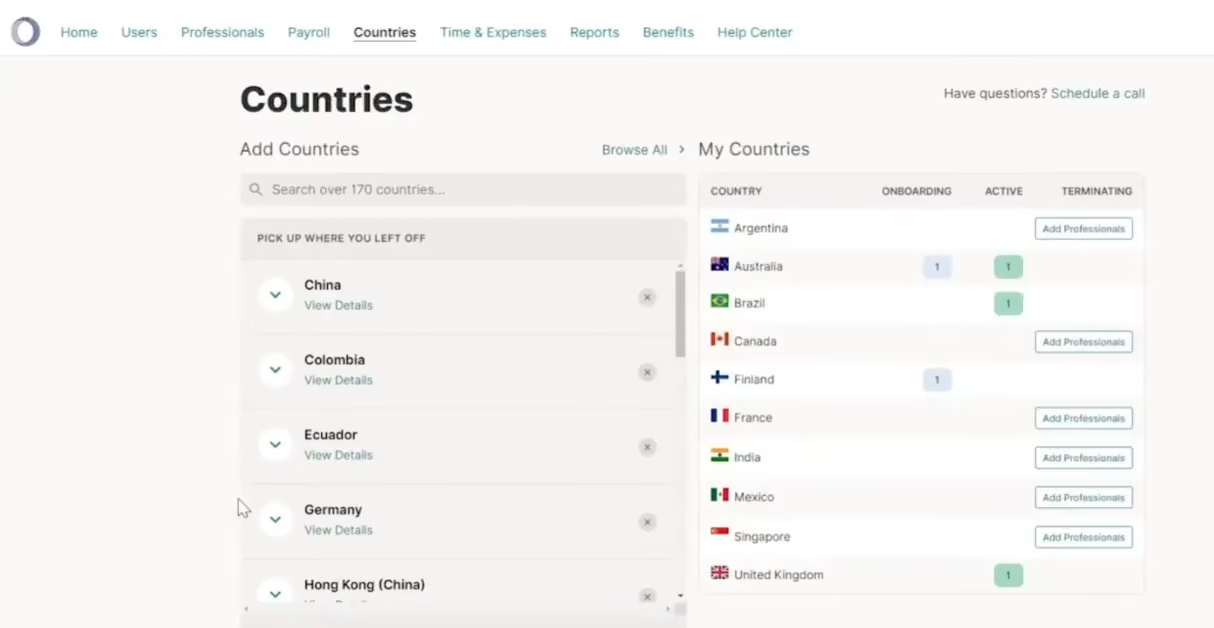
When I tested the platform, the interface felt simple and unintimidating, especially compared with more feature-dense competitors. It doesn’t try to do too much at once. One area that stood out was G-P Gia, the company’s AI assistant. It does a solid job of automating repetitive steps and flagging potential compliance issues before contracts are finalized. That kind of early warning can save time and prevent mistakes, particularly in a regulatory environment that changes as often as India’s.
That said, G-P’s workflow flexibility and integration options aren’t as robust as what I’ve seen from newer platforms like Deel or Remote. There’s also no native HRIS or performance management layer, so if you’re looking for a more unified HR stack, you’ll need to rely on separate systems.
Pricing is another area where G-P may give some teams pause. The company doesn’t publish standard rates, and costs increase on a per-country basis. If India is just one part of a broader multi-country expansion, that pricing structure can add up quickly. To be fair, this won’t matter as much for organizations that value predictability and compliance depth over cost optimization.
Undisclosed.
Best For
G-P is ideal for mid-sized to enterprise companies hiring in India who need rock-solid compliance, legal infrastructure, and hands-on local HR guidance.

My organization relied on G-P to manage our international employees efficiently. Specifically, we used it to streamline our onboarding process, payroll management, compliance management, and benefits administration.
Since G-P handled these functions collectively, we were able to focus more efficiently on other core operations within the organization.
G-P provided my organization with a simplified approach to compliance management, taking care of complex compliance issues, including payroll, benefits, and tax regulations from a global perspective.
Onboarding new employees across multiple countries was also more efficient, including contract management.
Additionally, G-P provided region-specific support, which was especially helpful for navigating various languages and laws across different countries. This gave my employees more accessible HR support.
My previous organization decided to purchase G-P last year because we were experiencing rapid global growth, and managing global compliance was becoming more complex.
We needed software that provided a solution to handle everything, including payroll, benefits, and understanding local tax laws, without creating a significant financial burden on our organization.
G-P managed most of the heavy lifting related to compliance, making it easier to onboard new employees globally. I personally began using the software during the implementation process, and the support staff at G-P were very responsive, which was invaluable.
G-P could offer additional HR tools, such as features for performance tracking and employee engagement.
The onboarding process could be more customizable to allow organizations to incorporate more brand-specific elements.
Another drawback is that G-P does not offer a dedicated section focused on training and employee development.
G-P stands out from competitors by offering a more comprehensive compliance management system. Compared to other solutions like Velocity Global, G-P handles more extensive international compliance requirements, providing additional checks and balances to ensure adherence to local laws.
When evaluating this type of tool, organizations should consider how it handles onboarding, manages local employment laws, and the level of ongoing employee support offered.
- The onboarding experience is important, as its quality can significantly impact company culture.
- Local employment law management is critical; strong compliance can help organizations avoid legal fees and fines.
- Reliable ongoing employee support is essential, specifically in terms of response times and problem-solving capabilities.
Most recently, in 2022, G-P rebranded to "G-P" to reinforce their commitment to supporting organizations in global growth. This rebranding was one of the first steps G-P took to demonstrate a proactive approach to enhancing their software.
G-P is particularly well-suited for small to mid-sized organizations. These companies often face challenges in hiring a dedicated HR department to manage global operations.
G-P may not be ideal for organizations that require highly customizable software. If an organization needs to tailor its onboarding or performance management processes significantly, this program may not be the best choice, as its primary focus is on compliance.

Payoneer Workforce Management
I like Skuad for its affordability, speed, and growing relevance for businesses expanding into India. Their platform balances cost-effective hiring with compliance with Indian labor law and offers localized benefits packages, which positions it as a highly competitive option for companies just starting to build international teams or operating on tighter budgets.
PROS
- Starts at just $199 per employee/month—significantly lower than most EORs.
- Offers customizable Indian benefits and fully compliant payroll support.
- The platform includes contract generation, expenses, and HR reporting.
- Scalable, multi-currency setup ideal for global employment.
- Responsive client support with India-specific employment expertise.
- Unified dashboard improves visibility across HR and payroll workflows.
- Starts at just $199 per employee/month—significantly lower than most EORs.
- Offers customizable Indian benefits and fully compliant payroll support.
- The platform includes contract generation, expenses, and HR reporting.
- Scalable, multi-currency setup ideal for global employment.
- Responsive client support with India-specific employment expertise.
- Unified dashboard improves visibility across HR and payroll workflows.
CONS
- No mobile app; platform access is limited to desktop use.
- First-time users may find the UI non-intuitive.
- Social security and benefits costs aren’t clearly itemized.
- Occasionally, delayed responses due to back-and-forth between local partners.
- The portal may lack awareness of legacy or customized company policies.
- No mobile app; platform access is limited to desktop use.
- First-time users may find the UI non-intuitive.
- Social security and benefits costs aren’t clearly itemized.
- Occasionally, delayed responses due to back-and-forth between local partners.
- The portal may lack awareness of legacy or customized company policies.
Skuad, now operating under Payoneer Workforce Management, is best known for being one of the cheaper ways to hire in India through an EOR. Going in, I expected trade-offs, but the low starting price at $199 per employee per month is genuinely hard to ignore, especially for startups or small teams expanding internationally for the first time.
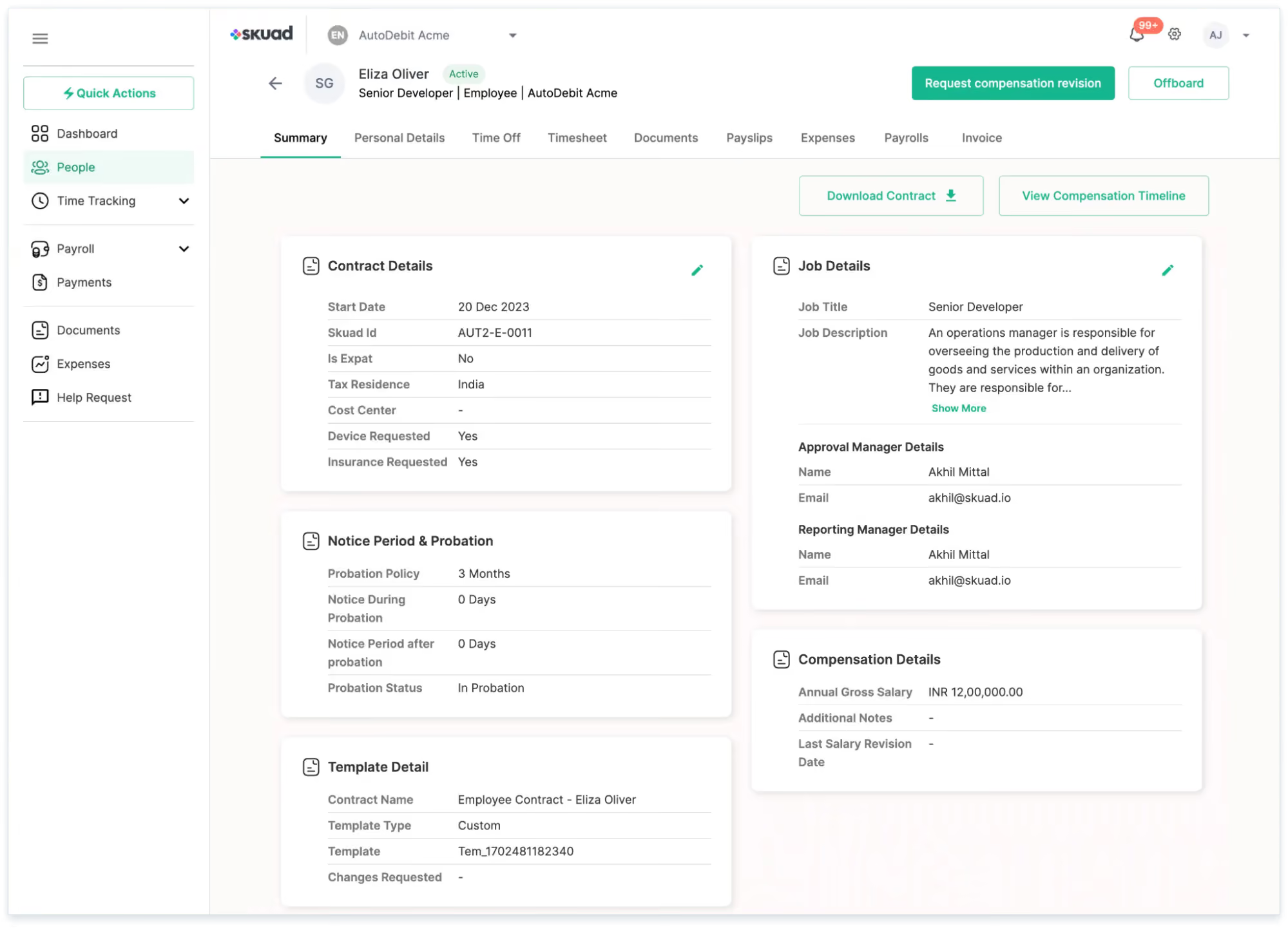
In practice, the platform covers more ground than I expected at that price point. Core features like contract generation, compliant payroll, and local tax handling are built in, and onboarding in India automatically accounts for Provident Fund, ESI, and income tax obligations. I also appreciated the multi-currency support and built-in legal safeguards, which help reduce misclassification risk. There’s even some room to customize benefits, which isn’t always a given with lower-cost EORs.
Where Skuad shows its limits is in polish and accessibility. The lack of a mobile experience stood out quickly. Basic tasks like viewing payslips or requesting leave require a desktop login, which feels dated for distributed teams. Support is generally responsive, but I did come across feedback about slower resolution times for policy-specific questions, particularly when coordination with the client company was required. It works, but not always quickly.
Cost transparency is another area that could be clearer. While the headline pricing is easy to find, I wasn’t able to locate detailed breakdowns for statutory versus supplemental benefit costs in India. That may not matter much early on, but it could become an issue for finance or HR leaders planning longer-term headcount.
Starts at $199/employee/month.
Best For
Skuad is best for startups and SMBs looking for a low-cost, scalable EOR solution to hire full-time employees in India compliantly.

GoGlobal
While many EORs rely on tech automation, GoGlobal’s strength lies in navigating India’s complex employment laws through direct support, local HR professionals, and compliance consulting. Their deep knowledge of India's dual-layered legal framework (central + state) makes them a strong choice for companies new to the Indian market.
PROS
- Fully compliant with Indian employment law, including PF, ESI, and tax obligations.
- Localized contracts and appointment letters tailored to regional norms.
- In-country support team ensures accurate, timely onboarding and guidance.
- Handles complex labor codes and jurisdiction-specific compliance nuances.
- Strong understanding of India’s cultural and HR practices.
- Dedicated experts for statutory deductions, leave policies, and termination compliance.
- Direct in-country presence with minimal third-party reliance
- Highly responsive in-country HR and legal support
- Strong expertise in Asia-Pacific hiring
- Rapidly expanding coverage across 100+ countries
- Nimble, self-funded and fully remote team
CONS
- Lags behind tech-first EORs in integration capabilities and self-service UX.
- No mobile app or advanced reporting dashboard for HR teams.
- Some support staff lack clarity on handling non-standard workflows.
- Pricing is undisclosed and likely varies based on role type and volume.
- Platform UX lags behind more tech-first EOR competitors
- Background checks and customizable contracts may require third-party solutions
- No free trial or transparent pricing available
GoGlobal approaches India EOR from a very different angle than most platforms I reviewed. Instead of leading with dashboards or automation, it leans heavily on local expertise, which matters more than it sounds in a country with layered labor codes and state-by-state variation.
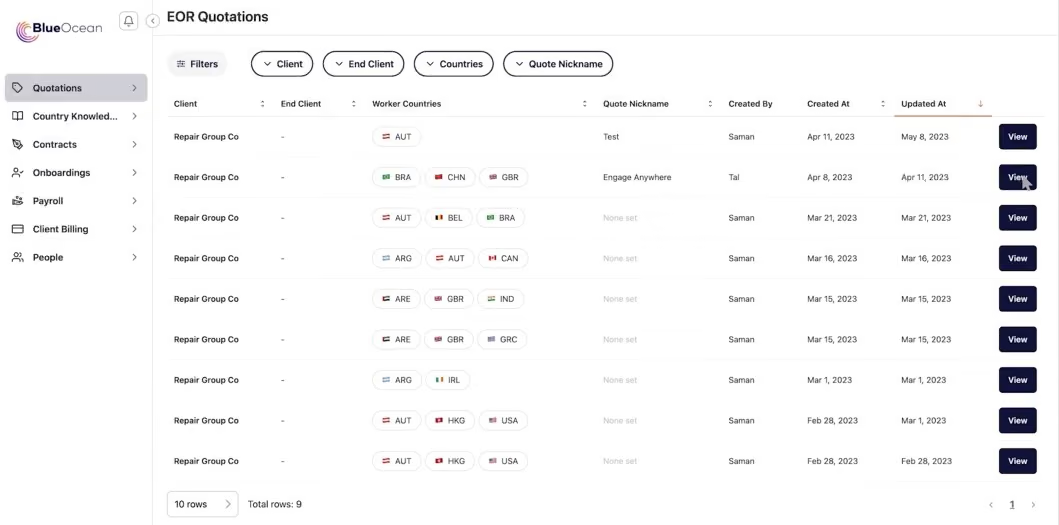
During the review process, I saw GoGlobal handle the full employment lifecycle competently, from templated contracts and offer letters through payroll, Provident Fund, ESI, and statutory bonus administration. What stood out was how often their India-based team proactively flagged details that are easy to miss, such as probation flexibility, region-specific leave rules, and bonus obligations under the Payment of Bonus Act. That kind of guidance isn’t flashy, but it can prevent real compliance issues down the line.
I also appreciated the emphasis on human support. GoGlobal assigns local HR specialists who understand both the legal requirements and the cultural context. Onboarding felt more consultative than transactional, which I can see being especially valuable for enterprise teams hiring senior talent across multiple Indian states, where expectations around compensation, benefits, and HR practices can vary widely.
The drawbacks are mostly on the technology side. GoGlobal’s software feels functional but dated. There’s no modern HRIS layer, native integrations with tools like BambooHR or Gusto are missing, and reporting options are fairly limited. Pricing transparency is another weak spot. Without clear, upfront cost breakdowns, it’s harder for teams to plan budgets confidently at scale.
Undisclosed.
Best For
GoGlobal is best suited for organizations that prioritize local expertise and hands-on guidance over advanced tooling.

We use GoGlobal daily at our company. The key workflows include managing payroll for our international team, which GoGlobal handles by automating tax calculations and compliance checks. Onboarding new crew members from different countries is another important task for us; the platform manages all the paperwork and legal requirements, allowing us to focus on getting them up to speed. We also rely on it for tracking employee records and ensuring everyone’s benefits are properly managed. It has become an essential tool in keeping everything running smoothly across our diverse projects.
- Effortless Payroll Handling: It simplifies managing international payroll, automating complex tax calculations and compliance tasks.
- Faster Onboarding: It handles all the onboarding documentation and legalities, saving us significant time and effort.
- Top-Notch Compliance Support: The platform keeps us aligned with local regulations across different countries, which is a huge relief from a legal perspective.
We bought GoGlobal because managing our international crew was becoming a significant hassle. With projects spread across various countries, we needed a tool that could handle the complexities of different payrolls and regulations without adding extra work. GoGlobal provided a solution that took care of compliance, payroll, and onboarding, which was a massive relief. I've been using GoGlobal for about a year now, and it has been smooth. The platform has streamlined our processes, saving us time and reducing errors, which was exactly what we needed.
- Limited Customization Options: It can be frustrating that we can't tweak things as much as we'd like to fit our specific needs.
- Slow Customer Support: The support team can be slow to respond, which is frustrating when we need quick solutions.
- Steep Learning Curve: The interface can be overwhelming for newcomers, making the learning curve steeper than it should be.
GoGlobal really stands out compared to other tools like Deel, Rippling, and Velocity Global. While those platforms have their merits, GoGlobal handles the complexities of international payroll and compliance better. Unlike Deel and Rippling, which often miss the mark on seamless automation, GoGlobal automates tax calculations and legal requirements flawlessly. Their onboarding process is much more streamlined and efficient compared to Velocity Global. Overall, it hits the sweet spot between simplicity and powerful features.
- User-Friendliness: Choose a platform that’s intuitive and easy to navigate; it’ll save you time and hassle.
- Process Automation: Ensure it automates tasks like tax calculations and compliance checks to reduce manual effort and errors.
- Support Quality: Evaluate the effectiveness and responsiveness of the support team, as prompt assistance is vital for resolving international issues.
- Growth Potential: Make sure the tool can scale with your business, handling more employees and expanding into new regions effortlessly.
- Regulatory Compliance: Robust compliance features are crucial for staying in line with local laws and regulations, especially with global operations.
The automation features have continued to evolve, keeping up with the competition. The onboarding process has also improved significantly. Overall, they seem to listen to feedback, as I've noticed some of my suggestions being implemented, which is encouraging.
GoGlobal is perfect for organizations with a diverse, international workforce. It's ideal for companies that operate in multiple countries and need a reliable solution for handling complex payroll and compliance issues across different regions. Businesses that prioritize seamless onboarding, efficient payroll management, and staying compliant with various local laws will find GoGlobal to be a fantastic fit. If you're managing a global team and need a tool to simplify intricate HR tasks, it's a great choice.
GoGlobal might not be the best fit for very small businesses or startups that operate solely within one country. If your organization doesn't have a complex international presence or diverse regulatory needs, the platform's advanced features might be more than you require. It is also not very budget-friendly.

RemotePeople
Starting at just $199/month, Remote People is one of the most budget-friendly EOR providers on the market without skimping on key compliance and payroll functionality. Their dedicated local teams and personalized account management make them especially attractive to small and mid-sized businesses entering the Indian market for the first time.
PROS
- Offers compliant hiring in India, including PF, ESI, gratuity, and tax filings.
- Pricing is among the most affordable for EOR in India.
- Responsive support and account managers are assigned to each client.
- Intuitive platform with support for payroll data, public holiday requests, and expenses.
- Professional onboarding and offboarding experience.
- Dedicated local teams provide regulatory and cultural guidance.
- Strong country hiring guides that go beyond basics and explain real compliance and payroll nuances.
- Affordable pricing (~$199/employee/month) compared to many EOR competitors.
- Covers 150+ countries, making it viable for broad international hiring.
- Clear payroll breakdowns with line-by-line visibility into costs and adjustments.
- Operational support services like IT equipment procurement and background checks.
- Free HR tools (salary calculators, offer generators, cost estimators) useful for planning hires.
CONS
- The web portal is occasionally slow and difficult to navigate.
- Payroll team responsiveness can lag, especially for escalated or complex requests.
- Ad hoc payroll changes may be delayed due to rigid deadlines.
- HMO/benefits partners may not suit all client preferences.
- Limited mobile access; most functions are desktop-based.
- Limited integrations compared to platforms like Deel or Remote.
- No phone support, and response times can vary for complex issues.
- Some services (e.g., visas, global payroll) only available in select countries.
Remote People is not the smoothest platform to use day to day, but from my evaluations, for teams that care more about cost control, responsive human support, and solid compliance than about UI or advanced workflows, it delivers dependable India EOR coverage at a very competitive price.
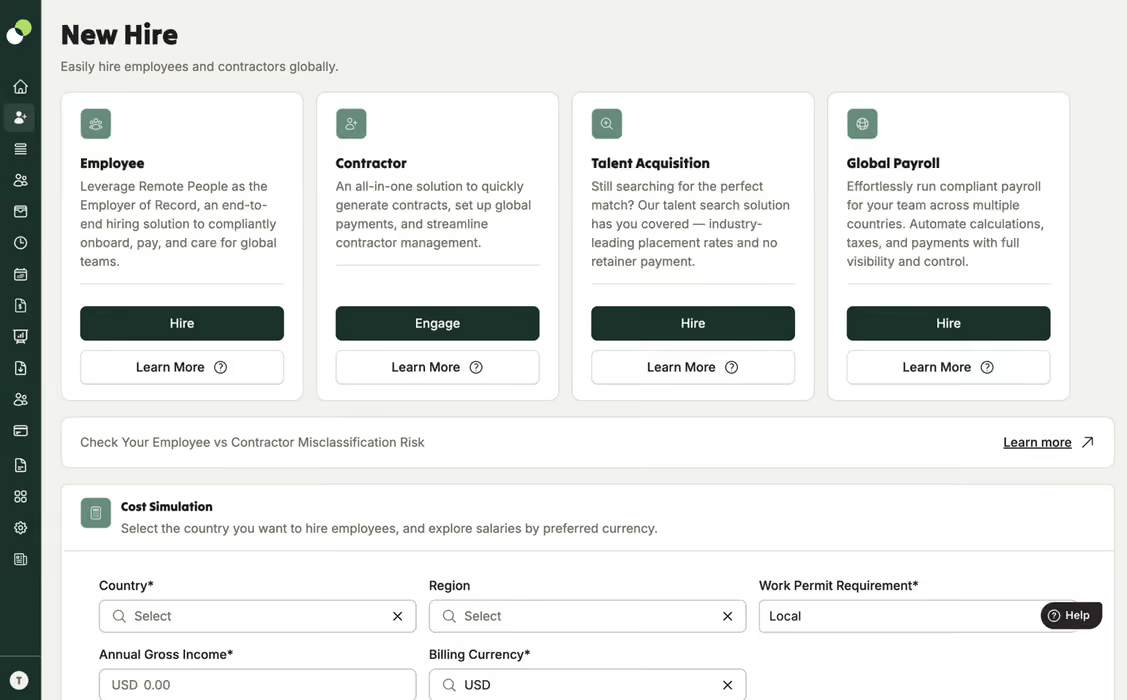
In my tech tests, Remote People handles the core employment requirements reliably. Localized contracts, EPF and ESI deductions, tax remittance, and benefits administration are all covered, and the team also supports less obvious needs like gratuity handling and appointment letter drafting. What stood out most was the human support. In user feedback and testing, dedicated account managers came up repeatedly as a strength, particularly during onboarding or when navigating unfamiliar local regulations in India. Responses were fast, and issues were generally resolved without excessive back-and-forth.
The minus points are mostly on the product side. Remote People doesn’t have the same level of tech polish as some newer platforms. The interface can feel clunky, and the split between systems like GMS and Remote People caused some confusion. I also came across reports of slower payroll handling for non-standard requests, including at least one delayed bonus payout tied to rigid cutoff dates. These aren’t constant problems, but they do show where process can outweigh flexibility.
Starts at $199/employee/month
Best For
Remote People is ideal for startups and global teams that need compliance coverage without enterprise-level spend.

Native Teams
Native Teams stood out by offering compliant employment, INR payroll, and benefits starting at just $99 per employee per month. For small teams looking to establish a presence in India without the overhead of setting up a local entity, it’s one of the most cost-effective ways to do it.
PROS
- Legally compliant employment in India with contracts in English and the local language.
- Local payroll processing in INR, including bonuses, leave, and tax allowances.
- Built-in wallet and Mastercard for employees, with 1% cashback on balance.
- Mobility and visa services are included for foreign hires relocating to India.
- Responsive legal review of contract changes, typically within five business days.
- Free trial available to test onboarding and platform features.
- Good range of EOR services with compliant contracts, payroll, benefits, and visa support.
- Pricing is half the typical EOR rate, and a free trial is offered.
- Built-in wallet and debit card for employees, with 1% cashback on balances.
- Contracts are bilingual and can be partially customized with legal team review.
- Visa and mobility support embedded in-platform for 20+ countries.
- Automated workflows for bonuses, tax allowances, and leave tracking.
CONS
- No HRIS or finance integrations available yet (expected 2026).
- Onboarding speed can lag, especially with local document syncing.
- The platform interface may not be intuitive for first-time users.
- Country coverage (95+) is modest compared to Remote, Deel, or Rippling.
- User interface lacks polish, and navigation can feel unintuitive.
- Onboarding can be slow, especially when syncing legal documentation.
- No HRIS integrations or open API (planned for 2026).
- Does not offer compensation benchmarking or planning tools.
For startups and small businesses expanding into India, Native Teams offers a low-cost, accessible EOR solution with built-in essentials. At $99 per employee per month, it’s significantly cheaper than most EOR providers, which typically charge four to six times as much. Despite the low price point, Native Teams still covers full-time employment, localized payroll, leave tracking, and employee expense management.
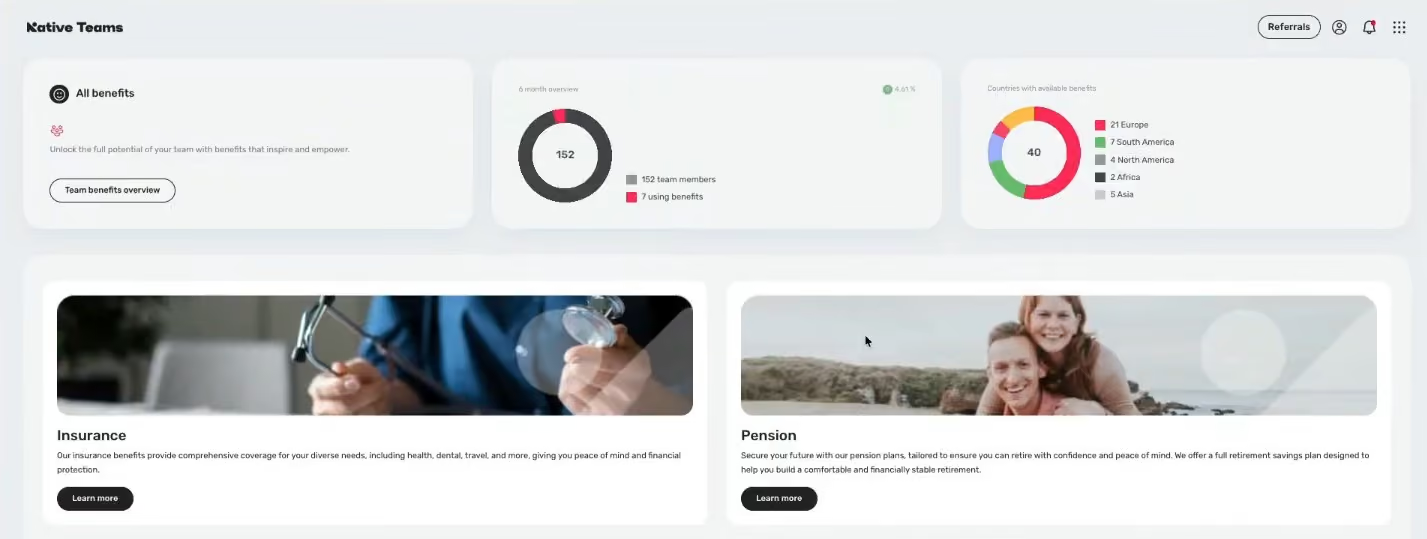
In India, Native Teams provides compliant employment contracts in English and a local language (typically Hindi), along with an INR-based payroll. Bonus payouts, sick leave, and salary changes are routed through automated workflows and reviewed by the internal payroll team. Employers can also leverage India’s government-approved tax allowances, such as reimbursement-based exemptions or food and transport perks, which are supported within the platform.
One standout feature is the digital wallet, which Mastercard issues to Indian employees. It supports multi-currency transactions, allowing employees to transfer money to personal accounts or spend directly using the card. Given that candidates often consider total compensation and financial flexibility when evaluating job offers, the 1% cashback on wallet balances is a practical and attractive perk for global employers looking to stand out in a competitive hiring market.
For global teams hiring Indian talent remotely, Native Teams also offers mobility support, which can help foreign workers obtain work permits or visas to relocate to India as needed. This functionality is fully integrated into the platform and managed by their in-house visa team.
That said, the platform’s interface still feels fairly basic, and multiple users we surveyed mentioned needing help during onboarding. Additionally, Native Teams currently lacks native integrations with HRIS, accounting, or automation tools such as Zapier, though these features are on the 2026 roadmap.
Semos Cloud, Mad Head Games, Kaiko Systems, inDrive, STURM
Pricing starts at $99/employee/month. A free trial is offered on Native Team's website.
Best For
If you’re looking for an EOR provider that offers compliance, INR payroll, and standout perks at a price built for early-stage teams, Native Teams is worth serious consideration for hiring in India.

Borderless AI
Borderless AI brings automation and speed to one of the most complex global hiring markets. For India, it offers same-day onboarding, zero deposit payroll, and fully localized compliance, making it an ideal choice for companies scaling quickly without in-house legal resources or the capital to tie up in advance payroll funding.
PROS
- Onboards Indian employees in as little as one day.
- No security deposits required which frees up significant cash for growing teams.
- AI-powered contract generation and real-time compliance monitoring.
- Payroll is processed quickly, with a turnaround time of five business days.
- Owned legal entity in India for better service consistency.
- HRGPT agent delivers quick, reliable, and personalized answers on contracts, policies, and compliance.
- Payroll processes are among the fastest in the industry, with no requirement to pre-fund salary deposits.
- Questions and technical issues are handled by in-country Borderless account and success managers.
- They have partnered with local experts from the Big Four accounting firms for accounting and tax compliance.
- Both the web platform and the mobile app are intuitive, quick to figure out, and easy on the eye.
CONS
- Still developing native integrations with major HRIS and finance platforms.
- Limited visibility into how AI handles state-level compliance variation.
- Shorter market history in India than legacy vendors.
- No direct integrations with major HRIS platforms, which could limit larger teams seeking ecosystem compatibility.
- Reporting and analytics features remain basic, offering limited drill-down capabilities for detailed audits or trend analysis.
Navigating the Indian EOR market is notably complex due to its multi-layered labor laws, diverse state regulations, and complicated payroll system. Borderless AI addresses these challenges through a highly automated approach. A key differentiator is its maximum 7-day onboarding timeline, facilitated by its integrated AI assistant, HRGPT, which can generate compliant offer letters and contracts in under 5 minutes.
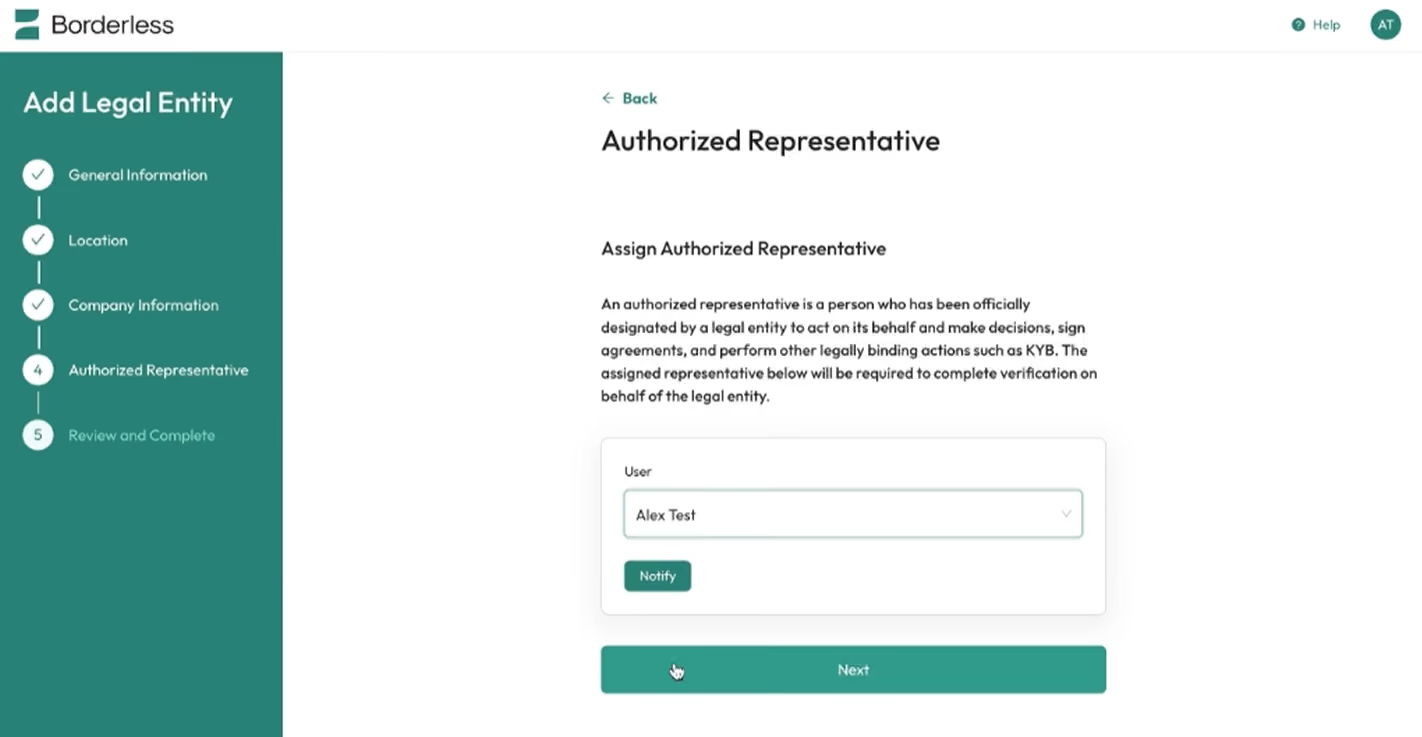
We found their payroll timelines to be faster than typical global benchmarks. While many EOR vendors require 10 to 15 business days to process salary payments, Borderless delivers payroll in just five days after invoice approval. There’s also no need to pre-fund payroll weeks in advance or hold security deposits, which is a huge win for cash-strapped startups or cost-sensitive expansion teams. According to the vendor, avoiding standard deposits of $10,000 to $20,000 per employee could free up $100,000 or more for a 10-person team.
The India offering runs through Borderless’s own local entity, not a third-party partner. This reduces delays tied to partner handoffs and ensures a consistent experience across compliance, invoicing, and support. HRGPT helps customers understand India-specific regulations like EPF, ESI, and Gratuity eligibility. While we didn’t independently validate the AI's accuracy across all state-level laws, users benefit from instant access to labor rule summaries and editable employment templates grounded in current Indian law.
Employees are paid in INR and receive compliant payslips, and expense reimbursements can be scheduled through the platform with clear approval workflows. We also appreciated the clean UI and 24/7 support from a North American in-house team—no outsourced help desks or inconsistent ticket routing.
That said, Borderless still trails more mature vendors in terms of integrations. As of early 2026, there are limited plug-and-play connections with HRIS or ERP platforms. Teams that rely on deep system syncs or custom workflows may need to use the API or request custom setup.
Pricing starts at $579/employee/month.
Since 2025, Borderless has added India-specific support for semi-monthly payroll, INR salary processing, and faster onboarding SLAs. The HRGPT assistant now handles India compliance questions, while backend upgrades such as real-time reporting, modern UI improvements, and graph-powered infrastructure have improved platform speed and accuracy. Native integrations are currently limited but are on the roadmap for expansion.
Best For
Small-to-mid-sized global companies hiring in India needing compliance automation and capital-efficient payroll.

RemoFirst
We like RemoFirst for India when you want EOR coverage and clear baseline pricing, but do not want to buy an enterprise HR suite to get there. Their India country guide shows they understand key local mechanics like contract types and Provident Fund (PF) cost components, and their cost calculator is helpful when you need a fast estimate for total employment cost before you start the approval process.
PROS
- Published EOR pricing starts at $199 per employee per month.
- Contractor management is free, which is useful before conversion to EOR.
- Their India guide includes employer cost callouts tied to PF and admin fees.
- A verified user review mentions support bridging policy gaps between the U.S. and India.
- An employer cost calculator provides country-specific hiring estimates.
- Integrations include BambooHR, GoCardless, and ADP Workforce Now.
- Published pricing is easy to find, with EOR starting at $199 per employee per month.
- Contractor management includes a free tier, plus premium contractor payments at $25 per contractor per month.
- Broad coverage supports hiring employees in 185+ countries and contractors in 150+ countries.
- Dedicated account managers and 24/7 support are included, plus chat and a knowledge base.
- Useful add-ons reduce the need for extra vendors, including RemoHealth, RemoVisa, background checks, and equipment provisioning.
- Contractor-to-employee conversion makes it easier to move from pilot hires to full-time employment.
- Integrations like BambooHR, GoCardless, and ADP Workforce Now help it fit into existing stacks.
CONS
- Delivery relies on exclusive local partners, so consistency depends on that network.
- Some verified reviewers want more advanced reporting and export flexibility.
- A verified reviewer described internal handoffs that slowed issue resolution.
- Integration coverage is growing but remains small versus full HR suite providers.
- EOR delivery often relies on exclusive in-country partners, so service consistency can vary by country.
- The integration catalog is improving but still smaller than what you get with full HR suites.
- Reporting and analytics are not as deep as enterprise-focused EOR platforms.
- The $199 rate is a starting point and total cost can still vary by statutory requirements in each country.
- Some features that matter for global teams can become add-ons, which can increase total spend.
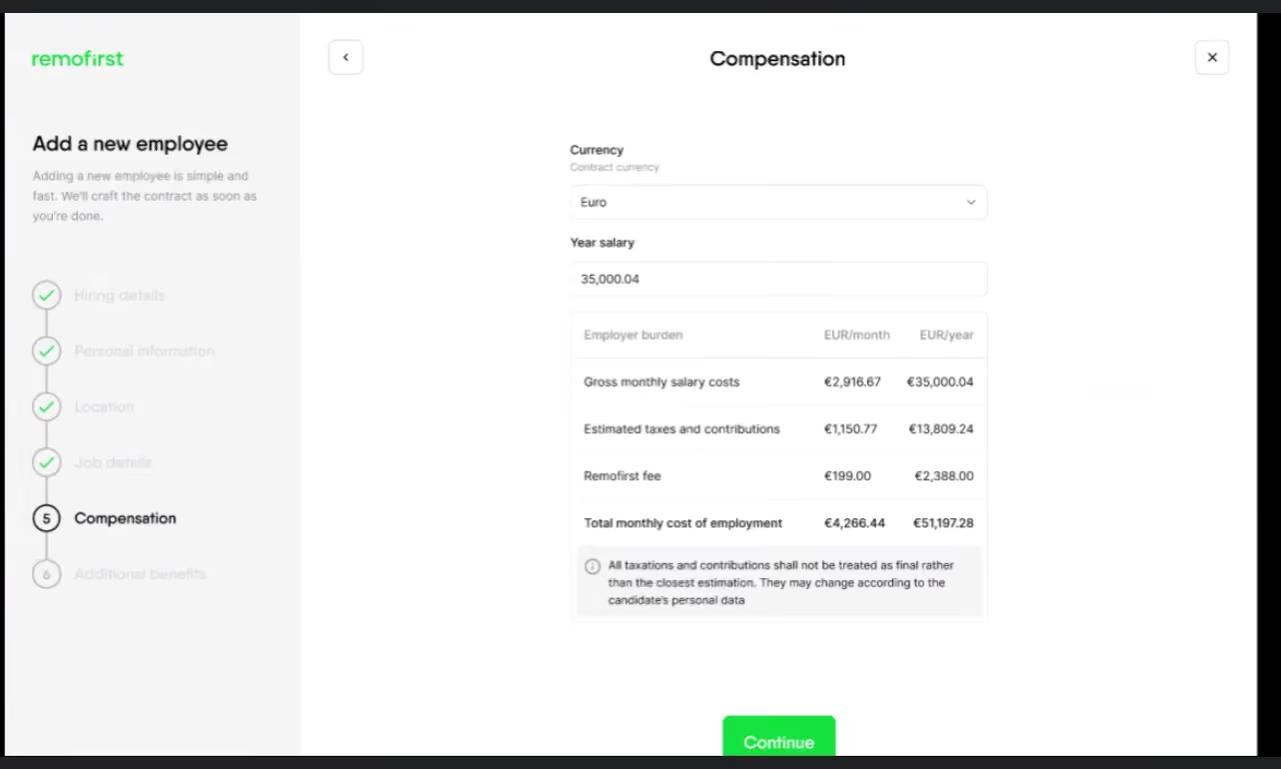
RemoFirst is a budget-first Employer of Record option for companies that want to hire in India without setting up a local entity. The pricing is easy to find and straightforward, with EOR starting at $199 per employee per month and contractor management available at no cost.
India is a market where payroll and compliance details matter, even for small headcounts. RemoFirst’s product adapts well to India from a practical standpoint. India-specific inputs like contract types, typical probation periods, and an employer cost snapshot highlights PF and related admin fees. That type of country-level framing is useful when you are trying to budget and avoid surprises on statutory costs.
They also lean heavily on an “exclusive partner” delivery model. They argue this is how they keep costs low while still offering broad coverage, and their site repeatedly positions local partners as a core part of how they deliver EOR services. For India buyers, this makes partner diligence important. We would ask who the legal employer is in India, how payroll cutoffs work, and how they handle common lifecycle events like role changes, leave, and offboarding.
On the user feedback side, we found a verified review that specifically calls out their help coordinating policies between the U.S. and India, which is a real-world pain point when you are hiring across jurisdictions. On the downside, other verified feedback points to cross-team handoffs and a desire for stronger reporting, which are worth watching if you expect complex workflows or want deep analytics.
Microsoft, Mastercard, ZocDoc, QED, Labster, Byrd, and the World Health Organization.
- Employer of Record: Starts at $199 per employee per month.
- Contractor management: Free tier for onboarding and basic management.
- Contractor payments: $25 per contractor per month.
- Add-ons: Visas and work permits (coverage varies), RemoHealth benefits options, and background checks in 185+ countries.
Since our last review, RemoFirst has expanded through tools and add-ons that are relevant to India hiring:
- Added an employer cost calculator for country-specific estimates.
- Expanded contractor-to-employee conversion as a core workflow.
- Continued scaling coverage for employees (185+ countries) and contractors (150+ countries).
- Expanded benefits and services via RemoHealth and background checks in 185+ countries.
Best For
RemoFirst is best for startups and small businesses hiring in India that want low entry pricing, the option to start with contractors, and the ability to convert to EOR later.

Oyster
For hiring in India, Oyster makes the process straightforward, from contract creation and tax withholding to employee benefits and payroll. Their ease of use, cost visibility, and support for U.S.-based companies hiring in India made it a standout for HR teams expanding globally without needing legal entities.
PROS
- Fully compliant India EOR offering, including payroll, taxes, and statutory benefits.
- Visually modern, easy-to-use platform with centralized access to documents and payroll.
- Offers a useful cost calculator for estimating hiring expenses in India.
- Fast setup with country-specific support and documentation.
- Responsive customer success team and dedicated account managers.
- Suitable for both individual hires and scaling teams.
- Intuitive: The platform is easy to navigate and makes logical sense.
- competitively priced: The flat rate for employees and contractors makes cost comparisons simple, and is competitive in the market.
- Targeted for a remote workforce: Whether your employees are in one country or 100, Oyster can accommodate them accordingly, and this is a feature few platforms can boast.
CONS
- High base price at $699/month per employee.
- Some key features (e.g., prior IP assignments) have experienced bugs or limitations.
- Limited HRIS/ATS integration requires manual data sync with existing HR tools.
- Customer support can be fragmented across multiple contacts and systems.
- No mobile app; mobile experience is limited to a desktop-adapted site.
- Onboarding delays and unclear ownership during escalations were reported.
- Slight delays in processing times for payments in the local currency are somewhat common.
- Immediate communication via phone support is not an option, but they do offer live support via Zoom when necessary.
- An initial security deposit is necessary to begin the engagement and is refundable.
- The platform lacks native time-tracking functionality and provides only an in-app tool for managing time off.
- If you’re looking to co-employ your employees and partially outsource HR responsibilities, Oyster isn’t for you. They are more akin to employer of record services (EOR) than a Professional Employer Organizations (PEO).
Oyster comes across as a product-first EOR, and that’s immediately apparent in how the platform looks and behaves. In India, it covers the core requirements reliably, including compliant contracts, payroll, tax deductions, and PF and ESI contributions.
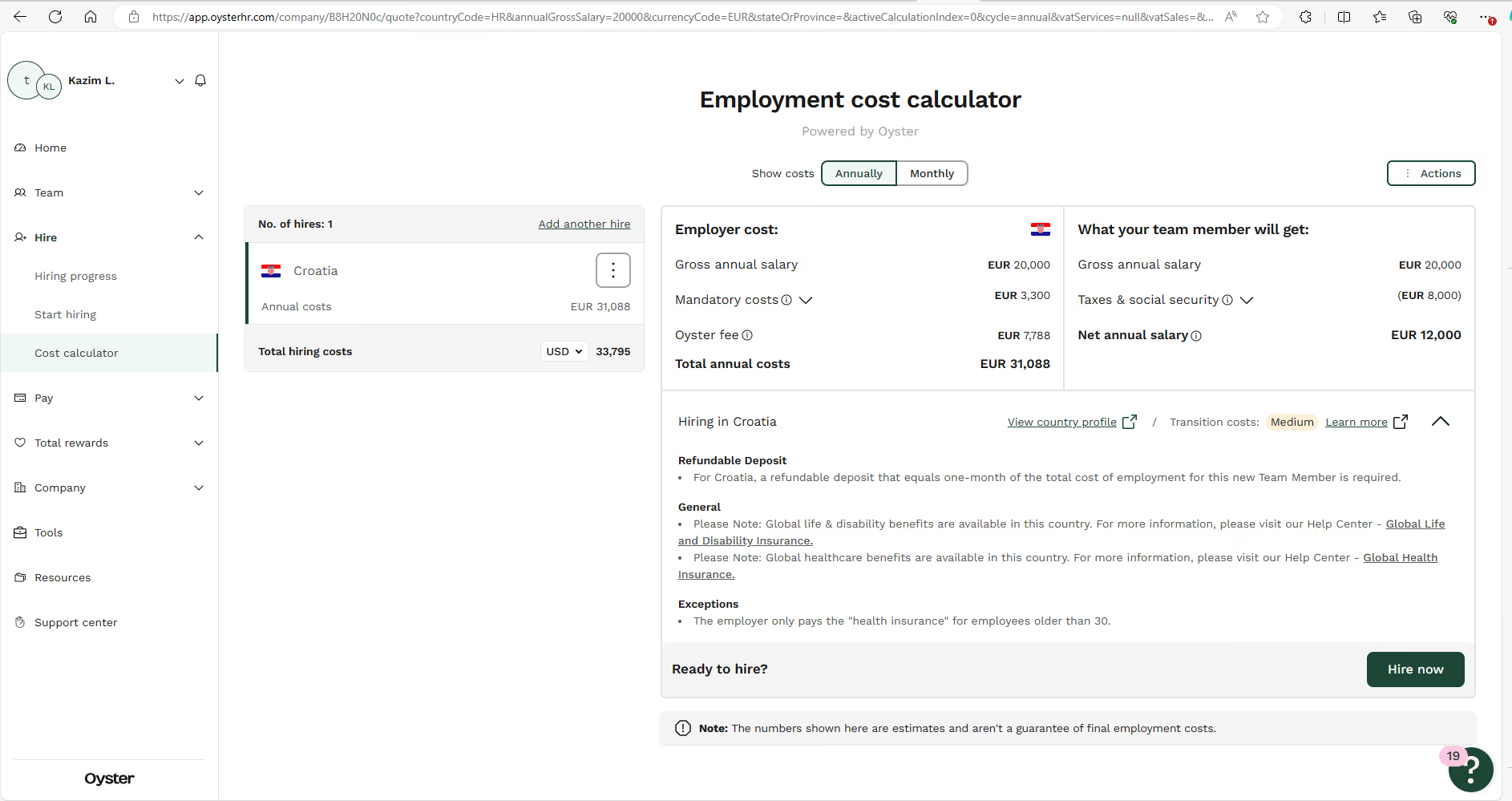
One feature I kept coming back to was the cost calculator. It makes modeling India headcount costs straightforward and shareable, which is genuinely useful when aligning with finance or leadership. Onboarding is generally smooth as well. Most users report a quick setup, and in my experience, documentation is clearly written and easy to follow. Where Oyster is less convincing is as part of a broader HR stack. Integrations with tools like BambooHR or Workable exist, but they’re limited or require manual steps, which makes Oyster better suited as a standalone EOR than a deeply connected system.
Support feedback is mixed. Many users speak highly of their customer success managers and day-to-day responsiveness, but others have flagged slower resolution times when dealing with edge cases. Issues like IP assignment tweaks or bonus adjustments sometimes require multiple handoffs, which can stall progress. I also came across reports of late payroll or rigid prefunding requirements. These don’t appear to be common, but they’re worth factoring in if cash flow timing is tight.
At $699 per employee per month, Oyster sits on the higher end, particularly for smaller teams. That said, the premium is reflected in the interface, documentation quality, and overall ease of navigating India’s employment rules. For teams that prioritize usability and a plug-and-play experience over deep customization or aggressive pricing, Oyster is a solid option.
$699/employee/month
Best For
Oyster is best for globally distributed companies that want a smooth, user-friendly hiring experience in India, backed by transparent cost modeling and reliable support.

The company will use Oyster to hire employees in different countries without setting up legal entities or subsidiaries. It will be used to handle payroll processing for international employees. It will be used for benefits administration.
This includes health insurance, retirement plans, and other employee benefits. Of course, it will be used for HR administration, such as employee data management, time tracking, and employee support services.
It simplifies the process of hiring and managing international employees. It provides a centralized hub for managing all aspects of global workforce administration. It guarantees stability, which is important for a global tool.
My organisation bought Oyster to facilitate hiring and to scale operations globally more efficiently. With it, it is easier to onboard new employees across different countries.
Oyster also focuses on improving the experience for remote employees by offering localized benefits and support, which can enhance employee satisfaction and retention. The company is currently implementing the tool. The plan is to use it globally till the end of the current year.
For smaller businesses or startups, the cost of using Oyster's services may be perceived as high, particularly if they have a limited budget for global expansion or HR management.
Integrating Oyster with existing HR or payroll systems requires additional effort or customization, depending on the company's IT infrastructure and requirements. Some users find that certain features or functionalities they desire are not available or fully developed within Oyster's current offering.
Oyster offers dedicated support from experts in global employment and compliance, ensuring that customers receive personalized assistance and guidance throughout their international expansion journey.
Consider whether the platform can scale with their business as you expand internationally. Evaluate the comprehensiveness of the services offered. A user-friendly interface and intuitive navigation are crucial for ease of use.
Oyster has continuously expanded its coverage to include more countries and jurisdictions.
Oyster supports the complexities of remote workforce management seamlessly.
Oyster is not needed for organizations that operate exclusively within a single country and do not have plans for international expansion.

Remote
I picked Remote for its direct legal presence in India and the control that comes with it. Owning its local entity allows Remote to handle contracts, statutory compliance, and IP protection without relying on third parties, which reduces risk in a complex regulatory environment. Combined with a clean platform and consistently fast onboarding, it’s a dependable choice for international teams hiring in India who value compliance certainty over pricing flexibility.
PROS
- Fully owned Indian entity ensures compliance and IP security under Indian law.
- Transparent flat-fee pricing with no upfront deposits or FX surprises.
- Localized benefits (PF, ESI, gratuity, health insurance) included.
- Responsive email and live chat support with India-specific expertise.
- Fast onboarding (often under three business days).
- Intuitive online platform with mobile app access for employees.
- Supports global equity planning with tax compliance built in.
- Fast and compliant payroll in 170+ countries.
- Live chat support with local payroll experts.
- Flexible, localized benefit packages.
- Flat-rate pricing structure, no deposits or hidden fees.
- Mobile app streamlines expense reimbursement with autofill from receipt photos.
CONS
- No support for off-cycle pay runs or phone-based assistance.
- AI-first chat support may be limiting for nuanced, time-sensitive issues.
- Net salary breakdowns aren’t visible until the first payslip.
- Reporting and filtering tools are less robust than those of some competitors.
- Overkill for companies hiring only one or two employees in India.
- Doesn’t have a free trial.
- Redundant for organizations solely recruiting within the U.S.
- Help center documentation isn’t easiest to understand.
Remote’s India EOR stands out immediately for its legal footing. Unlike many providers that operate through local partners, Remote owns its Indian entity outright. That difference shows up where it matters most, especially around employment contracts, IP ownership, and statutory obligations like provident fund and gratuity. For teams hiring in India for the first time, that level of control reduces uncertainty and limits downstream compliance risk.
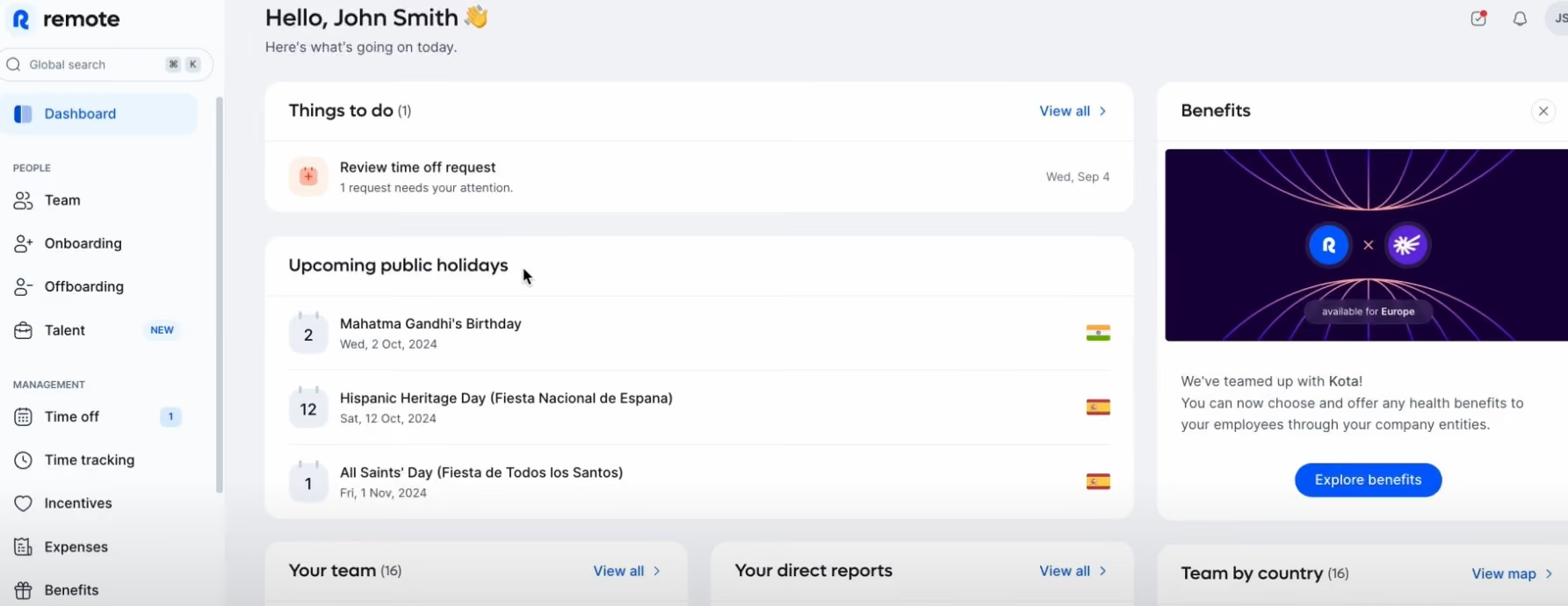
In day-to-day use, the platform feels well thought out. Key employee details are easy to surface, and core workflows like payroll processing, tax reporting, and leave tracking are straightforward to navigate. Onboarding is structured rather than rushed, but still efficient. Most users report going from contract to active employee in about three business days, which is fast enough to support aggressive hiring plans without cutting corners.
One area where Remote clearly differentiates itself is IP protection. Its IP Guard system is designed specifically to handle intellectual property rights and intellectual property under local law, which adds reassurance for companies building proprietary products or handling sensitive work overseas. Equity support is another strength. Remote is one of the few EORs that can manage tax withholding for global incentive plans across borders, which makes it a better fit for tech-forward teams offering stock-based compensation.
The trade-offs are mostly around cost and flexibility. Remote’s flat-rate pricing at $599 per employee per month with annual billing sits at the higher end, and there is little room to scale pricing down for teams hiring only one or two employees. I also ran into some constraints around payroll customization, including the lack of off-cycle pay runs and fairly limited analytics. Support is generally responsive through chat and email, but there is no phone option, and AI often handles the first interaction, which may frustrate teams seeking immediate human assistance.
$599/employee/month annually or $699/employee/month monthly.
Best For
Remote is best for fast-growing, global companies that want to hire independent contractors and full-time employees in India compliantly, without a local entity setup.

We started using Remote for our international employment. The HQ is in Belgium, and we were expanding into France, Spain, and other countries yet to be decided. The tool offers a basic understanding of the social laws and costs associated with employment in these countries. Once candidates were onboarded, Remote supported the full process, including onboarding, holiday, and payroll management.
- Remote provides the basic information needed to investigate employment in a new country.
- The documents are freely available and in clear language.
- All foreign employees and contractors are managed in one tool.
- Remote is ideal for initial foreign expansion.
My previous company (at the time of writing, I have left the company) intended to grow within Europe. The goal was to have a small team of employees in multiple European countries. As each country has its own unique social laws, and we did not have an entity in every country, we needed a partner to support us with this growth. Remote provided this solution. They act as an intermediary partner, take employees onto their payroll, and support you with specialized HR topics unique to each country.
- Remote's pricing is high—it is good if you only employ a few people per country, but once the team expands, it is better to have your own entity.
- There is limited customization, as most processes must follow the structure provided by Remote.
- In some countries, Remote works with subsidiaries, which can slow down the onboarding process.
We chose Remote because of its clear pricing and the intuitiveness of the tool.
People need to keep the following in mind:
- In which countries do we want to employ people?
- How many people do we want to employ per country?
- Are we going to open a legal entity or not?
I’m not sure as I haven’t used Remote for long.
Remote is good for organizations looking to expand into multiple countries with small teams, without the hassle of legal administration.
Remote is a bad fit for companies with large employment in a single country. Once you have a team of 5 to 10 employees in one country, it no longer makes sense to have Remote as an intermediary.
.avif)
Atlas HXM
Atlas earned a spot on this guide for offering tailored compliance solutions backed by strong in-country support. Their platform balances global HR functionality with local nuances like statutory contributions, payroll complexity, and appointment letter requirements, which is particularly appealing to companies with smaller hiring volumes or specialized compliance needs in India.
PROS
- Provides compliant payroll, PF/ESI, and benefits aligned with Indian law.
- Offers customized contracts, onboarding, and tax support for India.
- Dedicated support teams familiar with India’s dual-layer labor system.
- Willing to support companies hiring as few as 1–3 employees in-country.
- Salary sacrifice and pension features are available through providers like Aviva.
- Smooth onboarding experience and solid document management tools.
- Atlas has legal entities in over 160 countries. They’ll help you take care of employee onboarding and payroll processing in any of those countries, eliminating the need to engage any local service providers.
- The platform simplifies how you hire, manage and pay employees and contractors abroad, without needing to set up an operation where they are located.
- Atlas helps you stay compliant with local labor laws and frees you from employer liability.
CONS
- Complex UI and lack of feature parity between web and desktop versions.
- Communication gaps across departments can delay support resolution.
- Invoicing errors and late payments have been reported by users.
- Escalated support tickets (e.g., for payroll or pension issues) may take weeks.
- Atlas currently doesn’t offer global managed payroll for non-employer of record (EoR) clients; so if your company doesn't need Atlas to take on from you as EoR, but need to use Atlas' global payroll services, you can't do so at this time. Do note though that the team at Atlas is planning to offer this service next year.
- Atlas currently has limited prebuilt integration modules but they do offer API access for users to plug in third-party tools.
Atlas operates at a different scale than many EOR providers, and that comes through immediately. As a global workforce management platform with coverage in over 100 countries, it brings a structured, compliance-first approach to hiring in India. In practice, it handles the fundamentals well. Onboarding, payroll, Provident Fund, ESI, and statutory tax filings are all managed under a locally compliant framework, with support for nuances like probation rules, variable notice periods, and region-specific leave entitlements.
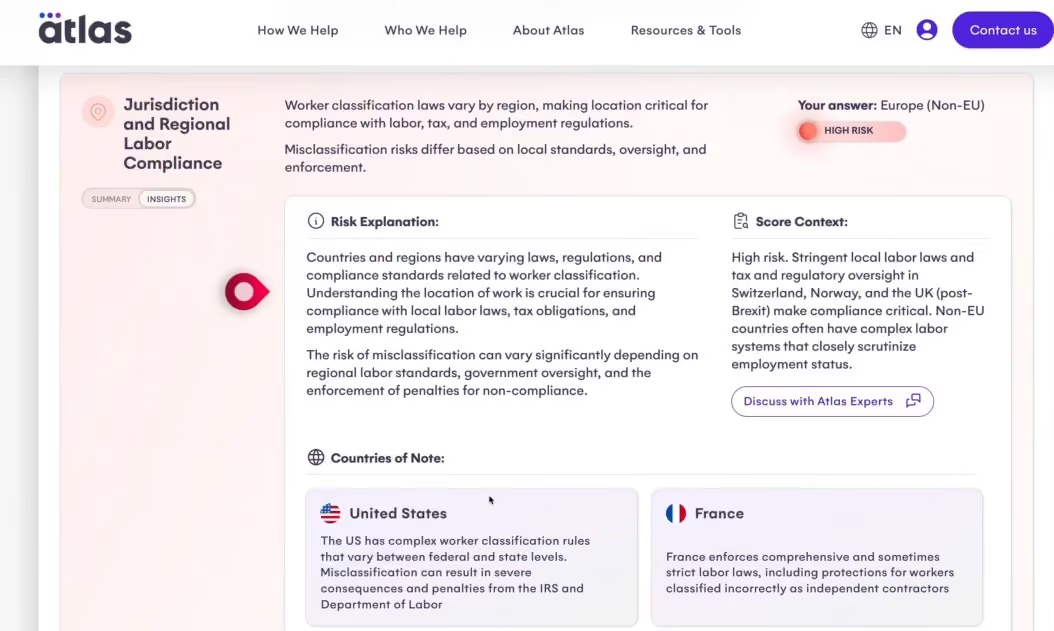
What surprised me most was how accessible the platform is for small teams. Atlas doesn’t push minimum headcounts, and during testing and user conversations, I saw one- to three-person teams receiving the same level of support as larger clients. This makes it a viable option for companies hiring a small number of high-skill roles in India, where compliance risk is high even if headcount is low.
The trade-offs show up in coordination and usability. Several users spoke positively about their dedicated account manager, but also mentioned friction when requests crossed internal teams like billing, legal, or support. I also found the interface heavier than necessary. It’s functional, but can feel overwhelming, especially for first-time users or teams sharing access across functions.
A few reports of delayed payroll or invoicing errors stood out as well. These aren’t minor issues in an EOR setup, and while they don’t appear widespread, they’re worth noting. In my view, this friction is tied to Atlas’s size. It’s a large organization serving a global client base, and execution isn’t always seamless across departments.
Starts at $599 per employee per month.
Best For
Atlas is best for mid-sized and growing global companies that want a flexible, compliance-strong India EOR partner without needing to hit high headcount minimums.

We used Atlas HXM as our Employer of Record (EOR). It was used as a payroll and global HR database for records. Atlas was our company's legal employer. Atlas acted as a liaison for our HR department, connecting and assisting us with global compliance questions and needs. It is compliance-focused.
I liked the reliable customer-centric focus of the Atlas team. I could count on their compliance and global regulatory guidance. I liked the cost-benefit.
We used Atlas HXM for three years. My company had cross-border employees, both inside and outside of the US. A pain point for them was maintaining one database, one source of truth for their employee records, and needing the flexibility to hire people quickly in new global regions. The key benefit of Atlas was that they were the employer of record, which was better than a PEO, saving me a lot of time setting up employer and other tax-related accounts. It is a good system and an alternative to the big players who are only interested in the bottom line. Customer-focused system.
It lacks flexibility in customized functionality. They could improve their customer support response time (but it wasn't bad considering the time zone differential). They could reduce costs or provide more incentives for smaller businesses or startups.
I have used many similar tools. Atlas HXM is truly a global provider! From Western to Eastern Europe, they are everywhere! I preferred this system over others because I could rely on them consistently in areas of global rules and regulations I was unfamiliar with.
Are you in need of a global employer of record for your business? How many countries do you have employees in? Do you struggle to keep current with global compliance at your company?
I haven't seen many changes, but since they are small, I assume evolution will happen quickly.
Global entities with cross-border employees.
An organization not wanting an EOR.
Why You Should Trust Us
I built this guide using a combination of first-hand testing, expert input, and real user feedback. Where possible, I demoed and tested platforms directly to see how India EOR workflows behave in practice, including onboarding, payroll setup, compliance handling, and everyday usability. Not every provider offers full sandbox access, but hands-on evaluation was prioritized whenever it was available.
To ground the research in local experience, I also sought input from my Indian colleagues Shubham Sahu, Aswin Raghav Rengarajan, and Mariam Mushtaq, who have either been hired through EORs themselves or supported their former employers with hiring employees in India. Their perspectives helped validate platform claims and highlight issues that tend to surface only after employees are live.
In addition, I reviewed feedback from verified users to capture common themes, expectations, and frustrations across different company sizes and industries. By combining direct product exposure, local insight, and user reviews, I aimed to evaluate these India EOR providers based on how they perform in real hiring scenarios, not just how they’re marketed.
What is an EOR in India?
An Employer of Record (EOR) in India is a third-party organization that legally employs your staff on your behalf, managing compliance with Indian labor laws, payroll in Indian Rupees (INR), taxes, and administration of local benefits. This allows you to hire talent in India without the hassle of setting up a local legal entity, while you retain operational control over their daily work.
Read More: What is an Employer of Record?
Is an EOR the same as a PEO in India?
No, though both offer HR services. The EOR becomes the legal employer of your staff in India. You outsource legal employment and HR compliance entirely. Professional Employer Organization, on the other hand, enters into a co-employment relationship with your company. Your company remains the legal employer, but the PEO shares certain employer responsibilities. PEOs usually require you to have a legal entity in India.
You might find these topics helpful:
Why EOR for Hiring in India?
- Speed is often the first reason teams turn to an EOR. Instead of spending months setting up a legal entity, companies can hire employees in India within days. As Kazim from Best Practice Institute explained, this matters most when headcount is small and distributed. His organization wanted to move away from expensive, short-term freelancers and hire actual employees, but setting up entities for one or two hires per country did not make financial sense. An EOR allowed them to hire quickly and convert freelancers into long-term employees without delay. “We have converted several existing freelancers to local employees and hired multiple employees into the local EOR entities,” he said.
- Compliance is the second, and often more enduring, benefit. India’s employment regulations change frequently, and errors around tax withholding, Provident Fund, ESI, gratuity, or termination can become costly. An EOR takes ownership of these obligations, ensuring contracts, payroll, and statutory filings remain aligned with local law. Statistically, more than 6 in 10 companies use EORs to reduce regulatory and compliance risks.
- An EOR also reduces the ongoing administrative burden. Payroll processing, tax remittance, benefits administration, and HR documentation are managed centrally, which frees internal HR and finance teams from navigating unfamiliar systems. In Kazim’s case, having country-specific HR information available upfront made planning far easier. “The cost calculator and HR information per country are great for planning,” he said.
- Cost efficiency and flexibility round out the picture. Establishing and maintaining an Indian entity involves legal fees, operational overhead, and long-term commitments that don’t always align with early-stage or distributed hiring plans. An EOR offers a more flexible model, allowing companies to scale headcount up or down anywhere in India without a permanent local presence.
Read More: Employer of Record Benefits & Key Use Cases
Key Services Provided by EORs in India
An EOR in India typically provides legal employment of staff, payroll processing, tax management (TDS, professional tax, etc.), administration of mandatory social security contributions (EPF, ESI, Gratuity), onboarding/offboarding procedures, benefits administration (statutory and optional), and HR administration support.
- Payroll Management and Tax Compliance: EORs handle all aspects of payroll management, ensuring employees are paid accurately and on time in accordance with Indian laws. This includes calculating salaries, statutory deductions, and benefits, as well as managing tax compliance at both the central and state levels.
- Employment Contracts and Local Labor Law Compliance: Drafting and managing legally compliant employment contracts are fundamental EOR services. EORs ensure that all contracts reflect current local labor law requirements, protecting both the employer and employee from legal risks.
- Employee Benefits Administration: EORs administer mandatory and optional employee benefits, such as Provident Fund (PF), Employees’ State Insurance (ESI), gratuity, health insurance, and supplemental benefits. This helps companies attract and retain top talent while ensuring full compliance with Indian regulations.
- Onboarding and Offboarding: Efficient onboarding and offboarding processes are managed by the EOR, covering document collection, background checks, induction, and exit formalities. This ensures a smooth transition for employees joining or leaving the organization.
- Expense and Time-Off Tracking: Many EOR platforms offer digital tools for tracking employee expenses and managing time-off requests. This streamlines approvals, improves transparency, and ensures compliance with company policies and statutory leave entitlements.
- Visa and Work Permit Sponsorship: EORs provide visa and work permit sponsorship services for foreign nationals and expatriates. They guide clients through the complex regulatory requirements to ensure the legal employment of non-Indian staff.
- HR Compliance and Risk Management: EORs monitor changes in Indian labor laws and implement necessary updates to HR policies and practices. They also manage risk through insurance coverage, such as workers’ compensation and liability insurance, protecting both the employer and employees.
- Recruitment Management: While not all EORs provide direct recruitment, many support recruitment management by vetting candidates, conducting background checks, and generating contracts, especially for rapid or large-scale hiring needs.
- AI-Powered Tools and Technology Integration: Modern EORs leverage AI-powered tools and advanced HR platforms to automate payroll, compliance checks, reporting, and employee management. These technologies enhance accuracy, reduce administrative burden, and provide employers with actionable insights.
How Much Does an EOR Service Cost in India?
India EOR pricing varies based on provider, service depth, and what’s included beyond the base fee. While many vendors advertise a flat monthly rate, the total cost depends on factors like compliance coverage, benefits administration, payroll support, and the level of hands-on service.
Across the providers reviewed in this guide, EOR pricing in India generally ranges from $199 to $699 per employee per month. Budget-oriented service providers like Skuad and Remote People (formerly Horizons) start at $199 per employee per month, covering core employment needs such as compliant contracts, payroll, and statutory contributions. These options tend to work best for straightforward hires where cost control is the priority.
Mid- to upper-tier providers typically start at $599 per employee per month. This includes Deel, Papaya Global, Atlas, and Remote’s annual plan, which bundles deeper compliance support, faster onboarding, and more structured employee management. Remote’s pricing increases to $699 per employee per month on a monthly plan, while Oyster also sits at $699 per employee per month, reflecting a stronger emphasis on UX, documentation, and employee experience.
Some providers, including G-P and GoGlobal, do not publish standard pricing. In these cases, costs are usually tailored based on country coverage, headcount, and service scope, which can make budgeting less predictable upfront.
It’s also important to note that the EOR fee is separate from employment costs, such as employer-side contributions, gratuity accruals, bonuses, and payroll taxes. Optional services like equity administration, off-cycle payroll, or advanced reporting may add to the total as well.
In practice, choosing the right EOR in India is less about finding the lowest advertised price and more about understanding what each pricing tier includes. Lower-cost providers can be effective for simple setups, while higher-priced options tend to make sense when compliance complexity, IP protection, or long-term hiring plans are involved.
Read More: How Much Does an Employer of Record Cost?
How to Choose an EOR in India
The best EOR provider in India is the one whose legal structure, payroll execution, support model, and pricing align with how you actually plan to hire in the country.
- Legal Entity Structure: Not all EORs operate the same way in India. Some use wholly owned local entities, while others rely on third-party partners. That distinction matters more than it sounds. Providers with their own Indian entity setup tend to have tighter control over contracts, payroll execution, and compliance interpretation. Partner-led models can work, but they often introduce extra handoffs and slower resolution when edge cases arise. Learn more about major EOR risks you should watch out for here.
- Compliance Depth: India’s employment rules are layered and change frequently, covering everything from Provident Fund and ESI contributions to gratuity, bonuses, notice periods, and state-specific leave rules (paid leave, maternity leave, sick leave, etc.) A strong EOR actively monitors regulatory updates, applies them consistently, and flags risks before they turn into problems, so make sure you ask how compliance updates are communicated and enforced.
- Payroll Reliability: Payroll accuracy and timing are non-negotiable. Late payments, incorrect deductions, or rigid cutoff dates can quickly erode employee trust. Look closely at how payroll runs are scheduled, whether off-cycle payments are supported, and how corrections are handled when something goes wrong. In practice, providers that emphasize predictability tend to outperform those that prioritize flexibility alone.
- Benefits Administration: Statutory benefits like Provident Fund, ESI, and gratuity are table stakes, but the details matter. Some EORs allow limited customization or offer guidance on region-specific expectations, while others treat benefits as fixed packages. If you’re hiring for senior or competitive roles, ask how benefits are structured and whether adjustments are possible within local rules.
- Platform Usability: A polished platform isn’t just about aesthetics. It affects how easily HR teams can find information, run payroll, and respond to employee questions. Some EOR tools are intuitive and reduce back-and-forth, while others feel cluttered or fragmented across systems. Request a live demo and see how quickly you can surface employee data, documents, and reports.
- Support Model: Support quality often matters more than feature depth. Ask who you’ll actually be working with day to day. Will you have a dedicated account manager? Is support centralized or split across regions and teams? User reviews often reveal whether issues are resolved quickly or bounce between departments, especially for policy-specific or compliance-related questions.
- Pricing Transparency: Headline pricing rarely tells the full story. Some EORs bundle most services into a flat monthly fee, while others charge separately for employee onboarding, analytics, tax filings, or legal reviews. Request a detailed, itemized proposal and ask what typically triggers additional charges. Predictable pricing is often more valuable than the lowest base rate.
- Contract Terms and Exit Flexibility: Finally, read the contract closely. Service level agreements, liability allocation, termination clauses, and pricing escalation terms all shape your long-term risk. Pay particular attention to how disputes are handled, how employee data is protected, and what happens if you need to exit or change providers.
The Future of EOR in India
The EOR market in India is poised for significant growth and evolution, driven by increasing global business interest in the Indian economy and ongoing technological advancements.
- Growing Market Demand: India possesses a vast, diverse, and skilled workforce, particularly in IT, engineering, finance, and professional services. Foreign companies increasingly leverage EORs to access this talent without the complexities of establishing a direct entity. The evolving and complex regulatory landscape in India, including recent labor code reforms, makes compliance challenging for foreign businesses. EORs offer a crucial service by shouldering this burden.
- Technological Advancements: EOR platforms will become more sophisticated, offering integrated solutions for talent management, performance analytics, employee engagement, and robust self-service portals. Artificial intelligence and automation will increasingly streamline payroll processing, compliance checks, HR administration, and reporting. Advanced data analytics will provide clients with deeper insights into workforce costs, compliance risks, and market benchmarks, enabling more informed decision-making.
- Expanding Service Offerings: EORs may offer more in-depth consulting on market entry strategies, compensation benchmarking, cultural integration, and local HR best practices. Beyond statutory requirements, EORs might offer a broader range of supplementary benefits, including specialized health plans, wellness programs, and retirement planning advice, to help clients attract and retain top talent. Some might integrate with or partner with learning and development platforms to offer employees training resources, enhancing their value proposition. EORs may develop specialized offerings tailored to specific industries with unique compliance requirements, such as technology, healthcare, or manufacturing.
FAQs on India EORs
How does an EOR ensure compliance with India's labor laws?
A reputable EOR employs in-country legal and HR experts who are constantly updated on India's evolving labor laws (e.g., Factories Act, Industrial Disputes Act, Shops and Establishments Acts, and new Labor Codes). They ensure:
- Employment contracts are legally compliant.
- Payroll deductions and contributions are accurate and timely.
- Termination processes adhere to statutory requirements.
- Statutory benefits like PF, ESI, and gratuity are correctly managed.
What about employee benefits in India through an EOR?
An EOR ensures compliance with mandatory benefits in India, which include:
- Employees' Provident Fund (EPF): A retirement savings scheme.
- Employees' State Insurance (ESI): Health insurance and medical benefits.
- Gratuity: A lump-sum payment upon completion of five years of service. Many EORs also facilitate competitive supplemental benefits like private health insurance, life insurance, and other welfare schemes to help attract and retain talent.
What information do I need to provide to an EOR to hire an employee in India?
To hire Indian employees, you must provide the EOR with key details such as the employee’s full name, contact information, address, PAN and Aadhaar numbers, agreed-upon salary in INR, job description, and any specific local benefits or allowances. The EOR will ensure that all documentation and contracts comply with both central and state laws.
Can I terminate an employee hired through an EOR in India?
Yes, you can terminate an employee hired through an EOR. The EOR will handle the termination process in full compliance with Indian labor laws, including notice periods, severance payments (if applicable), and final settlement calculations, minimizing legal risks for your company. You will communicate your decision to the EOR, who then executes the compliant process.
Is an EOR responsible for employee performance management?
No, the EOR is the legal employer but not the operational employer. You (the client company) retain full control and responsibility for managing your employee's day-to-day work, performance, goal setting, and professional development. The EOR handles the administrative and legal aspects of employment.
How does an EOR ensure compliance with Indian labor laws and tax regulations?
A reputable EOR employs in-country compliance experts who stay up to date on both central and state-specific labor laws. This is especially important for hiring in specific Indian regions, as requirements for payroll, professional tax, and local benefits can vary. The EOR tailors contracts and HR policies to each region, ensuring full legal compliance wherever your employees are based.
How does an EOR handle data security concerns and protect sensitive information?
Leading EORs in India follow strict data security protocols, often adhering to international standards such as ISO 27001. They use secure systems for storing and processing employee and company data, limit access to authorized personnel, and regularly review their security measures.
What incident response protocols do EORs have in case of a data breach?
Top EOR providers have formal incident response protocols in place to address any data security concerns. This includes immediate identification of the breach, containment measures, notification of affected parties, and steps to prevent future incidents. These protocols are designed to comply with ISO 27001 standards and Indian data privacy laws.
Does the EOR process payroll in INR and manage statutory deductions?
Yes, EORs process payroll in Indian Rupees and manage all statutory deductions required by law, including income tax, professional tax, EPF, ESI, and other region-specific contributions. This ensures employees are paid accurately and in compliance with both central and state regulations.
I am seeking to expand my operations beyond India. Could you recommend the top EOR services?
Of course! Here is a curated list reviewed by industry experts that you may find helpful:
About the Author


About Us

- Our goal at SSR is to help HR and recruiting teams to find and buy the right software for their needs.
- Our site is free to use as some vendors will pay us for web traffic.
- SSR lists all companies we feel are top vendors - not just those who pay us - in our comprehensive directories full of the advice needed to make the right purchase decision for your HR team.


