

6 Best Programmatic Advertising Platforms in 2026
An honest and fair evaluation from talent experts on the top programmatic companies.










The best programmatic job advertising platforms do more than post openings to multiple job boards. They use real-time performance data and bidding algorithms to decide where each job ad runs, when it runs, and how much budget it gets. Spend shifts automatically toward channels producing qualified applicants and away from those that aren’t. For teams handling high-volume, seasonal, or always-on hiring, that replaces hours of manual posting and guesswork with self-adjusting campaigns.
To help you find the right fit, we evaluated 25 platforms against the criteria that matter in practice: publisher network reach, bidding and budget controls, ATS integration, reporting depth, and total cost, including minimum spends and markups. Only 6 made the cut. Each review covers key features, best use cases, pricing, and limitations, so you can choose based on your hiring volume, team size, and budget.
To select the tools in this guide, our team followed a structured vetting process built around hands-on platform access.
- How we tested: For every platform that passed initial screening, we requested a live demo and, where possible, set up accounts to test the product ourselves. We evaluated each tool from two perspectives: a recruiter launching and managing campaigns, and a talent leader reviewing performance and budget. Where trial access allowed, we walked through the full campaign flow. That meant importing jobs, setting targeting rules and bid strategies, adjusting budgets mid-campaign, and reviewing results in the analytics dashboard.
- What we assessed: We scored each platform across dozens of factors. The ones that carried the most weight were:
- Targeting and segmentation: how precisely you can aim ads by job title, location, skills, industry, and experience level.
- Automation: whether bidding and budget allocation actually shift spend toward high-performing channels without manual intervention.
- Reporting depth: impressions, clicks, apply rates, cost-per-applicant, and cost-per-hire, broken down by source.
- Ease of use: for non-technical recruiters.
- Support quality: including the channels offered and how responsive they are.
- We also gathered feedback from recruiters and talent acquisition leaders who use these platforms daily. Their input shaped our pros and cons and our real-world usability notes.
- How we narrowed the list: We started with 25 vendors. Platforms were disqualified for failing baseline standards: limited publisher reach, opaque pricing or undisclosed markups, weak ATS integration, or reporting that stopped at clicks without tracking applicants. Of the vendors that remained, 6 stood out clearly enough to earn a full review.


Appcast

Appcast is straightforward, data-driven, and trusted by some of the world's leading brands. Thanks to its pay-per-applicant model (you only pay when candidates apply), you're sure to get a good return on investing in this programmatic recruiting software.
PROS
- Source-neutral job ad distribution across thousands of job boards, search engines, social media, and generative AI platforms.
- Pay only when candidates apply.
- Acquired Bayard Advertising to enhance recruitment marketing offerings.
- Gender Bias Decoder helps remove bias from job ads.
- Full control over spending and campaign pausing with no long-term contracts required.
- The audience dashboard provides key diversity insights and suggestions for improving your diversity hiring mix.
- Source-neutral job ad distribution to a network of 30k sites.
- Pay only when candidates apply.
- Acquired Bayard Advertising to enhance recruitment marketing offerings.
- Gender Bias Decoder helps remove bias from job ads.
CONS
- Difficulty controlling spending with a high volume of requisitions.
- Lack of transparency on job board sources for applications.
- Difficulty controlling spending with a high volume of requisitions.
- Lack of transparency on job board sources for applications.
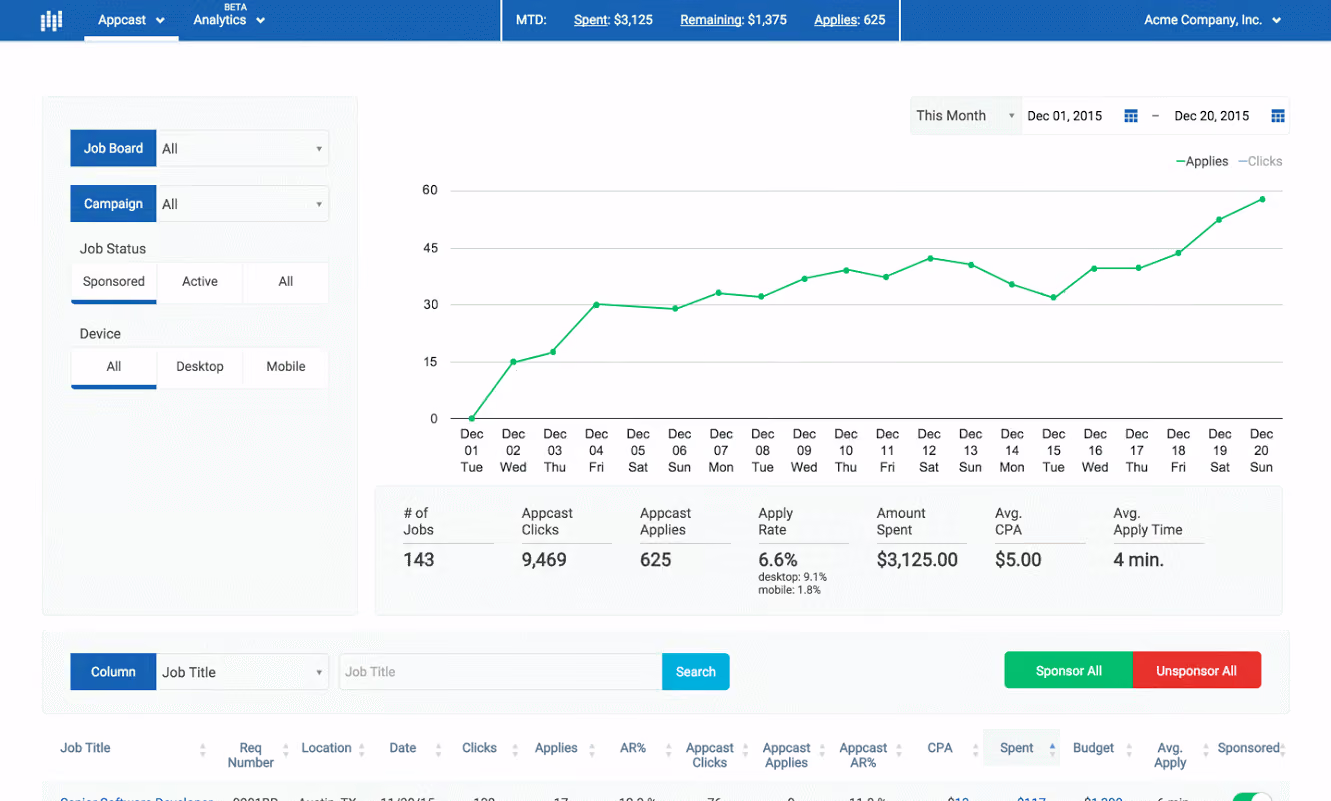
With over 1,000 customers, including Lyft, Refresco, and Encompass Health, Appcast is one of the brands you should look at when shortlisting the programmatic job ad tech partner for your TA team. The platform sees most clients save 10% of their advertising budget by turning off jobs that aren't getting applications, and the savings are significantly higher when machine learning is applied to their spending.
Our favorite part about Appcast is that when your hiring needs shift, the solution accommodates. You gain full control over when to pause or pivot your spending at any time, and the platform operates on month-to-month contracts with no long-term commitment required.
To get the most out of this platform, it's advisable not to run too many job ads simultaneously, as it can be difficult to control spending. Some recruiting customers have told us they learned this the hard way: they initially ran over a hundred jobs simultaneously and failed to monitor all of them diligently. Consequently, some of their jobs consumed more of the budget than they wanted.
Another drawback of Appcast is that its smart algorithms don't tell you which job boards sent the most applications your way. Compared with Indeed, Appcast may not hold a candle to it in terms of cost per qualified applicant, according to some employers.
1,000+ companies, including Lyft, Refresco, and Encompass Health.
Appcast operates on month-to-month contracts.
Core Solutions:
- AppcastOne: Unified programmatic distribution across thousands of job boards, search engines, social media channels, and generative AI platforms like ChatGPT, automatically directing spend toward the sources that drive results.
- Appcast Brand & Creative: Employer brand strategy and creative services that improve candidate engagement and hiring outcomes.
- Appcast Career Sites: Optimized, conversion-focused career site experiences designed to attract, engage, and convert quality candidates.
- Appcast Data & Analytics: Full-funnel performance visibility and benchmarks that help employers understand what drives hiring outcomes. Recruitonomics provides labor market insights and performance intelligence to help teams make more informed recruitment decisions.
For customers focused specifically on programmatic advertising, AppcastOne offers three core capabilities: Appcast Xcelerate (reach across job boards and generative AI platforms), Appcast Search Ads (programmatic search advertising), and Appcast Brand Ads (social advertising to reach passive candidates).

Best For
Appcast is best for direct employers with high-volume hiring needs.

Recruitics
For businesses with high-volume hiring needs, Recruitics is a top choice for outsourcing your programmatic job ad work.
PROS
- Flexible tool tailored to client needs.
- Intelligent, bespoke job landing pages.
- Automates critical ad campaign decisions based on real-time performance data.
- Recruitics’ account management team is highly rated by customers for its excellent support.
- It’s a very flexible tool. Recruitics’ account team will work with you to deliver customizations according to your needs.
- Provides AI-powered tech and robust automation features.
CONS
- The turnaround time for campaign launches could be improved.
- Not ideal for companies prioritizing talent outside of the U.S.
- No pricing info available online – potential customers must contact Recruitics.
Recruitics serves as an ideal talent acquisition solution for companies facing continuous hiring demands. By unifying market intelligence, recruitment strategies, and applicant engagement, it assists teams in sourcing necessary talent more effectively while adapting alongside modern candidate search behaviors.
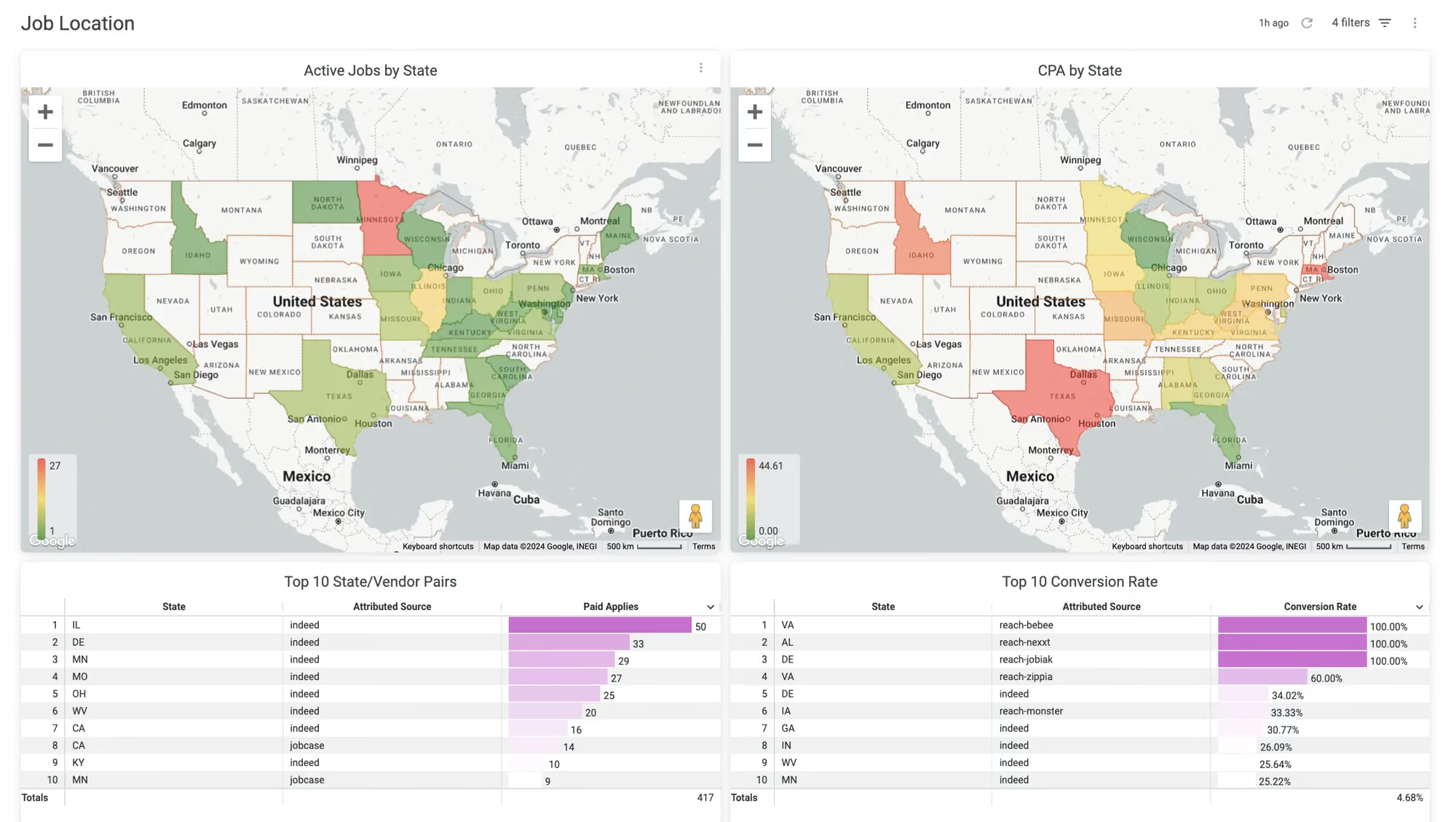
Recruitics’s Predict module offers live performance analytics across various channels, locations, and job titles. Meanwhile, Attract delivers listings directly to active and passive talent, and Convert enables seamless applications from any device while filtering for candidate fit and pushing data into your existing ATS.
Recruitics customer support team is our favorite. They have transformed from okay service to become a true extension of the customer’s internal subject matter experts over the past two years.
As we interviewed some of Recruitics’ customers, “collaborative” and “helpful” are what they brought up the most about their experience with the support team. The marketers and analysts were particularly in the spotlight of our convos. Lots of comments were about them closely monitoring campaign performance and providing real good insights for optimization. And the fact that these people touch base with you through regular weekly team calls and emails for open communication and feedback on their services explains why they’ve got this much customer love.
One significant drawback of Recruitics, however, is the turnaround time for launching a new campaign. While we appreciate the level of support the job ad agency provides customers, we wish for more speed in the way they get everything up and running. On another note, Recruitics’ network of media sources is quite U.S.-focused, so we wouldn’t recommend this vendor if the ideal talent profile demographics you’re after are in other parts of the world.
400+ businesses have partnered with Recruitics. Names include Hired, Wayfair, and Brother.
Recruitics has custom pricing.
Best For
Companies who don't want to pay for programmatic recruitment software and would rather have someone else do the work.

We used the Recruitics platform to help us manage, analyze, and optimize recruitment advertising campaigns across various channels, and leverage their data-driven insights and optimization tools. We especially needed them to help us increase applicant conversion to obtain the necessary and qualified hires in support of our planned growth. The data and analytics Recruitics provided also helped to inform many talent acquisition decisions.
I like working with Recruitics because they are able to provide data analytics to support well-informed business and talent acquisition decisions for my company. They can optimize the audience targeting and bidding process. It is also easily integrated with our ATS (Greenhouse).
We partnered with Recruitics for 3 years to help support our team's talent acquisition needs using programmatic job board advertising. We were hiring over 500 employees per year. Having that many requisitions there was no way we wanted to manage them manually so we enlisted the help of Recruitics. We had a very lean team and wanted to maximize their time sourcing qualified candidates. Recruitics was also able to target the ideal audience we were searching for.
There was a lot to learn on the data analytics side of the Recruitics platform making it a bit complicated. While I don't have the price we paid for their services, I know that Recruitics tends to be on the higher end of costs as far as these types of platforms go.
Recruitics is consistently updating its processes and staying in step with what is trending in the industry and workforce marketplace.
They should consider cost, integration, company resources to manage the tool, and if they would benefit from having a third party manage their TA ad campaigns.
They have added more integration partners, simplified the integration process, and expanded optimization possibilities.
Recruitics would be good for organizations running multiple TA ad campaigns, those who have a large number of requisitions open at the same time, and companies with high turnover needing to fill positions on a regular basis.
Those with low turnover, a low number of open roles annually, and companies who are not interested in TA data analytics.
Adway
Adway's futuristic UI evidently gives away what the company prizes: disruptive technology and the power of social media. Use the software to attract the next generation talent that's tailor made for you.
PROS
CONS

Adway helps companies >500 employees to target job seekers on social media and drive them into the hiring funnel. In addition, they have a retargeting offering that cheaply serves employer brand friendly ads to talent that has visited your job site.
NIRA Dynamics, Wiser, and Visma are a few of the companies that have used Adway for their hiring.
Best For
Companies with over 500 employees looking to engage social networks.

Pandologic
PandoLogic's AI enabled platform is not only automated but also self-learning. Exploit the power of their intelligent recruiting algorithms; Dominos did it and saw a 472% increase in applicant volume, all while decreasing their cost by 533%.
PROS
CONS
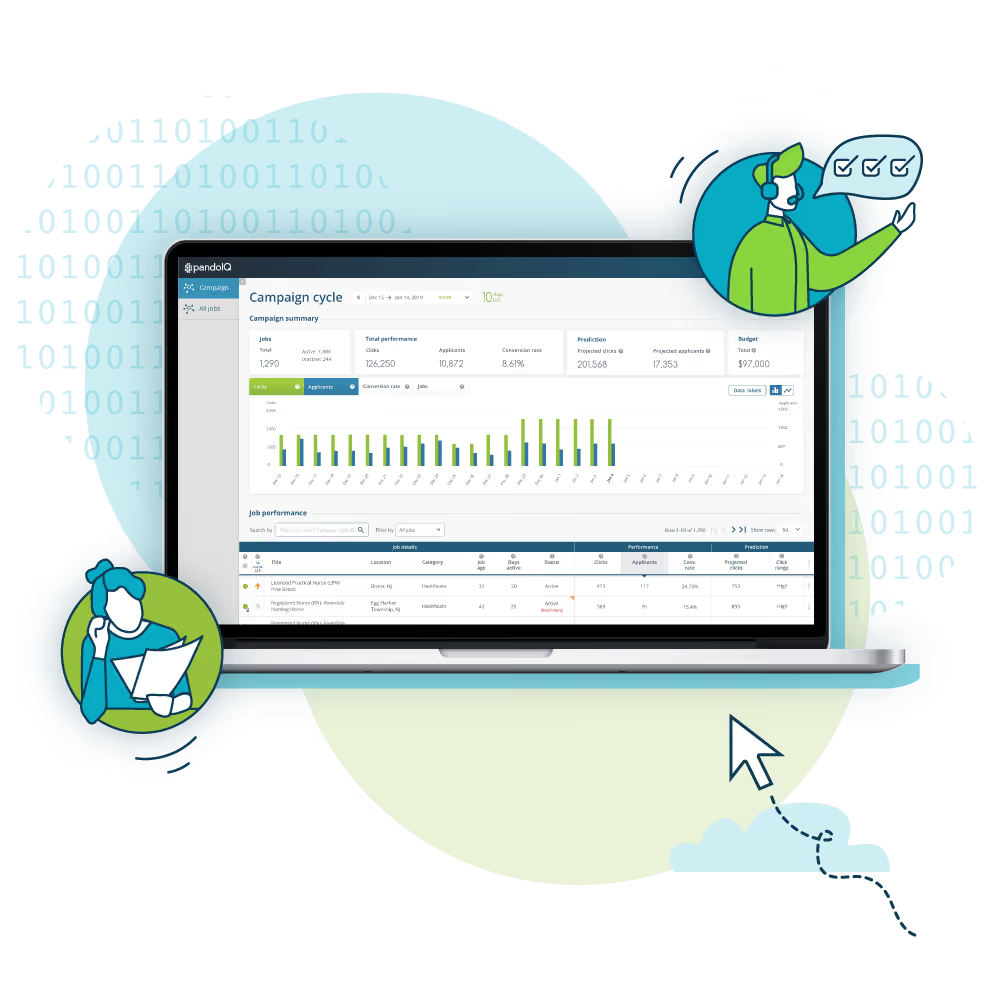
Talent Acquisition teams leverage PandoLogic's programmatic advertising platform, named pandoIQ, to quickly source talent across a broad variety of roles and geographies. Their AI-enabled automation means your team spends less time writing manual rules for job ads, eliminating waste in your media spend and enabling higher volume of quality applicants.
Some clients of Pandologic include Amazon, HCA/HealthTrust, and Wal-Mart.
Best For
Companies hiring rapidly who need to source qualified candidates more efficiently.

Talentify
Talentify's big advantage is its programmatic job ads that reach many candidates on various job boards and social platforms. While pricing isn't openly disclosed, you can use it for free for two months with their trial.
PROS
CONS
We liked Talentify’s bold commitment to boosting job ad metrics and the promise to cover the first monthly invoice if not met. With the platform’s programmatic approach, your job ads reach diverse platforms, from job boards to social media. Their custom dashboards offer clear campaign insights, and real-time tracking keeps users updated. A 2-month free trial is available for monthly spends of at least $5,000.
However, Talentify's candidate experience isn't very positive. Some job seekers have reported frustration and bugs when applying for positions through the platform. We also found that their website offers quite limited information. So, the demo is like a must if you want to know more about the software.
Alorica, TKC Holdings, and ECS are some of Talentify’s customers.
Talentify has two pricing plans:
- Indeed & ZipRecruiter Optimization: Pricing starts at $5K/month, free trial available.
- Job Advertise Hub: Pricing starts at $25K/month.
Best For
Midsized businesses and enterprises that are looking to improve their job advertising metrics.

We used Talentify daily to create multiple job listings. The tool allowed us to streamline the process by integrating with social media sites and job boards. After creating a listing, we specified the platforms to post on, and Talentify handled the distribution for us. This saved significant time compared to manually posting on each site. Over the year I used Talentify, it became an essential part of our daily workflow for job postings and recruiting.
- Talentify made posting job roles much easier by automating the distribution to multiple platforms.
- It saved us hours each day, allowing us to focus on other assignments or responsibilities.
- The tool was cost-effective for the value it provided, exceeding our expectations.
My company wanted to streamline the process of posting job listings across multiple job boards and social media sites. Previously, we spent hours each day manually posting to various platforms. Talentify simplified this process by allowing us to incorporate all social media sites and job boards into one platform.
With Talentify, we could create a job listing, specify which sites or boards to post on, and the tool handled the rest. This saved me several hours each day, freeing up time for other tasks. I used Talentify for a year during my time with the company.
- It still took some time to create the listings on Talentify, although it was faster than manually posting on each site.
- At the time we used it, Talentify was limited to certain platforms.
Talentify is the only tool I have used that specifically focuses on automating job postings across multiple sites.
The cost per year is a critical factor to consider when purchasing any tool. It’s important to evaluate the specific capabilities you need and ensure the tool aligns with your goals. Ask yourself whether the tool effectively accomplishes what you want, and consider whether its features are worth the investment.
Talentify has expanded the number of sites it integrates with, making it even more useful for distributing job postings.
Talentify is ideal for mid-sized and Fortune 500 companies with a monthly revenue of over $5,000, as it aligns with their policy and needs.
Talentify is not suitable for startups or organizations with a monthly revenue of less than $5,000, as they may not meet the company’s policy requirements.
How to Use Programmatic Job Advertising Platforms
Programmatic platforms can automate much of the work of job advertising, but results still depend on how you set them up. Here’s how to get the most out of yours.
- Define “qualified” before you launch. The algorithm can only optimize toward the target you give it. Before your first campaign, set targeting rules around the job titles, locations, skills, and keywords that actually predict a good hire. That way spend flows toward the job boards, social platforms, and niche sites where those candidates are active. As Miriam Scholes, former Vice President, People at Madison Reed, shared with us, Recruitics helped her team “increase applicant conversion to obtain the necessary and qualified hires” to support planned growth. It also informed many of their broader talent acquisition decisions.
- Set cost-per-applicant targets and caps, not just a total budget. Most platforms let you set a target cost-per-applicant, cap spend per job, and pause ads automatically once a role hits its applicant goal. Use all three. A total budget alone keeps spend under control, but per-job caps stop one hard-to-fill role from draining money meant for others.
- Consolidate job boards and publishers in one dashboard. Instead of posting manually to each board and social channel, centralize distribution across publishers like LinkedIn, Indeed, Facebook, and X. This saves the most time for high-turnover teams that repost the same roles frequently, such as consumer services jobs. Erin O’Neil, a Human Resources Specialist at the National Institute of Standards and Technology (NIST), described the change after adopting Talentify: “Prior to Talentify, we had to individually post job announcements on multiple sites individually. This took a lot of time since we have a lot of turnover.”
- Fix the apply experience before scaling spend. Programmatic ads drive traffic, but a clunky application wastes it. Make sure your career site is mobile-optimized and offers a short or one-click apply flow before you increase budgets. Otherwise you’ll pay for clicks that never become applicants.
- Give the algorithm time to learn. Bidding algorithms need performance data before they can reallocate spend well. Avoid pausing or overhauling campaigns in the first week or two. Judge results once enough clicks and applies have accumulated to show a pattern.
- Review source-level reporting regularly. Check which publishers deliver applicants who actually advance to interviews and hires, not just the cheapest clicks. If your platform integrates with your ATS, use that data to tune targeting and bids over time.
- Bring offline media into the same workflow when relevant. Some platforms also let you manage offline media buys, such as billboards, alongside digital campaigns. This is especially useful for agencies and for large-volume local hiring pushes.
Programmatic Recruitment Software Benefits
Programmatic platforms replace manual job posting and fixed-price ad buys with automated, performance-based distribution. The result is lower cost per hire, better-targeted ads, and recruiters who spend more time with candidates than with job boards.
- Lower cost per applicant. Instead of paying flat fees for postings that may never perform, you pay based on results, usually per click or per applicant. The platform automatically shifts budget away from low-performing channels, and you can set auto-pause rules so roles stop spending once they hit their applicant goal. Leftover budget can then go to harder-to-fill roles.
- Decisions based on data, not instinct. Every campaign is tracked in real time across clicks, applies, and cost-per-applicant by source. You can see which job boards and channels actually produce qualified candidates and adjust accordingly, which is the foundation of data-driven recruiting.
- More precise targeting. You define the candidates you want by title, location, skills, and experience level. The algorithm then places ads where those people are most likely to see them, including niche boards and social channels you might not have tried manually. This improves the odds of reaching qualified applicants rather than just more applicants.
- More recruiter time for candidates. Automation removes the repetitive work of posting the same role to Indeed, LinkedIn, Facebook, and dozens of other sites, then refreshing and tracking each one. Recruiters can put that time into screening, interviewing, and building relationships with top talent.
Nevertheless, programmatic job advertising software isn’t for every company.
Common Programmatic Job Ad Platform Pitfalls
Programmatic advertising works best for high-volume hiring with a budget to match, so it can backfire if you’re hiring for only a few roles, working with a tight budget, targeting candidates who don’t respond to job ads, filling executive or confidential positions, needing strict control over placements, or lacking someone to manage campaigns.
Before you commit, watch for these red flags.
- You only hire a handful of roles per year. As Kenny Wright, founder of Advantage.ai, explained on a recent podcast episode, programmatic job ads are designed for high-volume hiring. With only a few openings, the algorithm has too little data to optimize, and setup and management costs can outweigh the savings. Your applicant tracking system (ATS), employee referral software, and talent sourcing tools will likely deliver more for less.
- Your budget can’t cover platform fees and minimums. Most platforms charge a percentage of ad spend, a subscription fee, or both, and many require a minimum monthly spend. If that’s out of reach, free or low-cost options may serve you better. These include job postings on social media, a strong company career page, and local community boards.
- Your best candidates don’t respond to job ads. Programmatic platforms only reach people who are active online and browsing job content. If your talent pool is highly specialized, mostly offline, or typically hired through personal connections, traditional channels will outperform automation. These include industry-specific job boards, networking events, direct outreach, and referral programs.
- You’re hiring for executive or confidential roles. Broad, algorithm-driven distribution works against discretion. For senior leadership or sensitive security positions, confidentiality and candidate quality matter more than reach. Direct outreach, fractional CxO arrangements, or specialized staffing agencies are usually a better fit.
- You need full control over every ad placement. Most platforms let you include or exclude specific publishers, but the algorithm still decides how budget is distributed among them. If you have strict requirements about exactly where and when each ad appears, a manual approach gives you that control.
- No one on your team can own optimization. Bidding runs automatically, but someone still needs to set targets, review source performance, adjust budgets, and refine job content. Without that oversight, campaigns drift and spend gets wasted.
Job Advertising Platform Key Features
The core of any programmatic platform is automated bidding and multi-publisher distribution. The best tools add precise targeting, budget controls, real-time analytics, ATS integration, and built-in recruitment marketing features such as landing pages and social distribution. Here’s what to look for.
- Automated bidding and budget optimization. This is the feature that makes a platform programmatic. The algorithm adjusts bids and moves spend between publishers in real time, putting more money behind channels that produce applicants and pulling back from those that don’t. When evaluating vendors, ask how often reallocation happens and whether you can set rules for it.
- Multi-publisher distribution. A single campaign pushes your jobs to a network of job boards, aggregators, niche sites, and social channels. Network size and quality vary widely between vendors, so check whether a platform covers the boards that matter for your industry and locations.
- Audience targeting. You define the candidates you want by job title, location, skills, keywords, and experience level, and the platform places ads where those people are most likely to see them.
- Performance-based pricing and spend controls. You pay per click or per applicant, depending on the platform, rather than flat posting fees. Look for controls to set total campaign budgets, per-job caps, target cost-per-applicant, and auto-pause rules once a role hits its applicant goal.
- Campaign analytics. Real-time dashboards track views, clicks, applications, and spend for each job and publisher. The stronger platforms go beyond clicks to show cost-per-applicant and, with ATS integration, cost-per-hire by source.
- ATS integration. Jobs sync automatically from your ATS, and applicants flow back into it, so recruiters work in their usual workflow. Two-way integration also feeds hiring outcomes back to the algorithm, improving optimization over time.
- Landing page and career site builder. Many platforms let you build job landing pages or a full career site that showcases your employer branding. These pages then route applicants into your ATS or a dedicated inbox, keeping the experience seamless for candidates and recruiters.
- Social recruiting. Extends job ads to the social platforms where your potential hires spend time, helping you attract passive candidates. This is especially useful when a role isn’t getting traction on traditional job boards.
Programmatic Job Advertising Software Pricing And ROI
Programmatic recruitment solutions typically charge a percentage of your ad spend, usually 10-20%.
Additionally, there's often an annual SaaS fee and some potential extra fees such as markup fees, ad tech tax, data management fees, analytics and measurement fees, and fraud prevention costs, depending on the specific vendor and your needs.
Calculate the total cost of using programmatic technology by factoring in both the percentage fee and any additional fees. Compare this cost to the potential savings in your overall cost per hire.
If your hiring volume is medium to high, the upfront costs of adding a programmatic job ad platform to your recruitment process may be significant. Still, the efficiency gains and potential savings over time often justify the investment.
Demo Questions to Ask Programmatic Job Advertising Vendors
Go into every vendor demo with questions in six areas: publisher reach, targeting and optimization, analytics, pricing, integration, and support. Here are the questions worth asking in each.
Publisher Network and Reach
- How many job boards, aggregators, niche sites, and social channels are in your network, and which ones matter most for our industry and locations?
- Do you support both national and local campaigns, including hard-to-reach regions?
- Are any major publishers, such as Indeed or LinkedIn, excluded or charged differently?
Targeting and Optimization
- What criteria can we target on, such as job title, location, skills, experience, and keywords?
- How does your bidding algorithm decide where to shift spend, and how often does it reallocate?
- Can we set rules or override the algorithm for specific jobs or publishers?
- Do you offer retargeting for candidates who have engaged with our ads before?
- Can we A/B test job titles, descriptions, or ad creative?
- How do you make sure targeting complies with EEO and anti-discrimination rules?
Analytics and Reporting
- Which metrics do you track by job and by publisher, such as views, clicks, applies, cost-per-applicant, and cost-per-hire?
- How do you define an “applicant”: someone who starts an application, or someone who completes it?
- Is reporting real-time, and can we export data or connect it to our BI tools?
- How do you detect and filter bot traffic or fraudulent clicks?
Pricing and Contract Terms
- Is pricing based on cost-per-click, cost-per-applicant, a percentage of ad spend, a subscription, or a combination?
- Do you mark up publisher costs, and if so, by how much?
- Are there minimum monthly spends, setup fees, or long-term contract requirements?
- What happens to unspent budget at the end of a billing period?
- Can you estimate the total cost of a campaign based on our hiring volume?
Integration and Data Security
- Does your platform integrate with our ATS? Is the integration one-way or two-way?
- How long does implementation take, and what’s required from our team?
- Do you offer APIs or job feeds for custom integrations?
- Who owns our campaign and candidate data, and how do you handle privacy and security compliance?
Support, Training, and References
- What support do you provide during and after implementation, and through which channels?
- Will we have a dedicated account manager or campaign strategist?
- What training resources are available for new users?
- Can you share case studies or connect us with current clients similar to us in size and hiring volume?
Implementation Tips for Programmatic Job Advertising Platforms
Most platforms let you launch basic campaigns within days. Full implementation takes longer, though: you’ll need to plan for ATS integration, migrating existing job board contracts, and setting up tracking. You’ll also need to train your team. Here’s what to expect and how to keep the rollout on track.
- Loop in engineering early for ATS integration. Many platforms in this space connect through open APIs or custom feeds rather than plug-and-play native integrations, which usually means engineering or IT time. Ask the vendor upfront how many hours the ATS integration typically takes and what you need to provide. Then give your technical team a heads-up so they can schedule the work rather than squeeze it in.
- Expect job board contracts and feeds to take the longest. If you have existing agreements with job sites, the platform may need copies so it can manage those publishers within your campaigns. You’ll also need to set up how jobs reach the platform, whether through XML or API feeds, your ATS, or an existing job distributor. Because these steps depend on third parties cooperating, they often take longer than the ATS integration itself, so start them first.
- Set up source tracking before you launch. Confirm that applicants are tagged by publisher and that hiring outcomes flow back from your ATS. Without this, you’ll only see clicks and applies, not which channels actually produce hires. The algorithm will also have less data to optimize against.
- Record your baseline metrics. Note your current cost-per-applicant, cost-per-hire, and time-to-fill before switching over. This gives you a clear benchmark for judging whether the platform is delivering.
- Start with a pilot. Launch with a subset of roles or locations before rolling out company-wide. A pilot lets you test budgets, targeting rules, and integrations at low risk, and gives the algorithm time to learn.
- Train your recruiters, and keep training them. Make sure everyone who touches the platform knows how to set up campaigns, choose targeting options, adjust budgets, and interpret analytics. Schedule refreshers as the vendor releases new features, and ask whether your account manager offers ongoing strategy sessions.
FAQs
What is programmatic job advertising?
Programmatic job advertising uses software and data to automatically buy, place, and optimize job ads across the web in real time. Advertisers don’t negotiate with each publisher or pay flat posting fees. Instead, algorithms decide where each ad runs and how much to bid, based on where qualified candidates are most likely to see it.
The approach comes from broader digital advertising, where programmatic buying replaced manual ad deals. In recruitment, it means your job ads appear on the job boards, aggregators, niche sites, and social platforms your target candidates visit, targeted by skills, location, and online behavior.
How does a programmatic job advertising platform work?
You set the goals and rules, and the platform handles distribution and optimization. A typical campaign works like this:
- Import your jobs from your ATS, a recruiting CRM, or directly into the platform.
- Set your budget, including total campaign spend, per-job caps, and a target cost-per-click or cost-per-applicant.
- Define targeting rules based on your ideal candidate profile, such as job title, location, skills, and experience.
- Launch the campaign. The algorithm distributes your ads across its publisher network.
- Let the platform optimize. It tracks performance in real time and shifts spend toward the publishers producing the most applicants for the lowest cost.
- Pause automatically when goals are met. If you’ve set auto-pause rules, ads stop running once a role reaches its applicant target, freeing budget for other jobs.
How is programmatic advertising different from posting on job boards?
With traditional job board posting, you pay a fixed price per post or per slot, whether or not the ad performs, and you manage each board separately. Programmatic platforms use performance-based pricing and distribute ads across many publishers from one dashboard. They also adjust spend automatically based on results.
Why use a programmatic job advertising platform?
Companies with high-volume hiring needs or hard-to-fill roles use programmatic platforms to lower cost-per-applicant, reduce manual posting work, and make advertising decisions based on data rather than guesswork. It works best when you’re hiring for many roles or locations on an ongoing basis.
How much does programmatic job advertising cost?
Costs depend on your hiring volume and the vendor’s pricing model. Most platforms charge one or more of the following: cost-per-click, cost-per-applicant, a percentage of total ad spend, or a monthly subscription. Many also require a minimum monthly spend, so ask for a total cost estimate based on your expected volume before signing.
What are common hidden fees in programmatic job advertising?
Watch for these, which aren’t always clear in initial quotes:
- Markups on publisher costs: a margin added on top of what job boards charge.
- Platform or “ad tech” fees: a percentage of spend taken by the technology layer.
- Agency or managed-service fees: charged if the vendor runs campaigns for you.
- Charges for add-ons: advanced analytics, data management, or fraud prevention.
- Setup or onboarding fees.
- Minimum spend requirements.
Ask vendors to itemize every fee and explain how much of your budget actually reaches publishers.
How long does it take to see results?
Campaigns can start generating applicants within days of launch. The bidding algorithm, however, needs time and data to optimize, so give campaigns at least a week or two before judging performance or making major changes.
Final Advice on Choosing a Programmatic Job Advertising Platform
The right programmatic platform depends on your hiring volume, budget, and how much control you want over campaigns. Look for strong publisher reach in your industry, transparent pricing with no hidden markups, two-way ATS integration, and reporting that tracks cost-per-hire, not just clicks. For those who are still researching, you may want to bookmark this page and come back when your team is ready to buy. We update our reviews on a rolling basis as vendors change features, pricing, and publisher networks, so you’ll always find current information here.
About the Author


About Us
- Our goal at SSR is to help HR and recruiting teams to find and buy the right software for their needs.
- Our site is free to use as some vendors will pay us for web traffic.
- SSR lists all companies we feel are top vendors - not just those who pay us - in our comprehensive directories full of the advice needed to make the right purchase decision for your HR team.


