


Summary: Latest AI recruiting statistics consistently show that artificial intelligence has quickly become embedded in nearly every stage of the hiring process, with many employers reporting faster and improved recruiter productivity. But as adoption rises, so do concerns around candidate trust, AI-assisted deception, and fake credentials. The data suggests the companies seeing the strongest outcomes are not those replacing humans with AI, but those using automation alongside meaningful human oversight.
Artificial intelligence advancements have moved from a buzzword to the backbone of modern talent acquisition. From resume screening to interview scheduling, AI recruiting software now touches nearly every stage of the hiring process, reshaping how recruiters work, how candidates apply, and how much both sides trust each other.
If you're a recruiter, HR leader, or hiring manager trying to understand where AI fits into modern talent acquisition, these AI recruiting statistics will give you a clear, data-backed picture of where the recruitment industry stands today, so you can benchmark your own organization, build a stronger business case for AI investment, or simply stay ahead of a fast-moving field.
Key AI Recruiting Statistics
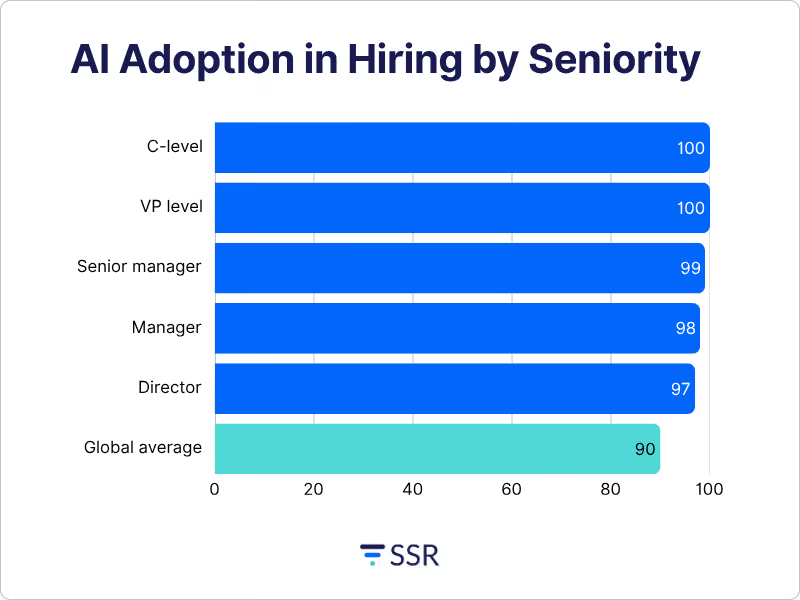
- 99% of U.S. hiring managers say their company uses AI in some capacity throughout the recruitment process; among C-level executives, that figure reaches 100%.[²]
- 98% of hiring managers who use AI say it has improved the hiring process at their organization.[²]
- Employers using AI report up to a 75% reduction in time-to-hire.[⁴]
- 95% of companies in North America anticipate they will invest more money or resources in AI to streamline hiring.[²]
- 74% of U.S. job seekers now use AI in their job search.[¹]
- 91% of recruiters and hiring managers have spotted or suspected candidate deception.[¹]
- 74% of hiring managers say they are more worried about fake credentials than they were a year ago.[¹]
- 41% of candidates admit to using prompt injections and hidden instructions in resumes to bypass AI screening systems.[¹]
- 93% of hiring managers agree AI is a useful tool but is not a substitute for human decision-making.[²]
- 46% of job seekers say their trust in the hiring process has decreased in the past year, with 42% attributing that decline to AI use.[¹]
- 87% of candidates say they want employers to be transparent about AI use in hiring.[¹]
- Only 31% of CHROs say they have strong controls in place to prevent hiring fraud.[⁵]

AI Adoption Is Nearly Universal in Recruiting
The numbers leave little room for debate: AI in hiring is no longer an edge-case experiment. According to survey data from Insight Global, 99% of U.S. hiring managers say their company uses AI in some capacity, with C-level adoption reaching 100%.[²] Globally, nearly 90% of companies report integrating global AI-powered recruitment tools into hiring in 2025, spanning resume parsing, AI agents, recruiting and HR chatbots, social media and LinkedIn automation, and machine learning match-scoring systems.[⁴]
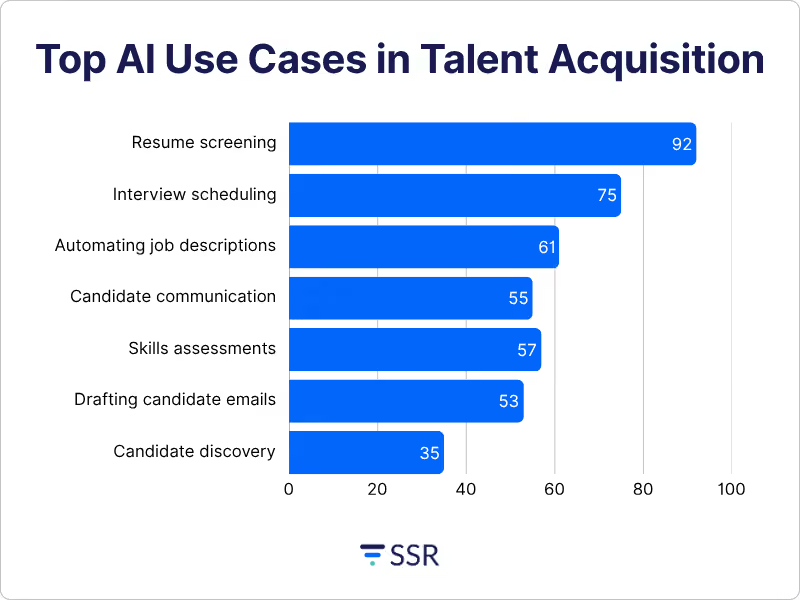
Research from HR.com shows that among organizations using AI for talent acquisition, the most common applications for GenAI and generative AI are automating job descriptions (61%), candidate communication (55%), resume filtering (45%), interview scheduling (36%), and candidate discovery (35%).[⁶]
What this means in practice: if your organization is not yet using AI in hiring, you are increasingly the exception. More importantly, the conversation has shifted from whether to use AI to how to use it well. The breadth of adoption across job description writing, candidate communications, and screening signals that AI is no longer a specialized recruitment tool for large enterprises, small businesses, or tech startups, nor is it limited to specific sectors like healthcare workflows. It is becoming a baseline expectation at every level of the hiring function, from drafting job postings to final selection and onboarding.
AI Recruiting Stats Show the Efficiency Gains Are Real
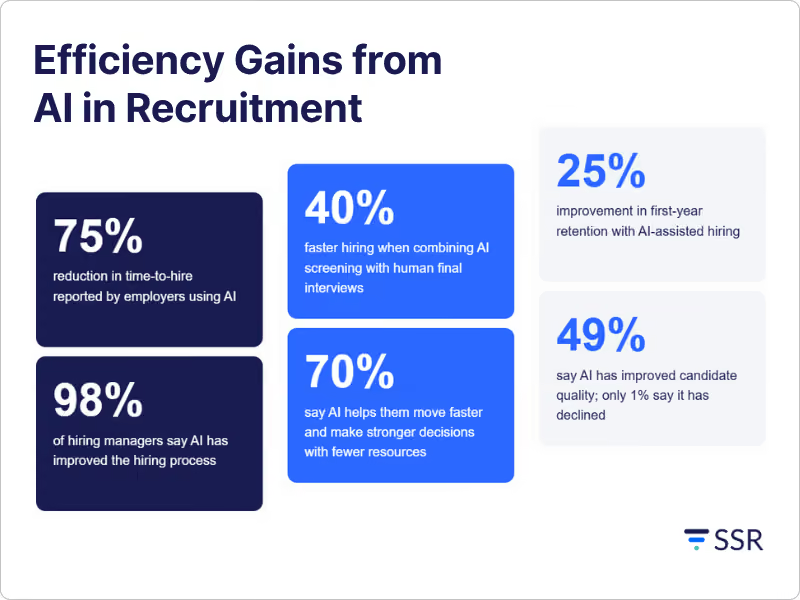
For hiring managers already using AI, the returns are measurable across various performance metrics. Survey data shows 98% say AI has improved the hiring process at their organization, and 70% report it helps them move faster and make stronger decisions with fewer recruiter resources.[²] Employers using AI report up to a 75% reduction in time-to-hire, and companies that combine AI screening with human-led final interviews cut time-to-hire by 40% while improving first-year retention by 25%.[⁴]
Beyond speed, 49% of hiring managers say AI has improved quality of hire, and only 1% say quality has declined.[¹] Companies using AI also report 21% better role alignment in new hires.[⁴] Recruiters currently spend up to 14 hours a week on manual candidate sourcing; AI can cut that time by roughly a third.[⁴]
These are not marginal improvements. A 75% reduction in time-to-hire has direct implications for offer acceptance rates, candidate experience, and competitive advantage in a tight job market and recruitment landscape. The retention and role-alignment gains suggest AI is not just accelerating hiring but improving the quality of matches. For organizations still skeptical of AI's value, this data makes a compelling case that the ROI is real and measurable.
AI Investment in Hiring Keeps Climbing
The results so far are fueling appetite for more. 95% of U.S. hiring managers anticipate their company will invest more money or resources in AI to streamline the hiring process, and among C-level decision makers, that number climbs to 99%.[²] According to the 2026 CHRO Insights Report, 37% of CHROs name AI-driven hiring acceleration as their top competitive advantage heading into 2026, ahead of employee experience (28%) and HR technology modernization (17%).[⁵]

This matters because budget follows belief. When nearly every hiring manager and C-suite executive expects to increase AI investment, organizations that delay are not just falling behind on tooling. They are falling behind on institutional knowledge, process maturity, and the ability to attract talent who expect modern hiring experiences. The gap between early adopters and laggards will likely widen significantly over the next 12 to 18 months as the recruitment market size continues its steady CAGR and growth rate.
AI in Recruitment Is Freeing HR Teams to Do More Human Work
Beyond speed and reductions in cost-per-hire, AI is changing HR in a deeper way. Research from Insight Global finds that among hiring managers using AI:[²]
- 73% say it frees up time for cross-training and collaboration with colleagues
- 61% say it frees up time for personnel management
- 60% say it creates more time for training other employees
- 60% say it improves work-life balance
- 56% say it creates space for team building activities
- 56% say it allows for greater attention to detail
Hiring managers are not just saying AI saves time in the abstract. They are describing a meaningful shift away from administrative tasks and toward relationship-driven, developmental work. This is significant for HR teams making the case internally for AI adoption. The benefit of using AI in recruitment is not just efficiency for the organization; it is a stronger partnership and quality of work life for the people doing the hiring.

AI in Hiring Stats Show Humans Are Still Essential
Despite the enthusiasm for automation, the data points consistently toward a human-in-the-loop model as the prevailing standard. 93% of hiring managers agree that AI is useful but not a substitute for human decision-making, with 53% strongly agreeing, and 100% believe human involvement remains essential to ensure the application experience feels personable.[²] C-level leaders are especially firm on this point: 96% of C-suite hiring managers agree AI cannot replace human judgment in hiring, and 98% say it is extremely or very important that humans remain involved.[²]
In practice, this conviction is showing up in behavior. 68% of hiring managers say their personal level of involvement in the hiring process has increased compared to a year ago, even as AI handles more of the workload. 39% are conducting more in-person interviews, and 61% are now using software to detect AI use during interviews.[¹]
AI is not reducing the need for human judgment in hiring. It is changing where that judgment is applied. Recruiters are spending less time on volume tasks and more time on evaluation, verification, and relationship building. Organizations that frame AI adoption as replacing recruiters are both factually wrong and likely to face internal resistance. The more accurate framing is that AI handles the processing so humans can focus on the staffing and hiring decisions that actually require human insight.

Candidates Are Using AI Too, Mostly Out of Necessity
Research from Greenhouse finds that 74% of U.S. job seekers now use AI in their job search.[¹] The most common applications, according to data from SIA and PrideStaff, are drafting resumes and cover letters (55%), interview prep (53%), filling application forms (53%), creating work samples (37%), and completing skills assessments (30%).[³][⁴]
What is driving this? The majority are not using AI to game the system. 47% say they use it to level the playing field with employers, and 37% say they need it just to stay competitive with other candidates. More than one in four say that if companies use AI, candidates should too.[¹]
This framing matters for how employers interpret AI-assisted applications. Candidates are largely responding to an environment that employers created. When AI models and algorithms screen thousands of resumes and score candidates, job seekers adapt by using AI to optimize their materials for those same systems. Penalizing candidates for AI use without examining your own AI practices is likely to be seen as inconsistent and may deter strong candidates who are simply being strategic. The more productive question is not whether candidates used AI but whether their underlying skills and fit are genuine.

AI Recruiting Stats Reveal Rising Fraud and Authenticity Concerns
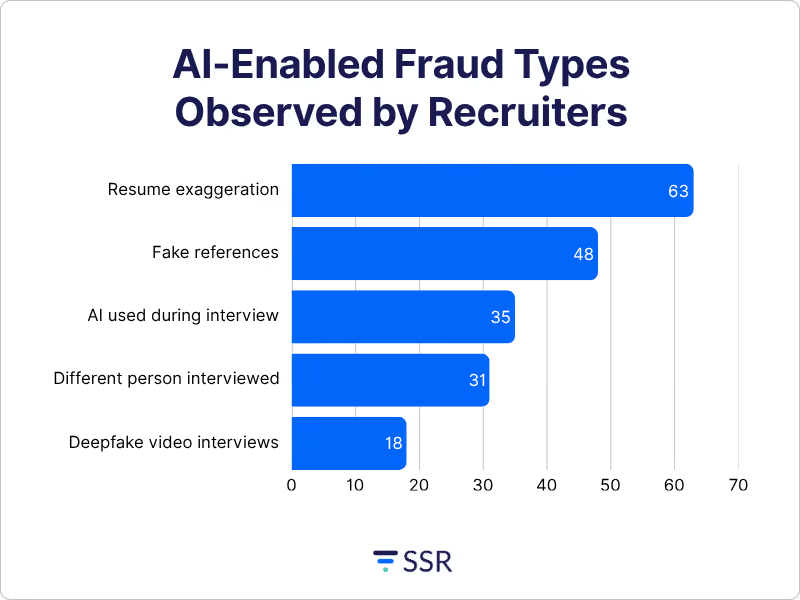
The widespread use of AI on both sides of the hiring equation has created a serious authenticity problem. According to Greenhouse's 2026 AI Hiring Report, 91% of recruiters and hiring managers have spotted or suspected candidate deception, and 74% say they are more worried about fake credentials than they were a year ago.[¹] The most common AI-enabled fraud recruiters observe includes AI-generated resume exaggeration (63%), fake references (48%), candidates using AI during interviews (35%), candidates in different time zones than stated (31%), a different person being interviewed than the one who applied (31%), and deepfake video interviews (18%).[¹]
Candidates, meanwhile, admit to tactics recruiters rarely catch. 41% say they have used prompt injections to bypass AI-powered talent assessment and screening systems, and 36% say they have altered their voice, appearance, or background for interviews, which is double the rate that recruiters actually detect.[¹]
The operational cost is tangible: 34% of recruiters now spend up to half their working week filtering spam and junk job applications, time that used to go toward sourcing and genuine candidate engagement.[¹]
The fraud happening at scale is not the fraud being caught at scale. Resume exaggeration is visible; deepfakes and prompt injections are not. Organizations that rely entirely on AI screening without layering in verification steps, identity checks, or skills-based assessments are exposed. The arms race between AI-powered screening and AI-powered fraud will not resolve on its own. It requires deliberate investment in verification infrastructure.
Trust in AI Hiring Is Eroding — Transparency May Be the Fix
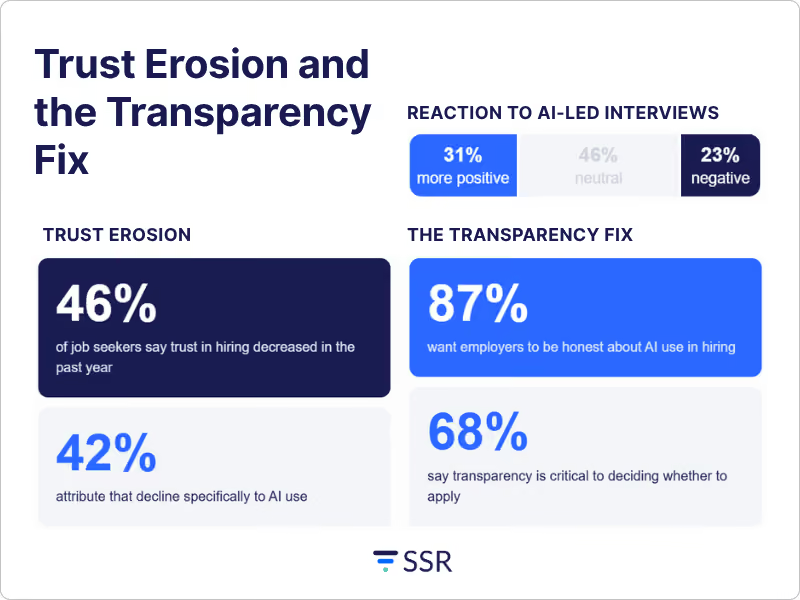
46% of job seekers say their trust in the hiring process has decreased in the past year, and 42% attribute that decline specifically to AI use. Their concerns center on AI shifting bias from human prejudice to algorithmic filtering (35%), AI amplifying historical bias through training data (18%), and AI being less fair because it misses context (17%).[¹]
Yet transparency appears to be a powerful antidote. 87% of candidates say they want employers to be honest about AI use in hiring, with 68% calling it very important or critical to their decision to apply. Only 12% of candidates consider heavy AI use a red flag, meaning the trepidation is largely addressable through clear communication. Among candidates who experienced an AI-led interview, 31% said they viewed the company more positively as a result, compared to 23% who had a negative impression.[¹] Separately, 67% of job seekers report a positive impression of a company when they receive consistent updates throughout the application process, underscoring how communication at every stage shapes employer perception.[³]
Most candidate concern about AI in hiring is not categorical opposition to the technology. It is a reasonable request for honesty about how it is being used. Companies that proactively communicate their AI practices, explain what it screens for, and clarify where humans make final decisions are likely to see stronger application rates and better candidate trust than those that stay silent. Transparency is not just an ethical obligation here; it is a measurable competitive differentiator for employer brand.
AI in Recruiting Statistics Show CHROs Still See Major Gaps
Despite strong interest in AI recruitment tools, HR technology is underperforming expectations. According to Checkr's 2026 CHRO Insights Report, 71% of CHROs say their HR tech tools only meet some expectations, and just 26% say they exceed expectations or are exceptional.[⁵] Confidence in fraud prevention is also limited: only 31% of CHROs say they have strong controls in place, while 45% acknowledge partial controls with gaps.[⁵]
The biggest blockers to a better tech stack are budget limitations and software pricing (19%), tool integration gaps (16%), customization challenges (16%), resistance to adoption (15%), and complexity of implementation (14%).[⁵] Where CHROs see the highest remaining opportunity for AI impact on talent acquisition: increasing background check speed and accuracy (40%), detecting identity fraud (35%), coordinating and scheduling interviews (33%), and automating resume screening (31%).[⁵]
Most HR organizations are in a transitional state. They have adopted AI broadly but have not yet optimized it. The gap between near-universal adoption and only 26% of tools exceeding expectations suggests that implementation quality, not just tool selection, is the differentiating factor. Organizations that invest in integration, customization, and change management are likely to see substantially different outcomes than those that deploy AI tools without a supporting infrastructure.

Key Takeaways from the Latest AI Recruiting Stats
AI has become the operating system of modern talent acquisition, accelerating decisions, surfacing better candidates, and freeing HR teams to focus on what humans do best. But it has also introduced new complexity: a candidate arms race, rising fraud, and a trust deficit that demands honesty from employers.
The organizations that will win in this environment are not necessarily those using the most AI. They are those using it most thoughtfully, keeping humans meaningfully in the loop, verifying what AI cannot verify on its own, and being transparent with candidates about how the technology shapes their experience.
Research and Data Sources
- Greenhouse. 2026 AI Hiring Report.
- Insight Global. AI in Hiring Survey Report.
- Talent Insight Group. The Role of AI in Talent Acquisition.
- PrideStaff. AI in Hiring: How to Leverage Technology Without Losing the Human Touch.
- Checkr. 2026 CHRO Insights Report.
- Eightfold AI. HR Future of AI and Recruitment Technologies Report.