


Introduction
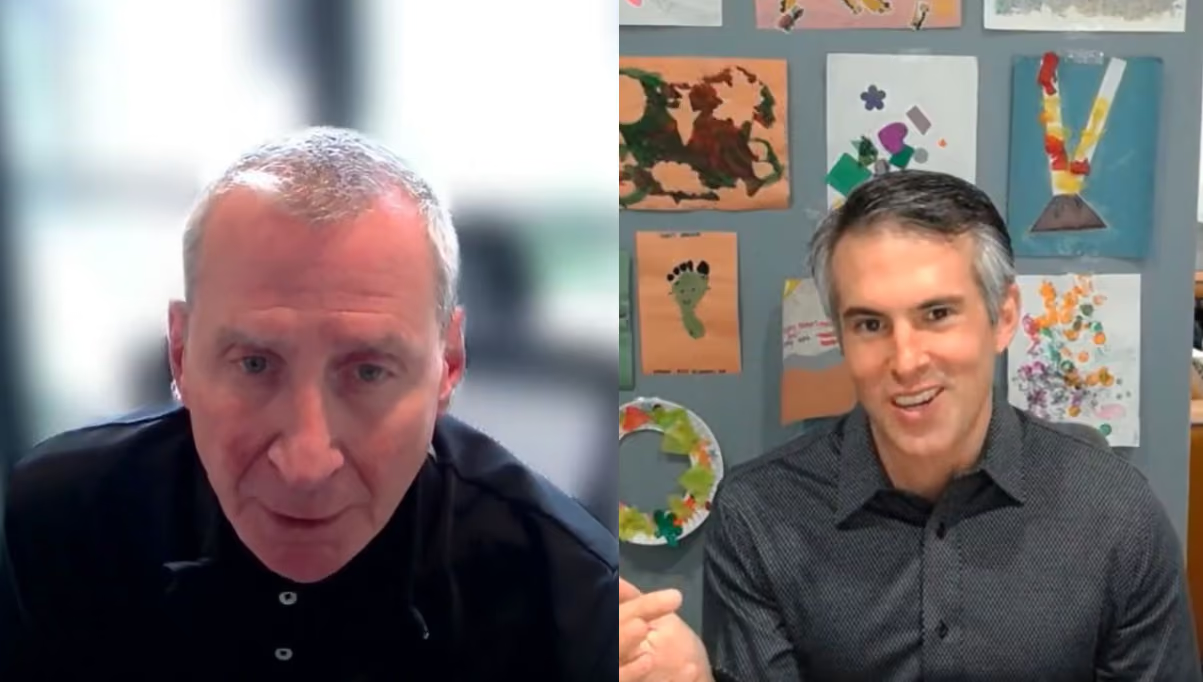
I recently sat down with Tom Hacquoil, the CEO and cofounder of Pinpoint, to talk about where the ATS market is heading and how talent teams are adapting to a world shaped by automation and AI. Tom has a uniquely candid view of the space.
Pinpoint started as a challenger brand eight years ago and has grown into a platform used by organizations with complex hiring workflows across desk and deskless environments. Their vantage point gives Tom clear visibility into the pressures facing HR tech buyers, the reality of AI adoption inside large organizations, and how modern ATS platforms must evolve to stay relevant.
Across our conversation, Tom unpacked why the ATS category feels “a little bit lost,” why executives and recruiters have radically different expectations for AI, and how structured data and workflow automation outperform most AI-first approaches.
He also shared where Pinpoint is seeing real customer success, what the 2030 talent tech landscape may look like, and why he believes the future hinges on purpose-built prehire platforms. If you’re following the ATS market, evaluating Pinpoint, or tracking how automation is reshaping talent acquisition, this interview is worth a full listen.
Interview Video
Full Transcript
Phil: Hey everybody, Phil Strazzulla from Select Software Reviews. I'm here with Tom, who's the CEO of Pinpoint. We're gonna just talk about the state of the ATS market. Where's it going in the future? Tom has built a really interesting business with Pinpoint, which, if you haven't heard about, you should definitely check out Pinpoint.
Tom, do you mind giving a quick background on yourself? Why did you start this business, and what are you guys up to?
Tom: Sure. Yeah. Cool. Thanks, Phil. Nice to chat again. I think, yeah, I started the business eight years ago. I think sort of, although the ATS segment was congested then as it is today, it still says there was an opportunity to do something slightly different. I think at the time that meant taking candidate experience a little bit more seriously, and then as the market has evolved, I think we've tried to evolve our product with it and make sure we're sort of the challenger brand in that kind of fast but flexible space. Right? So, we still think there's this huge opportunity to try and essentially solve this problem that we believe exists today and is growing in size around organizations that sort of need to be able to adapt and evolve, have different types of hiring workflows. Right? So, you maybe have a desk and a deskless workforce at volume and may have historically had several systems for that. We think we are sort of the sweet spot that can help you tackle all those problems in one system, and there's sort of lots of benefits as a result of that.
Phil: Amazing. How would you characterize the current state of the applicant tracking system market, and today, late 2025, a couple of years after the launch of ChatGPT, we've seen a lot of AI-type stuff get into this market? At this point, what's your state of the market?
Tom: Yeah, it's a really, really interesting question, and being honest, I think the space feels a little bit lost, right? I think there's a lot of open questions around what role an ATS has to play in sort of an AI and agentic AI market. I think people slightly overblow the pace at which we're going to get there, to be honest, especially in the HR amino, and I think you're hearing and seeing quite different priorities from recruiters, hiring managers, and folks on the ground and sort of some of the more senior folk and folks think about risk and compliance and other stuff involved there. So, we sort of need to find our footing a bit.
I think to me, like the ATS market has to evolve, and I think what we've seen sort of on the front lines from CFOs and CHROs and other folks making purchasing decisions today is this sort of push to consolidation and fewer P&L line items, right? And I think the ATS needs to work hard to defend its position in the stack. I think the way that we think about doing that, and obviously I'll only speak for us in this market, is sort of really trying to aggressively evolve into a prehire platform. So, we're sort of observing consolidation and see the benefit of that. But what we want is for folks to go from ten-point solutions to two. And we think those two are sort of a really strong pre-hire and a really strong post-hire platform, sort of a more in-one, if you will, rather than the all-in-one, and I think that is what we believe is the sweet spot. And so, we can talk a lot about what that means and how we're thinking about doing that, but sort of that's the sort of high-level summary and sort of where we think ATSs need to go.
Phil: What's the disconnect that you referenced between more senior level and the people kind of on the ground doing the work when it comes to AI and these systems?
Tom: Yeah, so, well, I think, well, specifically through the lens of AI, I think what we're seeing is, um, and we'll talk about the specifics of this in a second, but we're seeing lots of hiring managers, lots of recruiters, lots of actual kind of core users of an ATS ask really intelligent questions around AI, the role of AI in the recruitment process. How can it help me process this quicker? How can it help me contend with the AI we're seeing used in the candidate space, etc., etc., etc.
And a lot of folks are doing some really exciting stuff in this arena, and we're fortunate to partner with some of them, and we have some of our own tech there.
What I think we're seeing when we talk about that disparity is, um, three-month procurement cycles and then AI councils start to be born in these businesses. People get very scared about the use of AI in the context of recruitment in the context of discrimination and bias, and they think about the ethical ramifications, and what we're actually hearing being brutal from the front lines with some of the folks who have built their whole business on AI, unlike us, is they're stalling, and they're struggling to get this stuff into these tech stacks because ultimately the risk is perceived as being too high, and the end user doesn't have the authority to push that change through the business.
And so, AI is being rolled out slowly and carefully, but HR is not seen as a priority for AI in the same way as other areas, and it's also seen as a much higher-risk sector, and I guess that's what I'm referencing when I talk about that disparity. And obviously to us as a sort of commercial organization, it has to impact roadmap prioritization because we want to deliver things that we can actually get into the hands of our customers and see use.
Phil: Does that make sense?
Tom: It does, yeah.
Phil: Somebody yesterday had pitched me a new product that they're working on; they're calling it the anti-ATS, and sort of an interesting positioning. I don't know if it quite fits what they're doing, but what they're doing is effectively an AI to screen candidates. So, almost like a one-way video interview sort of thing, but more of a chat interface. And the problem that they're getting at is just a massive deluge of resumes from all these open positions because so many candidates are leveraging LLMs. Where do you see an ATS's role in solving that specific problem that I think a lot of talent acquisition teams are dealing with right now?
Tom: It's a really hard question to answer. I'll give it a go, but like, I—it's a smart question. I think, like to me, there's a big difference between like what I call automation and AI, right? And I think people sometimes blend those two worlds more aggressively than they should.
I think what we try and encourage folks to do when we think about, for example, like the deluge of volume that we're absolutely seeing in the market, is really understand and characterize how as a recruiter you're making those selection decisions if you were going through that process one by one. Think about how we can gather that information in an actually accurate state, not interpreted. For example, like how can you learn how you're going to screen candidates and then can we ask pre-screening questions that are multi-choice or boolean or otherwise, and then set up workflow automations, and we're super proud of our workflow automation engine to essentially mirror the behavior of you as an end user, which is a super defensible start and I think is the sort of right answer in the first instance to the managing of this huge volume.
You have to be intelligent about the input you receive and forcing the LLM inputs to sort of play the game you want them to play.
I think the risk is— what people have done is gone too quickly to, well, if Phil uses AI, I'm going to use AI, and you've got AI writing a CV, and then our AI interpreting that CV and inferring from that input a whole bunch of characteristics and trying to score against a job. I think I get why that's exciting, and we have some tech that does that. I think folks that we're seeing in the market get quite uncomfortable about the ramifications and the risk of that, and so we want to give people choice, right? And I think everybody has a different risk appetite. I think we've lent into sort of offering you a lot of choice and discretion and also going super deep on sort of how did we infer that and why is that the score we've given and how can you compute that and so on. But I think the right answer is going to be different for everybody. Right.
Phil: The Zapier team, sort of a side note, I've seen on LinkedIn the last few days, have been posting their new SOP around basically they're getting resumes in, and I think they're giving people the option to interact with some sort of chat interface to augment what's in their resume, which I think is sort of interesting. It's not forcing you to do that because I think a lot of people are like, "You're not even going to talk to me," but it's giving the candidate an opportunity to kind of go beyond the resume, which is good. And yeah, definitely interesting time. Like, in some ways, I think we should go to like faxes or something like that, or like super high friction.
Tom: I think the problem is that like, it just feels like the risk is asymmetrical, right? The candidate can use an LLM. No one's going to sue them. No one's going to have some policy that it violates. Nobody really cares if they exaggerate or if it's misinterpreted and they can just go, "Woe is me".
I think the risk is very firmly on the side of the organization, and that's why I think the approaches to those inputs are very firmly different, right? And I think like, to me, anything you can do, like the example you gave, where you're asking the candidate to actually give you structured data rather than inferred or inference data, is a completely different ball game, because if you said yes or no to a simple question, I don't mind screening you out on the basis of that answer, and I can defend that.
What worries organizations is if I'm inferring whether you're good at X based on something you wrote in a CV, that's where I think we're in sort of slightly more murky waters today.
Phil: Yeah, totally agree with you. I think one of the interesting aspects of ATSs, and especially adoption of them, is even before we get to this AI future, there's the automation aspects that a lot of teams haven't quite figured out. Can you talk a little bit about where you think Pinpoint can help with that, but also where talent acquisition teams should focus in terms of automation before they even maybe get to the AI step?
Tom: For sure. And I mean, and I'll start just by saying, and I may have already said it, I'm a bit of a broken record here, but like, actually we have a lot of conversations with folks that they call AI, and actually what they're describing is automation. And I think it's really important that they recognize that like, actually automation done well is achieving most of the outcome that AI is in theory playing in a lot of the processes we're talking to. Not always the case, but it's certainly worth thinking about.
I think we leaned in really heavily to automation and trying to kind of make the whole flow of our system built on that. And I think like you look at ATS, and they're often either built by recruiters, and I think that's great for domain expertise, but sometimes comes at the sacrifice of some of the technical infrastructure needed to make workflow automations work, or you've got the sort of Pinpoint-built-by-nerds type setup where we feel quite strong architecturally, and it allows us to do things in areas like workflow automation that maybe others would struggle to do.
So, I think like we've built very heavy there, and I think what we try and do is produce a lot of content shining light on what we're seeing other customers do, and I think we're really fortunate to work with a really diverse range of customers from folks like SKIMS in retail to people like the New York Public Library system to huge hotel chains, FIFA and football. Like, they're all using automations wildly differently, and with their permission, we'll often showcase how they're using automations in the product and sort of share that widely and openly.
And I think if it's cool with you, I'll kind of link to some of that content to sort of distribute alongside this, because I think we always rather use customer stories, but I think there's lots you can use automations to do to do things like deliver a wildly better candidate experience, to mitigate like negative interactions and touch points on the comm side, to stop things kind of like—one example is that we have a retail client who has an automation set up that whenever they get 500 applicants or more for a single position in a window of a week, they automatically close the job. They send an email to every one of those candidates telling them that they've been inundated with volume. They should expect a slightly larger and, sorry, longer time to respond. And then once they can see that that is whittling down, the job automatically reopens, and it sort of cycles through again.
And like, that might sound like an inconsequential thing compared to sort of automated job matching, but all these little micro adjustments are actually the thing that makes the difference between a sort of negative or a positive hiring outcome. And so, would love to give you some content to sort of support that message rather than talk about it for 25 minutes or five hours.
Phil: Yeah, sounds great. And yeah, I think that makes all the sense in the world to me, especially where a lot of these models are obviously non-deterministic, and you don't want something like that. That's very much an if-this-then-that sort of scenario, and you can think of many scenarios that would save you a lot of time and, to your point, increase candidate experience, etc. I'm kind of curious, how has Pinpoint's focus shifted? Like, how would you define your ideal customer profile—who you guys are best serving right now in the marketplace?
Tom: Sure. Yeah. I mean, like, honestly, we started as a relatively SMB-focused ATS, right? And a lot of our early customers had tens or hundreds of headcount and were recruiting at relatively small volumes. And I think we learned a lot working with those folks.
I think over the past five years, we've been fortunate to be able to really consciously push upmarket, and I think we'd say our sort of sweet spot today is sort of organizations typically in the US or the UK—although we work in sort of 60, 70 countries now—with 500 to 5,000 headcount if they're what we would call desk workers, and sort of typically up to 30 or 40,000 if they're deskless.
So, we work with lots of folks in retail and hospitality and leisure and logistics and places like that where we're actually sort of the first system they've ever found that can help them do their back-office or headquarter recruitment whilst also recruiting the truck drivers or the bartenders or the folks on the front line, so to speak.
And so yeah, 500 to 5,000 desk, I think up to sort of 30 or 40,000 deskless. If they're recruiting multinationally, all the better because we have these real nice long-tail integrations and multilingual functionality and things like that.
But ultimately, the more complex your underlying hiring workflows and processes are and the more of them there are, the better we feel we are a fit today, if that makes any sense.
Phil: It does. And I guess at that scale of organization, you need something that's quite flexible, but one of the keys is really how do you get these disparate types of users to adopt this system so that it is truly a system of record? Can you talk a little bit about how you decrease that friction and get everybody—from somebody hiring a bartender to somebody hiring a software engineer—to use Pinpoint throughout the hiring process?
Tom: Yeah, love the question. It's really hard is the answer, right? I think like it's the thing we think we've done better than everybody else, right? In a congested market where feature parity is expected and the norm, I think that is the point of differentiation.
And I guess my observation is that typically you have this very discreet choice, right? There are solutions at the smaller side of the market that are really easy to deploy and stand up and that are very intuitive for your bartender to use on their phone or their tablet. There's also the Workdays and everything in the middle of that that are incredibly customizable and powerful, but absolutely everybody despises using.
I think we've been a bit fortunate in that we kind of feel like we've come into the market at the right time where the underlying technology base supports us being able to do slightly more complex things in a more kind of simplistic way to the end user. And I think we spend a lot of our engineering effort thinking about how we can abstract away that complexity and make sure that it is easy for us to take a very complex product and really shine a light just on the bits that matter to your end user so they all have quite discreet experiences.
And I think what we're trying to deliver essentially is a system that looks and feels like a modern software solution and is inherently intuitive, but has a lot of the complexity in the background that you'd expect from an enterprise system that looks like it was built in the 90s. We feel like we're kind of striding both sides of that problem quite well.
I think the second piece to the puzzle, though, which cannot be understated, is the personal relationship that you actually have. And I think like we see our relationship with customers as the biggest driver of retention and the sort of thing that sets us apart.
I think a lot of folks, especially in enterprise tech, make the mistake of sort of throwing technology at the customer and hoping it sticks. I think our view very firmly is we have to hold hands and take folks on a journey, especially in the HR space.
And so, we spend a lot of time physically with our customers, including with end users like hiring managers. We have unlimited training and support and all of these things that we think are huge drivers of adoption, and we're very prepared to overinvest in those things because we think they lead to good outcomes for everybody at the back end.
And so, I think we just had a slightly different attitude for what that actually takes, if that makes any sense.
Phil: Yeah, it does. And frankly, you know, we can see it when we recommend Pinpoint as an ATS. Your team is extremely proactive, following up, making sure that people get what they need in a very transparent way. You look at your content marketing on your blog—it's very much like, here's useful information; it's not a commercial for your solution, which I really appreciate as somebody who reads a lot of this stuff.
One last question for you: Where do you think this market's heading? Like, if you had to make a prediction for the ATS landscape in 2030, is it a consolidation story? Is it an AI story?
Tom: Yeah, great question. Look, I think we can tackle both of those streams. I think there's already consolidation happening, right? We've seen that, you've talked about it. We've seen SmartRecruiters get snapped up. We've seen smaller deals happen in other smaller markets like in the UK and elsewhere. We're seeing point solutions—don't know if you saw the BrightHire–Zoom thing recently.
Like, there's a lot of consolidation happening where people are trying to bolt on these services, and I think a lot of that honestly is driven by a lot of these businesses having raised a tremendous amount of capital, and the market just not supporting that level of activity anymore. So, they've got no choice.
I think we're fortunate to not be in that position and have a very financially healthy business today. So there will be consolidation inevitably.
I think that consolidation will play into the sort of strategy I outlined earlier of this kind of prehire and post-hire platform. And I think trying to mold those two worlds is more difficult than it seems at face value. We're seeing lots of folks in prehire try and become post-hire players, and I think that's a fallacy. And I think the reverse is true also.
But I think for an ATS to really survive and thrive in the current very competitive landscape, it's not just about AI and trying to demonstrate value there. It's about taking more of the share of the prehire wallet and really demonstrating tremendous tertiary value beyond just the core recruitment flow.
And I think that serves two functions. One, it enables stickiness and allows us to defend why we're here and why we need to exist. But two, in the future AI world, the more data and perspective we have as a true system of record, the more layers of intelligent AI stuff we can add on. And there's no way we get to this sort of agentic AI recruiting world that people are hypothesizing unless you've got a dedicated prehire platform that has a really wide reach.
And so, I guess that would be a few thoughts from the top.
Phil: When do you think we'll get to an agentic recruiting world?
Tom: Um, diplomatically, not for a very long time. I think that will not be adopted equally, right? We're fortunate to work with a really diverse group of folks of all shapes and sizes and industries. And I think we're seeing us not be a million miles away there for some folks. I think we're 10, 20 years away for some of our customers and some of our prospects even starting to think about this.
And so, there's life left in us. Yeah. I'm not worried about it right now. I think what we're focusing on right now is earning the right to be the prehire platform of choice and the beast of data, so that when AI is appropriate and the market's ready for it, we've got the right kind of ingredients to feed it to get the outcome correct, if that makes sense.
Phil: Yeah, sure does. Tom, thanks so much for spending some time with us. Hope you enjoy the rest of your day.
Tom: Thanks, Phil.
If you enjoyed this conversation, you'll probably appreciate our ongoing HR tech webinars. We host deep-dive discussions with founders, product leaders, and industry experts, all focused on helping HR and TA teams stay ahead of what’s changing in the tech landscape.
Our webinars are free to join, and you can sign up for updates here: HR Tech Webinars.