Key Takeaway: The UK’s High Potential Individual (HPI) visa is a short-term work visa designed for graduates from selective top global universities, allowing them to live and work in the UK without a job offer. It is a strategic move by the UK government to enrich the nation’s innovation landscape by bringing in seasonal workers.
Hiring talent in the UK without a local entity?
See our UK EOR Buyer Guide for the best employer of record options.
What is the High Potential Individual Visa Scheme?
At its core, the HPI visa is a specific UK immigration route designed to attract global talent. It is for individuals who have excelled at globally recognized institutions. The UK government believes these graduates will make great contributions to the country's economy and society through entrepreneurship, specialized employment, or groundbreaking research.
Additionally, HPI acknowledges that a diverse pool of highly skilled individuals is crucial for innovation and economic growth. Instead of prescribing their actions, it trusts that these visa holders will thrive and contribute meaningfully.
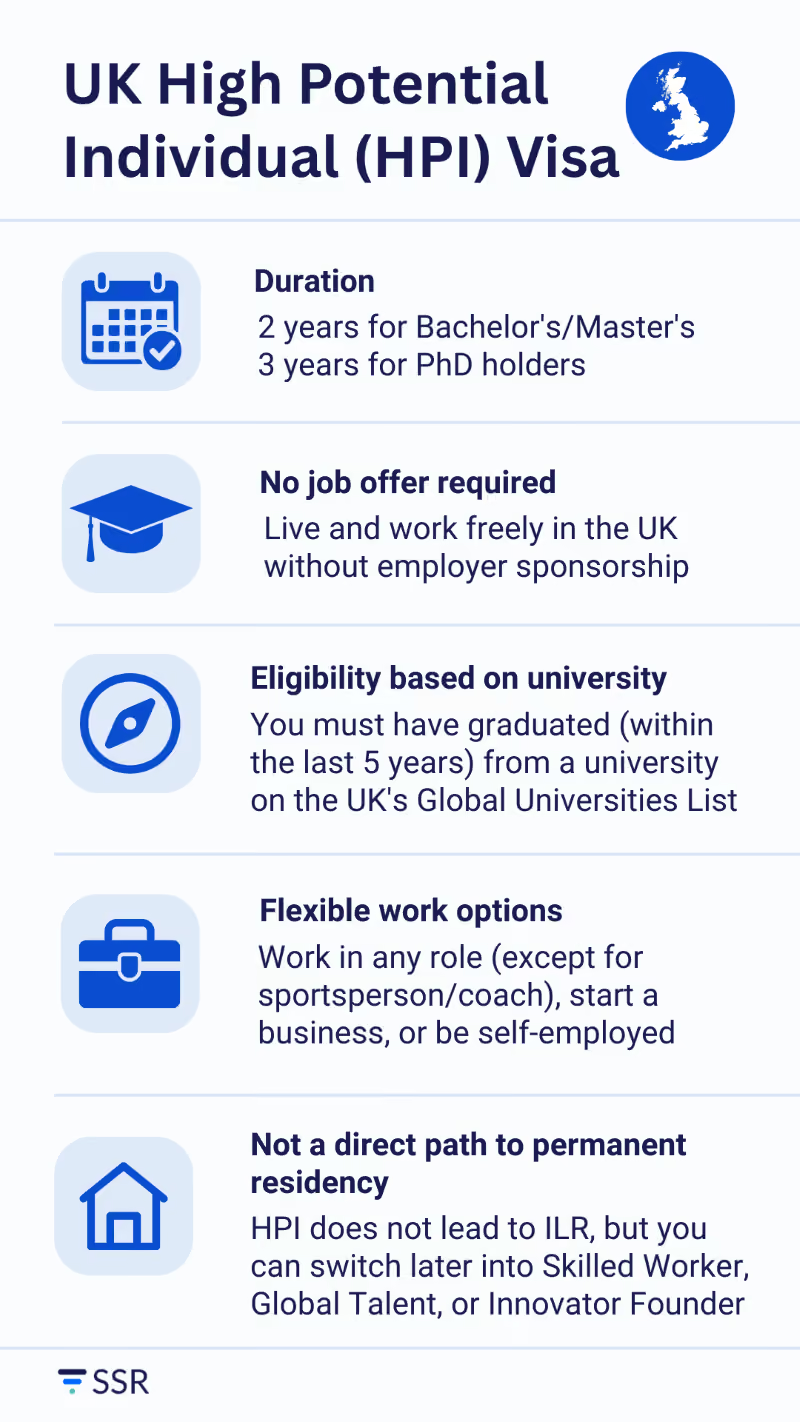
For most applicants with a Bachelor's or Master's degree, the visa is granted for two years. If you hold a PhD or another doctoral qualification, you'll be granted a three-year period. This duration is designed to give you ample time to settle in, explore career options, gain valuable experience, or even start your own venture in the UK. As an HPI visa holder, you can work in any job except as a professional sportsperson or coach.
Why Was the HPI Visa Introduced?
The High Potential Individual visa is a strategic UK post-Brexit initiative designed to attract exceptional global talent. Its primary goal is to strategically attract exceptional global talent to the UK. This is intended to address potential skill gaps and import new knowledge and expertise into the British economy following the country's departure from the European Union. But ultimately, the HPI visa aims to bolster the UK's overall competitiveness in the highly contested international market for skilled individuals.
Who Is Eligible For The HPI Visa?
The first eligibility criterion for the UK High Potential Individual visa is not about what job you have lined up, but rather where you've come from academically.
The Global Universities List
To be eligible to apply for this visa, you must have graduated from an institution on the "Global Universities List." Annually, gov.uk comprises and announces non-UK universities that appear in at least two of the following globally recognized university ranking systems:
- Times Higher Education World University Rankings
- Quacquarelli Symonds (QS) World University Rankings
- The Academic Ranking of World Universities (ShanghaiRanking)
For the period between 1 November 2025 and 31 October 2026, the list is as follows:
What if my university isn't on the list?
If your university isn't on the list, you are not eligible for the HPI visa. This is a non-negotiable requirement. That said, you can explore other UK visa routes, such as the Skilled Worker visa and the Graduate visa. Talking of a Graduate visa, you might be wondering…
What is the difference between a Graduate visa and an HPI visa?
Both the Graduate and HPI visas are post-study work visas that do not require a job offer and can only be held once. Regarding differences:
- Graduate visa is for students who have completed their degree in the UK on a Student visa, with the application being a direct switch from the Student visa.
- HPI visa is for graduates from a select list of top global universities (degree completed outside the UK) and offers fewer restrictions on dependants compared to the Graduate visa.
The time limit: graduating within the last five years
Another criteria is that you must have been awarded your qualification, a bachelor’s or postgraduate degree, no more than 5 years before the date you apply for the HPI visa. This ensures that the visa is indeed for "high potential individuals" who are relatively early in their careers, bringing recent academic achievements and fresh perspectives.
Beyond the Degree: Other Key Eligibility Criteria
While graduating from an elite institution is a must-have, it's not the only box you need to tick. The UK Home Office also assesses other crucial aspects to ensure you can integrate successfully into UK society.
English language requirement
To live and work effectively in the UK, you must prove English language proficiency at or above CEFR level B1 in speaking, reading, listening, and writing. This can be met by:
- Being a national of a majority English-speaking country (e.g., USA, Canada, Australia).
- Having an academic qualification taught in English, equivalent to a UK Bachelor's degree or higher.
- Passing an approved English language test with at least a B1 score in all four components.
Financial requirements
The UK government wants to ensure you won't become a burden on public funds. You must demonstrate that you have sufficient personal funds to support yourself in the UK without relying on state benefits. As of our last update, this typically requires you to:
- Show continuous funds of at least £1,270 held for 28 days, ending no more than 31 days before your application.
- Be able to pay one-off costs, including a £252 Ecctis check, a £880 visa application fee, and the Immigration Health Surcharge, which is typically £1,035 for each year of your stay.
No prior HPI visa history
The HPI visa is a one-time opportunity. You must not have previously been granted the Student Doctorate Extension Scheme or the Graduate route. Furthermore, if you are currently in the UK on a Graduate Route visa, Short-term student visa, Parent of a Child Student visa, Visit visa, Seasonal worker visa, or Domestic worker in a private household visa, you are required to leave the UK and submit your HPI visa application from abroad.
Character and criminal record checks
As with almost all UK visa applications, you must meet the general suitability requirements, meaning you must not have a history of serious criminal convictions or breaches of immigration rules. The Home Office will conduct background checks to assess your character and security risk. Full and honest disclosure is essential.
The Application Process: A Step-by-Step Guide
The HPI visa process can be broken down into 5 main stages.
Gathering your documents
Ensure all documents below are current, legible, and, if necessary, translated into English by a certified translator.
- Your valid passport/identity document.
- Your degree certificate (confirming your qualification from an eligible university).
- Evidence of English language proficiency.
- Bank statements proving you meet the financial requirement.
- A Confirmation of Acceptance of Studies (CAS) reference number from Ecctis (more on this below).
- Any past visa refusal letters (if applicable).
- A tuberculosis (TB) test certificate, if you're applying from a country where it's required.
The Ecctis verification process
A unique and critical step for the HPI visa! You must obtain a "Statement of Comparability" and a "Confirmation of Degree Verification" from Ecctis (formerly UK NARIC), the UK national agency for international qualification verification. Ecctis verifies your qualification's genuineness, its equivalence to a UK Bachelor's degree or higher, and confirms your university was on the Global Universities List for your graduation year. You must apply to Ecctis before applying for your visa. They will issue a unique reference number required for your visa application.
Completing the online application
Once you have your Ecctis reference number and all other documents, you can complete the online application form on the UK government's website. Be meticulous. Answer every question accurately and honestly. Be sure to take your time, double-check everything, and ensure your details match your passport and supporting documents exactly.
Paying the fees
There are several fees associated with the HPI visa:
- Application fee, whose cost was mentioned earlier.
- Immigration Healthcare Surcharge (IHS), which is a mandatory fee that grants you access to the UK's National Health Service (NHS) for the duration of your visa. You'll pay for two years upfront.
- Biometric Enrollment fee for providing your fingerprints and photograph.
Keep in mind that these fees may change, so you should always confirm the most current amounts on the official UK government website.
Biometric appointment and decision
After submitting your application and paying the fees, you'll need to book an appointment at a visa application centre (VAC) to provide your biometrics. Once your biometrics are submitted and your documents reviewed, the Home Office will make a decision on your application.
Processing times can vary by location and current caseload, but you'll usually be notified within a few weeks. If successful, you'll receive a visa vignette (sticker) in your passport and an immigration decision letter.
What an HPI Visa Holder Can Do
The HPI visa offers significant freedoms, such as:
Working and setting up a business
HPI visa holders can work for almost any employer in any sector, without a sponsor. You can also be self-employed or set up your own business. This entrepreneurial freedom is a huge draw for high-potential individuals looking to innovate and create.
Bringing dependants
You can bring your partner and dependent children (under 18) to the UK under this visa route. They will also need to apply for their respective dependent visas and meet specific eligibility criteria, including financial requirements and character checks. This allows you to embark on your UK journey with your family members by your side.
Studying (with some caveats)
While you are generally allowed to undertake studies in the UK, these studies must not violate your visa conditions, such as requiring substantial public funds. If your main goal is to pursue a full-time, long-term degree programme, the Student Visa is the more suitable option. The HPI visa is better suited to short courses or professional development than to extensive academic programmes.
What an HPI Visa Holder Cannot Do
A crucial limitation of the HPI visa is that you will have no recourse to public funds. This means you are not entitled to claim most state benefits, such as housing benefit, unemployment benefits, or income support. This is why proving your financial self-sufficiency during the application process is so important. You are expected to support yourself and your dependents financially during your stay.
What Happens After the HPI Visa?
The HPI visa is not a direct route to indefinite leave to remain (ILR), meaning it doesn't automatically lead to permanent residency. However, it's an excellent stepping stone. You'll need to plan your next move before your HPI visa expires.
Switching to other visa routes
The beauty of the HPI visa is that it provides a fantastic opportunity to establish yourself in the UK, gain experience, and build networks, which then opens doors to other long-term visa categories. You can switch from the HPI visa to most other work or family visa routes from within the UK, saving you the hassle of leaving and reapplying from your home country.
The Skilled Worker Visa
This is often the most common progression. If you secure a job offer from a UK employer who is a licensed sponsor, you can switch to a Skilled Worker Visa. This visa allows you to stay in the UK for up to five years and is a direct route to indefinite leave to remain after five continuous years in the category (or a combination of eligible categories). Your time on the HPI visa does not count towards the Skilled Worker's ILR clock, but it gives you time to find that sponsoring employer.
The Innovator Founder Visa
If you've spent your HPI visa time developing a genuinely innovative, viable, and scalable business idea, the Innovator Founder Visa could be your next step. This route is for serious entrepreneurs with endorsement from an approved endorsing body. It's a challenging but rewarding path if you're set on building a business in the UK.
The Global Talent Visa
For exceptional talent or promise in fields such as science, the arts, or digital technology, the Global Talent visa is an option. It requires endorsement from an expert body (e.g., Arts Council England, Tech Nation). Your time on the HPI visa could provide the opportunities and exposure needed to build a portfolio strong enough for this prestigious visa.
The importance of planning ahead
Do not wait until the final months of your HPI visa to consider your next steps. Start exploring options, networking, and understanding the requirements for other visa routes well in advance. The HPI visa gives you time to find your footing. Use that time wisely to secure your long-term future in the UK.
Common Misconceptions and Pitfalls to Avoid
In this section, we list down common misunderstandings about this visa that you should avoid.
"It's an easy route to permanent residency."
False. As discussed, the HPI visa does not directly lead to indefinite leave to remain (ILR). It's a temporary visa designed to allow you to enter the UK to work (including self-employment and voluntary work). After that, you must switch to another eligible route that offers a path to settlement. Viewing it as an "easy route" to ILR will lead to disappointment.
"Any international degree will do."
Absolutely not. This is perhaps the biggest misconception. Only degrees from universities on the highly selective "Global Universities List" are accepted. A fantastic degree from a highly respected university not on that specific list will not qualify you. The list is non-negotiable.
"I don't need to prove funds if I have a job offer."
Incorrect. Unlike some other work visas, where a sponsoring employer can certify maintenance, for the HPI visa, you must personally demonstrate you meet the financial requirement of £1,270 (as of current guidance) held for 28 consecutive days. Even if you have a job lined up with a high salary, you still need to show these personal savings.
Ignoring the IHS fee
The Immigration Health Surcharge (IHS) is a high cost, often hundreds or thousands of pounds, depending on the length of your visa. Many applicants overlook or underestimate this fee. It is a mandatory upfront payment that must be made in full as part of your application. Failure to budget for it will halt your application.
Is the HPI Visa Right for You?
Yes, if you prioritize career flexibility, gaining UK work experience, and are prepared to plan for your long-term residency. The HPI visa is an excellent choice because it offers great flexibility, allowing you to work for any employer, switch roles, or start a business without sponsorship. It also provides invaluable UK work and living experience, which is a major resume boost.
No, if you require a long-term solution or a direct path to settlement, or if the upfront costs are prohibitive. The main drawbacks are its limited duration (two or three years) and the lack of a direct path to Indefinite Leave to Remain (ILR), meaning you must transition to another visa category. Additionally, the upfront costs can be a barrier for some.
Expert Tips for a Successful HPI Visa Application
To maximize your odds of success, we recommend you:
Start early with Ecctis
Seriously, do this first. The Ecctis verification process can take time, sometimes several weeks, especially if they need to contact your university. You cannot submit your visa application without their reference number. Delaying this step is a common mistake that causes unnecessary stress and delays.
Double-check all documentation
Errors or omissions in your documents are a leading cause of delays or refusals. Ensure your passport is valid, your degree certificate clearly states your qualification and award date, your bank statements cover the full 28-day period, and all names and dates match across all documents. If a document isn't in English, ensure you have a certified translation.
Understand the financial requirement thoroughly
Don't just assume you have enough money. Read the specific guidance on the Home Office website. Understand the 28-day holding period, what types of accounts are accepted, and how to present the evidence. Funds must be readily available and not borrowed.
Consider professional immigration advice
While the HPI visa is relatively straightforward, if you have any doubts, complex circumstances (e.g., criminal history, previous visa issues), or simply want peace of mind, consulting with a qualified immigration lawyer or adviser can be invaluable. They can review your documents, clarify specific requirements, and help you navigate any risk of refusal.