

8 Best Employer of Record (EOR) Companies for Hiring in the Netherlands
Hire in the Netherlands compliantly without setting up a Dutch entity.











The Netherlands is one of Europe's most attractive hiring markets. A highly educated, English-speaking workforce, central location between major EU economies, and business-friendly infrastructure make it a natural hub for companies expanding into Europe.
But hiring in the Netherlands comes with real complexity. Employers must navigate strict dismissal protections, mandatory holiday allowance (8% vakantiegeld), pension contributions, and collective labor agreements (CAOs) that vary by industry. For non-EU hires, you'll also need IND-recognized sponsorship to secure highly skilled migrant permits. Setting up a Dutch entity takes months and requires ongoing compliance with the Belastingdienst (Dutch tax authority) and UWV (employee insurance agency).
An Employer of Record solves this by acting as the legal employer in the Netherlands on your behalf. The EOR handles contracts, payroll, taxes, and statutory benefits while you manage the work. Your remote employee gets the same protections as any Dutch hire, but contributes to your international team.
This guide breaks down the top EOR services for hiring in the Netherlands, with a focus on their software platforms—since that's what you'll use to manage everything remotely.
To find the best Netherlands EOR providers, we demo dozens of platforms annually and consult regularly with HR leaders managing distributed teams across Europe. The Netherlands is often the first EU hire for US companies, so we've seen firsthand what works and what fails.
The featured EOR providers all score highly on compliance, pricing transparency, and local expertise. We prioritized platforms that make onboarding fast and offboarding painless if you need to switch.
Compliance with Dutch labor law: Proper contracts, social security, tax withholding, 30% ruling support, and dismissal procedures.
Payroll and benefits administration: Accurate handling of holiday allowance, pensions, sick leave, and employer cost breakdowns.
Local expertise: Dutch-speaking support, in-country legal staff, or owned entities in the Netherlands.
Transparent pricing: Clear per-employee fees with itemized invoices; no hidden onboarding or offboarding charges.
Customer service: Responsive support with reasonable SLAs and dedicated account management for complex issues.
Integrations: Connections to HRIS platforms, accounting software, and existing payroll systems.
Entity model: Whether the vendor owns their Dutch entity or uses local partners—both affect speed and liability.


.png)
Deel

Deel is one of the most recognized global EOR platforms, supporting hiring in 150+ countries through a centralized dashboard. For teams that prioritize automation, integrations, and managing Netherlands employees alongside hires in other regions, Deel offers a streamlined experience with fast onboarding and transparent cost breakdowns.
PROS
- Onboarding in the Netherlands typically completes within 3–5 days.
- Payroll processes in EUR with Dutch statutory deductions handled automatically.
- Holiday allowance (8% vakantiegeld), pension, and sick leave are included.
- The platform shows itemized employer costs before you confirm a hire.
- Strong integration library connects to existing HRIS and accounting tools.
- Excellent 24/7 customer service with fast onboarding (2-3 days) and local payroll experts in each jurisdiction.
- Seamless integration with platforms like QuickBooks, BambooHR, and Greenhouse, plus custom integration options.
- User-friendly, self-service features enable quick setup; identity verification often takes under 24 hours.
- Automated invoices simplify payments, provided they're in English.
CONS
- Premium pricing compared to Netherlands-based local providers.
- Relies on partner network in some regions; entity ownership model isn’t always clear.
- Support is responsive but not Netherlands-specialized.
- Benefits packages are standardized with limited customization.
- Key features like onboarding automation are add-ons, which may increase costs.
- Limited flexibility in modifying contracts or service agreements; changes often require an addendum.
- Invoices cannot be generated in languages other than English.
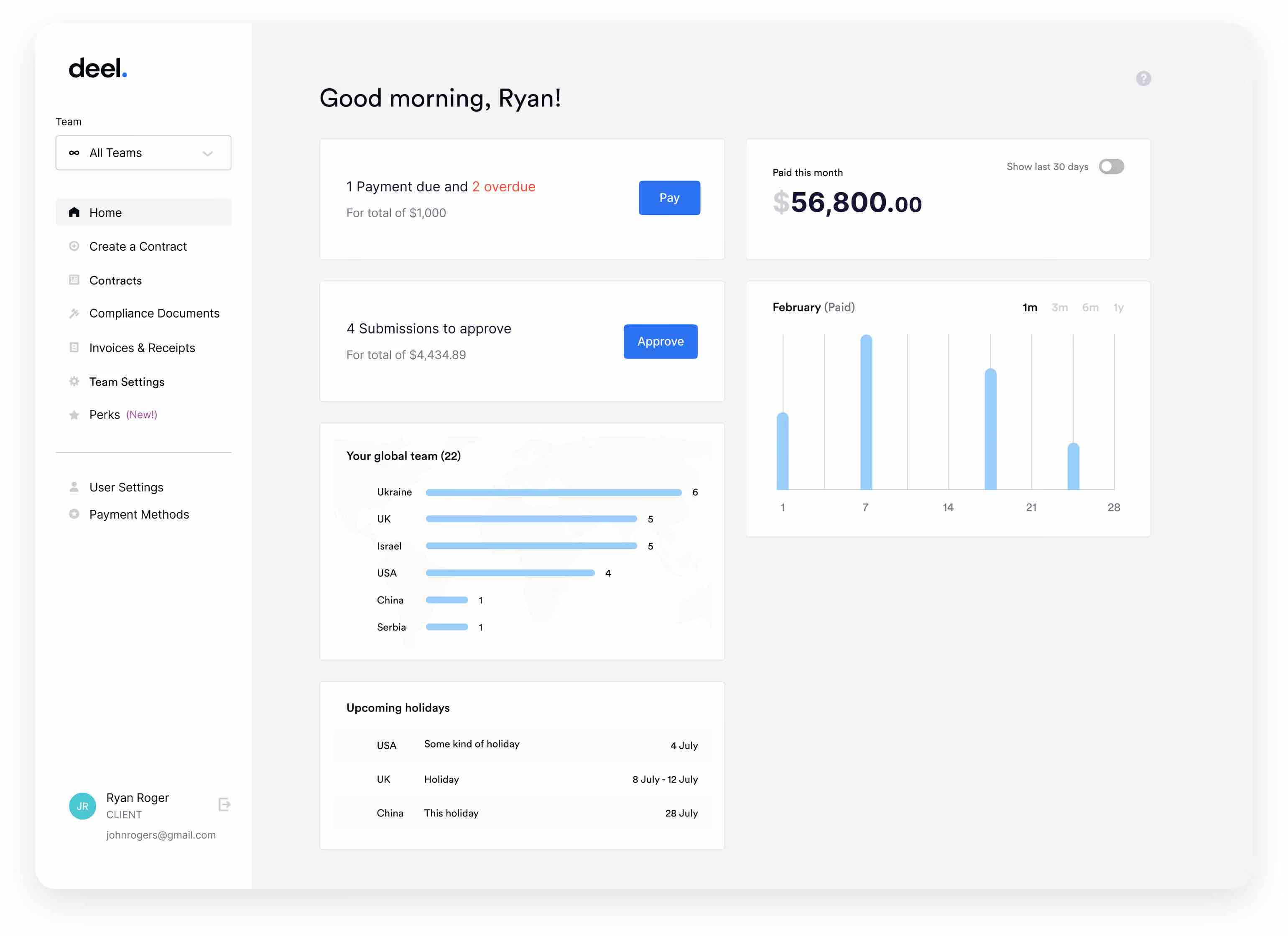
Deel’s Netherlands EOR works best for companies already using the platform globally. You manage Dutch contracts, payroll, and compliance from the same dashboard as your other international hires, which reduces tool sprawl and simplifies reporting.
During testing, we found onboarding straightforward; compliant contracts generated quickly, and the cost calculator provided clear breakdowns of employer contributions including holiday allowance and social security. Payroll transparency was a highlight: every statutory charge appeared before we approved the pay run.
Where Deel is less strong is Netherlands-specific depth. Support is responsive but generalist, and the platform doesn’t offer the same hands-on guidance as local Dutch providers for complex scenarios like works council setup or CAO interpretation. For companies hiring one or two people in the Netherlands as part of a broader global team, that’s usually fine. For Netherlands-heavy operations requiring local nuance, consider pairing Deel with local HR counsel.
Used by 35,000+ companies globally, including Shopify, Notion, and Reddit. Deel does not publish a Netherlands-specific customer list.
Deel’s Netherlands EOR starts at $599 per employee per month. Volume discounts may apply for larger teams.

Best For
Companies that want a single platform for global hiring and already use (or plan to use) Deel in multiple countries.

Papaya Global
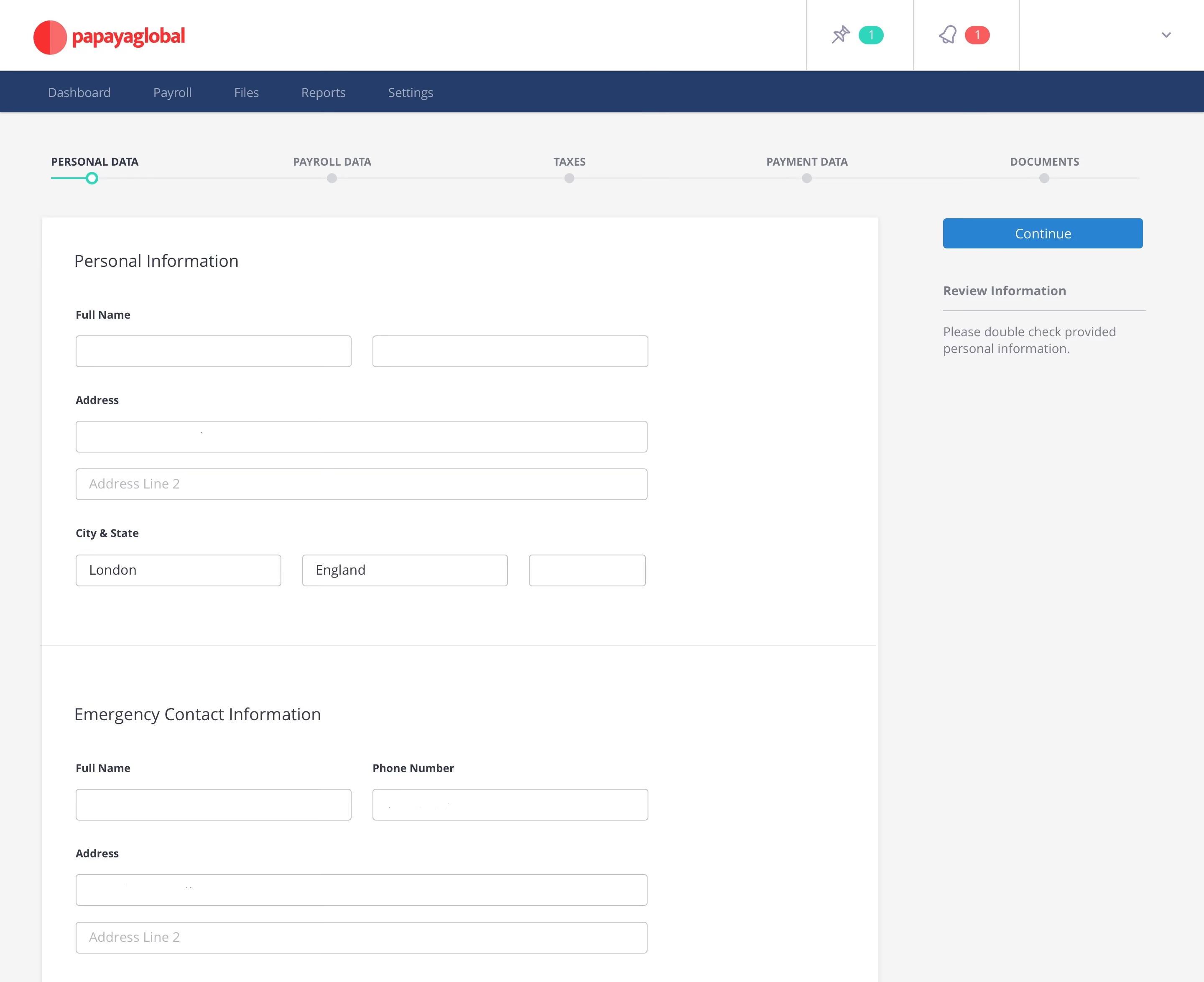
Papaya Global is built for CFOs, not just HR. Their proprietary payments infrastructure (acquired through Azimo in 2022) eliminates third-party payment providers and enables same-day payments with guaranteed 72-hour delivery. The BI suite provides real-time dashboards, workforce cost breakdowns by country and department, and integrations with SAP, Workday, and NetSuite that finance teams may find handy.
PROS
- Proprietary payment rails guarantee zero payroll leakage and same-day payments.
- Robust BI analytics for workforce cost tracking, forecasting, and ERP integration.
- Deep integrations with enterprise HRIS/ERP systems (SAP, Workday, NetSuite, BambooHR).
- 160+ country coverage with unified dashboard for EOR, payroll, and contractors.
- Papaya Global packs the EOR services you need to do global payroll and employment compliantly in over 160 countries.
- Automated payments in over 100 currencies, 80 of them directly to the worker's bank account through its global banking partners.
- Dedicated customer support providing locations-specific knowledge regarding employment and payroll.
- End-to-end payroll guaranteed payouts in 72 hours.
- Offers four standalone solutions: data and insights, supplemental benefits & immigration support, payment services, and employee data management, making the platform more affordable and scalable.
CONS
- Uses partner-based EOR model; no owned entities, which can create compliance variability.
- Enterprise contracts reportedly require $100K+ annual minimums; may be inaccessible for companies with fewer than 50 employees.
- Some users report support quality declining after initial onboarding.
- Two-year contracts are typical; less flexibility than month-to-month competitors.
- No free trial or free plan.
- Doesn’t own entities in all the countries it serves. The platform forms relationships with existing local in-country partners to handle employment in a specific region on the client’s behalf.
- BI analytics reports and global immigration services cost additional fees.
- Charges extra fees for setup, onboarding, employee cycle, and tax filing. Also requires a refundable deposit.
- Built-in integration options aren’t very robust. However, the platform does offer pre-built APIs, SFTP, and custom API integrations for free.

Papaya Global treats payroll as a payment infrastructure problem. While other EORs focus on compliance and HR, Papaya built its own regulated payment network. They have licenses in the Netherlands, UK, Canada, and elsewhere, so they can control payment speed, transparency, and fees directly in those jurisdictions. For finance teams managing payroll across 10+ countries, that treasury visibility is genuinely transformative.
In the Netherlands, Papaya handles compliant employment through local partners, covering the 8% holiday allowance, pension contributions, and social security filings. The platform’s strength is analytics: real-time cost breakdowns, spending comparisons over time, and automated journal entries aligned to your general ledger. If your CFO needs consolidated multi-country reporting at a level competitors can’t match, Papaya is purpose-built for that conversation.
The trade-offs are real. Papaya’s EOR uses vetted in-country partners rather than owned entities, which can introduce variability in service quality across markets. Several reviews note slower onboarding and support responsiveness compared to Deel or Remote. And the enterprise pricing floor makes Papaya overkill if you’re hiring 5–20 employees in common markets without complex payroll consolidation needs.
For mid-to-large enterprises managing global workforce payments at scale, Papaya delivers capabilities no other EOR matches. For smaller teams or compliance-first buyers, Remote or Deel offer simpler, faster alternatives.
Vimeo, Wix, Canva, Toyota, and thousands of enterprises processing $34B+ annually through the platform.
Papaya Global’s Netherlands EOR costs $599/employee/month. Enterprise pricing is custom; annual minimums reportedly exceed $100K. Contractor management starts at $30/month.
Best For
Mid-to-large enterprises needing unified payroll analytics, proprietary payment infrastructure, and deep ERP integrations across multiple countries.


We used it on a continuous basis. We had some weekly and monthly payroll, so it was used throughout the month. We mainly used the Global Payroll Plus service and the Employer of Record service. We also used the contractor payment service for contractors in specific locations when we needed a more flexible resource. Additionally, we used the Global Payments solution for paying expenses and suppliers.
Pricing flexibility was great and affordable for smaller enterprises. The representatives and customer service staff were very knowledgeable and experienced, offering excellent guidance and a can-do attitude, which was very welcome as we had become bogged down in red tape. We liked that there were very relevant add-on services that could be used on an ad-hoc basis.
We bought Papaya Global because we were expanding internationally. Our business meant that we had small offices and remote workers in many countries. It was time-consuming and error-prone to individually pay staff in so many countries. We needed a tool that could centralize global payroll and pay multiple international staff seamlessly and effortlessly, and Papaya Global did this. I used it for about a year.
It would have been good if they had a solution for 50 to 100 employees. We had to take the minimum 100-employee tariff even though we initially had fewer than 100 employees. Reporting could be improved; I found that the invoices were a little low on detail. It is a bit more expensive than the competition.
I have used other similar tools, and while a little more expensive, I found that this one has better global coverage and a more comprehensive service offering.
Consider global coverage, e.g., what countries they serve and if they have a depth of knowledge and expertise. Ensure it has a good and efficient global payroll service at its core, but also has the appropriate add-on services (like EOR, global payments, contractor payments) so you can quickly adapt to changing business circumstances.
I think the library and knowledge base have grown substantially, providing more on-demand information and advice about global payments.
Papaya Global is good for any international organization with employees in multiple countries.
Papaya Global is not a good fit for an organization with 50 or fewer employees in just one country. This product might be overkill.

Multiplier
Multiplier offers the most competitive flat-rate pricing we’ve seen—$400/employee/month with no onboarding or offboarding fees. For startups and SMBs testing European expansion, this predictability is a genuine advantage. The platform handles Dutch contracts, holiday allowance, and pension contributions without the sticker shock of premium providers.
PROS
- Flat $400/month pricing with no hidden fees for onboarding or exits.
- Fast onboarding—Dutch employees can be set up in 5–7 business days.
- Built-in ESOP management simplifies equity grants across jurisdictions.
- Covers 150+ countries, strong for multi-region expansion.
- ISO 27001/27017/27018 certifications for security-conscious buyers.
- Multi-currency payments in local currencies
- Multi-lingual contracts made instantly
- Compliance, payroll, onboarding, and timesheets, all in one platform
CONS
- Uses partner entities in the Netherlands, not owned infrastructure.
- Founded in 2020—less track record than established players like Deel or Remote.
- Limited integrations compared to Rippling (600+) or Deel (100+).
- Strongest expertise is Asia-Pacific; European depth is still developing.
- Limited integrations. As of Summer 2024, Multiplier only integrates with BambooHR, Personio, Workday, and HiBob for HCM-type tools, although they are working on adding more.
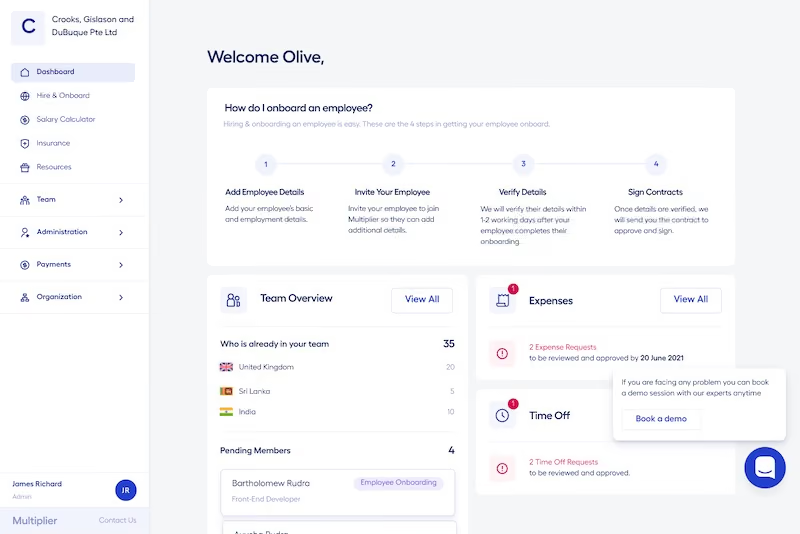
Multiplier’s pitch is simple: enterprise-grade EOR at startup-friendly prices. At $400/employee/month, it undercuts Deel ($599), Remote ($599), and Rippling ($499) while covering the same Dutch compliance basics—contracts, payroll in EUR, 8% holiday allowance, pension contributions, and social security filings.
In our testing, onboarding was straightforward. Dutch-compliant contracts generated quickly, and the dashboard gave clear visibility into payroll status and employer costs. The ESOP feature stood out: Multiplier centralizes stock option documentation, tax handling, and compliance across jurisdictions—useful for tech companies granting equity to distributed teams.
The trade-offs are real. Multiplier relies on local partners rather than owned entities in the Netherlands, which can introduce variability in service quality. Founded in 2020, they’re still building European expertise; their strongest regional knowledge remains Asia-Pacific. User feedback also flags occasional billing confusion and slower support response times compared to premium competitors.
For budget-conscious teams hiring their first few Dutch employees, Multiplier delivers solid value. For companies prioritizing owned entities or deep Dutch expertise, Remote or a local provider like Parakar may be worth the premium.
Used by thousands of companies globally, particularly tech startups and SMBs scaling across multiple regions.
Multiplier’s Netherlands EOR costs $400/employee/month. No additional onboarding or offboarding fees.
Best For
Startups and growing companies that want predictable, budget-friendly EOR pricing without sacrificing core compliance features.

We use Multiplier to onboard new hires outside our home country, collect documents, and generate locally compliant employment or contractor agreements.
Every month, we also use it to run payroll for our international employees and process payments for contractors, all from a single dashboard. Managers submit changes such as salary updates or terminations in Multiplier, and HR reviews and approves them before each cycle.
We also pull standard reports for finance from Multiplier to reconcile costs by country and team. For our distributed workforce, Multiplier effectively serves as the core system we rely on for global hiring and payments.
- Multiplier makes it easy to hire and pay people in multiple countries from one platform, reducing the need for vendor management.
- The onboarding and contract flows are clear, so HR, managers, and new hires know exactly what to do without unnecessary back-and-forth.
- The platform handles local compliance, currencies, and payroll rules, which reduces the time we spend checking with external experts.
We bought Multiplier when we started hiring outside our home location and needed a simple way to stay compliant without opening entities in every new country.
We already had a mix of employees and contractors but had been handling contracts, invoices, and payments on varying timelines and in multiple currencies. I had seen the platform in a previous role, so I knew onboarding was straightforward and the pricing made sense for a growing team.
We have now used Multiplier for almost three years, and it has become the default way we hire and pay people according to their location.
- The pricing feels a bit high compared to the level of service provided.
- The reporting system offers limited customization options.
- The response time for resolving errors or requests could be faster.
Compared with similar vendors, Multiplier’s new hire onboarding time is very fast. In many cases, a new hire can start within a week, whereas other providers typically take a minimum of two weeks.
Start by mapping out your requirements and identifying which services or modules you need. Check which countries Multiplier has its own entities in, and which rely on external partners.
Ask specific questions to confirm the tool can support your use cases, especially if your needs are unique or span multiple regions.
Multiplier has steadily added more HR features over time. I remember when I first explored EOR/PEO options, the platform focused primarily on global payroll.
Now it offers a broader range of services. For example, it can now assist with providing equipment to new hires, which was not available before.
Multiplier is a strong option for small to mid-sized organizations looking to expand internationally without setting up local entities. It works well for companies that want a fast, compliant way to hire and pay talent globally.
Multiplier may not be a good fit for very large companies that require extensive customization. Organizations that operate solely in one country may also find limited value in using the platform.

Rippling
Rippling isn’t just an EOR, it’s a full workforce platform that unifies HR, IT, and finance. If you already use Rippling for US payroll or device management, adding Netherlands EOR feels like flipping a switch rather than onboarding a new vendor. The automation is genuinely impressive: onboarding flows, compliance alerts, and payroll all run through one system.
PROS
- Unified platform for HR, IT, device management, and EOR in one place.
- 600+ app integrations connect to your existing tech stack.
- Automated onboarding handles Dutch contracts, tax forms, and benefits enrollment.
- 5-day payroll processing in major markets, faster than most competitors.
- Easy transitions between contractor, EOR, and direct employment models.
- All-in-one platform for employee management + PEO services offered, and even a suite of other IT products
- With 500 integrations, it’s very likely that they integrate with other key tools from your tech stack.
- Operates globally with any currency
- Workflow automation
- Analytics opportunities
- Provides a holistic view of company outflows—headcount costs included
CONS
- EOR coverage in ~80 countries—narrower than competitors, but solid.
- Uses a mix of owned and partner entities; less clarity than Remote’s owned-only model.
- Modular pricing can add up quickly if you need multiple features.
- Overkill if you only need EOR without broader HR/IT capabilities.
- Total buy-in to Rippling is essential
- Very SMB-oriented, in case you’re a larger company.
- New features tend to be buggy in ways that tech teams are not accustomed to fixing

Rippling makes sense when EOR is one piece of a larger workforce puzzle. The platform shines for companies that want Dutch employees managed alongside US payroll, device provisioning, and app access—all from one dashboard. That consolidation eliminates the tool sprawl that plagues companies juggling separate systems for each function.
In the Netherlands, Rippling handles compliant contracts, holiday allowance, pension contributions, and payroll in EUR. The automation is a standout: onboarding triggers can provision software, assign devices, and enroll benefits without manual intervention.
The trade-off is complexity. Rippling uses a mix of owned entities and local partners for EOR, which means less transparency than Remote’s owned-only approach. And if you only need Netherlands EOR without the broader platform, you’re paying for capabilities you won’t use. For companies already invested in Rippling’s ecosystem, adding Dutch hires is seamless. For EOR-only buyers, considering players like Deel or Remote may be simpler.
Used by thousands of companies globally, including Superhuman, Expensify, and Checkr.
Rippling’s Netherlands EOR starts at $499/employee/month. Additional modules (benefits, IT, finance) are priced separately.
Best For
Companies already using Rippling—or planning to—that want Netherlands EOR integrated into a unified HR, IT, and finance platform.

I use Rippling daily to manage various HR functions, including recruitment, payroll, benefits administration, and employee engagement. The platform's integration capabilities allow me to streamline candidate analysis and facilitate a smoother recruitment process. Additionally, I rely on Rippling for time and attendance tracking, ensuring accurate payroll processing. The learning management system helps in organizing and tracking employee training programs. Overall, Rippling's comprehensive features enable efficient handling of all HR-related tasks within a single platform.
Rippling encompasses features for every HR component, including recruitment, payroll, HRIS, benefits administration, and engagement. The platform's user-friendly interface makes it easy to navigate and use. Rippling's integration with other systems ensures seamless data flow and process automation. The comprehensive nature of Rippling's suite of products allows us to manage all HR functions within a single platform, enhancing overall efficiency.
Our organization chose Rippling to address the need for a comprehensive HR software solution that could handle multiple aspects of employee management. Prior to using Rippling, we faced challenges in integrating various HR functions such as payroll, benefits management, and time tracking into a single platform. Rippling provides a suite of products, including an applicant tracking system (ATS), full payroll and benefits management, time and attendance tracking, learning management, and professional employer organization (PEO) services. I have used Rippling for over a year and found it instrumental in streamlining our HR processes and enhancing overall efficiency.
The pricing structure lacks full transparency. Additional modules cannot be acquired independently; instead, the core Rippling Unity platform must be purchased first. Opting for the HR help desk feature, which includes phone and email support, incurs additional costs that escalate as more features are added.
I have not used other tools to know the difference between them and Rippling.
Rippling is a comprehensive HR platform designed to streamline and automate various employee management processes. Its extensive features empower users to seamlessly handle hiring, employee management, payroll, and training tasks. Beyond HR functionalities, Rippling also provides IT solutions for configuring and overseeing computer devices and application access. This platform is particularly well-suited for small to midsize companies, especially those with aspirations for international expansion.
I’m unsure of how WorkTango changed or evolved over time.
It is particularly well-suited for medium-sized businesses and large startups in need of a modern payroll platform.
Rippling is not suitable for smaller companies.
G-P
G-P are pioneers in the EOR industry since 2012 and remain the gold standard for compliance-first enterprise buyers. They own their employing entity in every one of their 180+ countries; no partner chains, no coordination delays. For companies in regulated industries or hiring in complex markets like the Netherlands, that direct control matters when terminations, audits, or works council issues arise.
PROS
- Owns entities in 180+ countries with 100% pass rate on compliance audits.
- Deepest legal expertise in the market, 14 years of edge cases and regulatory changes.
- G-P Gia AI advisor provides compliance guidance, document generation, and monitoring.
- Enterprise integrations with the likes of Workday, SAP SuccessFactors, BambooHR, and ADP.
- Dedicated account managers with regional expertise and 24/7 support.
- Their G-P Meridian platform is heavily focused on the EOR space, but it’s offered in several plans that can cater to varying needs, even those that might only need to hire people as contractors.
- Using their tool also implies access to a team of HR and legal professionals with significant experience in each country they operate in.
- Their UX has evolved continuously and gotten more intuitive and modern each time we delve into the product.
CONS
- One of the most expensive EORs at $699–900+/month— a 33–67% premium over the offerings of Deel or Remote, for instance.
- No public pricing; requires sales conversation for quotes.
- Platform UX feels dated compared to newer entrants like Deel.
- Onboarding slower than competitors; thorough but not fast.
- Customizing a contract is only possible with the G-P Meridian Prime plan.
- Features like background checks, equity management, and IT equipment— to name a few— are only available as add-ons.
- There is no way to try out the software product unless you sign up for a demo and request a proposal.
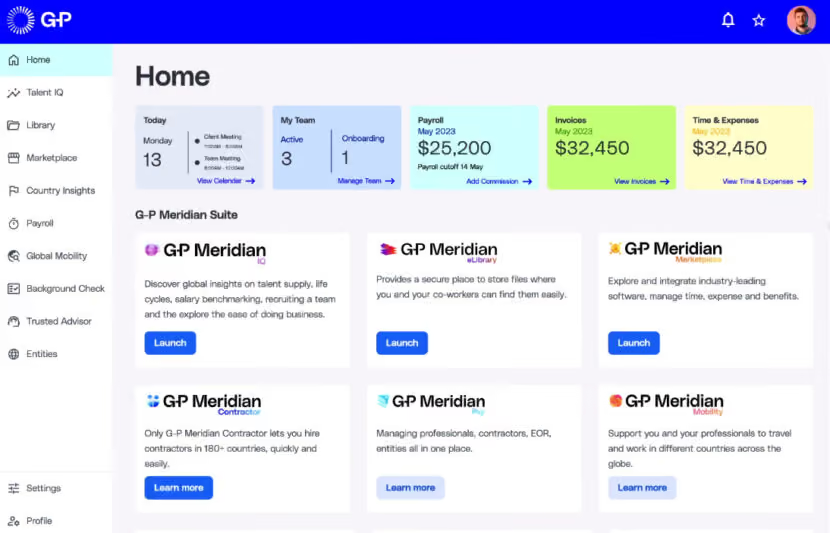
G-P is the EOR you choose when compliance risk outweighs cost concerns. In the Netherlands specifically, they handle the complexities that trip up newer providers: UWV termination approvals, cantonal court procedures, CAO requirements, and the 8% holiday allowance calculations. Their legal team has navigated Dutch employment law since before most competitors existed.
The owned-entity model eliminates partner chains entirely. When you need to terminate a Dutch employee—a process requiring either UWV permission or court approval—G-P’s in-house team handles it directly. No coordination with third parties, no surprises during offboarding. For companies in financial services, healthcare, or other regulated industries, that direct control ends compliance conversations faster.
The trade-off is price and speed. At $699–900+/employee/month, G-P costs 33–67% more than Deel or Multiplier. Onboarding is thorough but slower. The platform, while functional, lacks the polish of newer competitors—G-P has invested heavily in modernization but is still catching up. To be fair, a lot of it may be intentional. They may not tout something like “onboarding takes 10 minutes” because there’s a specialist involved; which is preferable if compliance and a white glove-accompanied approach is your preference.
For enterprises deploying 50+ employees across multiple countries, or companies where a compliance failure would be catastrophic, G-P’s premium buys genuine peace of mind. For smaller teams or cost-conscious buyers, Deel or Remote deliver a good chunk of the capability for a fraction of the cost.
Boston Dynamics (9 markets), IRIS Software Group (60 employees in 50 days), Repsol ($3.7M saved in onboarding), Strada (80% reduction in talent integration time).
G-P doesn’t publish exact pricing. Estimates range from $699–900+/employee/month depending on country, volume, and contract terms. Annual contracts with minimum headcount commitments are typical. Implementation fees ($10K–50K+) may apply for complex deployments.
Best For
Enterprise buyers in regulated industries who need maximum compliance coverage, owned entities in every market, and are willing to pay a premium for the most experienced EOR provider.

Employor
Employor solves a specific problem exceptionally well: getting non-EU talent legally employed in the Netherlands. As an IND-recognized sponsor, they can submit highly skilled migrant permit applications directly, typically receiving approval within 2–3 weeks. For companies without a Dutch entity who need to hire engineers, developers, or specialists from outside the EU, Employor removes the biggest bottleneck in the process.
PROS
- IND-recognized sponsor status enables 2–3 week permit approvals for highly skilled migrants.
- Handles complete immigration workflow: HSM permits, EU Blue Cards, family reunification visas.
- NEN 4400-1 certified; transparent fixed-fee pricing with no commission charges.
- Facilitates 30% ruling applications for qualifying international employees.
- One-month notice period for offboarding; easy transition when you’re ready to sponsor directly.
- IND-recognized sponsor status enables 2–3 week permit approvals for highly skilled migrants.
- Handles complete immigration workflow: HSM permits, EU Blue Cards, family reunification visas.
- NEN 4400-1 certified; transparent fixed-fee pricing with no commission charges.
- Facilitates 30% ruling applications for qualifying international employees.
- One-month notice period for offboarding; easy transition when you’re ready to sponsor directly.
CONS
- Netherlands-only, no coverage for companies needing multi-country EOR.
- Premium pricing (€990/month + €2,300 setup) significantly above global competitors.
- Limited platform features; service-led model rather than self-service dashboard.
- Netherlands-only, no coverage for companies needing multi-country EOR.
- Premium pricing (€990/month + €2,300 setup) significantly above global competitors.
- Limited platform features; service-led model rather than self-service dashboard.

Employor occupies a specific niche: they’re the EOR you use when your hire needs a work permit sourced by local experts. While other companies in this guide such as Deel and Remote can also sponsor visas, Employor’s entire operation is built around Dutch immigration compliance. Their IND-recognized sponsor status—maintained through years of successful applications—means they know exactly which salary thresholds apply, which documents the IND requires, and how to structure contracts to avoid delays.
The 2026 HSM salary thresholds (€5,688/month for workers 30+, €4,171/month for under-30) are non-negotiable, and Employor structures employment contracts to meet these requirements from day one. They also handle the 30% ruling application to the Belastingdienst, which can save qualifying employees thousands in taxes over five years.
Their pricing—€990/month plus a €2,300 setup fee—is significantly higher than most global platforms. But the comparison isn’t entirely fair: you’re paying for immigration expertise that most EORs outsource to third parties. For a company hiring one senior developer from India or Brazil, the premium buys speed and certainty. For a company hiring five EU citizens who don’t need permits, Deel or Multiplier might pack better value.
Employor’s model also emphasizes flexibility. They position themselves as a bridge solution: use their sponsorship while you’re getting established, then transition employees to your own entity when you become a recognized sponsor yourself. The one-month notice period for offboarding supports this approach.
Undisclosed publicly. Focus on international companies hiring highly skilled migrants, particularly in technology, engineering, and professional services sectors.
Employor charges €990/employee/month with a €2,300 one-time setup fee. Additional services (employment law consultations, complex tax advice) billed at €150/hour. No percentage-based commissions.
Best For
Companies hiring non-EU talent in the Netherlands who need IND-recognized sponsorship for highly skilled migrant permits, EU Blue Cards, or other work authorizations.

Oyster
Oyster is the only B Corp-certified EOR on this list, which matters for mission-driven organizations and ESG-conscious procurement. More practically, their Netherlands benefits packages go beyond statutory minimums—including mobility budgets and WIA gap insurance that Dutch employees expect. If you’re competing for senior talent against local employers, these defaults help close offers.
PROS
- B Corp certification appeals to impact-focused companies and simplifies ESG procurement.
- Premium Netherlands benefits include mobility budget, enhanced pension, and disability gap insurance.
- Discounts available for nonprofits and B Corps through Oyster for Impact program.
- Intuitive platform with strong compliance coverage across 180+ countries.
- Equity management handles stock option documentation and tax treatment by jurisdiction.
- Intuitive: The platform is easy to navigate and makes logical sense.
- competitively priced: The flat rate for employees and contractors makes cost comparisons simple, and is competitive in the market.
- Targeted for a remote workforce: Whether your employees are in one country or 100, Oyster can accommodate them accordingly, and this is a feature few platforms can boast.
CONS
- At $699/month, it’s one of the most expensive major EOR—$100–300 more than competitors.
- Uses partner entities in the Netherlands, not owned infrastructure.
- Onboarding can take 7–10 days, slower than Deel (1–3 days) or Rippling (5 days).
- No contractor-to-employee conversion workflow—requires full offboarding and re-onboarding.
- Slight delays in processing times for payments in the local currency are somewhat common.
- Immediate communication via phone support is not an option, but they do offer live support via Zoom when necessary.
- An initial security deposit is necessary to begin the engagement and is refundable.
- The platform lacks native time-tracking functionality and provides only an in-app tool for managing time off.
- If you’re looking to co-employ your employees and partially outsource HR responsibilities, Oyster isn’t for you. They are more akin to employer of record services (EOR) than a Professional Employer Organizations (PEO).

Oyster’s pitch isn’t cost friendliness—it’s a state of the art employee experience, but that premium buys benefits packages that genuinely compete with local Dutch employers: enhanced health coverage, WIA gap insurance (supplemental disability), and mobility budgets that matches what senior candidates in Amsterdam would expect.
The B Corp certification is more than marketing. It’s become a procurement factor for ESG-conscious buyers, and Oyster for Impact offers real discounts for nonprofits and certified B Corps hiring globally. GiveDirectly, for example, used Oyster to hire 24 employees across 17 countries while keeping operating costs low.
In the Netherlands specifically, Oyster handles the 8% holiday allowance, pension contributions, and social security with solid compliance. The platform is intuitive—contract generation, payroll, and benefits all flow through a clean dashboard. Equity management is a nice addition for tech companies granting stock options to distributed teams.
The trade-offs are cost and speed. Multiplier charges $400/month for similar coverage. Onboarding takes 7–10 days versus 1–3 days at Deel. If budget or speed are your primary constraints, look elsewhere. If you’re hiring senior Dutch talent and benefits quality affects your close rate, Oyster earns its premium.
GiveDirectly (800+ employees across 30 countries), Superside (250 employees across 45 countries), Muse Group.
Oyster’s Netherlands EOR costs $699/employee/month. Scale discounts (3+ employees) reduce effective pricing to ~$600–650/month. Nonprofit and B Corp discounts available through Oyster for Impact.
Best For
Mission-driven organizations and companies hiring senior talent in Western Europe where above-market benefits packages are competitive differentiators.

As an HR consultant, I used Oyster HR to manage several key workflows for our organization. Primarily, I utilized the platform to handle the end-to-end hiring process for our international employees, from posting job openings to onboarding new hires. Oyster simplified compliance and guaranteed that all our contracts and employment practices followed local labor law regulations, which was brilliant and would have been too complicated for us to manage. I also oversaw payroll management, ensuring that all our remote employees were paid accurately and on time, and handled complaints and inquiries. Additionally, the platform helped us administer localized benefits. Oyster streamlined many of our HR processes.
The interface was intuitive, so even employees who were not tech-savvy could use it. There is a built-in time zone coordination feature, which is perfect for international team alignment. It made scheduling easy. Customer service was exemplary. I think they probably had 24/7 people on call because we never had to wait "till tomorrow" for a reply.
We set up an account with Oyster about four years ago and used it for about two years. We were expanding rapidly and needed a workforce from countries with lower salary rates to be more economically efficient. We did not want to go through the hassle of setting up entities in different countries, and our HR team did not feel confident we could do it in-house and remain compliant. So, we outsourced this service. The platform's ability to handle international payroll has been a game changer.
Cost. We dropped it because of the cost; it simply made no sense for us to use such a pricey platform. If the company had been developing as fast as we hoped, we might have stayed with them, but not under the circumstances we had. There were also some limitations with the integrations, and we could not lose some of the other platforms we were using for other aspects of people management. I also would have liked to see more customization; the system was rather robust and did not allow finesse.
Oyster stood out from its competitors mainly because of its top-notch compliance management across countries, which was a game changer for us. Many other tools don't cover this as thoroughly. I also found Oyster's interface incredibly user-friendly, which isn't something I can say about all the HR platforms I've tried—some of them feel like navigating a spaceship. One special thing I really appreciated is how it helps with time zone coordination; it's a small detail, but it makes scheduling across a global team much easier.
Other than the compliance aspect, look for a user-friendly interface that makes daily operations smooth and straightforward. It is important to evaluate the integration capabilities with your existing HR systems to avoid tech compatibility issues. Lastly, consider the quality of customer support, as having reliable, real-time assistance can save you a lot of trouble down the line and is a reason clients would walk away.
Initially, Oyster was mainly about helping companies hire and stay compliant with local laws globally. Over time, they added stronger payroll management features, making it easier to pay employees accurately and on time, which goes hand in hand with the first service. They also kept working on the interface and the integrations.
Oyster is perfect for companies that want to hire talent from all over the world without getting bogged down by local labor laws and payroll hassles. It is ideal for startups looking to grow quickly and mid-sized businesses expanding their global footprint.
Oyster might not be the best fit for very small businesses or startups with tight budgets that don't plan to hire internationally. If your organization primarily hires locally and doesn’t need to navigate different countries' labor laws, Oyster may be overkill.

Remote
Remote owns its legal entity in the Netherlands rather than relying on local partners—a meaningful difference for compliance-conscious buyers. The platform includes IP Guard at no extra cost, which protects your intellectual property across borders. For companies where legal counsel scrutinizes the employment chain, Remote’s owned-entity model often clears review faster than partner-based alternatives.
PROS
- Wholly owned Dutch entity means no third-party partners in the compliance chain.
- IP Guard protects intellectual property assignments at no additional cost.
- Handles 30% ruling facilitation for skilled migrant hires.
- Holiday allowance (8%), supplemental health coverage, and pension included.
- Integrates with BambooHR, Personio, and Gusto as a backend EOR.
- Fast and compliant payroll in 170+ countries.
- Live chat support with local payroll experts.
- Flexible, localized benefit packages.
- Flat-rate pricing structure, no deposits or hidden fees.
- Mobile app streamlines expense reimbursement with autofill from receipt photos.
CONS
- Narrower country coverage (~85) than Deel or Rippling; if you’re considering hiring beyond the Netherlands.
- Contractor management tools are basic; may need a second platform.
- No phone support—ticket-based system only.
- Onboarding runs 4–6 days, slightly slower than some competitors.
- Doesn’t have a free trial.
- Redundant for organizations solely recruiting within the U.S.
- Help center documentation isn’t easiest to understand.
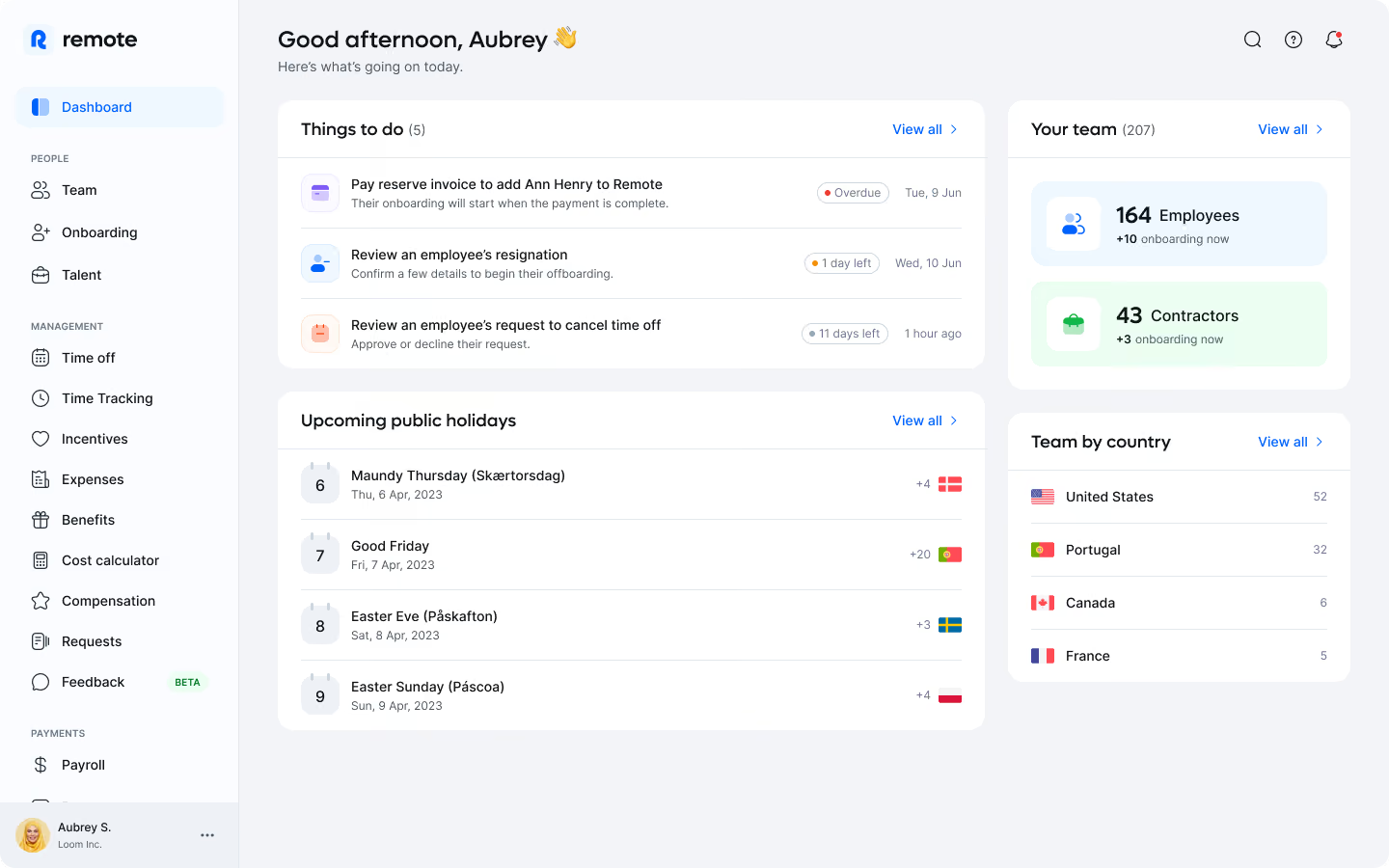
Remote’s Netherlands EOR stands out for one reason: they own their Dutch entity outright. When compliance issues arise, Remote’s in-house legal team handles them directly rather than coordinating with a local partner. For regulated industries or companies with strict legal oversight, this structure simplifies due diligence.
In testing, we found the platform clean and functional. Contracts generated quickly, and the cost breakdown clearly showed employer contributions including holiday allowance and social security. Remote also facilitates the 30% ruling for expat hires, which can meaningfully reduce tax burden for skilled migrants.
The trade-off is flexibility. Remote covers fewer countries than Deel, and their contractor management is bare-bones. Support is responsive but ticket-based—no dedicated account manager unless you’re on an enterprise plan. For Netherlands-only hiring with strong compliance requirements, Remote delivers. For multi-region expansion with contractor-heavy teams, you may outgrow it.
Used globally by companies including GitLab, DoorDash, and Loom. Remote does not publish a Netherlands-specific customer list.
Remote’s Netherlands EOR costs $599/month per employee (annual commitment) or $699/month (monthly). No setup or onboarding fees.
Best For
Compliance-focused companies that want owned-entity infrastructure and strong IP protection for Netherlands hires.
What a Good Netherlands EOR Handles
A reliable Netherlands EOR manages the compliance-heavy parts of Dutch employment so you can focus on the work itself. Here's what that looks like in practice.
Payroll and Tax Filings
Dutch payroll runs monthly, with strict deadlines for submissions to the Belastingdienst (tax authority). Your EOR should handle wage tax withholding, social security contributions, and real-time reporting without requiring your involvement beyond approving the payroll each cycle. They'll also manage year-end filings, including the jaaropgave (annual statement) that employees need for their tax returns.
Holiday Allowance (Vakantiegeld)
The 8% holiday allowance is mandatory and typically paid as a lump sum in May. A good EOR accrues this monthly on your invoice so there's no surprise bill, and ensures employees receive it on time. Some EORs offer the option to distribute it monthly instead, which can help with employee cash flow but requires clear documentation in the contract.
Pension Administration
Most Dutch employees expect pension contributions, and certain sectors mandate them through industry-wide funds. Your EOR should either enroll employees in a compliant pension scheme or connect to the relevant sectoral fund (like PME for metalworking or PFZW for healthcare). They'll handle employer and employee contribution splits, reporting to the pension provider, and annual statements.
Sick Leave and Continued Pay
Dutch employers must continue paying 70-100% of salary for up to two years when an employee is ill — the most demanding sick leave obligation in Europe. A good EOR carries insurance (verzuimverzekering) to cover this liability and manages the reintegration process required by UWV, including engaging an arbo-dienst (occupational health service) for assessments. Ask whether sick leave insurance is included in your fee or charged separately.
Employment Contracts and Compliance
Dutch contracts require specific clauses: probation periods (max two months for permanent contracts), non-compete terms, notice periods, and clear references to any applicable CAO. Your EOR should generate contracts that comply with Dutch labor law and update them as regulations change. They should also track the ketenregeling — the rule limiting temporary contracts to three within three years before triggering permanent status.
Termination and Offboarding
Ending employment in the Netherlands is procedurally complex. Dismissals require either UWV approval (for economic reasons or long-term illness) or court approval (for performance or conduct). Your EOR should guide you through the correct route, calculate the transitievergoeding (severance), and handle final pay including accrued holiday allowance and unused leave. Expect this process to take four to eight weeks minimum.
30% Ruling Support
If your hire qualifies for the 30% ruling (the tax exemption for skilled migrants recruited from abroad) your EOR should handle the application to the Belastingdienst. This must be submitted within four months of the start date, so timing matters. A top-notch EOR will flag eligibility during onboarding and manage the paperwork proactively rather than waiting for you to ask.
Work Permit Sponsorship (Where Applicable)
For non-EU hires, only IND-recognized sponsors can apply for highly skilled migrant permits. Not all EORs hold this status. If you're hiring from outside the EU, confirm your provider is recognized and can handle the full permit process, including salary threshold verification, document collection, and renewal tracking.
Netherlands EOR Pricing Breakdown
EOR costs in the Netherlands include two components: the provider's service fee and the mandatory employer contributions required by Dutch law. Both vary significantly, and understanding the total cost of employment helps you budget accurately before making a hire.
EOR Service Fees by Provider Type
EOR providers in the Netherlands charge between €350 and €990 per employee per month, depending on their model and market positioning.
Global platforms (Deel, Remote, Rippling, Multiplier, Oyster HR, G-P): Their price ranges between €350-699/month. These providers spread infrastructure costs across 80-180 countries, enabling competitive per-employee pricing. Multiplier sits at the low end (€350~), while G-P commands premium rates (€650-900+) for enterprise compliance guarantees. Most global EORs include payroll, contracts, statutory benefits, and basic HR support in their base fee.
Enterprise-focused platforms (Papaya Global, G-P): €599-900+/month. Higher fees reflect deeper analytics, ERP integrations, and dedicated account management. Papaya's proprietary payment infrastructure and G-P's 100% owned-entity model justify premiums for companies prioritizing compliance certainty over cost.
Netherlands-specialist providers (Parakar, Employor, Rock Payroll): €750-990/month + setup fees. Local specialists charge more but offer hands-on Dutch expertise, IND-recognized sponsorship for work permits, and native Dutch-speaking support. Employor's €990/month + €2,300 setup fee reflects their immigration focus; Rock Payroll charges €750/month + €1,500 setup.
Mandatory Employer Contributions (2026)
Dutch employers pay approximately 20-25% of gross salary in mandatory contributions on top of the base wage. For a mid-level software engineer earning €75,000 gross annually (€6,250/month), here's the breakdown:
Holiday allowance (vakantiegeld): 8% of gross salary = €6,000/year (€500/month). This is mandatory and typically paid as a lump sum in May, though some employers distribute it monthly.
Employer social security contributions: Approximately 18-23% of gross salary, capped at €79,412 (2026). This includes:
- Health insurance (ZVW): 6.57% = ~€4,575/year
- Unemployment insurance (AWf): ~2.74% (permanent contracts) or ~7.74% (temporary) = ~€1,980-5,730/year
- Disability insurance (WIA/Aof): 6.27-7.63% = ~€4,700-5,720/year
- Return-to-work fund (WHK): 0.38-1.5% (varies by sector) = ~€285-1,125/year
Pension contributions: Typically 8-15% of salary, split between employer and employee. Many sectors have mandatory industry pension funds (e.g., PME for metalworking, BPF for construction). Employer portion is usually 2/3 of total contribution = ~€4,000-7,500/year.
Total Cost of Employment: Example Calculation
For a software engineer at €75,000 gross annual salary:
The EOR fee adds roughly 7-10% on top of total employment costs. For this €75,000 hire, you're looking at approximately €106,000/year all-in with a mid-tier global EOR, or €110,000-115,000/year with a Netherlands specialist.
What's Typically Included vs. Extra
Included in most EOR fees:
- Employment contract drafting and compliance
- Monthly payroll processing and Belastingdienst filings
- Statutory benefits administration (holiday allowance, sick leave)
- Basic pension enrollment
- Employee onboarding and offboarding
- Payslip generation and tax document delivery
Often charged separately:
- Highly skilled migrant permit applications (€500-2,500)
- 30% ruling application support (€500-1,500)
- Supplemental health insurance or enhanced benefits
- Equipment procurement and shipping
- Complex termination procedures (hourly consulting fees)
- Off-cycle payroll runs
When Netherlands EOR Pricing Makes Sense
EOR becomes cost-effective compared to entity setup when:
- You're hiring fewer than 10 employees over 24 months
- You need to onboard within 2-4 weeks rather than 3-6 months
- You want to test Dutch market fit before committing to permanent infrastructure
- Your hire requires work permit sponsorship and you're not yet IND-recognized
At 10+ employees, the math often favors establishing a Dutch BV, where ongoing costs drop to €29-50/employee/month for payroll processing alone—though you absorb setup costs (€10,000-40,000), ongoing compliance overhead, and full liability for Dutch employment law.
Read More: How Much Does an Employer of Record Cost in 2026?
Netherlands-Specific Employment Challenges
Dutch employment regulations are among the most protective in Europe. Understanding these challenges helps you choose an EOR equipped to handle them.
Collective Labor Agreements (CAO)
A collectieve arbeidsovereenkomst (CAO) is a sector-wide agreement setting binding terms for wages, hours, pensions, and other conditions. Nearly two-thirds of Dutch employees fall under one. When declared algemeen verbindend verklaard (universally binding), a CAO applies to all employers in that sector — even non-signatories. Your EOR should identify whether a CAO governs your hire and ensure the contract reflects it.
Dismissal Procedures
Terminating employment requires UWV approval (for redundancies or long-term illness) or court approval via the kantonrechter (for performance or relationship issues). Either route takes weeks to months. You'll also owe transitievergoeding: one-third of gross monthly salary per year of service, capped at €102,000 in 2026. Settlement agreements can bypass formal proceedings but typically cost more than the statutory minimum.
The Chain Rule (Ketenregeling)
The ketenregeling limits temporary contracts to three over three years. Exceed that, and the employee becomes permanent with full dismissal protections. A gap over six months resets the chain. Your EOR should track contract durations and flag when you're approaching the threshold.
Works Councils (Ondernemingsraad)
Companies with 50+ employees must establish a works council with consultation and consent rights on major decisions. For small EOR arrangements this won't apply directly, but it matters if you're scaling or planning to establish your own entity.
Misclassification Enforcement (Schijnzelfstandigheid)
Dutch authorities now impose fines on companies misclassifying employees as contractors. The Wet VBAR, expected July 2026, introduces a legal presumption of employee status for workers earning under €36/hour. For ongoing roles, EOR employment is the safer path.
Highly Skilled Migrant Permits and the 30% Ruling
If you're hiring non-EU talent in the Netherlands, two mechanisms matter: the highly skilled migrant (kennismigrant) permit and the 30% ruling tax benefit. Both have specific requirements, and not every EOR can support them.
Highly Skilled Migrant Permits
Only IND-recognized sponsors can apply for highly skilled migrant permits. This status requires a formal application, compliance audits, and ongoing obligations — not all EORs hold it. If your EOR isn't recognized, they can't legally sponsor your non-EU hire.
The 2026 salary thresholds (excluding 8% holiday allowance) are:
- Age 30+: €5,942/month
- Under 30: €4,357/month
- Recent graduates (reduced criterion): €3,122/month
These thresholds are indexed annually; applications submitted in 2026 must meet the 2026 figures. Processing typically takes 2-4 weeks through a recognized sponsor.
The 30% Ruling (Expatregeling)
The 30% ruling allows employers to pay up to 30% of an eligible employee's salary tax-free for up to five years, compensating for extraterritorial costs. To qualify, the employee must be recruited from abroad, possess scarce expertise, and have lived more than 150km from the Dutch border for at least 16 of the 24 months before starting work.
The 2026 salary thresholds for the 30% ruling are:
- General: €48,013/year
- Under 30 with qualifying master's degree: €36,497/year
Applications must be submitted within four months of the employment start date. If you miss this window you lose the benefit entirely.
Key Changes Coming in 2027
From January 1, 2027, the tax-free percentage drops from 30% to 27%, and salary thresholds will increase further (approximately 9-10% above 2026 levels). Employees hired in 2024-2026 can still benefit from the full 30% through 2026, but revert to 27% from 2027 onward. Pre-2024 hires retain the 30% rate under transitional rules.
What to Ask Your EOR
Before signing, confirm whether your EOR is an IND-recognized sponsor, whether they handle 30% ruling applications, and what fees apply for immigration support. Providers like Employor and Parakar specialize in this; global platforms vary in their Dutch immigration capabilities.
Netherlands Employer of Record FAQs
What is an Employer of Record in the Netherlands?
An EOR acts as the legal employer for your Dutch hire, handling contracts, payroll, taxes, and statutory benefits while you manage the day-to-day work. It lets you hire in the Netherlands without setting up a besloten vennootschap (BV) or navigating Dutch employment law yourself.
How much does a Netherlands EOR cost?
EOR service fees range from €400-990/month per employee depending on the provider. On top of that, expect 20-25% of gross salary in mandatory employer contributions (health insurance, pension, social security) plus the 8% vakantiegeld. For a €75,000/year hire, total cost is approximately €105,000-110,000 annually.
Can an EOR sponsor highly skilled migrant permits?
Only if they hold IND-recognized sponsor status — not all EORs do. If you're hiring non-EU talent, confirm your provider is recognized before signing. Without this status, they can't legally apply for the kennismigrant permit on your behalf.
What is the 30% ruling and can my EOR handle it?
The 30% ruling (expatregeling) allows employers to pay up to 30% of an eligible employee's salary tax-free for five years, compensating for extraterritorial costs. Most EORs handle the application, but it must be submitted within four months of the start date. The rate drops to 27% from January 2027.
How long does it take to hire through a Netherlands EOR?
Most global EORs can onboard a Dutch employee in 5-10 business days. Netherlands specialists with IND recognition can process highly skilled migrant permits in 2-4 weeks. Compare that to 8-12 weeks to establish your own entity.
What happens if I need to terminate an employee?
Dutch dismissals require UWV or court approval and statutory severance (transitievergoeding) of one-third gross monthly salary per year of service, capped at €102,000 in 2026. Your EOR should manage the process, but expect it to take 4-8 weeks minimum.
Final Thoughts: How to Choose your Netherlands EOR Provider
The right Netherlands EOR depends on your hiring profile, not the vendor's feature list or pricing.
If you're hiring EU citizens and want a streamlined platform, global providers like Deel, Remote, Rippling, or Multiplier will handle Dutch compliance competently. There, you can choose based on price and platform fit. If you're hiring non-EU talent, IND recognition is non-negotiable; confirm your provider holds it or work with a Netherlands specialist like Employor or Parakar. If cost is the priority, Multiplier's €400/month is the floor. If you need hands-on Dutch expertise and white-glove service, the local specialists earn their premium.
Already using a global EOR in other markets? Adding Netherlands to your existing provider usually makes sense if their Dutch operations are solid; no need to fragment your stack.
For a broader look at how EOR works across regions, see our main Employer of Record guide.
About the Author


About Us
- Our goal at SSR is to help HR and recruiting teams to find and buy the right software for their needs.
- Our site is free to use as some vendors will pay us for web traffic.
- SSR lists all companies we feel are top vendors - not just those who pay us - in our comprehensive directories full of the advice needed to make the right purchase decision for your HR team.


