

Best Interview Intelligence Platforms for AI-Assisted and AI-Led Hiring
Structure, score, and improve every interview — whether a human or AI runs it.










Interview intelligence platforms capture, structure, and analyze hiring interviews so talent teams can run them consistently, score them fairly, and improve them over time. The category now spans a spectrum: AI-assisted tools that augment a human interviewer with notes, scorecards, and coaching insights, and AI-led tools that conduct the interview autonomously. Both sit under Gartner’s “AI-Enabled Interview Intelligence” market and address the same core buyer problem: making interviews more rigorous, more defensible, and harder to game.
We’ve been reviewing recruiting technology since 2018, and the interview layer has changed more in the last 18 months than in the previous five years combined. Candidates now arrive AI-coached by default, structured interviewing has gone from best practice to compliance shield, and we argue that the line between “interview intelligence” and “AI interviewer” has blurred enough that buyers regularly conflate the two. This guide is built to cut through that confusion: we’ll show you which vendors sit where on the spectrum, when each approach is appropriate, and what to evaluate before signing a contract.
We evaluate interview intelligence platforms through hands-on testing, live demos, vendor interviews, and verified user feedback. We've evaluated 25+ platforms in this category, and given how fast the space is evolving, we re-test our shortlisted vendors quarterly.
To complement this process, we also engage regularly with experts in the space. For example, we recently spoke to Tracy St. Dic, Global Head of Talent at Zapier, who leads talent at one of the most public AI-first companies and has spent 15+ years in recruiting. Her framework for evaluating AI hiring tools — and her hard line on what AI should never do — informs how we score this category. (See the full conversation here.)
Our pre-screening benchmarks reflect that posture:
- Position on the spectrum: Does the platform serve AI-assisted use cases, AI-led, or both? Vendors that try to be everything to everyone usually do nothing well.
- AI quality and explainability: Can the platform show why it surfaced a given insight or score? Black-box AI is a compliance liability in 2026.
- Compliance posture: Does the vendor proactively address NYC Local Law 144, the EU AI Act, and EEOC guidance — or leave bias auditing to the buyer?
For more on our process, see how we evaluate HR tech vendors.


Kula

We picked Kula as the interview-intelligence option for teams that want the capability built into their ATS rather than bolted on: a native AI notetaker, auto-filled scorecards, and cross-interview analysis living inside the candidate profile.
PROS
- Native AI notetaker records, summarizes, and auto-fills scorecards inside the candidate profile, no separate tool to integrate.
- Transcripts and notes live in the ATS, so you can compare a candidate across every interviewer in one place.
- Customizable scorecards with structured, AI-assisted feedback to reduce bias in evaluations.
- Bundled into a full ATS with flat headcount-based pricing, removing per-seat interview-intelligence fees.
- AI scoring stack-ranks applicants against your criteria and shows the reasoning behind each score.
- Native AI notetaker records, summarizes, and auto-fills scorecards inside the candidate profile, no separate tool to integrate.
- Transcripts and notes live in the ATS, so you can compare a candidate across every interviewer in one place.
- Customizable scorecards with structured, AI-assisted feedback to reduce bias in evaluations.
- Bundled into a full ATS with flat headcount-based pricing, removing per-seat interview-intelligence fees.
- AI scoring stack-ranks applicants against your criteria and shows the reasoning behind each score.
CONS
- Less depth on interviewer coaching and analytics than dedicated tools like Metaview or BrightHire.
- Customization for reports, candidate templates, and filtering options still feels somewhat limited for users, but it’s something the team is continuously addressing.
- As a newer platform, it has occasional bugs and minor performance issues.
- Less depth on interviewer coaching and analytics than dedicated tools like Metaview or BrightHire.
- Customization for reports, candidate templates, and filtering options still feels somewhat limited for users, but it’s something the team is continuously addressing.
- As a newer platform, it has occasional bugs and minor performance issues.
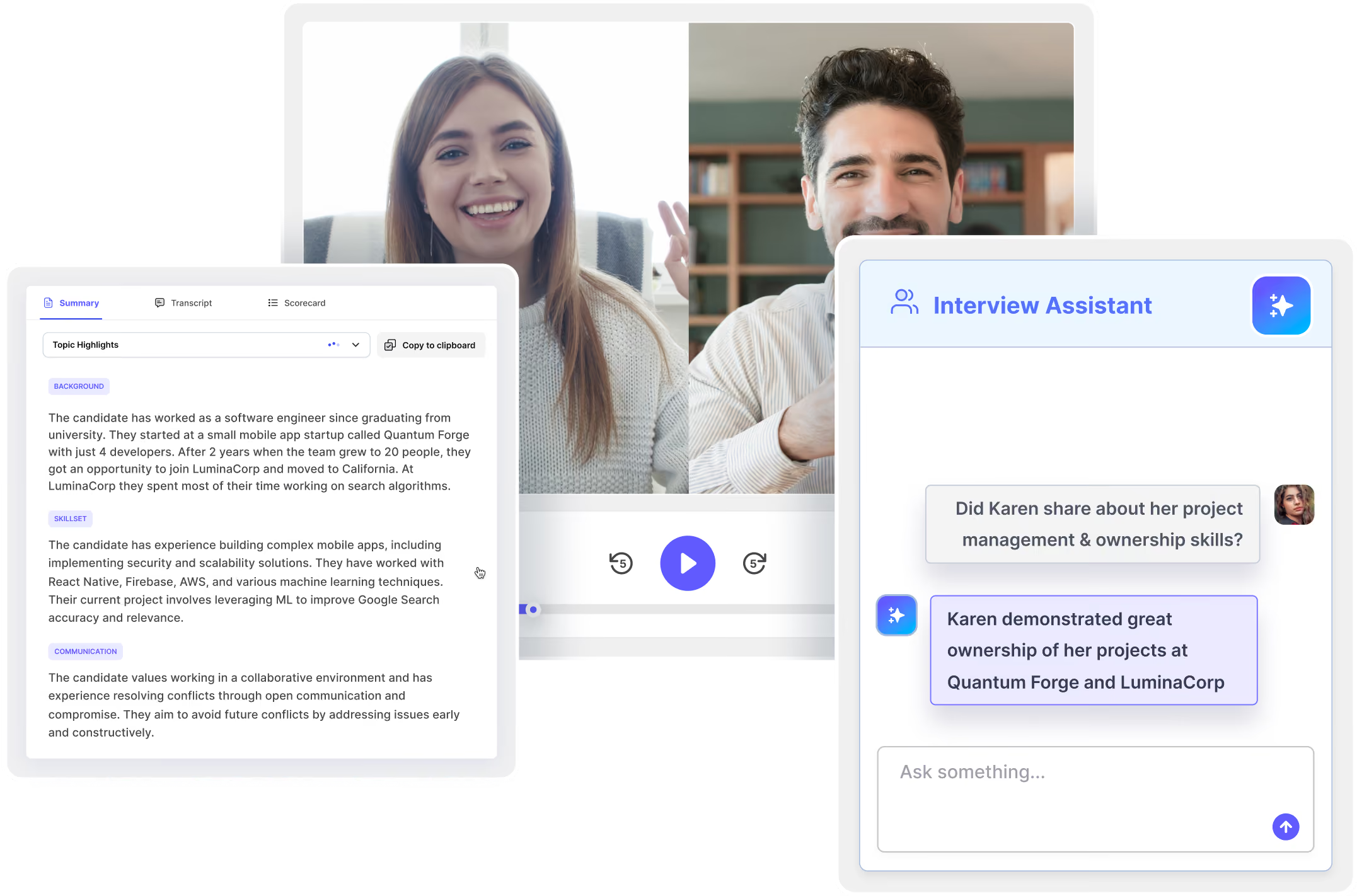
Most tools in this guide plug interview intelligence into your ATS. Kula comes at it from the opposite direction: it is a full applicant tracking system with a native AI notetaker, a distinction worth understanding before you shortlist it here. Founded in 2021 by an early Stripe and Uber recruiter, it started as a sourcing tool and relaunched 18 months ago as an all-in-one AI-native ATS.
On the interview layer, Kula sits firmly at the AI-assisted end of the spectrum. The notetaker joins each live interview, transcribes it, writes a summary, and auto-fills a customizable scorecard inside the candidate profile, so the conversation stays human while the admin disappears. Because transcripts live in the ATS rather than a separate tool, you can query across every interviewer a candidate met and compare notes in one place. The team at health benefits platform Plum told Kula their hiring managers were "fascinated" by it. As one analyst framed it to us, Kula has essentially brought a BrightHire-style product into the ATS itself.
For teams already wanting a new ATS, that is the appeal: no second tool to sync or pay for. The tradeoff is focus. A dedicated platform like Metaview or BrightHire goes deeper on interviewer coaching and analytics, and Kula's reporting is a common user complaint. It is also a young product with occasional bugs. If you want interview intelligence without adopting a new ATS, a standalone tool fits better; if you want both in one system, Kula makes a strong case.
Kula serves 220+ companies, including DeepScribe, Healthie, Plum, Dapper Labs, Vidyard, and CleverTap.
Kula uses all-inclusive, headcount-based annual pricing with every feature included and no per-seat fees or usage credits. Unlike per-seat interview intelligence tools, you do not pay separately for the notetaker. Custom pricing applies above ~100 employees, and a free trial is available after a demo.
Kula launched in 2021 as a sourcing and outreach automation tool and, 18 months ago, relaunched as a full AI-native ATS. The interview intelligence layer, including the AI notetaker, auto-filled scorecards, and interview summaries, arrived as part of that shift, alongside AI scoring, conversational analytics, built-in scheduling, and a Kula API and MCP for AI agents.

Best For
Kula is best for SMB and mid-market teams that want AI-assisted interview intelligence as part of a full ATS, rather than buying and integrating a standalone tool.

BrightHire
BrightHire was one of the pioneering tools of the interview intelligence category and offers some of the deepest ATS integrations in the space. Its December 2025 acquisition by Zoom adds a native path inside Zoom Workplace while preserving the standalone, cross-platform product its customers already run.
PROS
- Deepest ATS integration set in the category, covering Greenhouse, Workday, Lever, Ashby, SmartRecruiters, iCIMS, and 10+ more via Merge.
- Available both as a standalone product across Zoom, Microsoft Teams, and Google Meet, and as capabilities embedded inside Zoom Workplace, giving buyers flexibility on how to deploy it.
- Interview Planning Copilot builds structured interview guides from job descriptions in minutes.
- BrightHire Screen, an asynchronous AI interviewer, extends the platform into AI-led screening.
- SOC 2 Type II certified, GDPR and CCPA compliant, with consent-first recording and available bias audits.
- The BrightHire widget lets you access most of BrightHire’s interview intelligence without leaving your ATS.
- You can capture specific interview highlights and share them with other hiring team members, or even compare them to snippets of other candidate conversations.
- It includes an interviewer training module that is powered by the best interviews you’ve done, leveraging in-house knowledge.
CONS
- No published pricing, so every quote requires a sales conversation.
- Bot disclosure in meetings can feel awkward for candidates, per user reports.
- The Interviewer Quality Score lacks transparency in how it is calculated, a recurring complaint from verified users.
- There is limited mobile and in-person support, as the platform is built around video calls.
- Long-term cross-platform parity is a known unknown. Zoom has committed to continued Teams and Meet support, but it’s uncertain whether this will hold over several years.
- The product is currently available only in English and we were told that transcription for interviews in other languages is not on the roadmap for now, but could be prioritized at any time.
- While it does integrate with Google Calendar and Zoom, the tool is currently lacking specific features for interview scheduling. However, you can integrate with Goodtime, Calendly or Greenhouse and Lever’s scheduling tools.
- The tool doesn’t currently have a sentiment analysis for conversations, although it is on the roadmap.
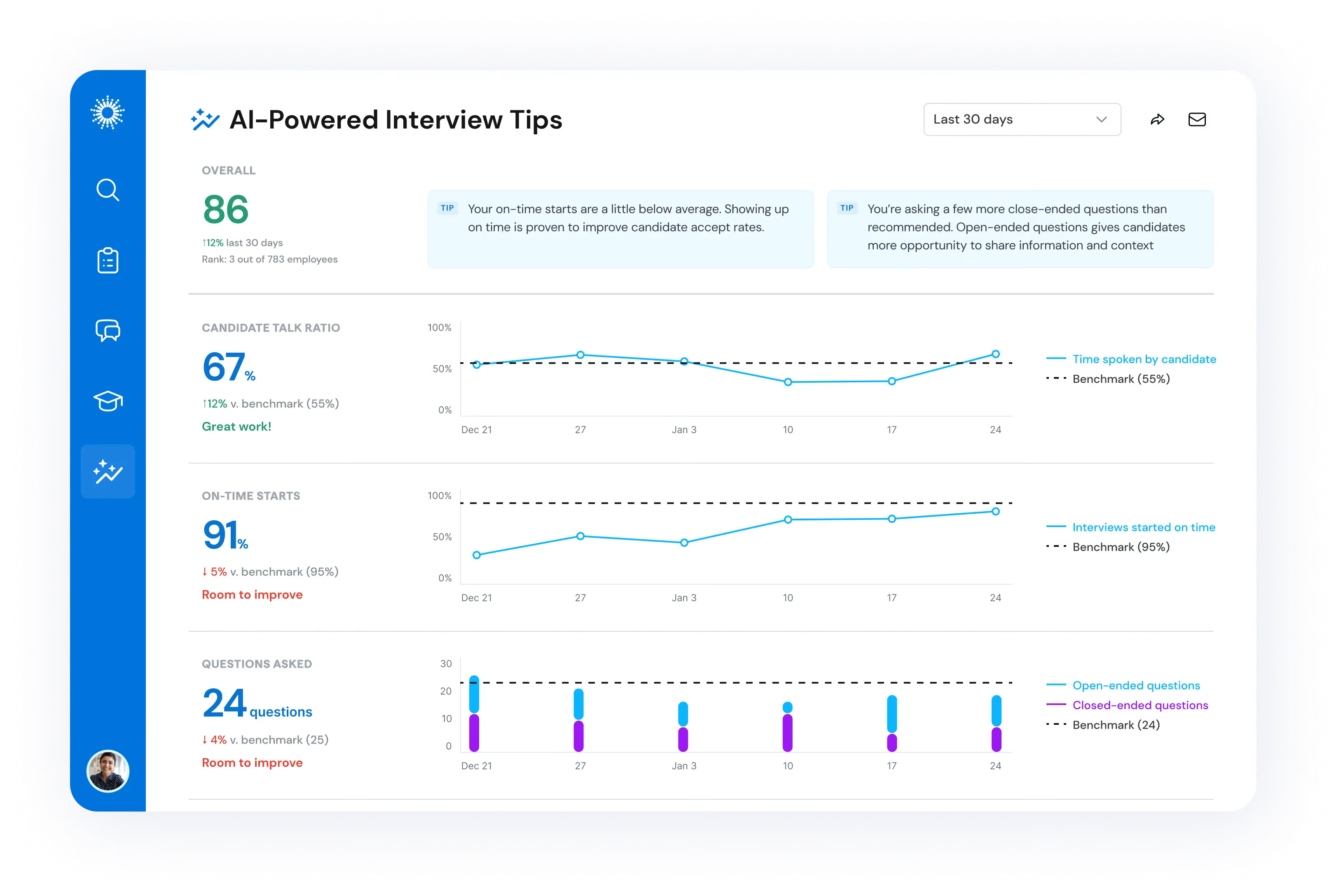
Founded in 2019, BrightHire is the interview intelligence platform that helped define the category, and has remained pivotal in shaping it to this day. We remember demoing this thing in 2022 and being taken aback by features like the live interview assistant that surfaced our scorecard questions right inside the call. Or the way it would auto-generate a structured transcript with highlights mapped to each competency, and sync the whole thing back into the ATS with a single click. At the time, the ability to jump straight to the moment a candidate answered a specific question, and share that clip with the rest of the hiring panel, felt like a genuine leap and a promising start.
While revisiting this tool year after year, we've always been happy to see that they continue to push the envelope, now with novel features like the Interview Planning Copilot, which builds the structured interview guide from the job description before the call even starts.
The AI Chat Assistant now reasons across every interview a candidate has had, so a hiring manager can ask whether someone addressed a specific concern across all three rounds and get a synthesized answer rather than a stack of recordings to rewatch. Interview Quality Analytics turned the lens around too, measuring interviewer behavior to coach panels toward more consistent interviews. The biggest leap is BrightHire Screen, a voice-based AI interviewer for asynchronous first-round screening built on insights from more than three million interviews run on the platform. The tool we first saw quietly taking notes in 2022 now plans the interview, coaches the interviewer, and can run the first conversation on its own, which puts it on both the AI-assisted and AI-led sides of the category alongside Humanly.
We credit BrightHire for restraint that is rare in this space: its messaging consistently frames AI as augmenting human decisions, and the audit trail it generates carries real defensive value, with one user citing it during an EEOC complaint.
As of 2026, BrightHire operates as a standalone brand within Zoom following its acquisition, though it still runs across Zoom, Microsoft Teams, and Google Meet, and its ATS integration depth remains the deepest in the category.
BrightHire serves hundreds of enterprises, including LinkedIn, Canva, Duolingo, HCA Healthcare, Instacart, Lucid Group, Ramp, SoFi, and Gartner (per Zoom's Nov 2025 acquisition announcement and Greenhouse's partner directory).
BrightHire offers custom, quote-based pricing across three tiers, so the best way forward is to request a demo.
- All tiers include ATS integration, interview planning, AI interview notes, interview insights, enterprise security, and dedicated support.
- Higher tiers add more AI copilots and enterprise sophistication features.
- BrightHire Screen is sold separately or bundled.
- User-reported deployments range from roughly $15,000 to $100,000+ per year by team size and volume.
When we last reviewed BrightHire, it was a venture-backed standalone and the AI-assisted category's pioneer. Since then it launched BrightHire Screen — a voice-based AI interviewer that pushes the platform into AI-led screening — and was acquired by Zoom in December 2025. It now operates as "BrightHire by Zoom."
Best For
Mid-market and enterprise talent teams that want the deepest ATS integrations in the category and are already standardized on, or moving toward, Zoom Workplace.

Metaview
Metaview built the category's sharpest recruiting-specific AI notetaker, then wrapped it in an agentic platform spanning sourcing, outreach, and interview intelligence. Genuine free tiers and transparent pricing make it easy to trial, experiment with, and figure out before you decide to incorporate it into your recruiting workflow.
PROS
- Recruiting-tuned notes capture competencies, hiring signals, and red flags rather than generic transcription.
- Real free tier on every agent (notes, sourcing, application review), not a time-capped demo sandbox.
- Transparent published pricing, rare among peers that gate quotes behind a demo.
- Native ATS integrations (Greenhouse, Ashby, Lever, Workday, Bullhorn) connect in under ten minutes.
- Cross-interview AI chat lets you query a candidate's answers across multiple rounds.
- GDPR, CCPA, and SOC 2 compliant with consent-first candidate disclosure.
- Perform software engineer interviews live and see what the candidate is coding in real-time, and refer back to it in the transcript.
- Get consistency metrics for each interview based on how they compare to other interviews in the same category.
- Run training internally so your best interviews become learning materials for future interviewers.
- Free plan for organizations with fewer than five interviewers
CONS
- According to several user interviews, transcription accuracy may be affected by heavy accents and dense technical jargon.
- The agent expansion adds surface area; teams who only want the notetaker may find the broader platform more than they need.
- Running several agents at volume climbs in cost; unlimited sourcing (Max) runs $300/mo before adding other agents.
- Currently, Metaview only works with interviews conducted in English.
- As with most interview intelligence software, Metaview’s interview scheduling works best when you already use an ATS. For companies without an ATS, Metaview integrates with Google and Microsoft calendars as well as Calendly (or users can manually add Metaview to their interviews).
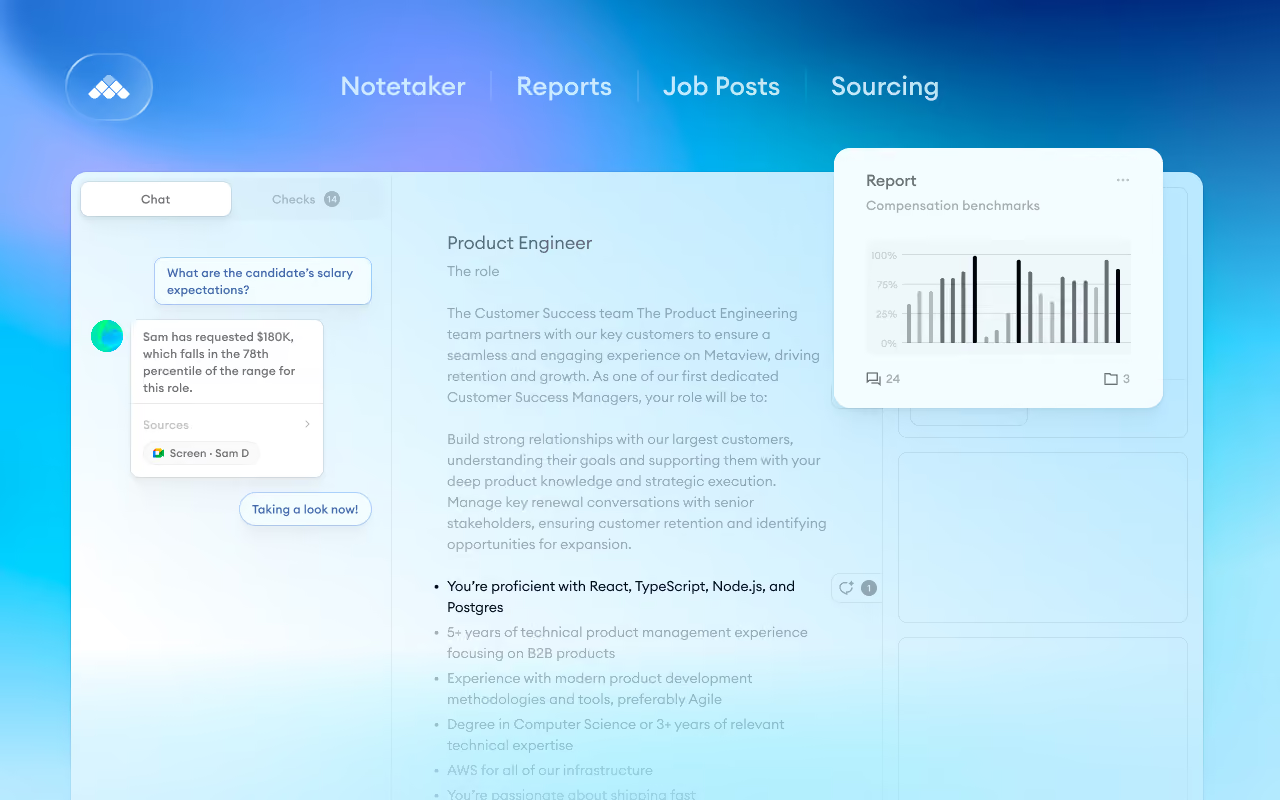
Metaview started as the sharpest AI notetaker tuned for recruiting conversations, and in 2026 it repositioned as an agentic recruiting platform. When we last looked, it handled English-only interviews and centered on transcripts and consistency metrics; today it runs connected agents for sourcing, outreach, application review, and notes.
In our hands-on time, the notetaker impressed us most. Its structured notes (Metaview calls them "Magic Notes") map cleanly to scorecard competencies and pull out technical detail that generic meeting tools miss. The cross-interview chat assistant, which answers questions across a candidate's rounds, is something we haven't seen done as well elsewhere in the category. On the interview side Metaview is purely AI-assisted; its autonomy lives in the sourcing agent, so it spans the spectrum at the workflow level rather than running interviews itself.
Compared to BrightHire, which goes deeper on enterprise interview intelligence, Metaview reaches wider across the recruiting funnel and undercuts on price transparency. Against Pillar, now absorbed into the Employ stack, it's the broader independent option. Two caveats: transcription accuracy drops with strong accents and heavy jargon, and the multi-agent expansion can feel like more than small teams need if all they wanted was notes.
In-house teams at companies like Deel, Deliveroo, KellyOCG, Brex, Pleo, ClickHouse, and Brainly.
Metaview prices each agent separately, and every one has a free tier:
- AI Notes: Free (25 calls/month, basic transcription); Pro $60/month (unlimited calls, priority processing); Enterprise custom.
- AI Sourcing: Free (first 100 profiles); Pro $100/month (200 profiles/mo); Max $300/month (unlimited profiles); Enterprise custom.
- AI Application Review: Free (50 applications/mo); Pro $150/month (500 reviews/mo); Enterprise custom.
- All agents bundled: custom, sales-led pricing.
At our first review, Metaview was an English-only interview notetaker built around transcripts, consistency metrics, and interviewer training, serving logos like Brex, Robinhood, and Pleo. Since then it has added multilingual support, rebranded as an agentic recruiting platform in early 2026, and launched autonomous agents for sourcing, outreach, and application review alongside the core notes. Recent funding rounds are backing a US expansion from its UK base.
Best For
Mid-market in-house recruiting teams (50-500 employees) that want recruiting-specific notetaking, may expand into AI sourcing, and prefer transparent pricing over sales calls.

Humanly
Humanly pairs an autonomous AI interviewer for early screening with an AI co-pilot that records, transcribes, and surfaces insights from live interviews. Built for high-volume, hourly, and frontline hiring, it leans on behavioral-science design and ATS-native data flow to screen more candidates fairly.
PROS
- The AI Interviewer can run structured first-round screens via chat, voice or video at scale
- The interview co-pilot joins live calls to produce notes, transcripts, and shareable insights, cutting double note-taking.
- Scheduling works across outreach campaigns, chat screening, and interview flows, not just one path.
- Co-designed with named linguistics and psychology PhDs for bias reduction and validity.
- Bi-directional integration with major ATS platforms including Greenhouse, Workday, Lever, iCIMS, Bullhorn, and ADP.
- Support and time savings on screening and scheduling are praised consistently across user reviews.
- Humanly leverages a huge database of candidates to present you with talent from all corners of the globe. You can also source new ones through their Chrome extension while browsing sites like LinkedIn and GitHub.
- The Humanly tool integrates with hundreds of ATSs, providing an upgrade to your sourcing that won’t require you to switch tools.
- Generative AI is cleverly implemented for messaging candidates, automating campaigns, and ranking candidates at various stages of the hiring funnel, yet a human can step in and take over at any time.
- Their reporting module is among the cleanest and most in-depth we’ve seen for this kind of tool.
CONS
- Pricing is opaque, with no public rates or trial, and reviewers flag enterprise-tier cost as the main friction.
- Users report occasional bugs and gaps in reporting and navigation.
- Another common source of user frustration we’ve heard is there’s no way for candidates to reschedule interviews if need be.
- Since it’s a tool that was relaunched after a company acquisition, there might be some changes in the near future that could impact your workflows.
- The price point might be a bit steep for smaller teams, but they do offer custom prices based on the functionality you need and the number of users.
Founded in 2018 and now merged with sourcing platform Teamable, Humanly has grown into a broad suite spanning an AI Recruiter (engage, screen, schedule), an AI Interviewer, an AI Notetaker, and an underlying talent CRM and ATS. For this guide, the interview intelligence sits in two of those pieces, and they land at different points on the spectrum.
The adopted, proven layer is the co-pilot notetaker. It joins live interviews, records and transcribes them, and feeds structured notes and insights back to the ATS, which is the assisted, human-in-the-room half of the category. We have consistently found "co-pilot" an accurate label for it.
The bolder layer is the AI Interviewer, a conversational bot that runs structured screens across chat, voice, and video and scores responses against role criteria. That is the autonomous, AI-led end. HR-community reception has evolved as familiarity with AI-led screening has grown. Early skepticism was common across the category; teams running Humanly's AI Interviewer at scale, particularly in healthcare and hospitality, report strong candidate completion rates and measurable time-to-screen improvements.
Compared to BrightHire or Metaview, which stay firmly in human-augmentation territory, Humanly spans both modes. The behavioral-science design is a genuine credibility signal. The honest caveats are pricing opacity and candidate skepticism toward AI video, both of which belong in any shortlist conversation.
Customers span healthcare, hospitality, logistics, and retail, and include Domino’s, Massage Envy, MGM Resorts, Addus HomeCare, Crew Cashwash, and Dish Network, with case studies for Mutual of Omaha, Reid Health, HomeTeam Pest Defense, DK Security, and Cellular Sales..
Humanly is quote-based and sales-led, with no public pricing and no free trial.
- Model: Historically subscription tiers (set conversation or interaction volumes) plus custom enterprise plans.
- Emerging: Outcome-based options (pay-per-candidate, pay-per-hire) have been announced, aligning cost to deliver hiring outcomes.
- Note: Reviewers cite pricing opacity and enterprise-tier cost as the recurring friction.
At our first review, Humanly was an AI-powered recruiting chatbot for mid-market teams, with a co-pilot that automated screening and scheduling and joined live interviews to take notes. Since then it has merged with Teamable to add sourcing and CRM, split its offering into distinct AI Recruiter, AI Interviewer, and AI Notetaker products on a talent CRM and ATS, launched a conversational AI that conducts structured real-time video interviews, and raised a $25M Series B (May 2026), bringing total funding to roughly $52M. Its center of gravity is shifting toward high-volume, autonomous screening.
Best For
High-volume, hourly, and frontline employers (mid-market to enterprise) that want to screen and structure-interview every applicant at scale with ATS-native data flow. A weaker fit for solo recruiters, low-volume hiring, or teams that specifically want human-in-the-room coaching rather than an AI that runs the screen.
Honeit
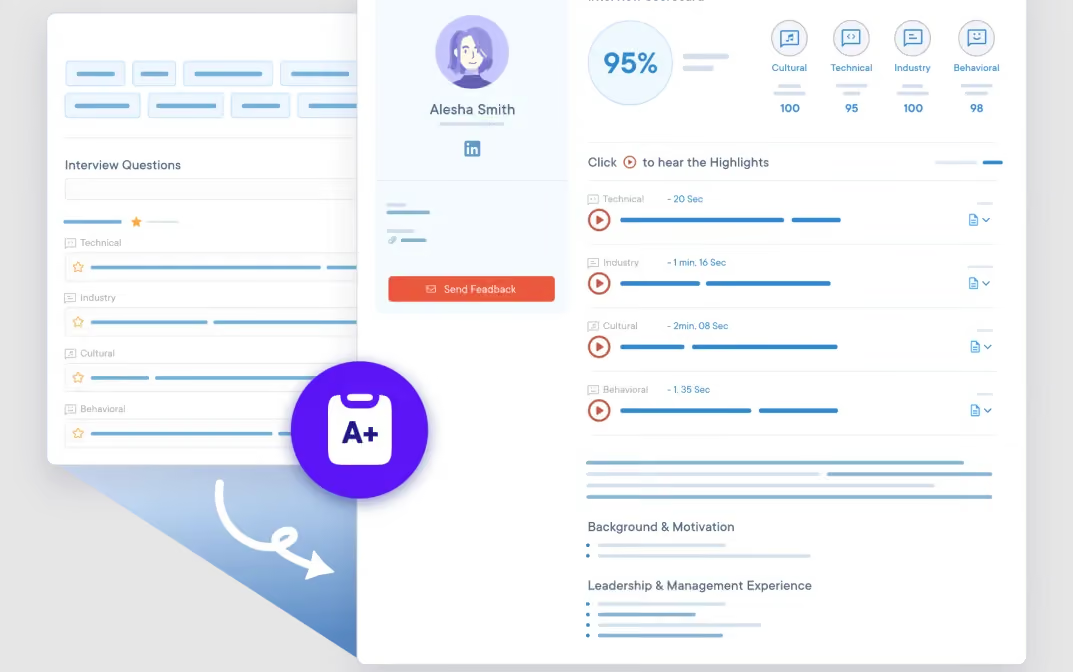
Honeit is interview intelligence built for the recruiter's screening call, regardless of where it takes place. Their tool is notable for incorporating this technology into the full communication stack (phone, VoIP, video, SMS), then records, transcribes, and turns each conversation into a shareable candidate presentation, complete with clips of the candidate’s answers.
PROS
- Packages a 15 to 20 minute screen into a candidate presentation with scorecards, summaries, and audio highlights in the candidate's actual voice.
- Built-in phone, VoIP, video, and SMS with local numbers, so there's no separate dialer or conferencing tool to bolt on.
- A Bias Button auto-hides names, photos, and resumes for blind candidate marketing and DEIB workflows.
- Auto-generated summaries and clips save recruiters roughly four to five hours a week of write-up admin.
- Integrates with Greenhouse, Lever, SmartRecruiters, Loxo, Outlook, and Slack for exporting interview data.
- The note-taking bot is positioned as compliance-safe; it won't auto-join every meeting the way consumer tools do.
- HoneIt’s tech can transcribe in 24 different languages.
- The tool presents great deliverables for each candidate, including a unique profile complete with a branded presentation and interview highlights.
- Interview scheduling tool integrated into the system.
CONS
- ATS sync is imperfect; reviewers report that the full interview summary doesn't always carry across.
- Video has historically been capped at two participants, with broader multi-party support still maturing.
- International candidates can run into bandwidth and connection issues on calls.
- It's a very small vendor so the ecosystem is leaner and feature velocity slower than venture-backed rivals.
- While the platform is robust, design-wise it’s less modern-looking than some of its current competitors.
- Though ATS integrations are supported, there’s no widget that allows you to perform certain HoneIt tasks from your ATS as opposed to having to switch to the platform.
Founded in 2014 in San Francisco, Honeit serves a slice of hiring that the better-known interview intelligence tools don’t reach quite the same way: the cold, unscheduled phone and text screens that dominate high-volume and agency recruiting. BrightHire and Metaview have added phone and even SMS, but their capture is still organized around a scheduled event and a recruiter-side record. Honeit inverts that. The phone, VoIP, SMS, and video stack, with its own local dial-in numbers, is the product itself, built for the outbound call an agency recruiter makes to a warehouse candidate or a nurse between shifts.
That design choice tracks with the industries it serves. In healthcare staffing, logistics, manufacturing, food production, retail, and hospitality, candidates apply from a phone and answer a text faster than an email, and recruiter are placing at volume. Honeit records and transcribes the screen, lifts the recruiter out of manual note-taking, freeing them to focus on the conversation.
The output is the second real differentiator. Honeit packages the screen into a candidate presentation with audio soundbites of the candidate’s answers most relevant moments. This is built to forward to a hiring manager or client with ease, with everything they need for the next steps. That suits agency, RPO, and embedded teams whose job is to submit vetted candidates that stand the highest chance to fill the role. Recruiters who use it report saving four to five hours a week and praise the support. The honest caveats: ATS sync doesn't carry every field, video has been capped at two participants, and this product is, for now, brought to life by a small, bootstrapped team.
Named customers include Reser's Fine Foods, Trinity University, Earthjustice, and Everly Health, plus RPO and staffing firms Sevenstep, Advanced RPO, and Titus Talent Strategies.
Honeit uses a per-recruiter subscription and is largely self-serve, with a free trial and an ROI calculator on the site.
- Model: Per-recruiter, per-month subscription; notably affordable versus enterprise interview-intelligence platforms, and reviewers repeatedly call it strong value.
- Free trial: Available directly on the site alongside a demo.
Honeit has been a long-running, bootstrapped niche tool since 2014, and its recent direction has sharpened rather than pivoted. Over the last year to 18 months it added customizable interview scorecards with a built-in competency framework and interactive candidate presentations (mid-2025), and leaned hard into RPO, embedded, and fractional recruiting with one-click submissions and "talent delivery platform" positioning. It also pushed its compliance-safe AI notetaker for Zoom, Teams, and Meet, framed against consumer note-takers that auto-join every call.
Best For
Agency, RPO, and high-volume in-house recruiters who screen by phone or text and want those conversations turned into structured, shareable intelligence (scorecards, summaries, and the candidate's own voice) without typing write-ups. A weak fit for teams wanting fully automated, candidate-facing AI interviews; Honeit is deliberately the opposite.
Fabric
Fabric is an early-stage AI interviewer built around a timely thesis: that in the age of AI, interview integrity is now the core hiring problem, and a conversational AI that probes every answer is the best defense against AI-assisted cheating. In other words, fighting fire with fire. It runs two-way voice interviews, generates an interview agent from a job description in under two minutes, and returns scorecards with transcripts.
PROS
- Interviews are conversational and low-latency, available 24/7, built for real-time adaptive follow-ups.
- The cheating-detection thesis is genuinely differentiated: rather than bolt on surveillance, Fabric uses adaptive questioning to push candidates off-script.
- They market pre-built, role-specific interview agents, scorecards, and rubrics for 100+ technical and non-technical roles.
- Anyone can try the live interviewer in minutes: pick a role-specific agent on the site, enter an email, get a verification code, and start talking.
- SOC 2 and ISO 27001 certified.
- Interviews are conversational and low-latency, available 24/7, built for real-time adaptive follow-ups.
- The cheating-detection thesis is genuinely differentiated: rather than bolt on surveillance, Fabric uses adaptive questioning to push candidates off-script.
- They market pre-built, role-specific interview agents, scorecards, and rubrics for 100+ technical and non-technical roles.
- Anyone can try the live interviewer in minutes: pick a role-specific agent on the site, enter an email, get a verification code, and start talking.
- SOC 2 and ISO 27001 certified.
CONS
- Very early-stage and small (founded 2024, roughly $110K raised), with limited disclosed customer scale and no independent review base. We’d like to see more traction after 2 years, but the product itself beckoned a mention and we see potential to grow.
- Every detection and customer metric Fabric cites is self-generated and unaudited; even its stated 3 to 5% false-positive rate means some legitimate candidates get flagged.
- Fabric's own pages contradict each other on gaze tracking: one says it uses no obtrusive methods like gaze detection, another describes tracking gaze patterns throughout the interview.
- The cheating-crisis framing that sells the product rests on Fabric's own platform data, not independent research cited that we could find.
- Heavy technical and engineering orientation, with less evidence of fit for non-technical, frontline, or hourly roles despite "domain agnostic" claims.
- Very early-stage and small (founded 2024, roughly $110K raised), with limited disclosed customer scale and no independent review base. We’d like to see more traction after 2 years, but the product itself beckoned a mention and we see potential to grow.
- Every detection and customer metric Fabric cites is self-generated and unaudited; even its stated 3 to 5% false-positive rate means some legitimate candidates get flagged.
- Fabric's own pages contradict each other on gaze tracking: one says it uses no obtrusive methods like gaze detection, another describes tracking gaze patterns throughout the interview.
- The cheating-crisis framing that sells the product rests on Fabric's own platform data, not independent research cited that we could find.
- Heavy technical and engineering orientation, with less evidence of fit for non-technical, frontline, or hourly roles despite "domain agnostic" claims.
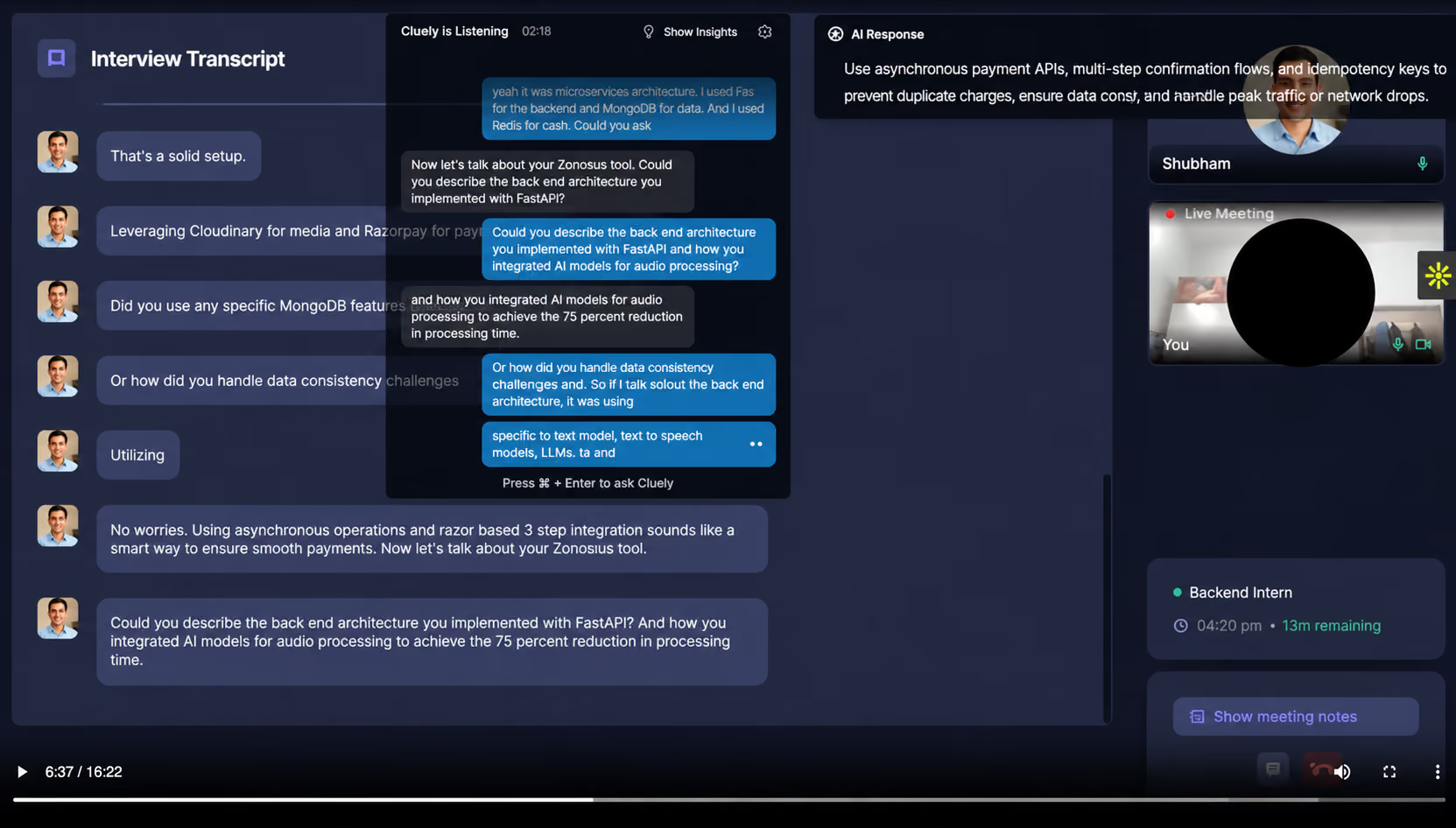
Founded in 2024 in Bengaluru and reporting roughly $110K raised, Fabric is a young AI recruiting startup whose platform revolves around an AI interviewer. The interviewer is refreshingly easy to try: Fabric lets anyone run a live trial from its site by picking a role-specific interviewer, entering an email, and confirming a verification code, with no sales call in the way.
Our experience went well, hiccup-free, but the real test would be trying this at scale, deployed for hundreds of candidates. The case studies they publish are interesting, but we'd treat them as only partially illustrative: they skew to small startups hiring engineers, and all of them validate only the time savings. We found no independent candidate voices anywhere, as of summer 2026.
That said, the product and the thesis are still interesting. Fabric argues that AI-assisted cheating on the candidate side is one of the biggest challenges recruiters face today. Traditional screening for technical roles, as they put it, is broken. So, their conversational AI is designed to drill into each answer with adaptive follow-ups. For instance, it may ask for the specific time a textbook approach failed or ask about a technology that doesn’t exist, which is supposed to draw cheating tools off-script.
On our spectrum Fabric is AI-led, conducting the interview autonomously while leaving the decision to a human, near Alex, Humanly, and Braintrust. Its wedge against them is the cheating-detection emphasis.
Fabric's published case studies name companies like Furlenco, Trigent, QuickReply, Skydo, and Aidetic.
Fabric uses a tiered, mostly self-serve model:
- Pilot — $250/mo: 50 interviews/mo. Video AI interviews, resume screening, 360-degree reports. Aimed at a one-person HR team hiring ~1–2 people monthly.
- Growth — $450/mo: 100 interviews/mo. Everything in Pilot plus WhatsApp automation and custom branding. Aimed at small teams hiring ~3–6 monthly.
- Scale — $950/mo: 250 interviews/mo. Everything in Growth plus AI proctoring, analytics dashboards, and a dedicated account manager. Aimed at fast-growing teams hiring ~6–10 monthly.
- Enterprise — custom: 500+ interviews/mo. Everything in Scale plus ATS integration, VPC deployments, and API access.
Fabric cites a 10% discount billed quarterly and 20% billed yearly. A free trial is available with no login or credit card, and the live interviewer is testable directly from the site.
Best For
Technical and high-volume hiring teams (startups, IT staffing firms, agencies, campus recruiters) that want a conversational AI interviewer with a serious cheating-detection emphasis and a low-friction, self-serve entry point. A weaker fit for enterprises needing a proven, well-capitalized vendor with audited metrics, or for teams hiring primarily non-technical or frontline roles.
_Logo.avif)
Apriora (Alex)
Alex is the live, conversational AI interviewer built by Apriora, Inc., an AI that runs first-round screens across phone, video, and text and asks real-time follow-ups instead of replaying fixed prompts. Its appeal rests on a bet the founders make: that a first round which adapts to each answer can stand in for a recruiter phone screen, and sometimes an early technical round, without adding headcount. A $17M Series A in 2025 and reports of up to 1,000 interviews a day suggest the bet is finding buyers.
PROS
- Live, real-time follow-up questions adapt to each answer, somewhat closer to a real conversation than recorded-prompt tools.
- Multi-channel across phone, video, or text, adapting to candidate availability.
- Reviewers repeatedly praise screening efficiency and standardized, level assessment across candidates.
- Fast, low-effort ATS setup and customization
- Live, real-time follow-up questions adapt to each answer, somewhat closer to a real conversation than recorded-prompt tools.
- Multi-channel across phone, video, or text, adapting to candidate availability.
- Reviewers repeatedly praise screening efficiency and standardized, level assessment across candidates.
- Fast, low-effort ATS setup and customization
CONS
- The fully autonomous first round has no human fallback when it fails. For example, a widely reported 2025 glitch (the AI looping on the phrase "vertical bar Pilates") ended a candidate's screen (and journey, reportedly) with no recruiter to step in and no corporate response.
- Interviews can feel rushed and disjointed, with hectic pacing and weak engagement noted across reviews.
- Completion rates might run low, with one user citing the mid-20% range, and the automated reject flow draws "lacks human touch" criticism.
- Cheat detection, a signature feature, is not always accurate and can false-flag candidates.
- Disclosure friction: some candidates report preparing for a human interview and meeting an AI, which raises transparency and ADA considerations as AI-hiring laws tighten.
- The fully autonomous first round has no human fallback when it fails. For example, a widely reported 2025 glitch (the AI looping on the phrase "vertical bar Pilates") ended a candidate's screen (and journey, reportedly) with no recruiter to step in and no corporate response.
- Interviews can feel rushed and disjointed, with hectic pacing and weak engagement noted across reviews.
- Completion rates might run low, with one user citing the mid-20% range, and the automated reject flow draws "lacks human touch" criticism.
- Cheat detection, a signature feature, is not always accurate and can false-flag candidates.
- Disclosure friction: some candidates report preparing for a human interview and meeting an AI, which raises transparency and ADA considerations as AI-hiring laws tighten.
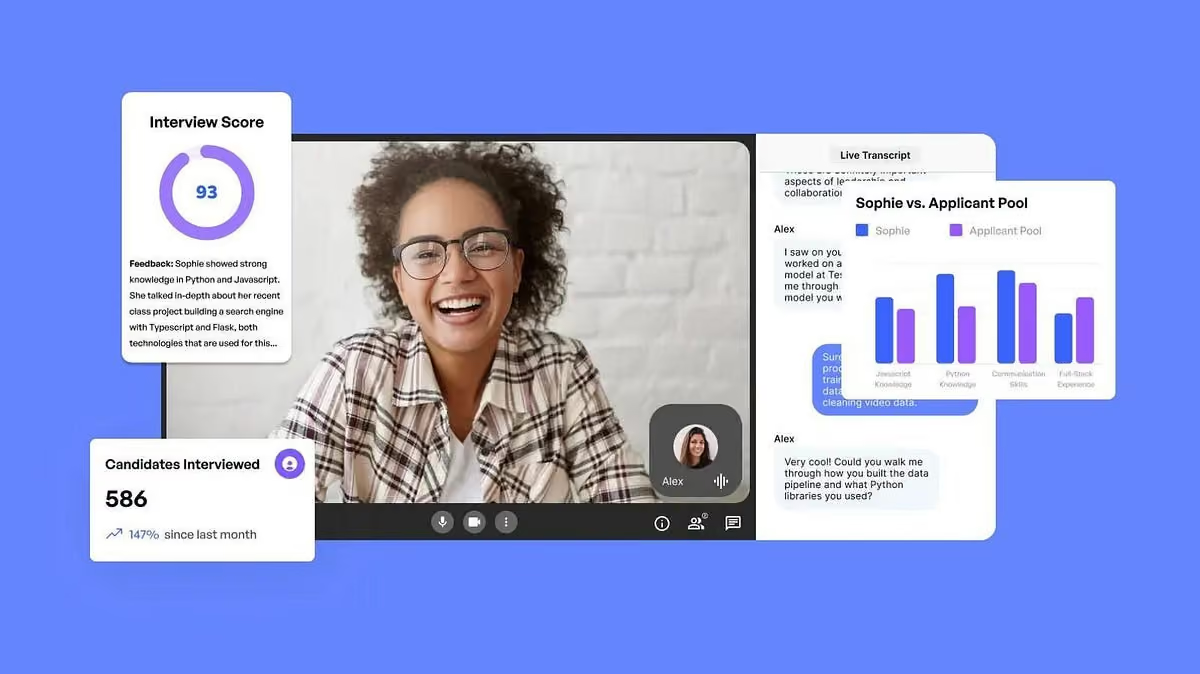
Founded in 2023 out of Y Combinator by Aaron Wang and John Rytel, Alex (formerly Apriora) is one of the pioneers in this category. Apriora's design follows from a single claim the founders make about the status quo: that one-way video interviews, whatever they save recruiters in time, are an insufficient screen. In their telling, a recorded answer to a fixed prompt can't be probed, so a vague or surprising response just gets captured rather than followed up on, yielding, in their words, a "limited hiring signal," and the format's lack of interaction leads some candidates to abandon it partway.
From that premise they built the opposite of a one-way tool, a live AI interviewer, "Alex," that asks real-time follow-ups, lets the exchange adapt to each answer, and is pitched as giving every applicant the same structured conversation on demand. Whether that amounts to a better experience for the candidate, rather than simply more throughput for the recruiter, is still an open question for us. The meaningful test of any AI interviewer is whether it returns something to the candidate while saving recruiters time.
The autonomy that powers Alex also defines its risk. Because the first round runs with no human present, a malfunction leaves the candidate with no one to fall back on, as a 2025 incident captured on video showed when the AI looped a phrase until the screen ended. Wang has said such failures are exceedingly rare, which at this volume is plausible but unverified. Buyers weighing Alex are weighing that trade directly: a ‘live’ conversation for every applicant on one side, but no fallback when the system fails on the other.
Still, to be fair, we’re talking about something that probably seemed far-fetched if you tried to pitch it in 2021. It’s still amazing, new technology, being perfected as we speak. As of now, in the eyes of this reviewer, and only seeing it in action as a third-party, never as a candidate, more of a promise than a game-changer, but one worth considering.
Independently reported customers include Xponential Fitness brands (StretchLab, Club Pilates, Rumble, Lindora, BFT, Pure Barre, YogaSix), plus Allen Recruitment and the University of Alberta, spanning roles from software engineers to front-desk staff.
Alex is quote-based and sales-led, with no public pricing and no self-serve trial.
Founded in 2023 as Apriora, the company has since rebranded to Alex, taking the AI interviewer's name as its own and moving to alex.com. It raised a $2.8M seed in 2024 and a $17M Series A in September 2025, reaching roughly $19.8M total. The product broadened from a video interviewer into a multi-channel one (phone, video, text) and added modules: Verify for identity and fraud, Coordinator for scheduling, resume screening, and Talent Match for ATS rediscovery.
Best For
SMB, mid-market, and staffing teams that want to give every applicant a live, conversational first-round screen and collapse the recruiter phone screen and an early technical round into one automated call. A weaker fit for enterprise buyers needing deep scoring rubrics and audit-ready compliance, or teams whose candidate experience can't absorb the pacing, completion, and disclosure concerns raised.

Braintrust
We picked Braintrust for its uniquely autonomous AI interviewing engine, AIR. Rather than recording answers to fixed prompts, AIR actively conducts the interview, asks follow-ups, answers applicant questions, scores candidates, and delivers a recruiter-ready shortlist. In our own testing it's one of the best applications of AI in candidate screening we've seen to date.
PROS
- In our testing, the AI voice interviewer responded naturally, asked real follow-ups, and adapted intelligently beyond a script.
- Braintrust says its models are designed to reduce bias by excluding personally identifiable information from scoring.
- Candidates can complete interviews at any time, which removes scheduling friction and no-shows.
- Recruiters get a centralized dashboard to watch interviews, read scorecards, leave notes, and move candidates through the pipeline.
- Multilingual support covers up to 10 languages for global hiring.
- The AI voice interviewer responds naturally, asks follow-up questions, and adapts intelligently beyond scripts.
- Models are designed to avoid bias by excluding personally identifiable information.
- Candidates can complete interviews at any time, improving flexibility and convenience.
- Recruiters get a centralized dashboard to watch interviews, read scorecards, leave notes, and process candidates through the pipeline.
- Multilingual support allows interviews in up to 10 languages for global hiring.
CONS
- It's a screening layer, not a suite: there's no proactive candidate sourcing, and built-in ATS features are basic next to a standalone ATS or CRM (though it integrates with them).
- No automated re-engagement of past candidates; recruiters have to reach out manually.
- Reporting and analytics are limited, with users pointing out more customizable dashboards and deeper pipeline data would be desirable.
- Parent-company context worth weighing: Braintrust runs an active Web3 token economy (BTRST), and its separate freelancer marketplace has documented a paid "Application Boost" that lets candidates spend tokens to surface above others. It sits outside AIR's interview flow, but the candidate-fairness optics are worth a look.
- The platform doesn’t include tools for proactive candidate sourcing.
- Built-in ATS features are basic compared to standalone applicant tracking systems or recruiting CRMs, but the tool would integrate to such platforms.
- Recruiters must manually reach out to past candidates to re-engage them, as automation isn’t included.
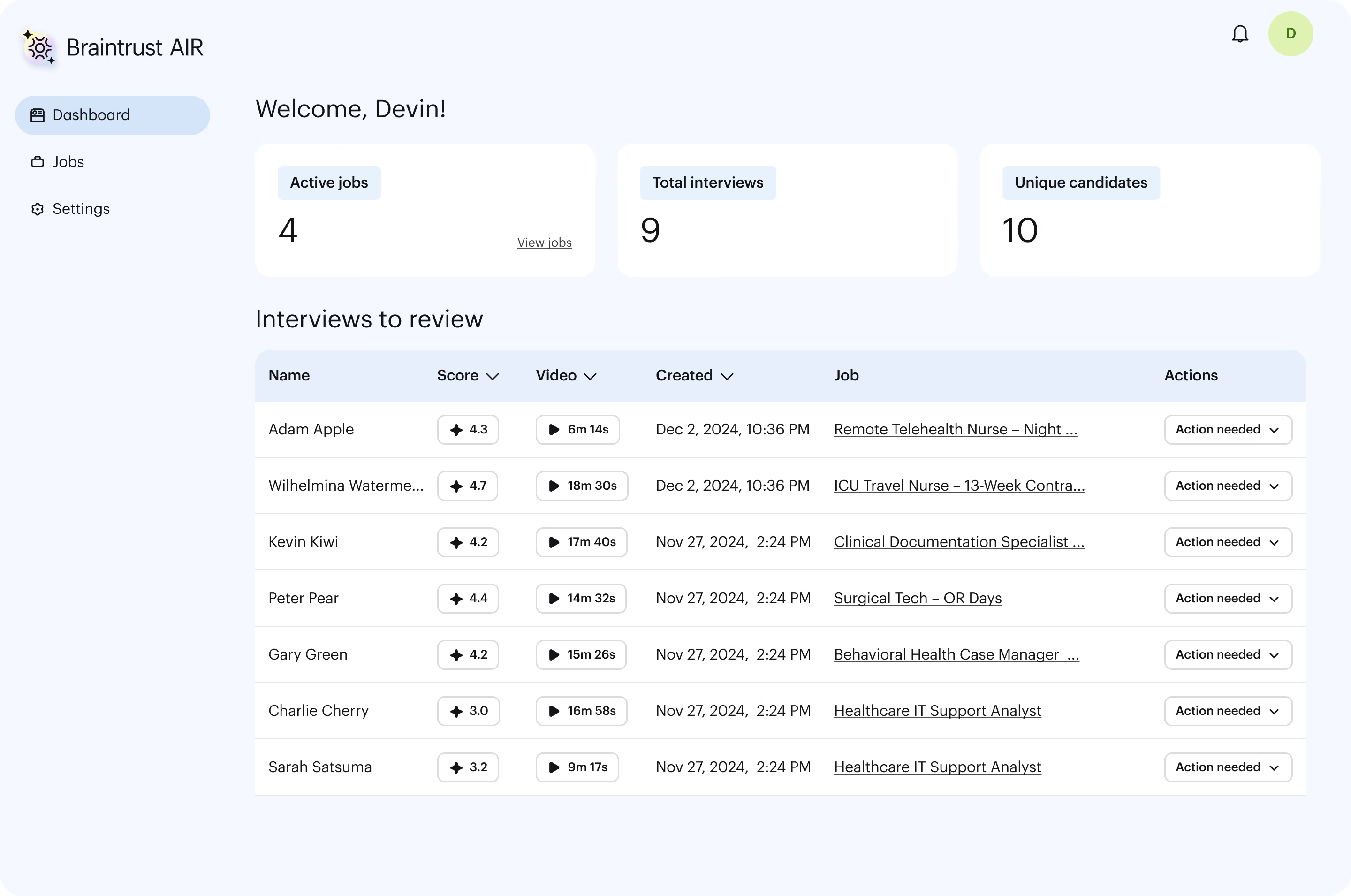
Braintrust AIR is the AI interviewer built by Braintrust, a talent-marketplace company now that has evolved into an AI hiring infrastructure business. Its design follows from a claim the company makes about hiring's core failure: that the first-round screen is the bottleneck, and that most applicants are never properly evaluated. The sharpest version, from a sponsored Brandon Hall write-up, is that when hundreds apply and a recruiter can screen only a fraction, the rest vanish as a matter of math, not malice.
AIR's answer is to interview everyone the recruiter can't. Braintrust also says AIR was built and iterated by operators of its own recruiting marketplace, which is credible given the company's history but not independently confirmed.
What we can vouch for is the product itself. In our demo and hands-on testing, AIR held a remarkably natural conversation, doubling back with clarifying questions and even acknowledging us adjusting our equipment mid-interview. It identified knowledge gaps, gave precise feedback, and produced a detailed scorecard we'd call tough but fair, among the more realistic AI interviews we've run.
The dashboard is straightforward, and while AIR can act as a basic ATS for small teams, it shines integrated with Greenhouse or Workday. On our spectrum it sits at the AI-led end, near Alex and Humanly, with a fuller compliance story and no comparable public reliability incident.
The honest caveat is scope. AIR is a screening layer, not a suite: there's no proactive sourcing, re-engaging past candidates is manual, and the reporting is thinner than power users want, so you'll likely run it alongside a real ATS rather than in place of one. But that focus is also the point. AIR does the one job most teams can't staff their way out of, the first-round screen at volume, and does it about as well as anything we've tested. For a high-applicant, high-turnover pipeline, that can certainly speed things up for everyone involved.
Braintrust's notable customers include NASA, Nike, Nestlé, Google, Wayfair, and Goldman Sachs.
Braintrust prices AIR custom, based on company needs, with a try-before-you-buy model that lets teams pilot the AI interviewer at no charge, sometimes resulting in hires directly from the trial pool.
Braintrust has shifted its self-description twice in recent years, from a decentralized talent marketplace to, now, an "AI infrastructure company" building AIR (interviews), Nexus (workflow automation), and the Talent Marketplace. It raised an $80M Series B in February 2026, on top of earlier equity and a 2021 token sale tied to its BTRST cryptocurrency. Roadmap items we noted in our review include recruiter intro videos, company-level culture questions, and expanded language support.
Best For
Companies in high-volume, high-turnover industries (staffing, retail, fast food, healthcare) that need to screen large applicant pools with a rigorous AI interviewer. A weaker fit for teams needing sourcing, deep analytics, automated re-engagement, or a full ATS; AIR is a screening layer for now, not an end-to-end suite.


- We use it for skills-based sourcing, candidate screening, and interview coordination based on verified skills and experience.
- We also use Braintrust for candidate screening, which helps streamline evaluations and maintain a high-quality talent pool.
- It is a great tool for coordinating interviews, making it easy to schedule each one.
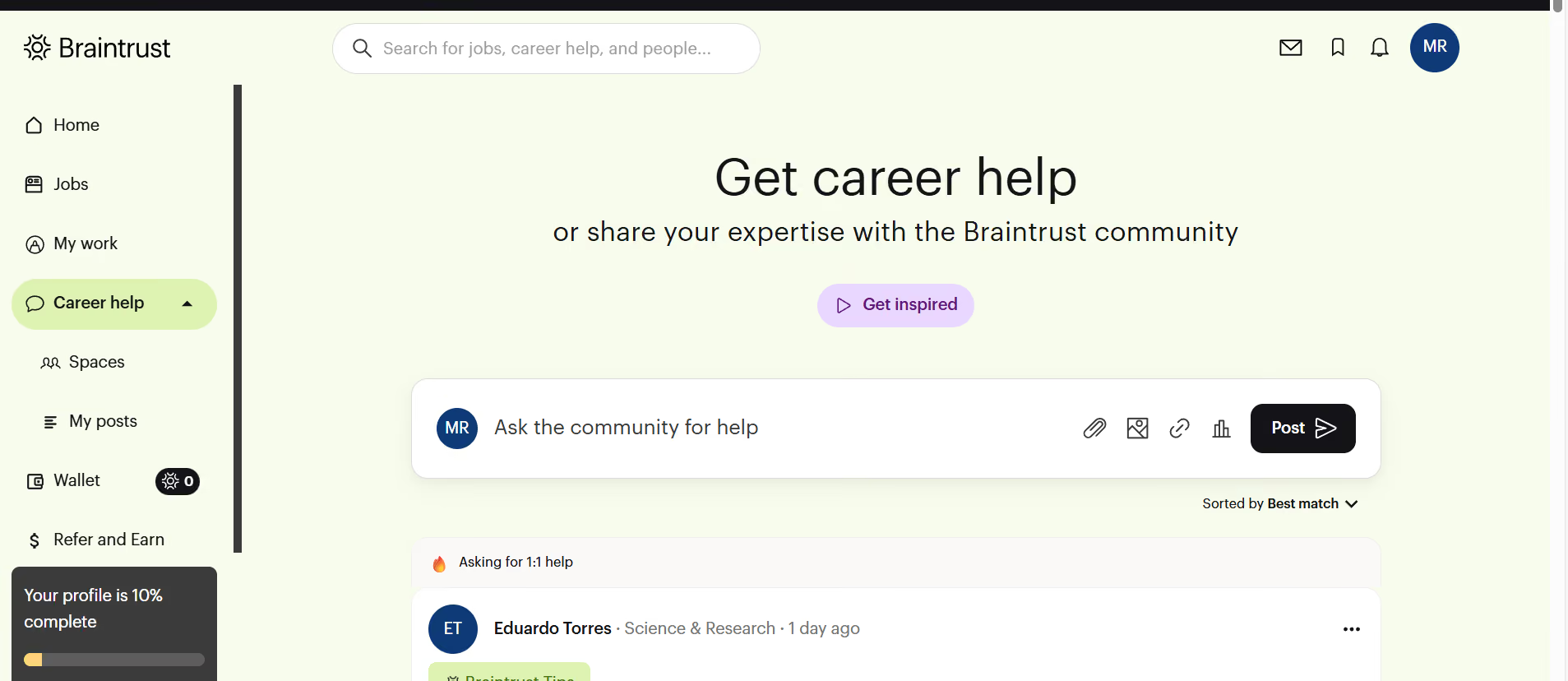
- Braintrust has a transparent fee structure, which creates trust and predictability.
- It is a great source of specialized talent.
- AI assistance helps reduce time in the hiring process.
We chose it to access talent and enable efficient workflows, particularly in supporting strategic HR processes such as recruitment and selection (talent acquisition).
Before implementing it, many of our workflows were manual and time-consuming, which limited our ability to operate strategically.
This tool helped streamline operations, improve processes, and centralize information, allowing teams to work more efficiently.
- The reporting features are fairly limited, so it’s hard to get deeper insights into hiring performance.
- I wish there were more customizable dashboards to better track progress and metrics.
- More detailed data on the talent pipeline would make planning and decision-making easier.
Braintrust feels different from other tools because you’re working directly with talent from its own network, not through layers of recruiters or agencies. That makes the processes more transparent, faster, and manageable. The built-in AI also helps streamline matching and screening, saving time and reducing a lot of manual work compared to similar platforms.
When buying a tool like Braintrust, buyers should first look at pricing and make sure the model is transparent and sustainable. It’s also important to evaluate the quality and size of the talent marketplace, along with how easy the platform is to use in daily workflows.
Finally, consider confidentiality and whether it integrates smoothly with other systems already in use.
Braintrust has evolved from just a decentralized marketplace into a platform with strong AI integration, making it easier for users to connect and find work.
It now offers valuable networking opportunities and tools that help users understand labor law concepts according to their location.
Braintrust is ideal for organizations that need highly specialized and flexible talent. It works well for companies looking to hire experts for short-term projects or with specific technical skills. It also suits freelancers and professionals seeking meaningful, high-quality work.
Braintrust is not a great fit for organizations looking for long-term, full-time employees or on-site jobs. It’s less useful for projects that don’t require specialized skills or flexible, remote talent.
Companies needing large-scale, traditional hiring might find it limiting. Braintrust works best for companies that need temporary or project-based talent.
AI-Assisted vs. AI-Led Interview Intelligence
Interview intelligence platforms fall along a spectrum defined by how much of the interview the AI actually handles. On one end, AI-assisted tools augment a human interviewer with real-time notes, structured scorecards, and post-interview analysis, but the conversation is still 100% human to human. On the other end, AI-led tools — often marketed as "AI interviewers" or "AI recruiters" — run the conversation themselves, asking questions, probing answers, and producing a candidate evaluation without a human in the loop. Most buyers need one or the other, occasionally both, and the choice depends almost entirely on hiring volume, role complexity, and company culture.
AI-Assisted Interview Intelligence
AI-assisted platforms sit alongside the recruiter or hiring manager during a live interview, typically over Zoom, Teams, or Google Meet. They transcribe the conversation, surface structured highlights, auto-populate scorecards, and feed everything back into the ATS. The interviewer still drives the conversation; the AI handles the manual process of note-taking and producing a report afterwards.
In practice, this means recruiters spend less time on administrative tasks and more on candidate relationships. In conversation with us, Tracy St. Dic described how Zapier uses AI to summarize scorecards from every interviewer so recruiters can deliver tailored, specific feedback to candidates they don't advance. Almost no one with Zapier’s candidate volume (and we’d wager, way less) does this because it would take recruiters too much time, but now it can be provided thanks to interview intelligence tools.
This category is where vendors like BrightHire, Metaview, Pillar, Humanly, and HoneIT compete most directly, alongside enterprise-tier competitors such as HireVue and Karat. The buyer is usually a mid-market or enterprise talent team running a high volume of structured interviews — often for engineering, sales, or senior individual contributor roles where a real conversation still matters. The value proposition is consistency, coaching, and a defensible audit trail, not full automation or the sheer amount of candidates processed.
If scheduling is your actual bottleneck rather than interview quality, that's a different category, covered in our interview scheduling software guide.
AI-Led Interview Intelligence (AI Interviewers)
AI-led platforms, controversial as it sounds, are made to remove the human interviewer from the first conversation entirely. The candidate joins a video or voice session with an AI agent that asks role-specific questions, is supposed to follow up dynamically based on answers, and ideally produces a scored evaluation the recruiter can review afterwards. In practice, the value-add is that the recruiter can review the best-scored, not go through every single one, and then speak 1:1 with those that made the cut. Companies like Apriora, Braintrust AIR, and Fabric are the clearest examples in our lineup, with competitors like HeyMilo, Micro1 (Zara), and Ribbon occupying similar territory.
As I said, this approach is still somewhat controversial. HR Dive reported in May 2026 that 38% of U.S. candidates surveyed had withdrawn from a hiring process because it included an AI interview, and only 12% said they'd sit through one if it was required. A Fortune article from 2025 reported that candidates were refusing AI interviews altogether, calling them "a red flag for company culture". That same piece, however, also sheds light on the other side of the story: HR teams insist it's the only way to handle thousands of applicants.
For broader context on adoption and sentiment trends, see our roundup of AI recruiting statistics.
The HR teams adopting this tech are almost always optimizing for screening volume — high-applicant, for high-turnover roles like customer support, retail, BPO, or early-career technical pipelines. The tradeoff is candidate experience and signal depth: AI interviewers handle volume well but produce thinner judgment on roles where reading a candidate matters more than scoring them.
So, Which One Do You Need?
If your bottleneck is interview quality ( inconsistent scoring, weak structure, missing notes) start with AI-assisted. If your bottleneck is interview throughput (hundreds or thousands of applicants per req) start with AI-led. Mature talent functions often run both: AI-led for initial screening, AI-assisted for the human interviews that follow. A small but growing group of vendors (Humanly is the clearest example in our lineup) now span both modes in a single platform.
Whichever direction you go, Tracy's framework for evaluating any AI hiring tool is a useful screen: she looks at three things before signing a contract.
- Ethical baseline. Has the vendor considered bias mitigation, data privacy, and local laws — every question your legal team would ask? If the answer isn't immediate, it's a signal.
- Roadmap fit. Is the roadmap aspirational but feasible, and aligned with where your team is going? You're not just buying today's market leader; you're buying the next three years of their decisions.
- Pilot evidence. Never buy without a pilot, ideally a free one. Tracy goes further: A/B test it — have AI do the task, have a human do the same task manually, compare the outcomes.
Benefits of Using an Interview Intelligence Platform
Interview intelligence pays for itself in places most HR teams have learned to tolerate as the cost of hiring: inconsistent scoring, recruiter burnout, generic candidate feedback, and hiring decisions that can't be defended with solid records. The benefits below are the ones we see consistently delivered across both AI-assisted and AI-led deployments.
- Structured, consistent evaluation: The platforms enforce the same questions, the same scoring rubric, and the same data capture across every interviewee, reducing inconsistency between interviewers.
- Recruiter time reallocated to relationships: Transcription, scorecard auto-population, and AI-summarized feedback compress the administrative load, freeing recruiters to spend time on the candidates that stand out for each role.
- Better candidate experience at scale: Tracy described how Zapier uses AI to generate tailored rejection feedback for every candidate; which is noteworthy considering generic templates, or no feedback at all, sadly tend to be the norm.
- A defensible audit trail: Every interview is captured, transcribed, and scored against documented criteria, which is the kind of evidence that holds up when a hiring decision is challenged in a bias audit, a regulatory inquiry, or a discrimination claim.
- Earlier signal on candidate authenticity: As AI-coached resumes flood top-of-funnel, structured live conversation becomes the cleanest place to surface real experience versus rehearsed answers.
Common Pitfalls When Buying Interview Intelligence Software
Most interview intelligence buys go wrong before the contract is signed. Picking the wrong vendor is very common in this space because the demos all make each product look impressive and groundbreaking. But also, the category’s compliance exposure is still being understood. In our research, these are the five mistakes that show up repeatedly with buyers who end up regretting their purchase.
- Shopping for tools before defining your AI hiring philosophy: As Tracy put it: figure out where humans need to stay in the loop before you start demoing vendors. Otherwise you'll buy features you don't need and miss the ones you do.
- Treating AI scores as decisions, not signal: Vendors that market autonomous "ranking" or "fit scoring" without an explainability layer create real compliance exposure under the recent AI hiring laws like NYC LL144 and the EU AI Act . Furthermore, our current assessment is that the industry has yet to prove AI-screened pipelines actually produce better hires than what they replaced.
- Assuming vendor compliance claims transfer the obligation: They don't. DLA Piper, a global law firm, notes that NYC’s LL144 puts bias evaluation and transparency obligations directly on the employer, and the laws being passed in other US states tend to follow a similar framework. Hence, at least for now, a vendor's "compliance-ready" claim does not imply less liability, unless their features truly adhere to regulations.
- Skipping disclosure design: As the HR Dive and Fortune reporting both surface, how candidates are told an AI is involved drives candidate tolerance more than the AI's capability does. A common mistake is to focus on the model and forget the candidate-facing UX.
- Buying without a pilot: Per Tracy's evaluation framework: A/B test the tool against your existing process on real reqs before signing. Demo flows and roadmap promises don't survive contact with your actual hiring funnel.
Interview Intelligence Software Pricing: What to Expect
Interview intelligence pricing splits cleanly along the AI-assisted vs. AI-led divide, with two fundamentally different pricing logics. AI-assisted platforms price per user (recruiter or hiring manager seat), because their value scales with how many interviewers are augmented. AI-led platforms price per interview or per usage, because the AI is doing work that would otherwise belong to a recruiter, and that work is measured by volume, not seats.
AI-Assisted: Per-Seat, Tiered by Volume
Per-seat pricing for AI-assisted tools typically runs $30 to $115 per user per month, with annual contracts the norm and volume tiers kicking in beyond a few hundred interviews per month.
For example, according on Vendr's 2026 transaction data, BrightHire deployments range from about $15,000/year for small teams (fewer than 100 interviews/month) to $100,000+ for enterprise rollouts. Metaview lands in a similar band, with paid plans commonly cited in the $20-$100/user/month range. The biggest pricing variables to negotiate:
- Seat count: Some vendors charge per active user; others use tiered seat bands. Active-user pricing is usually better for hiring teams with seasonal volume.
- Interview volume: Higher monthly volumes typically unlock tier discounts of 15-30%.
- Multi-year contracts: 2-3 year commitments often produce 15-30% off list, but reduce optionality in a category where vendors are still consolidating (Pillar was recently acquired by Employ; expect more).
- Integrations and add-ons: Custom ATS integrations, advanced analytics, API access, and dedicated support can add 10-25% on top of base pricing.
AI-Led: Per-Interview, Tiered by Usage
Per-interview pricing dominates the AI-led end of the spectrum, because the AI is conducting work that scales with candidate volume, not seat count. Public pricing benchmarks are thinner here (most vendors require a demo), but the structural pattern is clear: rates may fall between $1 and $5 per AI-conducted interview, but high-volume customers may be able to negotiate below that, and some of the vendors in this guide may definitely charge above that, but again, depending on volume and yearly commitments. Some vendors bundle interviews into monthly usage packages; others charge true pay-per-use. Apriora, Braintrust AIR, and Fabric all use variants of this model, with Micro1's Zara also offering a subscription tier for teams running internal pipelines through the AI recruiter agent. All of these, however, offer custom pricing and don’t publicly disclose it.
Custom / Enterprise: Both Models, with Floors
Custom enterprise contracts apply to both sides of the spectrum and are the norm above a certain scale — usually 1,000+ employees or 500+ interviews per month. Expect minimum commitments in the $50,000-$100,000/year range at the enterprise tier. Vendors will package interview volume, seat licenses, ATS integrations, dedicated implementation, and SLAs into a single annual figure. This is where the negotiation matters most: discounts of 20-40% off initial list are not unusual on multi-year deals.
What to Watch For
The most expensive line items in your interview intelligence contract usually aren't the per-seat or per-interview rates. They're the implementation fees ($500-$10,000 depending on scale), the ATS integration setup (often $5,000-$15,000 if non-standard), and the "premium support" tier (commonly 10-20% on top of base). We recommend getting these itemized in the quote, not bundled into a single number.
Other Interview Intelligence Tools Worth Knowing
The interview intelligence and AI interviewer category extends well beyond the eight platforms we reviewed in depth above. The tools below came up repeatedly in our research and represent the current breadth of the market. We did not shortlist them for this edition, but some may be a strong fit depending on your use case, region, or ATS.
AI-Assisted Interview Intelligence:
- Pillar (Employ AI Interview Companion): Real-time bias detection and in-interview guidance, acquired by Employ in March 2025, so not available as a stand-alone tool anymore.
- HireVue: Enterprise video interviewing pioneer, now broadened into structured assessments and AI evaluation.
- Karat: Outsourced technical interviewing with AI-assisted structure, popular with engineering teams.
- Sapia.AI: Chat-based, text-only AI interviews; strong fairness positioning and case studies in retail.
- Screenloop: ATS plus interview intelligence in one platform, mid-market UK focus.
- Jobma: Video interviewing with one-way, live, and agentic AI interview modes.
- Interviewer.AI: Singapore-based AI video interview platform with strong APAC presence.
AI-Led / Autonomous AI Interviewers:
- HeyMilo: End-to-end AI recruiter with voice, video, and phone; 20+ language support.
- Ribbon AI: Voice-first AI interviewer in 10+ languages; named Fast Company Most Innovative 2026.
- Micro1 (Zara): Autonomous AI recruiter agent paired with vetted talent network.
- ConverzAI: Staffing-focused AI recruiter, conversational interviews across voice and chat.
- Tezi AI: Chatbot-driven AI hiring assistant for application analysis and ranking.
- Talently AI: Live AI-led video interviews and coding assessments for technical hiring.
- Tenzo AI: Sourcing-first AI recruiter that pairs candidate discovery with screening interviews.
- TurboHire: SMB-focused, combines AI screening with ATS, resume parsing, and WhatsApp.
- MyInterview AI: Asynchronous video screening with AI scoring, frontline and retail focus.
- Purplefish: Newer entrant emphasizing explainable scoring and recruiter augmentation.
- InCruiter: AI-led interviews bundled with broader recruitment automation features.
Demo Questions to Ask Interview Intelligence Vendors
Demos are designed to make every vendor look impressive. The questions below are the ones we've seen separate the platforms that hold up from the ones that fall apart at scale — ask all of them, listen for what gets deflected.
Spectrum positioning
- Are you primarily AI-assisted, AI-led, or both? Where do you genuinely excel? Vendors that claim "both, equally" usually mean "we built one and bolted on the other." Press for the actual depth on each side.
- If our biggest use case is [the other mode], what should we expect to compromise on?
AI quality and transparency
- Show me a real (anonymized) interview transcript next to the AI-generated scorecard. Walk me through where the AI got it right and where it didn't.— This may be the most revealing question in a demo. Vendors that can't or won't do this are signaling something.
- When the AI surfaces an insight or a score, can you point to the exact moment in the transcript that triggered it?
- How does the platform handle accents, technical jargon, and non-native English speakers? Show me, don't tell me.
Compliance and bias
- Have you completed an independent bias audit for NYC Local Law 144? Can I see the public summary? The audit is the employer's obligation, not the vendor's — but a vendor that has one already is doing meaningful work on your behalf. A vendor that doesn't know what you're asking about is a red flag.
- If the EEOC asked us for evidence of how a specific hiring decision was made, what would your platform produce, and how quickly?
Operational and commercial reality
- Show me the live ATS sync — not a slide. How long after the interview ends does the scorecard land in our ATS, and what happens if our ATS releases an update?
- What's the all-in annual cost for our deployment, itemized: per-seat or per-interview rate, implementation, ATS integration setup, premium support, and any usage overage charges? — Bundle pricing is where the surprises live. Make them itemize.
- Are you the same company you were 18 months ago? Have you been acquired, pivoted, or significantly changed leadership? Any future plans of doing so?— This category is consolidating quickly (BrightHire to Zoom, Pillar to Employ). A 3-year contract today is a bet on where the vendor will be in 2028 — ask before signing, not after.
FAQs on Interview Intelligence Software and AI interviewers
What's the difference between interview intelligence and an AI interviewer?
Interview intelligence platforms record, transcribe, and analyze human-led interviews to produce structured scorecards and coaching insights. AI interviewers conduct the interview autonomously, replacing the human interviewer for the first conversation with an AI model and avatar. Both sit in the same category; but at opposite ends of it.
What's the difference between interview intelligence and a generic AI notetaker like Otter or Fireflies?
Generic AI notetakers transcribe meetings; interview intelligence platforms structure that transcription around hiring competencies, auto-populate candidate scorecards, sync to your ATS, and surface interviewer coaching signals. Recruiting-specific AI catches what a horizontal notetaker treats as background noise.
When should I choose an AI interviewer over a human-led interview?
Choose AI-led when screening volume is the bottleneck — high-applicant, high-turnover roles like retail, hospitality, BPO, and early-career pipelines. Stick with human-led, AI-assisted interviews for senior, technical, or culturally sensitive roles where reading the candidate (or getting the hiring managers to read the candidate scorecard) matters more than going through hundreds of them.
Does AI hiring actually work?
AI hiring tools can save time and lift completion rates. Whether they produce better hires than the methods they replaced remains conspicuously unproven — vendors publish speed metrics, not quality-of-hire data. This evidence gap is recent, real, and worth pressing vendors on directly, as well as figuring out in-house. If you end up implementing one of these tools and have a case study you’d like to share, don’t hesitate to reach out.
Can interview intelligence platforms detect when candidates use AI to cheat?
For the most part, not reliably. AI-coaching detection is a moving target — every detector lags behind newer coaching tools. The stronger defense is structural: live conversation, follow-up probes, and skills assessments that surface gaps between rehearsed answers and real depth. Our rule of thumb would be, worry less about cheating detection; more about designing conversations that truly uncover what the person on the other end of the interview is about, and why they may fit the role.
Does interview intelligence work for non-English interviews?
Most major platforms support multilingual transcription, with Metaview, Pillar, and BrightHire offering the strongest non-English coverage. Accuracy degrades with heavy accents and technical jargon across the category — pilot in your hiring languages before signing, especially for technical or specialized roles.
Is AI interviewing legal in the US?
Yes, but with growing patchwork compliance obligations. NYC Local Law 144 requires bias audits and candidate notice; Illinois, California, Colorado, and Texas have varying AI hiring laws now in force; Connecticut's framework phases in through 2027. Multi-state employers should map obligations jurisdiction by jurisdiction.
Last Tips on Buying Interview Intelligence Software
Interview intelligence is one of the most exciting categories in HR tech right now — and one of the easiest to mis-buy. The vendor pitches are seductive: faster hiring, less recruiter overload, AI doing the work humans don't want to. Some of that is genuine. A lot is hype. Quality of hire from AI-screened pipelines remains conspicuously unproven, and candidate sentiment is genuinely fragile.
The strongest signal we can offer: don't buy because everyone else is buying. As one TA leader recently put it on Reddit, the real bottleneck for most companies isn't volume — it's hiring managers not actually reviewing the candidates they're sent. AI screening doesn't fix that. Better scorecards reaching the hiring manager instantly might.
Figure out what your hiring process actually needs. Then demo. Then pilot. Then buy. Buy because you've found the right tool for your problem. Not because the demo was impressive.
About the Author


About Us
- Our goal at SSR is to help HR and recruiting teams to find and buy the right software for their needs.
- Our site is free to use as some vendors will pay us for web traffic.
- SSR lists all companies we feel are top vendors - not just those who pay us - in our comprehensive directories full of the advice needed to make the right purchase decision for your HR team.


