



For decades, performance management has largely followed the same rhythm: set goals, conduct reviews, assign ratings, calibrate performance, repeat.
AI could break that cycle.
Doug Dennerline, CEO of Betterworks and former President of SuccessFactors, believes we're moving toward something very different: performance management in real time.
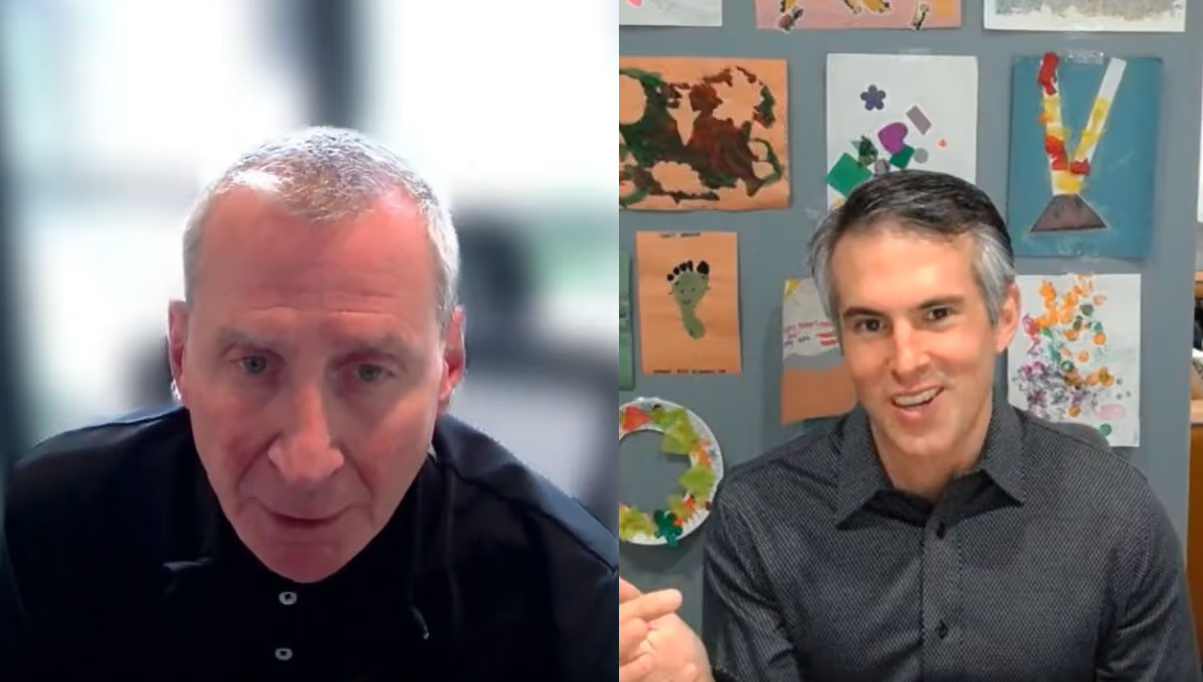
I recently sat down with Doug to discuss how AI will change performance management, manager development and the role of HR itself. His prediction isn't simply that AI will make existing HR processes faster. It could fundamentally change which processes we need in the first place.
Here are five ideas that stood out.
1. Performance management could become continuous
Traditional performance management is inherently backward-looking. Managers periodically reconstruct what an employee has done, assess their performance and decide what needs to change.
AI potentially flips that model. Instead of waiting six months for a performance conversation, an AI system could continuously analyze the information employees and managers already generate through their work.
Think goals, meetings, one-on-ones, project activity and workplace communications.
Doug gave a simple example: Imagine an employee discusses a development area during a meeting. AI identifies it and prompts their manager before the next one-on-one:
"You discussed this skill last time. Should you add it to your next agenda and create a development goal around it?"
That's a very different version of performance management. Rather than documenting performance after the fact, the system helps managers influence it while work is actually happening.
Doug calls this "performance management in real time."
Access our Buyer Guide, Best Performance Management Software, to learn more about Betterworks.
2. AI could give every manager a coach
Companies spend enormous amounts developing senior executives. The average newly promoted manager gets a considerably less sophisticated development program: "Congratulations. You're a manager now. Good luck."
Doug sees AI coaching as one way to close that gap. An AI coach could help managers prepare for difficult conversations, improve one-on-ones, identify employee development opportunities and even role-play unfamiliar situations.
Consider a manager delivering their first performance improvement plan. Instead of reading a policy document and hoping for the best, they could practise having the conversation with AI first, getting feedback on their language, tone and potential bias.
That's an important distinction in Doug's vision for AI. The goal isn't to have AI manage people. It's to give managers a copilot that helps them manage people better.
And unlike traditional executive coaching, that assistance could potentially be available to every manager in an organization.
3. Skills data could become dramatically more useful
The term "skills-based organization" has been floating around HR conferences for years. One major problem remains: skills data isn't particularly useful if it's inaccurate.
Employees can self-report skills. Managers can assess them. HR can maintain competency frameworks. But none of those necessarily tell you what someone can actually do.
AI introduces another possibility: infer skills from demonstrated work.
If systems can analyze meetings, projects and workplace interactions, they could potentially identify where employees are demonstrating particular technical and soft skills. That could turn skills databases from static employee profiles into something much more dynamic. The implications extend well beyond L&D.
Suppose you have an open role. Instead of immediately recruiting externally, AI could analyze the organization's existing talent and identify employees whose demonstrated skills suggest they're ready for it.
Doug saw this problem firsthand while leading thousands of employees at Cisco: large companies can hire externally while qualified internal talent remains hidden somewhere inside the organization.
Better skills intelligence could make that much harder to justify.
4. HR needs to become a business "mobilizer"
One of Doug's strongest messages had surprisingly little to do with AI: HR leaders need to get better at connecting people initiatives to business outcomes.
He described the strongest HR partners from his CEO days as people willing to hold up a mirror to leadership. They weren't simply there to administer processes or keep everyone happy.
They might tell a CEO: "You have two people on your leadership team who don't have the skills required to get where you're trying to go."
That's uncomfortable. It's also strategic HR.
Doug's advice is to start with the organization's business objectives and work backwards:
- What are we trying to achieve?
- What capabilities will achieving it require?
- Do we have the people and skills required to get there?
- If not, what needs to change?
He calls HR leaders who can turn that analysis into action "mobilizers."
They're not merely champions for a new HR program. They understand the business case, win support from leadership and actually get organizational change implemented.
That capability becomes even more important as AI automates administrative HR work.
5. HR teams could get smaller and more important
Doug expects AI to absorb a significant amount of the process-heavy work HR teams currently perform.
Performance ratings are one example. In theory, AI could analyze an employee's body of work against clearly defined performance criteria and provide an evidence-based starting point for their rating.
Compensation processes could become more automated too. Give the system a compensation budget and agreed criteria and it could recommend how increases should be distributed.
That doesn't mean AI should make the final decision. In fact, Doug was explicit about keeping humans involved.
AI should be the copilot, not the decision-maker.
Managers and HR still need to debate promotions, ratings and compensation decisions. But those conversations could start with substantially better information.
There's another potential advantage here: reducing some existing human biases. Performance calibration isn't objective today. One manager may be generous while another is harsh. One leader may be exceptional at advocating for their team while another struggles to articulate why an employee deserves a particular rating.
AI won't magically eliminate bias, and poorly designed systems could introduce new forms of it. But used carefully, it could help create a more consistent evidence base for human decisions.
If that happens, HR professionals may spend considerably less time administering processes.
Doug's prediction?
HR teams become smaller, but more important.
Their focus shifts toward the questions that determine organizational performance:
- Do we have the right people?
- Do they have the right skills?
- Where are our capability gaps?
- Who should we develop?
- Who is ready for a bigger role?
- Where does leadership need to improve?
- And what talent decisions will give the business the best chance of achieving its goals?
So here the big question, will AI replace the need for a human-managed performance management process? According to Dough, it should.
The bigger shift: From managing HR processes to improving performance
There's a tempting way to think about AI in HR: Take everything HR already does and make it faster.
Generate the performance review.
Summarize the one-on-one.
Write the development plan.
Automate the compensation cycle.
Those applications are useful, but they're probably not the most interesting part of what's coming. The bigger opportunity is redesigning the system itself.
If managers receive useful coaching exactly when they need it, employees' skills can be identified through their actual work, internal talent becomes easier to discover and performance conversations happen continuously, organizations may need far fewer formal processes to accomplish the same goals.
That would also change HR's value proposition.
The function becomes less responsible for making sure everyone completes the performance management process and more responsible for making sure the organization has the talent and leadership required to perform.
That's a much more ambitious job. And potentially a much more valuable one.
For more insights, catch the full conversation here: