HR pros are using more tech than ever, AI has officially moved into the office, and most HR teams are still doing it all with fewer hands than they need.
That's the big picture from our 2026 HR Tech & Trends Report, where we surveyed 250+ HR professionals about their tech stacks, AI use, stress levels and what would help them succeed at work. Our respondents came from every company size, but they skew lean: nearly two-thirds (65.4%) are solo HR pros or on teams of two to five.
We dug through the data and pulled out five trends every HR team should know about, whether you're building your first tech stack or rethinking the one you have.
1. AI is mainstream in HR, but mostly as a writing assistant

Almost nine in ten respondents (89.3%) are at least exploring AI, and 53.8% are piloting it or actively using it. But only 6.7% say AI is embedded across their HR function. Most teams are still in the "try it and see" phase.
What are they using it for? Writing, mostly. Two-thirds (66.5%) of AI users lean on it for job descriptions and policies, and 47.2% use it for recruiting and sourcing. Higher-stakes work like performance management (28.8%), workforce analytics (27%) and compensation (23.6%) sees much lower uptake.
Our respondents' stories back this up. They described AI as a "second set of eyes" for dense regulations, a brainstorming partner, and a way to turn a dry policy email into something people actually read. One HR manager put it nicely: AI has become the colleague they ask "Am I overthinking this?"
Why it matters: The everyday wins are real, but they're the easy ones. The bigger opportunity is moving AI from ad hoc drafting into the workflows where HR spends the most time.
2. AI adoption is moving faster than AI governance

Among respondents whose organizations are piloting or using AI, only 32.4% have a formal AI policy. Another 30.9% have one in progress, and 36.8% have none at all. Even among teams with AI embedded across HR, fewer than half (47.1%) have a completed policy.
The gap is widest for solo HR pros. Just 7.9% of HR teams-of-one say their organization has a formal AI policy, compared with 50% of respondents on HR teams of 50+.
Here's the surprising part: governance seems to go hand in hand with results. 70% of respondents with a formal policy say AI has reduced their workload, compared with 56.6% of respondents overall. And among organizations where AI is embedded across HR, 76.5% report a lighter workload, including 29.4% who call the reduction significant.
Why it matters: A policy isn't just a compliance checkbox. Clear guardrails seem to give teams the confidence to build AI into real workflows, which is where the meaningful time savings show up.
3. Lean HR teams are carrying a heavy load, and solo HR pros most of all

HR is a small-team sport. More than half (52.2%) of respondents at companies with 50 or fewer employees are the only HR person, and 38.2% of solo HR pros support organizations with more than 50 employees. Solo HR functions only really disappear once a company passes 200 people.
Solo practitioners are still embracing AI: 47.4% are actively using it, and half say it has already reduced their workload. But they use it more narrowly, averaging 2.8 HR functions compared with 3.8 among teams of 16 or more. And as we saw above, they're doing it mostly without formal guardrails.
The isolation is real, too. Nearly one in six respondents said nobody really has their back at work. Among solo HR pros, that rises to more than one in five.
Why it matters: For a team of one, every hour counts. Tools that automate the basics, and a peer network to lean on, can make an outsized difference.
4. Better tools top HR's wish list, even above higher pay

When we asked what would make the biggest positive difference to their well-being or success at work, 42.6% of HR pros picked better tools and automation. That edged out higher pay (42.2%) and a bigger budget (41.4%).
The demand is strongest where you might least expect it. Better tools were chosen by 65.4% of HR teams with 16 to 49 people and 68.8% of teams with 50+. Respondents at companies with more than 1,000 employees were the most likely to want better technology. In other words, a bigger department doesn't mean a better-equipped one.
Today, the average respondent uses software across 5.5 HR tech categories. Core systems lead the way: HRIS/core HR (66.4%), payroll (63.2%), onboarding and time and attendance (58.8% each). People analytics (32%) and compensation management (30%) have the lowest adoption. Mid-sized companies (51 to 500 employees) run the broadest stacks, averaging almost six categories.
Why it matters: HR teams aren't short on software. They're short on software that fits how they work. Choosing well matters more than adding more.
5. HR stress is high, and resources and support make the biggest difference

More than four in ten HR pros (42.3%) rate their stress at 7 or higher out of 10, and 16% picked a 9 or 10. The top drains aren't any one task. They're being pulled in every direction (49.2%) and the sheer volume of work (45.6%), followed by compliance and paperwork (34.5%).
Resources are the clearest dividing line. 62.1% of respondents who lack enough time and resources report high stress, compared with 29.1% of those who feel adequately resourced. Yet 52.8% rated their access to time and resources 6 or below.
Leadership matters too. High stress was 16 percentage points lower among respondents who could turn to leadership for support. But only 46.8% believe HR has high strategic influence, and those who report low influence also rate leadership support much lower (4.4 out of 10 vs. 7.8).
So where do HR pros turn? Mostly to each other: 54.4% lean on HR peers and 27% use online HR communities. And the least-stressed respondents had one habit in common: setting boundaries (51.2% vs. 36.1% of highly stressed respondents).
Why it matters: Resilience tips only go so far. Less admin, clearer priorities, real leadership backing and a strong peer network are what move the needle.
What this means for your HR team
The thread running through all five trends is simple: HR teams are stretched, and the right tools, guardrails and support can take real weight off their shoulders. If you're feeling pulled in every direction, you're in good company.
A few places to start:
- Put your AI use on paper. Even a simple policy can help you move from experimenting to building AI into everyday workflows.
- Audit your stack for fit, not size. Look for the manual work that's eating your week and find tools that take it off your plate.
- Build your peer network. Your HR peers are already your biggest support system. Lean in.
Get your free HR software shortlist
Researching new HR tech shouldn't add to an already full plate. SSR's free Advisor service matches you with 2 to 3 HR software options suited to your company's size, needs and budget. One quick call replaces hours of research, and you only hear from vendors you've agreed to connect with.
Get your free HR software matches
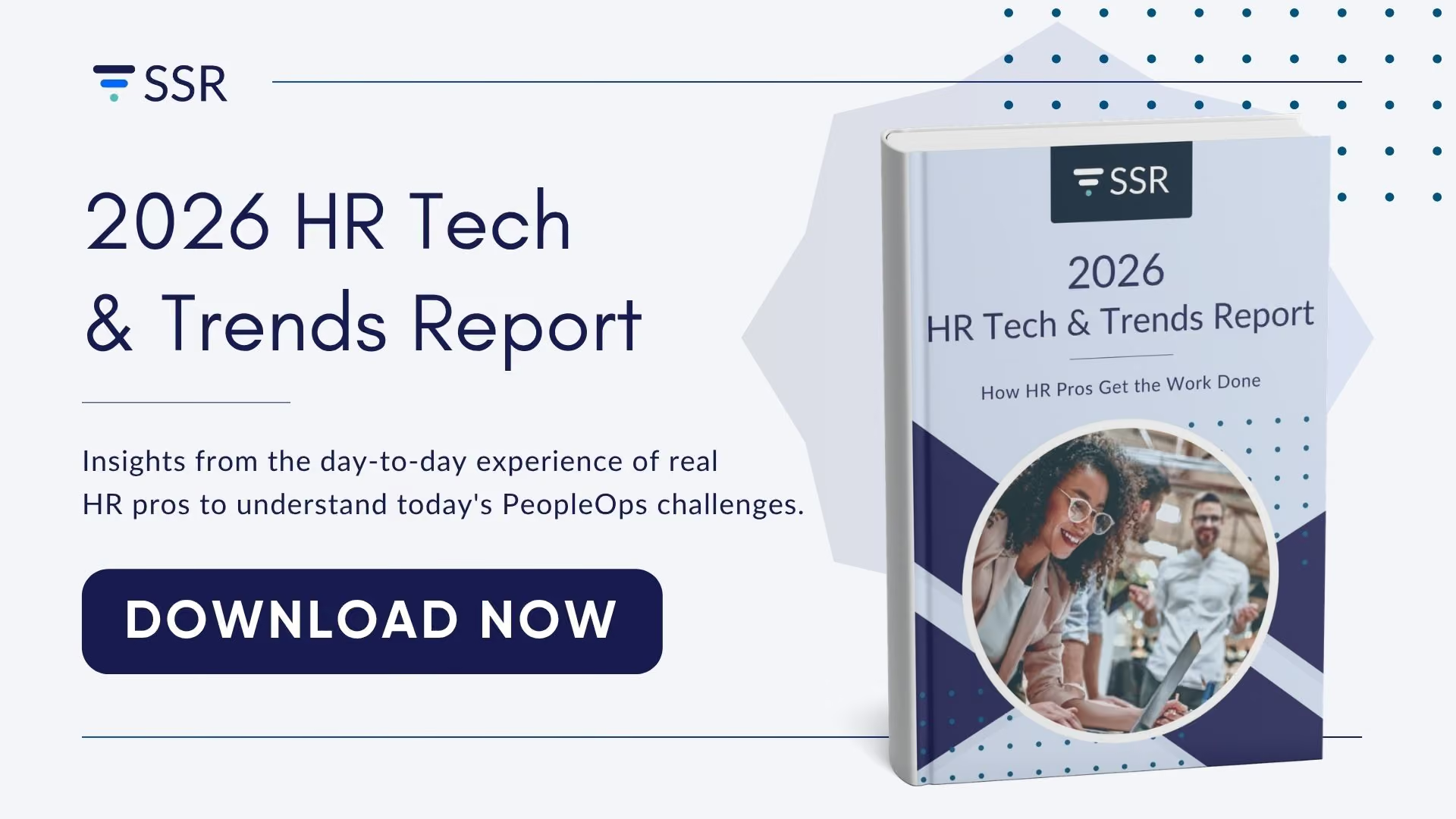
Want the full picture? Download the 2026 HR Tech & Trends Report for all the data, plus advice from HR leaders on navigating it all.