


With over 30 science-backed and customizable survey templates, detailed analytics, and more, Culture Amp helps over 6,000 companies keep their employees engaged. Behind their all-in-one employee experience is platform is a team of data experts focused on all things engagement.
Ratings
Ease of Use
Best For
Key Differentiator
Price
Free Trial
PROS
- People science team
- Tons of engagement surveys
CONS
- Their people science plus offering is not available for very small companies
- Enterprise clients might find that they lack some of the integrations and customizations a bigger team needs.

Need Help? Talk to an HR Software Advisor!
Tell us more about your company & an HR Software Advisor will help you find the right software




Culture Amp is an all-in-one employee experience platform, that runs the gamut from engagement to performance management to employee development and skills coaching. With over 6,000 customers that include some big names across many industries, it's a tried-and-true solution for any company looking to boost engagement efforts.
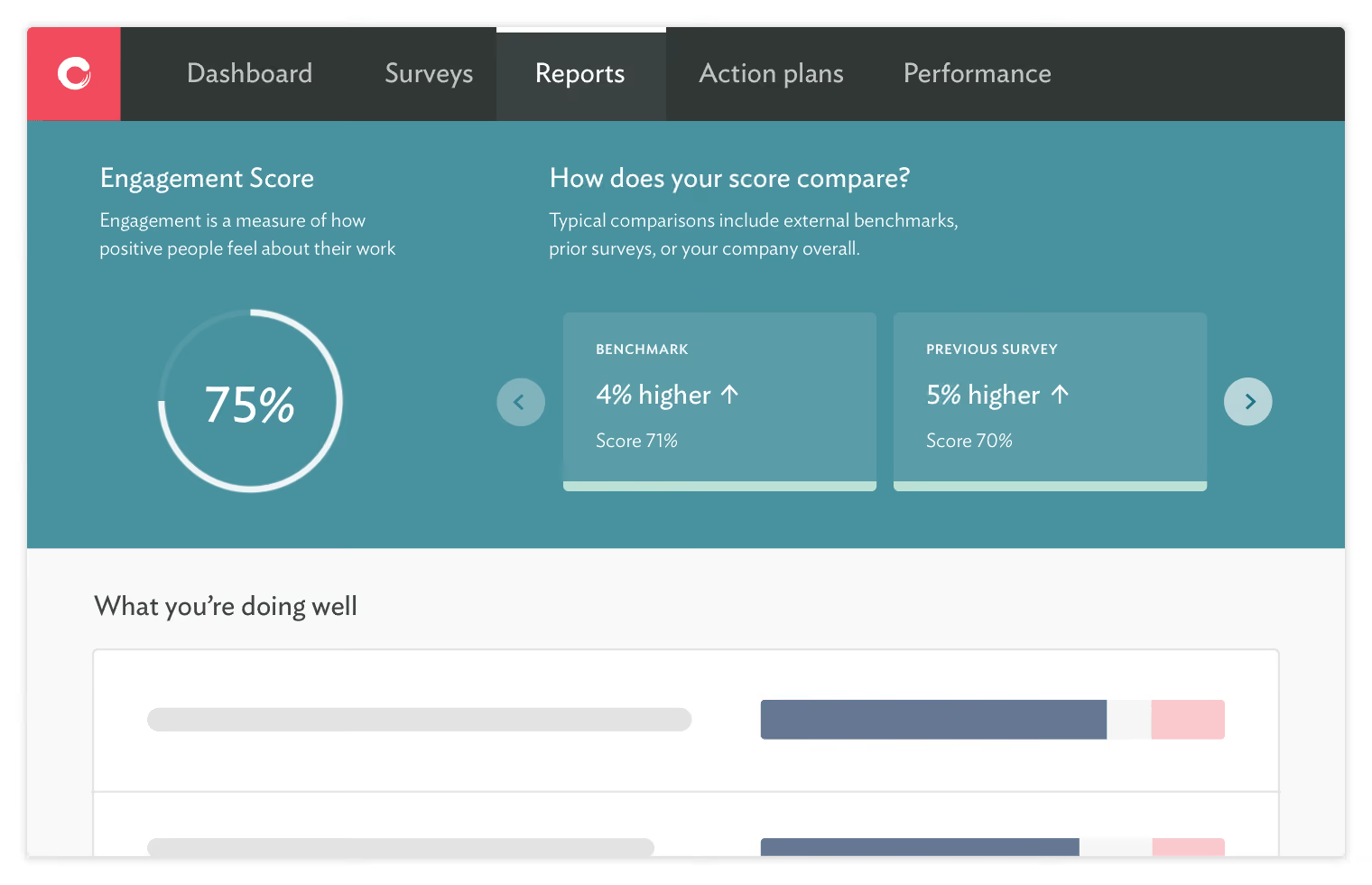


We used Culture Amp for about two years to manage engagement surveys, 360 feedback, and performance reviews. We also used the eNPS graphics in our analytics presentations. It was useful for understanding employee sentiment, identifying engagement trends, and tracking performance.
As our organization grew quickly, we needed a more integrated platform that supported OKRs and OKR trees. Culture Amp provided solid tools like surveys and performance management, but we ultimately moved to a more robust system.
We really enjoyed using the eNPS and engagement analytics, as they helped us understand employee needs and track trends over time.
We appreciated the research-backed surveys, which ensured our data was grounded in scientific methodology. Culture Amp also has a user-friendly interface and is easy to use.
Initially, we adopted Culture Amp to improve how we measure, understand, and act on employee engagement. We used it for two years before transitioning to Lattice due to the need for OKR functionality.
While we had it, it fulfilled its purpose, which was to help us understand employee sentiment, pull analytics, conduct surveys, and more. We used the analytics to improve employee engagement and leveraged the platform for performance reviews as well.
Culture Amp had some limitations with integrations and lacked built-in OKR functionality. The cost to add expanded features like advanced analytics was high.
As our company grew, Culture Amp no longer offered the features we needed, such as OKRs and more advanced analytics capabilities.
Culture Amp focuses on engagement, sentiment analytics, and research-backed surveys. I enjoyed using the platform, but our company eventually outgrew its offerings.
I recommend evaluating data depth, ease of use, and integration capabilities. Consider scalability and the cost of future modules, as additional features may require extra investment.
Culture Amp’s interface and analytics have become more intuitive and data-driven, supporting HR leaders in gaining actionable insights.
Culture Amp is well-suited for mid-sized organizations that prioritize employee engagement, feedback, and culture development.
Culture Amp is less suited for small businesses with limited budgets or large organizations seeking robust OKR tracking and more advanced tools.

I use Culture Amp for conducting exit interviews, pulse surveys, and various other internal surveys. The tool is primarily used when feedback from employees is needed on specific topics or during key transition points.
Most of my interaction with the platform involves setting up surveys, reviewing responses, and analyzing trends over time. It helps us collect candid feedback and identify areas for improvement.
- It is highly intuitive and easy to navigate, making it accessible for HR teams and managers across industries.
- It offers tailored templates for engagement, onboarding, diversity and inclusion, and performance reviews, allowing organizations to align feedback tools with their unique culture.
- It supports regular pulse surveys and anonymous responses, fostering honest communication and continuous engagement tracking.
I have been using the tool for the past three years, both in my current organization and in my previous one. It was primarily purchased for conducting exit interviews, pulse surveys, and other types of surveys.To my knowledge, the Performance Feedback feature has not been utilized by either organization.
Culture Amp offers features that go beyond what the Microsoft 365 suite provides, especially in the area of employee engagement and feedback collection.
- Some users mention missing integrations, such as with Outlook calendars, which can disrupt workflow automation.
- Reporting and customization options are limited compared to other tools.
- Although intuitive for many, some users feel the platform requires extensive onboarding to use effectively.
Culture Amp is known for its research-driven survey templates, developed with input from organizational psychologists.
Unlike some platforms that focus only on data collection, Culture Amp emphasizes closing the feedback loop by helping teams take actionable steps based on the data collected.
Look for analytics that go beyond simple data collection—features like Culture Amp’s Focus Agent help translate feedback into meaningful action. It’s also important to check if the system integrates smoothly with existing HRIS or calendar tools to minimize workflow disruption.
Ease of use, support for anonymity, and flexibility in survey design are other key factors to consider.
I'm not sure how it was initially, as I've only used it for the past few months.
Culture Amp is well suited for mid-sized to large companies that prioritize culture, employee feedback, and inclusion. It works best for people-focused teams.
Culture Amp may not be a good fit for small businesses or companies that rely heavily on system integrations.

We conducted engagement surveys every six months. We sent an email to employees, informing them that it was time to complete the survey. It would come directly from Culture Amp and only took a few minutes.
Once the survey was complete, we ran reports to review the results. We could separate data by department, manager, VP, etc.
We primarily used it to assess employee sentiment within the company and its departments, as well as for biannual pulse checks.
- The main thing I liked about Culture Amp was the ability to run reports from the top level down to the direct manager. It was anonymous, but it gave us a realistic idea of how the team was doing.
- The second thing I liked about Culture Amp was its user-friendly interface. Employees were impressed with how easy and quick it was to complete the survey.
- A third thing I liked about the platform was the in-house tools. We utilized the action planning guide, and managers mentioned they appreciated that feature.
We bought Culture Amp because we had never conducted an engagement survey before. We wanted to start focusing on our culture and retention. We were experiencing a period of high turnover and needed to understand the reasons behind it.
The integration of Culture Amp was smooth, and our employees found it very user-friendly. I personally used it for two years.
- The biggest complaint I had was that it wouldn't let us customize it as much as we wanted. There were things we wanted to do but couldn't.
- We also wanted to delve deeper into some of the results.
- I don't really have a third con, but my HR team did have to spend extra time working with the reporting function to get the exact report we wanted.
I've only used a couple of engagement tools, but I liked Culture Amp. The surveys are simple to take, and our representative was always informative.
- When buying this type of tool, the first thing I think about is integration. Will it work with my current systems?
- People should also consider how easy it is to use from the employee’s perspective. If it’s difficult or time-consuming, many employees will not complete the survey.
- It's important to evaluate what type of reporting the tool provides and how detailed the reports can get.
- Cost is always a factor as well.
I'm not sure, as I only used it for two years.
I would say Culture Amp is suitable for medium to large-sized companies.
I would say smaller organizations. Many of these tools are expensive, so smaller companies may not have the budget for larger platforms. This is also an issue because Culture Amp only provides feedback if the team has three or more employees. For smaller companies, that may not always be the case.

WorkTango

WorkTango

Assembly
Assembly

Bonusly
Bonusly
.avif)
Deel
Deel

AdvantageClub.ai
AdvantageClub.ai
Culture Amp has a lot of features, so it's easy to get shiny object syndrome and want to pay for them all. Brainstorm what specific features will provide the most value to your organization before buying.
Canva, SoulCycle, Etsy, Oracle, Bombas, Intercom, McDonald's
- Customizable engagement surveys
- Performance reviews
- Goal and OKR tracking
- 360 degree feedback
- Skills coaching
- Detailed analytics
- Benchmarking tools
- People science team
- Turnover prediction
- Personalized growth plans
Culture Amp provides integrations to connect where work happens, increase employee participation, and expand team impact across your organization.
Key integrations include:
- SAP SuccessFactors
- Namely
- Workday
- Slack
- Microsoft Teams
- BambooHR
- Personio
- Rippling
- Gusto
Culture Amp has three different plans. Each one features all of the engagement and performance management features that CultureAmp is known for. The plans differ in coaching and education features.
The plans are as follows:
- Self-starter: Designed for 25-200 employees. Includes all Engagement and Performance features. Limited HRIS integrations. Group coaching and education. Coaching and education features include survey design review, project working sessions, and demographic mapping under education.
- Standard: Designed for 200-1000 employees. Includes all the features from Self-starter. All HRIS integrations. Adds one-on-one Coaching features, including feedback strategy review, project planning, and results & report sharing follow up. Group Education features.
- Enterprise: Designed for 1000+ employees. Includes all Standard features. One-on-one Coaching and Education features, including meetings with Success coach, action guidance, management training, and People Scientist insights.
You may also purchase the employee engagement or performance management modules individually. While you must contact a representative for exact pricing, as these will vary depending on the modules subscribed, most companies pay between $3 to $9/per person per month.
Culture Amp works best for global companies with over 50 employees, ideally in the 150 - 5,000 range. They are industry agnostic, but most of their clients do come from tech and white collar settings like HR and finance.
Culture Amp has a customer success team that supports with implementation and onboarding. These professionals are guided by the advice of the in-house data science team. At Culture Amp, there are hundreds of in-house experts across People Science, Customer Success, Community, Support and Account Management
Culture Amp clients get access to a community of over 100,000 HR practitioners.
People science has been at the heart of Culture Amp since the get-go. Their mission is to help companies solve even the toughest organizational challenges. Their offering is led by a team of in-house people scientists who channel key learnings from millions of data points into the platform. This data is then used to provide strategic guidance. The team is quite diverse, including people with PhDs in everything from industrial/organizational psychology to machine learning. They also have significant expertise in diversity and inclusion, change management, business analytics, and more.
Company HQ
Richmond, Victoria
Number of Employees
900+
Year Founded
2010
Amount Raised
Last raised $10M through series F funding.
FAQ
About SSR

We spend hundreds of hours researching the best HR and recruiting software so you don’t have to. We never take money from vendors during our research phase and rely heavily on practitioners and experts to help us recommend the right software. However we may earn a small fee if you click on vendor links on this page.

