Bonusly is an employee recognition and rewards platform that specializes in gift cards. Available in dozens of countries, their international rewards catalog is impressive.
Ratings
Ease of Use
Best For
Key Differentiator
Price
Free Trial
PROS
- Intuitive user interface.
- Available in German, English, French, and Spanish.
- Supports Android and iOS.
- Discounts for nonprofit and education organizations.
- 14-day, full-featured free trial.
CONS
- Analytics and reporting features are relatively underdeveloped.
- The reward catalog lacks in-person experiences and physical goods.
- All our plans are billed annually, and the vendor no longer discloses their pricing.

Need Help? Talk to an HR Software Advisor!
Tell us more about your company & an HR Software Advisor will help you find the right software





Bonusly’s global offering makes it easy for multicultural teams to send gift cards to recognize excellence and reward their peers.
Users choose a reward, select the country from the drop-down menu, and pick gift cards from available partners. Options also include local establishments. Recipients can "cash out" and spend the money on services (housekeeping, for example) or donate their bonus.
In addition to streamlining the process for rewards, Bonusly also lets users recognize employee accomplishments by broadcasting to the entire company or with selected teams. When someone is singled out for doing good work, Bonusly will help users shout it from the rooftops (safely within the confines of the platform, of course).
Bonusly can make building rewards into the manager’s daily routine easier. Impromptu team-wide or individual rewards are easy to give, and users can set up goodies for "delivery" for recurring events like birthdays and work anniversaries. Additionally, each employee is provided with a monthly allowance for peer-to-peer recognition.
Along with all the revelry, Bonusly has also created a swag integration, namely AXOMO. Users choose the swag, connect to the AXOMO store to the Bonusly Reward catalog, and employees can directly redeem their points for company swag in addition to the usual reward choices.




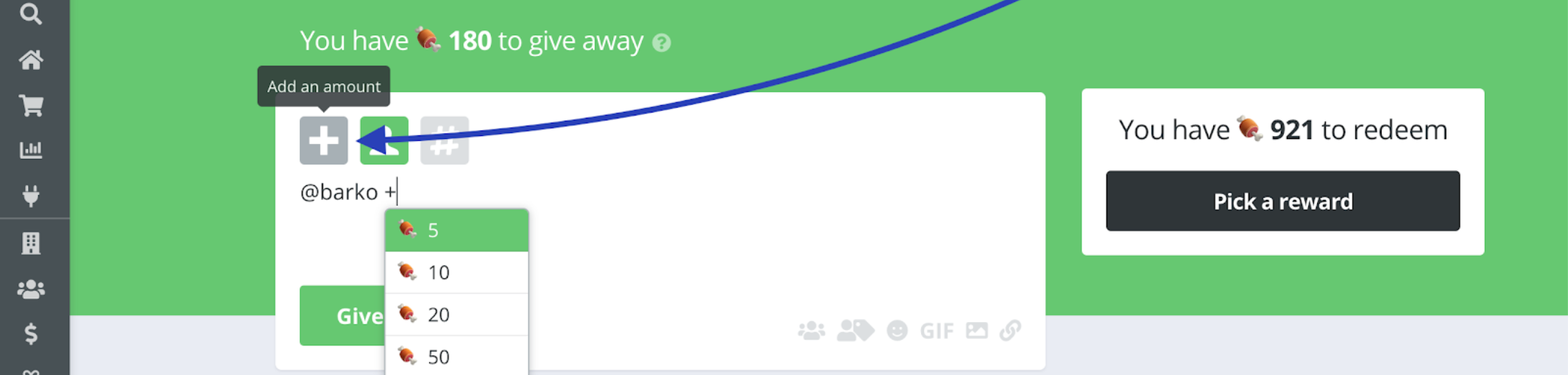
When using Bonusly, you create a post highlighting the recognition you would like to publicly share about a team member or team members. The post includes required fields such as @name(s) and #value(s).
If your company has points enabled, you can allot a specific number of points to gift using the +point(s) field.
Each team member has a set number of points they can give each month, and accumulated points received from others can be redeemed for gifts in a company store, if configured. At the end of each post, you have the option to include a GIF.
I like that the platform is easily accessible and intuitive for publicly recognizing team members in a visible way.
From an HR perspective, I like that I can track data showing which company values resonate most and least with employees, which helps leadership focus on areas that may need stronger reinforcement.
I also like that team members are incentivized to participate through a points and rewards system.
As our company began to scale as a globally distributed workforce across the US, EMEA, and APAC, we wanted to adopt a tool that could promote a company culture of recognition and appreciation.
Our teams were spread across multiple offices, so finding a tool that made recognition easily accessible in real time was important. We also believed that incentivizing team members to recognize others’ contributions through gamification would encourage broader participation.
To make it easier for team members to think through their recognitions, we created hashtags aligned with each of our core company values. This allowed us to collect measurable data to track which values resonated most with team members and identify areas where leaders could lean in more and lead by example.
I have personally used the tool for over three years.
It would be helpful to filter public recognition posts using more advanced criteria, particularly when reviewing usage by teams or functional groups.
At the time, the integration with our company swag store was not very user friendly, though improvements may have been made since then. An easier integration with Zenefits would also be beneficial.
I have not used similar tools to Bonusly, so I cannot directly compare it to competitors.
One key consideration is weighing the pros and cons of both adopting the tool and gamifying recognition. Gamification introduces factors such as budget constraints and the risk of misuse by team members acting in bad faith.
Another consideration is whether a platform like Bonusly will support your intended outcomes, such as improving company culture, morale, or engagement.
The platform has become more intuitive to use over time. Integrations with HRIS systems like Gusto have made importing new hires into the platform much more seamless.
It works well for distributed workforces, whether remote, in person, hybrid, or global. Organizations focused on strengthening engagement and building a culture of recognition and appreciation are likely to see strong value from this platform.
I believe Bonusly can work for any organization that wants to improve or reinforce a culture of recognition and appreciation. The tool is intuitive and can motivate team members by highlighting the contributions of others across the company.
I used Bonusly regularly as an HR administrator to support employee recognition and oversee platform governance. From an administrative perspective, I managed user access, ensured employee profiles were properly set up, and allocated monthly point balances based on organizational guidelines.
I also monitored recognition activity to ensure appropriate usage and alignment with company values, and reviewed redemption requests, including approvals for company swag and rewards.
Bonusly was used as a tool to reinforce culture by encouraging peer-to-peer recognition and increasing visibility of positive contributions across teams.
I also supported onboarding and education around the platform so employees understood how and when to use Bonusly as part of the organization’s engagement and recognition strategy.
Bonusly helped reinforce a culture of appreciation by making recognition frequent, inclusive, and integrated into everyday work rather than limited to formal review cycles.
From an administrative perspective, Bonusly was easy to manage and offered a flexible, points-based rewards system that employees could redeem for gift cards or company swag, increasing participation and motivation.
My organization implemented Bonusly to create a more consistent and visible way to recognize employees in real time, rather than relying solely on annual reviews or manager-led recognition.
The goal was to improve morale and engagement by giving all employees the ability to acknowledge each other’s contributions across the organization.
Bonusly allowed peer-to-peer recognition through public shout-outs, which helped reinforce positive behaviors and made appreciation more immediate and inclusive. The platform also offered a points-based system that employees could redeem for rewards such as gift cards, adding a tangible incentive to recognition.
I personally used Bonusly for approximately one year as an HR leader, during which time it was well-received and had a positive impact on team morale and workplace culture.
Depending on how the points and rewards system is configured, Bonusly can become costly for smaller organizations or nonprofits when points are redeemed for cash-based rewards.
While the platform is intentionally lightweight, organizations may need to invest time in ongoing moderation, guidelines, and education to ensure consistent and appropriate use across teams.
Compared to other employee recognition tools I’ve evaluated or used, Bonusly stands out for its balance of simplicity, visual appeal, and ease of adoption. The platform is intuitive for employees, with a minimal learning curve, while still offering enough structure for HR teams to manage recognition in a meaningful way.
When selecting an employee recognition platform like Bonusly, organizations should first assess their company culture and readiness for a public, peer-to-peer recognition model.
Budget considerations are also important, particularly regarding how points are valued, funded, and redeemed over time.
Leaders should evaluate employee demographics and engagement levels to ensure the platform will be widely adopted and used consistently.
During my time using Bonusly, the most noticeable evolution was in how employees adopted and engaged with the platform rather than changes to the tool itself.
Initially, there was some hesitation as employees learned how recognition worked, but usage increased as the organization reinforced its purpose and value.
Over time, employees became more comfortable giving and receiving recognition, and participation grew as the impact on morale became more visible.
Bonusly is well-suited for organizations of various sizes and industries that value real-time, peer-driven recognition as part of their culture.
Bonusly may not be the best fit for organizations that are not prepared to support a culture of open, peer-driven recognition or that prefer all feedback and recognition to be tightly controlled or manager-led.

We use Bonusly to recognize and reward our team members for exceptional work. Everyone gets a monthly allowance of points to give to their team members or cross-functional teammates. We give points when a teammate demonstrates our company core values, goes above and beyond, or shows great teamwork. The points can be redeemed for gift cards or other rewards.
We also use Bonusly to celebrate birthdays, work anniversaries, and special quarterly employee recognition awards. It is a fun way to stay connected and show appreciation.

- Bonusly is easy to use and integrates seamlessly with popular communication and collaboration tools like Slack. The platform is user-friendly and convenient for recognizing colleagues in real time.
- Public recognition motivates employees and fosters a positive work culture.
- Employees can choose from a wide range of gift cards or donations, making rewards meaningful.
- The platform provides reporting and analytics to track recognition trends and understand engagement levels within teams. This helps managers adjust their one-on-ones and engagement strategies.
Our organization bought Bonusly to improve employee recognition. We wanted an easy way to appreciate our employees and boost team morale across all geographies. Bonusly also encourages a positive company culture and makes recognition visible to everyone. The platform is easy to use and enjoyable.
I have been using Bonusly for over five years, and it has made a noticeable difference in employee engagement.
- Over time, recognition messages can become generic and feel repetitive.
- As the team grew, costs increased due to subscription fees and reward spending.
- If teams do not engage regularly, the impact of the tool diminishes. Many people use it only at the end of the month when Bonusly points are about to expire.
- Some teams, especially those outside the United States (across LATAM and Canada), found the range of rewards to be limited.
- If recognition is not distributed evenly, it can create bias and reduce the value of genuine appreciation.
Bonusly stands out from its competitors by making employee recognition easy, social, and engaging. Unlike platforms such as Awardco, which limit recognition to managers, Bonusly allows everyone to give recognition.
Recognition messages are public, so the entire organization can see and celebrate wins. Bonusly also offers a wide range of reward options, including gift cards, donations, and custom rewards.
Compared to Kazoo or Kudos, Bonusly promotes peer-to-peer recognition in a more social and real-time format, using a fun points-based system with flexible rewards. Kudos, in particular, tends to have more limited reward options.
When choosing an employee recognition tool, look for one that is easy to use so everyone can participate. Make sure it offers flexible reward options across all geographic locations to keep recognition meaningful.
The tool should support both peer-to-peer and manager-led recognition. Strong reporting features are important to track engagement and make improvements.
Pricing should also be reviewed carefully, including subscription and reward costs, especially as your team scales.
Bonusly updated its admin dashboard to provide clearer cost visibility, improved program insights, and industry comparisons. It now allows organizations to customize recognition points based on department, role, location, or team size to better meet their needs.
They also introduced a simpler design, bright colors, and a new logo to reflect their fun and modern brand.
Bonusly is ideal for distributed teams, as it helps maintain team cohesion and recognition across different locations. It is well-suited for companies with remote or hybrid workforces and for teams that value transparency and social recognition.
Bonusly has been shown to improve retention, engagement, and productivity. It helps teams adopt behaviors that support long-term success through meaningful recognition and performance-focused tools.
Bonusly might not be an ideal fit for very small teams that do not need a formal recognition system or for organizations with strict, top-down cultures where only managers give recognition. It may also be less suitable for companies with very tight budgets, as costs can add up.
Organizations that prefer private or one-on-one recognition rather than public acknowledgments might also find Bonusly less appropriate.

Motivosity

Motivosity

Nectar
Nectar

Awardco
Awardco
Achievers
Achievers

C.A. Short Company
C.A. Short Company
- Those looking for a wide variety of reward types, including in-person experiences or physical goods, should look elsewhere.
- A team with slumping morale, high attrition, bad reviews, or other widespread company culture problems should not use Bonusly. No single tool can "fix" a team with deep systemic issues.
The software has over 3,100 companies from 100+ countries. Some of them are ZipRecruiter, TOAST, SurveyMonkey, and Chobani.
- Peer-to-peer recognition: Employees can easily acknowledge each others’ contributions.
- Automated milestones: Automation of gifts for important dates (birthdays, work anniversaries).
- Incentive programs: Foster a positive culture with incentives.
- Rewards options: Employees can choose from gift cards, charitable donations, cash, or company swag.
- Integrations: Built-in integrations with numerous collaboration tools.
- Social media style interface: Add gifs, images, links, and emojis to recognition.
- Accessibility: Open API, web-based, and iOS/Android friendly.
- Recognition Analytics: Identify trends, monitor changes, and monitor the employee recognition program’s efficiency.
- Chat & Collaboration Software: MS Teams, Google Chat, and Slack integrations.
- Human Resource Information System (HRIS): BambooHR, Workday, Namely, Zenefits, Paycom, ADP, Gusto, and more.
- Custom Tools: Open API & Widget.
Bonusly offers three annual plans: Appreciate, Connect, and Achieve. Pricing for these plans is not publicly disclosed. A free trial is available for the Appreciate plan.
Small and large teams (50 to 5,000), and those who want to shape company culture with employee recognition. Also an excellent choice for peer-to-peer recognition in remote and hybrid work modes.
Bonusly is cloud-based, so companies can sign up and use it almost immediately. However, as the employee recognition program gets more complex, it can help with a launch strategy, manager resources, and training, resulting in streamlining the implementation process.
- Help Center.
- System status site.
- Typical response under 24 hours.
- Contact support is done through an online form.
- Customer support teams are based in Seattle, Boulder (HQ), and New York.
Headquartered in Colorado with teams in Seattle and NYC, Bonusly has been around since 2012, which, along with their client list and track record, makes them one of the first names in the employee rewards and recognition software space.
Current CEO Raphael Crawford-Marks founded the company in. Speaking to Crunchbase, Crawford-Marks said that his previous work experience at several startups made him realize that employee experience would become integral to business success. The software was likely the way to measure and improve the said experience.
Interestingly, Crawford-Marks was also a Peace Corps volunteer in Honduras and an instructor for Year Up. He dropped out of High School to work as a software engineer in the mid-nineties. He eventually returned to school, getting a BA in Cognitive Science at Hampshire College.
Bonusly was named one of the most successful companies in America by Inc. Magazine and one of the top 50 places to work in the US by Outside Magazine in 2019.
Company HQ
Boulder, Colorado
Number of Employees
11-50
Year Founded
2012
Amount Raised
12.5M
FAQ
Does Bonusly have a free trial?
Yes, it gives access to all the features and their customer success team and doesn’t require users to provide any payment information to start.
Who uses Bonusly?
While most Bonusly customers are midsize and large corporates, such as Hulu, ZipRecruiter, and SurveyMonkey, their pricing plans make them very accessible to small teams.
About SSR

We spend hundreds of hours researching the best HR and recruiting software so you don’t have to. We never take money from vendors during our research phase and rely heavily on practitioners and experts to help us recommend the right software. However we may earn a small fee if you click on vendor links on this page.