




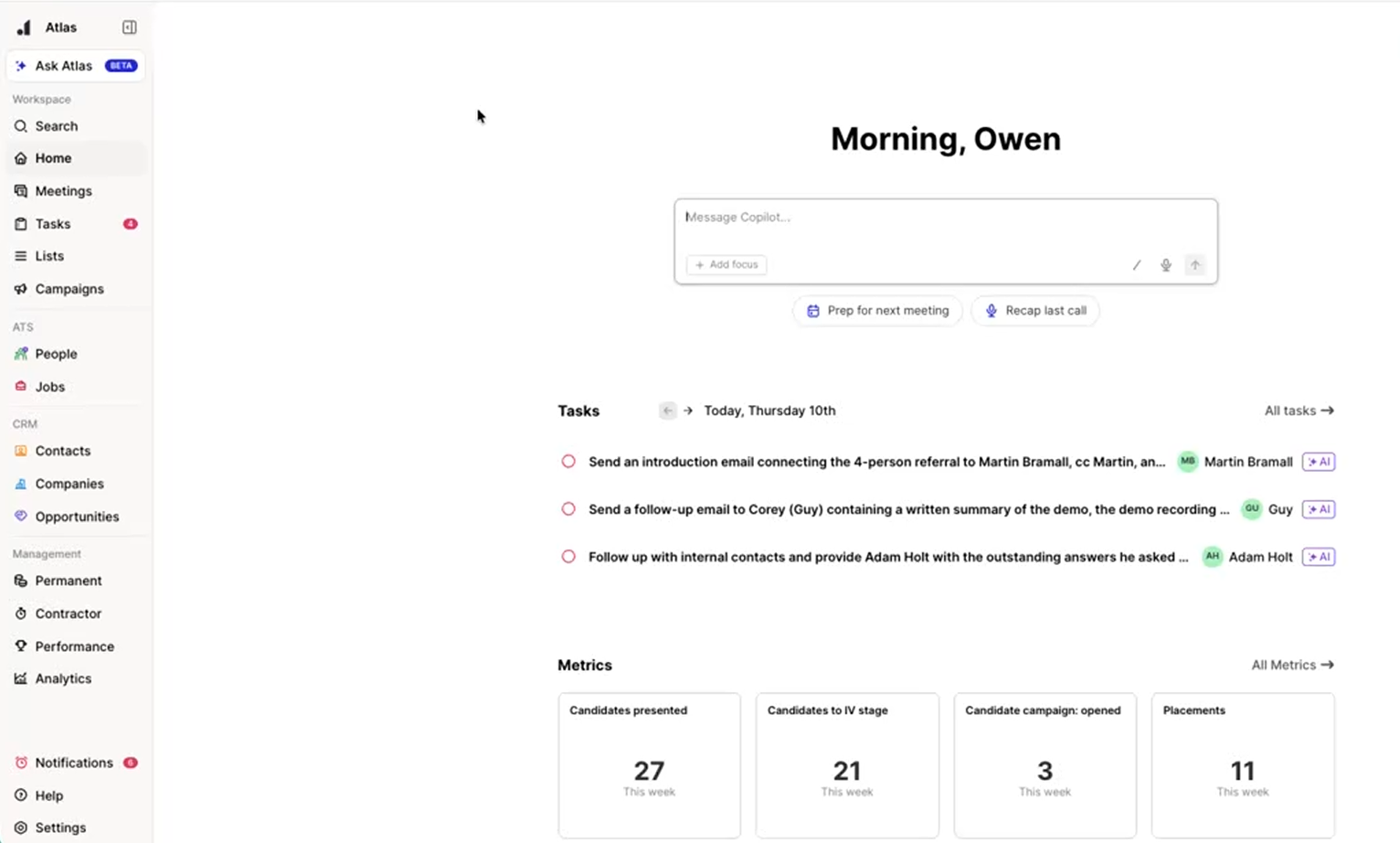
If your recruiting team has years of candidate relationships but struggles to find the useful information buried inside them, Atlas is an interesting way to bring that intelligence back to the surface. The platform automatically captures candidate interactions across email, LinkedIn, phone, and video, then makes that data searchable via Magic Search, while evidence-backed AI answers, automated follow-up tasks, and conversation-based candidate matching add even more ways to put those conversations to work.
Ratings
Ease of Use
Best For
Key Differentiator
Price
Free Trial
PROS
- Automatically records, tracks, and indexes candidate communications across multiple channels.
- Magic Search lets recruiters search candidate conversations using natural language.
- Atlas AI can answer questions about candidate experience, preferences, salary, and previous interactions.
- AI answers include supporting evidence so recruiters can verify information before presenting candidates.
- Video meetings can be automatically recorded, transcribed, and summarized using customizable templates.
- AI can turn commitments made during conversations into follow-up tasks.
- Candidate profiles can be enriched from conversations, LinkedIn, email, calls, and other sources.
- Customizable AI scoring criteria allow recruiters to define required, preferred, and nice-to-have qualifications.
CONS
- All subscription tiers typically require a 12-month contract, though monthly subscriptions are available in select cases.
- Its U.S. presence is somewhat new, with regional compliance and local support underway.

Need Help? Talk to an HR Software Advisor!
Tell us more about your company & an HR Software Advisor will help you find the right software





Atlas is built around an idea we were excited to see in action: recruiters already have valuable candidate information sitting inside their conversations, but much of it gets buried in emails, LinkedIn messages, call notes, and meeting recordings. What we liked most about Atlas is that it brings all of that information together and makes it searchable, rather than expecting recruiters to manually document every conversation.
Magic Search was the feature that really stood out to us. Instead of searching only for resume keywords or information stored in traditional candidate fields, recruiters can search for what candidates have actually discussed, such as salary expectations, career preferences, past experience, or what they want in their next role. We were particularly impressed by this because it gives recruiters a way to find relevant candidates based on information that might never make it onto a resume. If you have ever known a candidate would be a great fit but struggled to find them again because the important detail was buried in an old conversation, you can see why this is useful.
We also have to give Atlas credit for how it handles AI-generated answers. Recruiters can ask questions about a candidate in plain English, and Atlas searches the information it has indexed to provide an answer. What we loved most was that the platform also shows the evidence behind that answer, including whether the information came from an email, phone conversation, video call, InMail, or another source. That extra context matters. Rather than simply taking an AI answer at face value, recruiters can go back to the original conversation to verify the information is accurate before sharing it with a client or hiring manager.
The video and follow-up features were another pleasant surprise. Atlas can automatically record and transcribe candidate meetings, while customizable summary templates turn those conversations into structured notes for candidates or hiring managers. We particularly liked the way Atlas can identify commitments made during conversations and turn them into follow-up tasks, such as reminding a recruiter to contact a candidate after an interview. These are the kinds of features that directly address the minor administrative tasks that frequently accumulate in a recruiter’s workday.
Of course, Atlas is not yet as feature-rich as some of the more established recruiting CRMs. Founded in 2023 and entering the U.S. market in 2025, the platform is still developing the broader functionality you'll find in products such as Bullhorn. Its rapid development is exciting, but it also means buyers need to be comfortable with a product that is changing fast. During our review, support was available 24 hours a day, five days a week, although Atlas told us its U.S. business was still predominantly inbound-led and that it did not yet have employees on the ground in the country. For U.S.-focused recruiting teams, that relatively recent market entry is something we would keep in mind alongside Atlas' otherwise international positioning.

Recruit CRM

Recruit CRM

Hellora
Hellora

Humanly
Humanly

Spott
Spott

Gem
Gem
Atlas pricing starts at $125 per user per month, billed on a 12-month commitment. A free trial is available upon requesting a demo.
Atlas is best suited to recruiting teams that want AI-powered search across candidate conversations and a more complete view of candidate relationships. It may be particularly useful for teams looking to reduce manual CRM updates and quickly surface candidate insights from past interactions.
Company HQ
Number of Employees
Year Founded
Amount Raised
FAQ
About SSR

We spend hundreds of hours researching the best HR and recruiting software so you don’t have to. We never take money from vendors during our research phase and rely heavily on practitioners and experts to help us recommend the right software. However we may earn a small fee if you click on vendor links on this page.

