




Willo is still one of the easier one-way interview platforms to set up, but it has grown well beyond basic video screening. It now builds a scoring framework for each role from your existing hiring documents, then grades every candidate against it with evidence attached. That puts it closer to AI-assisted screening tools than the lightweight video tool we first reviewed.
Ratings
Ease of Use
Best For
Key Differentiator
Price
Free Trial
PROS
- Asynchronous screening that saves your recruiting team time while letting them see candidates beyond a resume
- Blueprint scoring ties every candidate score back to criteria you defined, with timestamped evidence from their answers
- Flexible question formats: video, audio, text, multiple choice, file upload and identity checks
- Strong candidate experience: 18+ languages, practice questions, device switching by QR code and 24/7 candidate support
- Broad ATS coverage on Enterprise, including Workday, SAP SuccessFactors, Oracle, iCIMS and Greenhouse
- Pay-as-you-go Lite plan means occasional hirers don't need an annual contract
CONS
- No free tier anymore, and the entry price is now per role rather than per user
- Lite caps you at 5 live roles and 5 users, and native ATS integrations, SSO and AI insights require Enterprise
- No real-time 1:1 video interviews; live conversations are scheduled through your own calendar tools
- No native mobile app, though the candidate experience works in any mobile browser
- AI scoring is only as good as the documents you feed it, so teams still need to review and adjust each Blueprint

Need Help? Talk to an HR Software Advisor!
Tell us more about your company & an HR Software Advisor will help you find the right software





Willo's screening platform is now built around one idea: define what good looks like for a role before candidates apply, then score everyone against that definition. Setup is still quick, but there's more to configure than in earlier versions, and the payoff grows with the number of candidates you screen.
Building the Blueprint
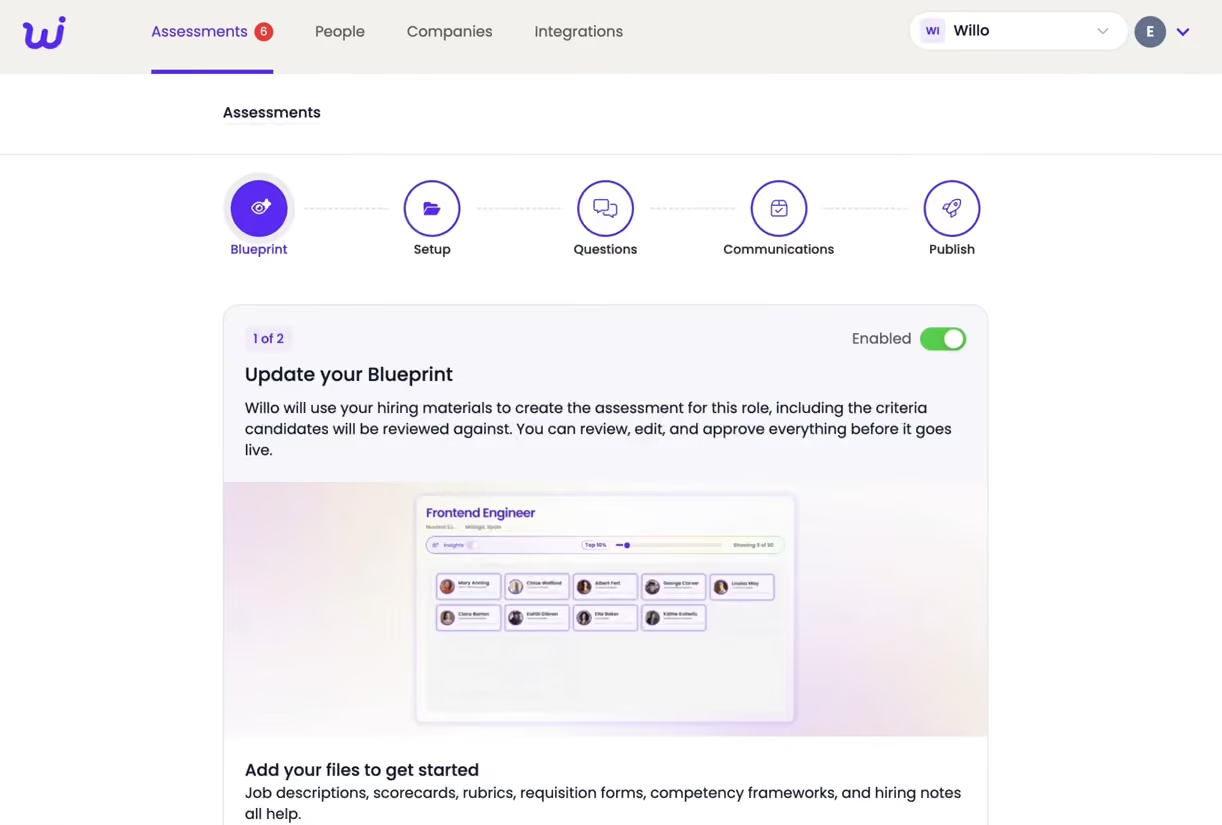
The first step for a new role is Willo's Blueprint feature. Your team uploads whatever material you already have for the role: a job description, a scorecard rubric, an email from the hiring manager, even an audio recording of a team member describing the job. Willo analyzes those files and drafts a Blueprint split into three parts: must-haves, differentiators and context.
You can edit the Blueprint before locking it in, and change it later. This matters, because every candidate's score downstream is based on it. Few teams write down structured role criteria today, so the real value here is forcing that conversation with hiring managers up front. Garbage in, garbage out still applies: a vague job description will produce a vague Blueprint.
Setting up the assessment
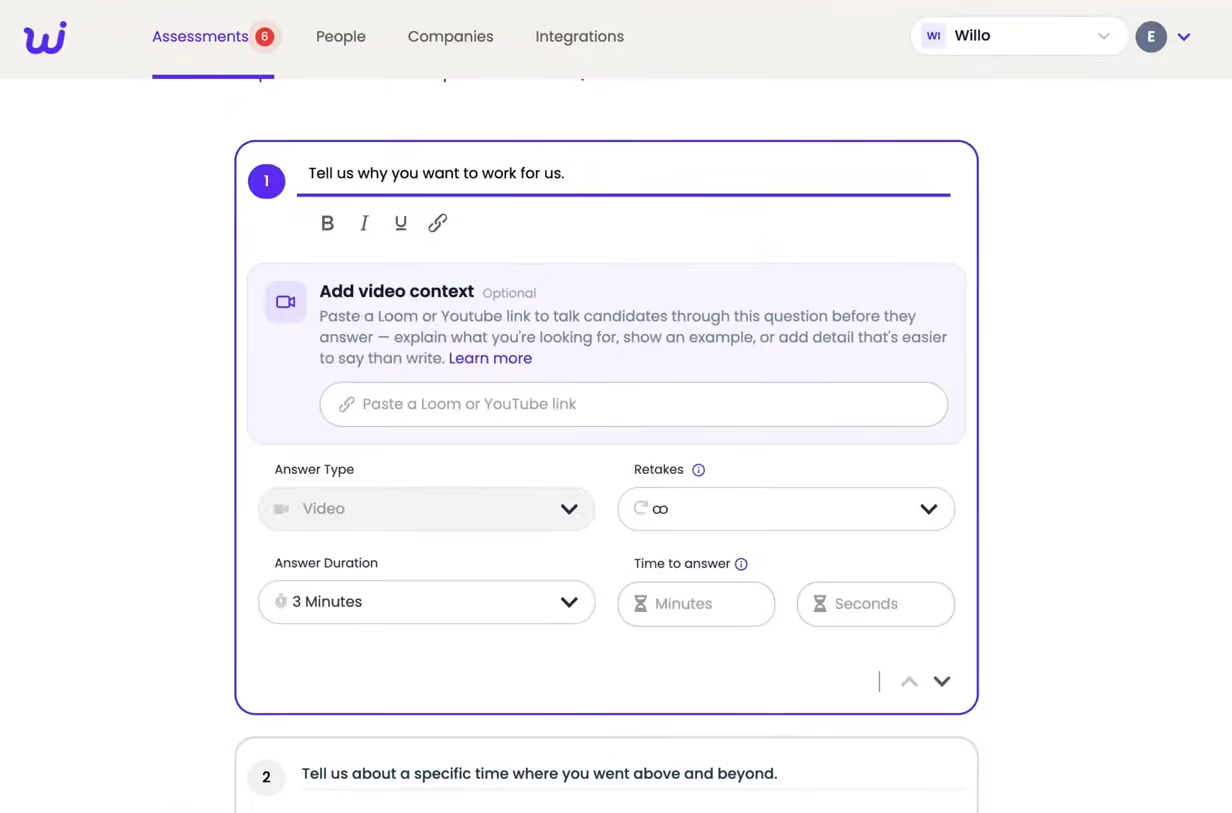
Next, you add an intro video and written instructions for candidates. Willo then suggests questions based on the Blueprint, which you can edit, replace or reword to fit your brand. You can also start from Willo's assessment library, which the vendor says covers 1,500+ roles and seniority levels.
Question formats include video, audio, text, multiple choice and file uploads, plus identity checks. For each question, admins set the number of retakes allowed, thinking time and maximum answer length. Email and SMS templates for every candidate touchpoint are fully editable, and you can share access with hiring managers before publishing.
Once published, there are several ways to invite candidates:
- Through your ATS, so moving a candidate to a set stage triggers an automatic email and SMS invite
- Directly from the Willo platform
- A shareable link you can post on LinkedIn, WhatsApp or Slack
- A printable QR code for career fairs, shop windows or office notice boards
The QR and link options are useful for frontline and retail hiring, where candidates often aren't coming through an ATS at all.
The candidate experience
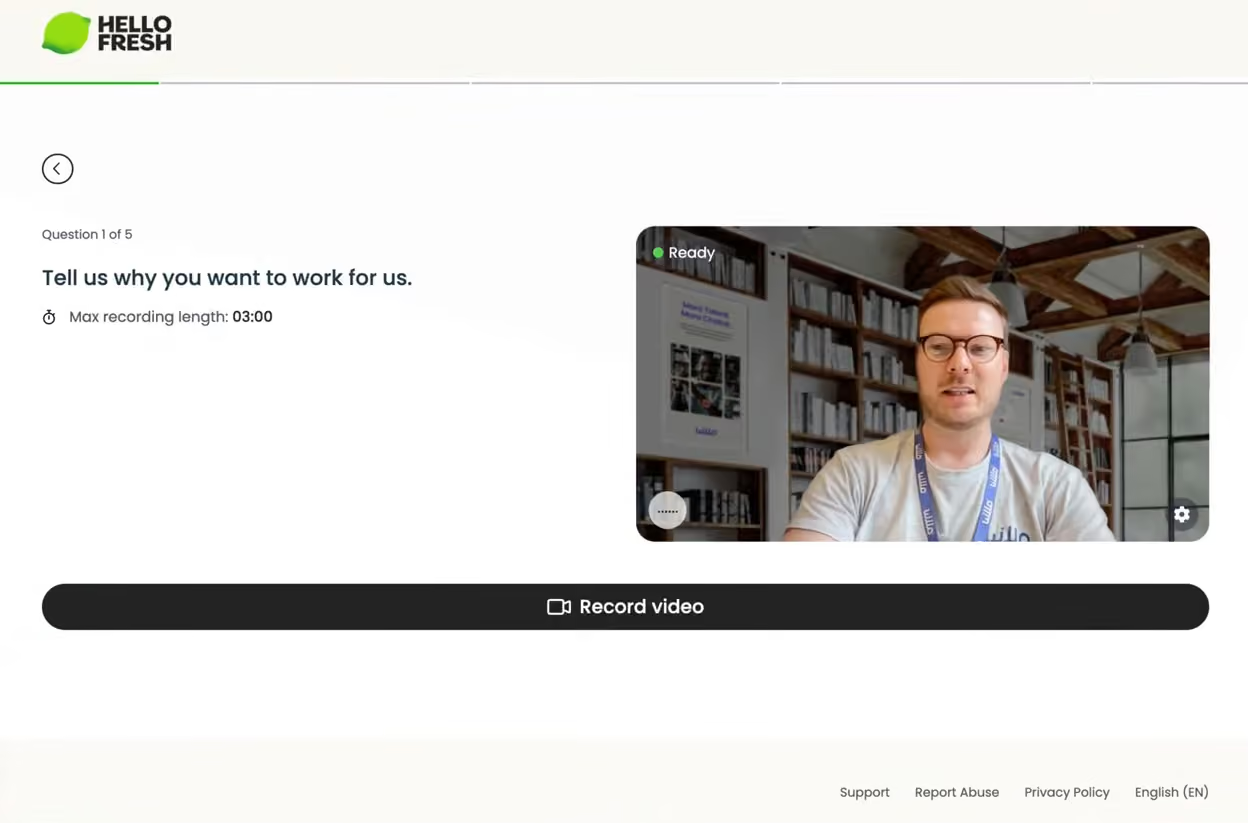
From the candidate's side, the assessment is branded with the employer's colors, logo and intro video, alongside information about the role and process. Candidates can choose from 18+ languages, and Willo defaults to the language of their browser.
Before starting, candidates land on a tips page with a practice question they can answer as many times as they like. Nothing on that question is saved. A support widget connects to 200+ help articles and an AI agent, with 24/7 human support behind it.
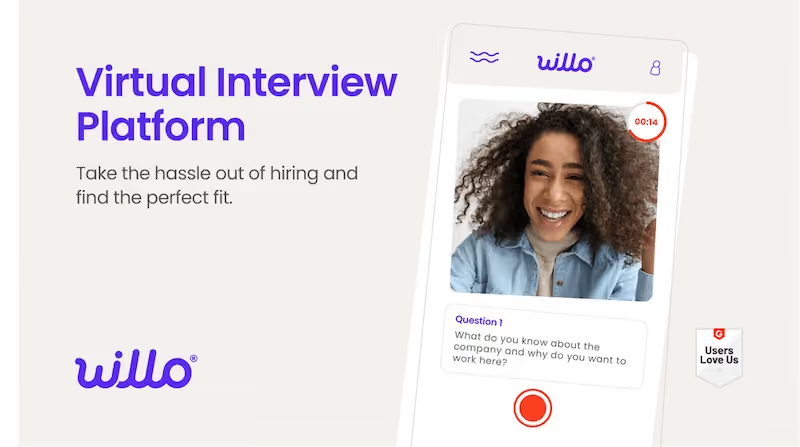
During the assessment, candidates see one question at a time with a visible time limit and an audible countdown before recording. If their laptop fails, they can scan a QR code and finish on their phone. Willo says the platform works in any browser, on low bandwidth, and is built to WCAG 2.1 accessibility standards.
At the end, candidates review all their answers before submitting, then share their availability for next steps. That availability syncs with Google, Microsoft, Apple and Yahoo calendars, which cuts some back-and-forth scheduling. Candidates get a confirmation page and email.
Reviewing candidates
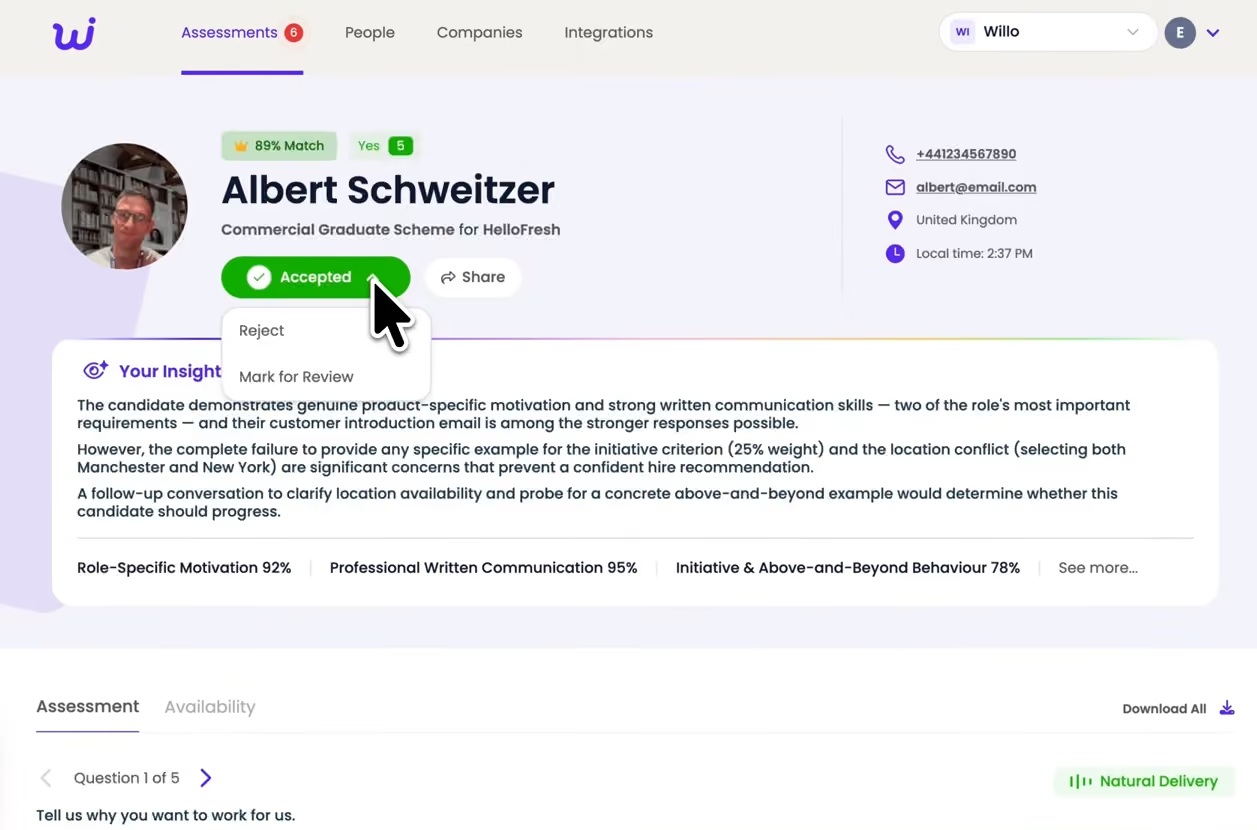
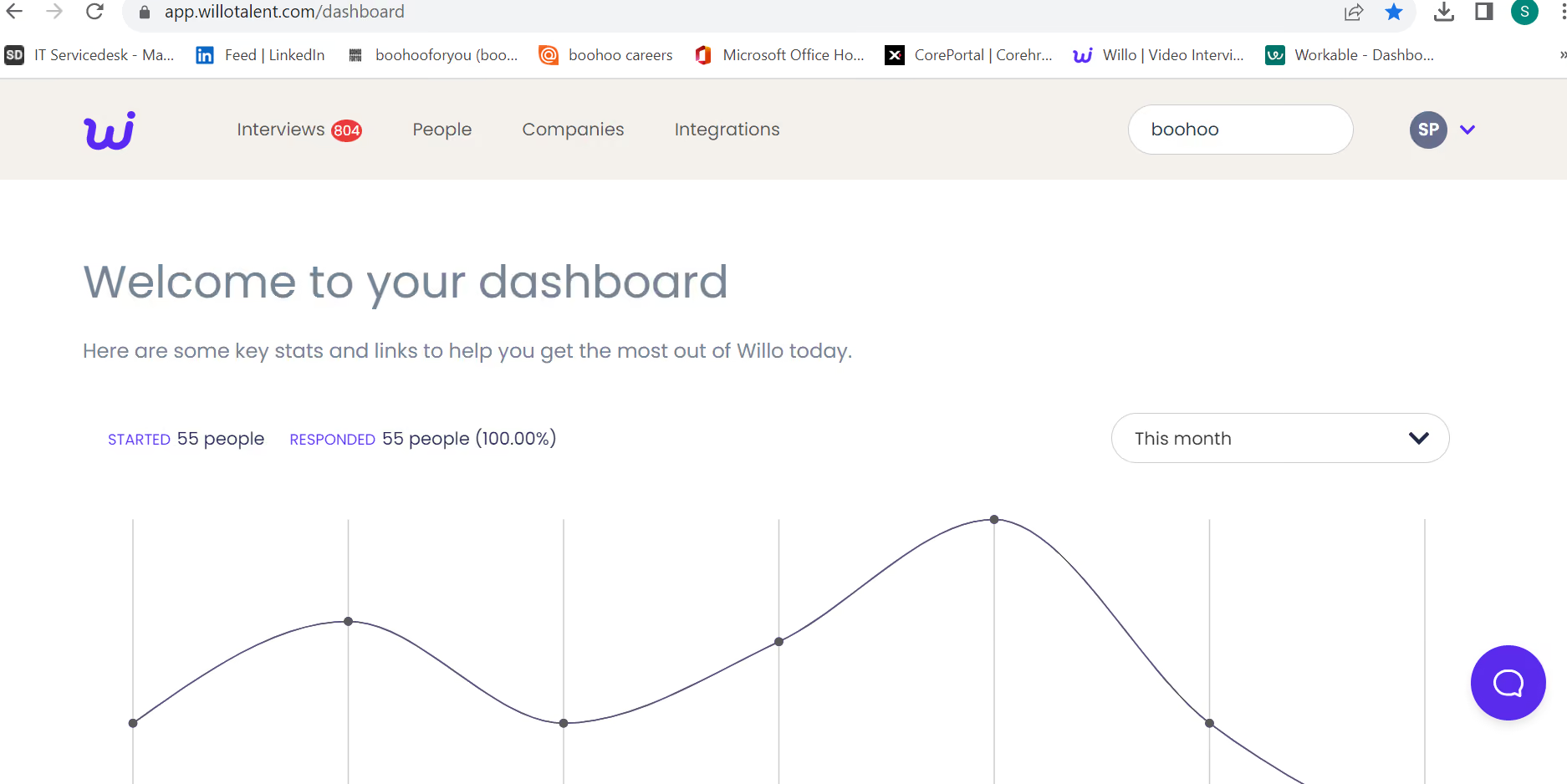
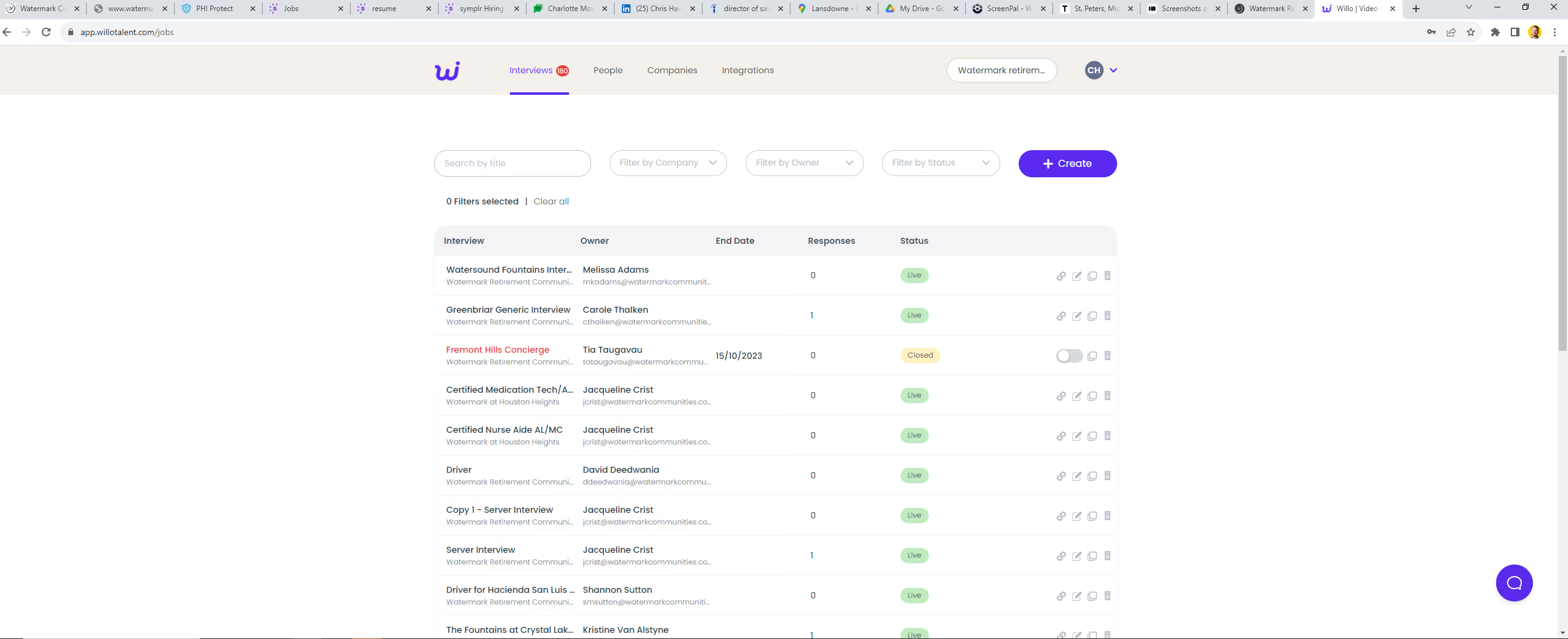
Back on the employer side, candidates appear in a list with a green, amber or red rating based on how well they match the Blueprint. Most teams will start with the greens.
Clicking into a candidate shows their score against each Blueprint criterion. Each score links to timestamped evidence from their answers, so reviewers can jump straight to the moment a candidate discussed a given skill instead of watching every video end to end. From there, reviewers can watch videos, leave comments for colleagues, complete a scorecard, and accept, reject or progress the candidate in the ATS. Every action is logged in an audit trail.
We like that Willo keeps the final decision with people rather than auto-rejecting candidates. That said, the RAG ratings will heavily shape who gets watched first. Teams should spot-check amber and red candidates periodically to make sure the Blueprint isn't filtering out people it shouldn't.
One metric still worth tracking with this tool, or any one-way interview product, is candidate completion rate. It depends on the role and where in the funnel you send the invite. Late-stage invites should approach 100% completion. Expect 20-30% if you invite every applicant as a first step, especially for lower-skilled roles.



We use Willo for Async interviews which thousands of applicants complete every month. We use the interview to confirm their identity and check their suitability and ability for the role. We then have a team of people who review the interview recordings. We also have used Willo to interview candidates for this team and conduct right-to-work checks. We will be moving our Right to Work checks for our Tutors onto Willo which will be great to free up operational resources.
- I really like that Willo is so easily adaptable to our needs. and we can update our interviews whenever we need.
- The Willo team has been super open to our suggestions and have added new features that we have requested.
- The platform is really reliable and we can rely on it to cope with our large volume of interviews and the recordings are of a really high quality.
We onboard thousands of Tutors each year and needed an effective way to conduct interviews for so many people. We previously did interviews on calls that were booked with a team of freelance interviewers. There were issues with applicants and interviewers not turning up and sometimes problems with tech issues. In these cases, candidates would need to rebook the interviews. There were also constraints with the availability of the interviewers which could cause bottlenecks in our onboarding flow. We wanted to move to async interviews to remove these problems and Willo was the best tool to do this. Using Willo has meant that our tutors have a much better experience when applying and giving them the ability to complete their interviews in their own time has improved our conversion rates significantly. We purchased Willo in Q1 of 2023. I have been working more closely with Willo since May of 2023.
- When there are tech issues that affect the interview it is hard to tell the reason for the tech issues without getting in touch.
- It would be great to get more insights on the main dashboard about the performance and conversion rates of the interviews. Here it would be great to see expected conversion versus actual conversion.
- I would love to be able to see information about how long applicants are spending on questions and how many retakes they are using.
I haven't tried or had any experience with their competitors.
Price per interview, the flexibility- how well will this tool fit in with your business needs. From our perspective, our applicants are also our customers so being able to create and update the interviews so easily was a must.
Willo has a great platform for requesting updates, improvements and new features. We have requested a lot of new features that have now been introduced. They are also currently working on implementing multiple-choice questions for us for example.
Organisations that are completing high volumes of interviews daily. Willo would be great for first-round interviews or quick ability checks like we use them for.
I think for users that are needing to demonstrate a technical skill in something like data or software engineering. If you need to ask follow-up questions to get clarification Willo is not the right tool- at least from my experience.

We use Willo as part of our interviewing process. Typically we set a Willo interview at the first stage, as part of screening candidates.
It's really user friendly and easy to roll out to multiple members of the team. It has saved the team so much time, not having to phone screen has made the process smoother for everyone involved. With the use of video interviewing it means our hiring managers can start to get move involved in the recruitment process and make it a much more collaborative experience. The Willo team are ALWAYS on hand for any issues or questions the team may have.
We brought Willo to help us manage high volume recruitment, specifically at an early careers level. We have used it for over a year.
This is a tough one as Willo is so user friendly there aren't many cons. I suppose for us as a business we would like to see how Willo can explore more options to be used at a more senior level. Would be nice if when you press reject or accept comms was sent to the candidate.
Willo is by far the best tool I have used for video interviewing, for me it's so easy to use (especially for someone not very tech savvy) and means I can include more of my hiring team with recruitment.
Think about what they actually need Willo to do, where are their biggest pain points and most time consuming tasks. For us as a business we were spending a lot of time phone screening which is how Willo came to reduce time spent and gave us so much time back to be able to improve other areas of the process.
Willo has become much more diverse, with different languages being added, as well as features such as recording without video and text answers. This makes it much more user friendly for those who don't always feel comfortable with video interviews.
Businesses with high volume recruitment, as well as those looking to add a personal touch to their recruitment process.
Maybe start up companies, where not as many people are aware of the company. I think for these companies it is easier for a recruiter to speak to the candidates directly about what the company is about and have an open dialogue.

We use it every day. We've put the Willo interview link in our automated thank you emails that go out to all our applicants. That way everyone gets the chance to record their interviews. We also send the interview links to applicants via text & email blast.
It speeds up the hiring process, minimizes ghosting and reviewing video interviews as opposed to resumes has proven to yield better hires.
We wanted to speed up the hiring process, give our applicants additional options/ways to interview and minimize the amount of ghosting that happened when scheduling interviews. It has helped in all 3 areas and we've been using it now for about 7 months.
The publishing section where Willo interviews are shared was not built well initially but they have since fixed it.
Easy of use, simplicity and customer service is great
Who you are recruiting for; what your main challenges are in your hiring process; do you have a recruiting problem or a retention problem?
They have fixed some bugs and made some updates.
Any and all.
I can't think of one.

VidCruiter

VidCruiter

Spark Hire
Spark Hire

Hireflix
Hireflix

Criteria
Criteria

BarRaiser
BarRaiser
Willo makes the most sense for teams hiring at volume. The value of asynchronous screening comes from saving time: if you replace 10 phone screens with 30 minutes of reviewing answers, you've saved hours. Multiply that across hundreds or thousands of hires a year and the savings are large. If you only hire a handful of people a year, the ROI is much harder to find.
The Lite plan softens this for occasional hirers, since you pay only for months with live roles. But Lite leaves out native ATS integrations, SSO and Willo's AI insights, which are much of what now sets the product apart. Small teams paying for Lite are mostly buying a solid one-way interview tool.
Willo also isn't the right fit if you need live 1:1 video interviews inside the same platform, or deep technical skills testing such as coding assessments. Its question formats suit communication, motivation and situational questions better than hands-on technical work.
Danone, NHS Scotland, 7 Eleven, Samsung, University of Pennsylvania
- Blueprint: Upload job descriptions, rubrics, hiring manager notes or audio, and Willo drafts role criteria (must-haves, differentiators, context) that every candidate is scored against.
- Evidence-based scoring: Each candidate score links to timestamped moments in their answers, with a green/amber/red summary in the candidate list.
- Willo Intelligence: AI tools for transcription, answer summaries, suggested follow-up questions and candidate insights. Most of this is listed under Enterprise.
- Question builder and library: AI-suggested questions from your Blueprint, plus a library of ready-made assessments. Formats include video, audio, text, multiple choice and file upload.
- Interview settings: Control retakes, thinking time, answer length and deadlines per question.
- Identity and right-to-work checks: ID, right-to-work and background checks run inside the assessment, using credits on Enterprise or as a paid add-on on Lite.
- Anti-cheat and employer verification: Willo Verified checks candidate identity, and Willo Proof is designed to show candidates that the employer is legitimate.
- Device transfer: Candidates can scan a QR code to move an in-progress assessment from laptop to phone.
- Multiple invite channels: ATS-triggered invites, email and SMS, shareable links and printable QR codes.
- Templates: Reusable templates for candidate emails, SMS and interview setups.
- Scheduling handoff: Candidates share availability at the end of the assessment, synced with Google, Microsoft, Apple and Yahoo calendars.
- Collaborative review: Comments, scorecards and accept/reject/progress actions, with an audit trail.
- Bulk invite: Upload candidates in bulk, invite individually, or add via the ATS.
- Lite customers only get Zapier and Integrately.
- Enterprise customers get 50+ native integrations, including enterprise systems that were missing in earlier versions: Workday, SAP SuccessFactors, Oracle, iCIMS, UKG and Avature. Mid-market ATS options include Greenhouse, Lever, Ashby, SmartRecruiters, Teamtailor, Workable, BambooHR, Pinpoint, Recruitee, JazzHR, Personio and Bullhorn.
- Open API is also available.
Willo has dropped its free tier and per-user plans. It now sells two plans.
- Willo Lite: $59 per live role/month. Up to 5 live roles, 150 assessed candidates per role, up to 5 users, Zapier and Integrately; ID and right-to-work checks as add-ons
- Willo Enterprise: From $3,799/yr (1-year), $3,419/yr (2-year), $3,229/yr (3-year). Annual contract, payable monthly or quarterly. Custom roles and users, Willo Intelligence, 50+ native ATS integrations, SSO, 12+ months data retention, ID check credits, dedicated customer success
Non-profits can apply for a 50% discount.
Willo is best for organizations screening large or repeatable volumes of candidates, especially across multiple teams, sites or hiring managers. Graduate programs, retail, hospitality, healthcare and other frontline hiring are natural fits, as the customer list reflects.
The Blueprint approach is most valuable where consistency matters: many reviewers assessing similar roles, or regulated environments that need an audit trail for screening decisions. Smaller companies that hire a few roles a year can still use Lite, but will get less of the value that sets Willo apart.
Willo is moving upmarket toward larger, high-volume employers. That brings more depth, but the low-cost entry point that defined the product early on is less generous than it was.
- AI-assisted evaluation: Blueprint and Willo Intelligence add role criteria, scoring, transcription and summaries, while leaving the hiring decision with reviewers.
- More question types: Audio, text, multiple choice, file upload and identity checks now sit alongside video.
- Enterprise integrations: Native integrations grew from a handful of ATS's to 50+, including Workday, SAP SuccessFactors and Oracle.
- Trust and compliance: ISO 27001 certification, SSO and MFA, plus identity, right-to-work and background checks.
- New pricing model: The free tier and per-user tiers were replaced by pay-per-role Lite and annual Enterprise contracts.
Smaller teams on Lite can sign up and send their first interview links the same day. Enterprise rollouts take longer. Expect time for building Blueprints for each role family, connecting your ATS, setting up SSO, customizing communication templates and training hiring managers on reviewing candidates.
Enterprise plans include an onboarding call and department-level onboarding. Budget time for hiring managers to review and sign off on each Blueprint before going live, since the quality of the scoring depends on it.
Willo offers 24/7 support for both candidates and customers, combining a help center of 200+ articles, an AI support agent and human support staff. Enterprise customers also get priority support, quarterly business reviews and a dedicated customer success manager.
Willo was started by Euan Cameron, who had been on both sides of the interview process and found it stressful. He was also constantly hiring as part of his roles at various startups.
He wanted to find junior people with high potential but found it hard to judge potential from a resume alone. He also saw that many candidates lacked transport to an interview or a suit to wear, which made in-person interviews somewhat discriminatory.
Euan started asking candidates to record a few answers on video to supplement their resumes, and saw how much more he learned. He also noticed that existing platforms were too expensive for smaller companies. So, he started Willo.
Company HQ
Glasgow, Scotland
Number of Employees
11-50 employees
Year Founded
2018
Amount Raised
$4 million
FAQ
About SSR

We spend hundreds of hours researching the best HR and recruiting software so you don’t have to. We never take money from vendors during our research phase and rely heavily on practitioners and experts to help us recommend the right software. However we may earn a small fee if you click on vendor links on this page.

