



Unlike most competitors, who emphasize micro-recognition or focus on surveys, Kudos finds a middle ground: blending recognition, points-based rewards, and cultural insights into one ecosystem. In our most recent testing, this balance made Kudos feel both motivational for employees and genuinely useful for HR teams trying to measure and influence engagement.
Ratings
Ease of Use
Best For
Key Differentiator
Price
Free Trial
PROS
- Recognition messages can include redeemable points, making appreciation both meaningful and actionable.
- Admins can offer gift cards, merchandise, experiences, donations, or company swag tailored by location, team, or budget.
- Combines data on morale, recognition, churn, and loyalty into a digestible culture score.
- Pulse Surveys automatically generate executive summaries, saving HR time and improving visibility.
- SOC 2 Type II and ISO 27001 certifications make Kudos viable for enterprise buyers.
- The platform is available in 11+ languages with regional reward options.
CONS
- No free trial or sandbox, so buyers must book a demo to access the platform.
- Average app store ratings of 3.2/5 and hasn’t been updated since mid-2024.
- Requires upfront configuration, making it not ideal for teams without internal admin capacity.
- If employees don’t use the recognition system regularly, culture insights lose depth.

Need Help? Talk to an HR Software Advisor!
Tell us more about your company & an HR Software Advisor will help you find the right software





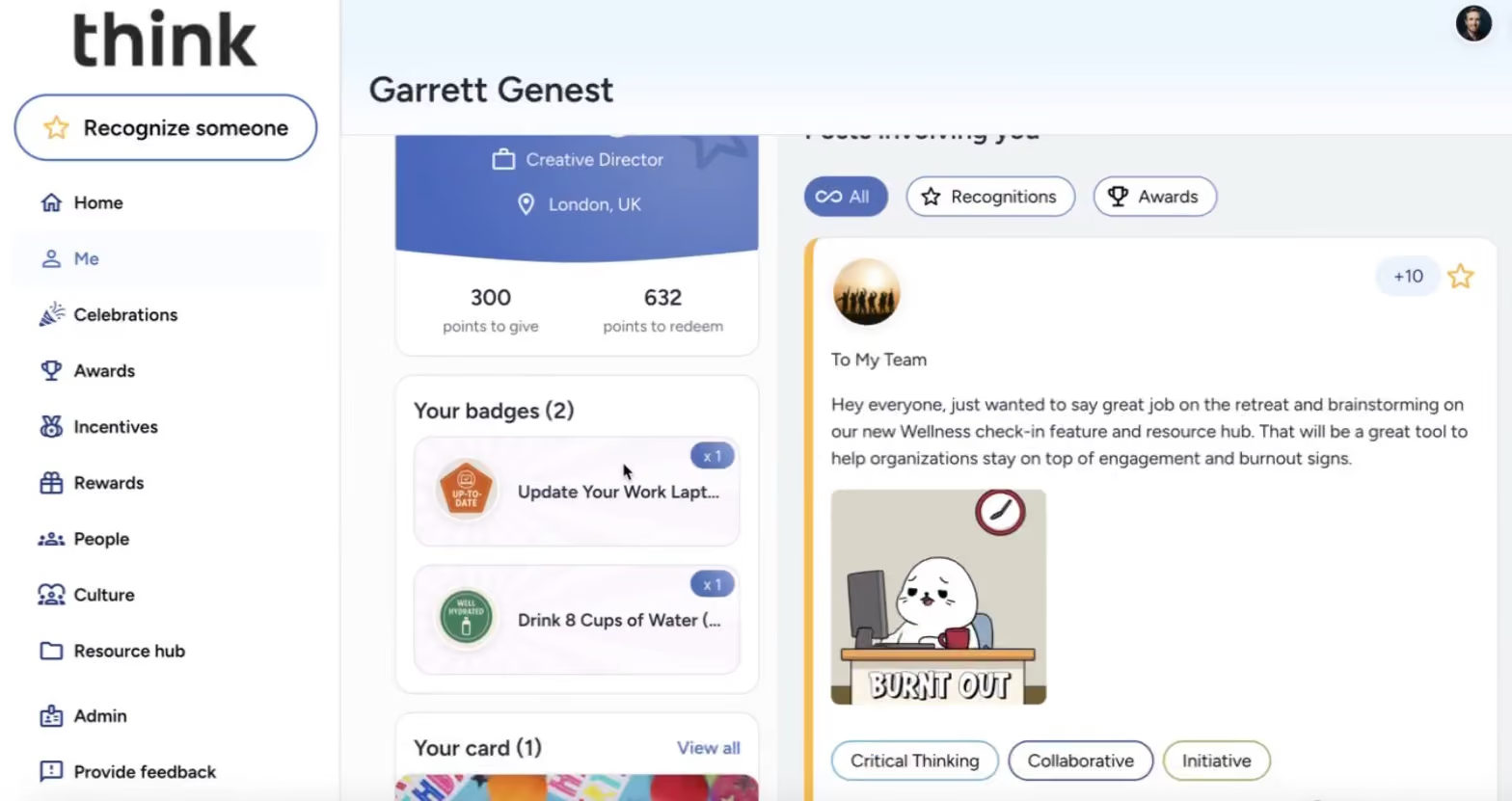
Kudos describes itself as a platform that brings recognition, rewards, and engagement tools together under one roof, and based on the most recent demo we’ve had with the vendor, that’s a fair claim. Recognition lives at the center of the experience. Shoutouts from peers, milestone messages, and manager praise all show up in a shared feed where each message can carry points, GIFs, or Kudos-branded eCards. That visibility helps shift recognition from being occasional to expected.
The rewards side is where Kudos tries to set itself apart. When someone gets recognized with points, they can redeem those through a built-in storefront. We were shown how admins can create separate catalogs for different teams or locations, each with a tailored mix of digital gift cards, branded swag, or even local experiences. Everything from point conversion rates to approval rules is configurable. For HR teams juggling multiple programs, that kind of control matters.
The engagement tools came across as quietly effective. The Sentiment Survey pops up once a month when users log in, offering a lightweight emoji-based mood check. For deeper feedback, the Pulse Surveys support standard formats like eNPS and Likert scales. Results are aggregated in a dashboard that tracks loyalty, morale, and churn indicators over time. One feature we didn’t expect but appreciated was the AI-generated Executive Summary, which condenses survey responses into a readable PDF for leadership. We didn’t test that directly, but it was shown during the demo and looked thoughtfully executed.
That said, Kudos doesn’t offer a free trial or self-guided version. At $3.25 per user per month, pricing is reasonable for larger companies, but there’s a minimum employee count of 500. This makes it a better fit for midsize and enterprise organizations with the resources to manage a full rollout.
While Kudos gives admins a high level of control, that also means the initial configuration takes effort. We verified during testing that the setup involves defining reward structures, budgets, automation rules, and survey thresholds. Consequently, teams without dedicated HR admins may find the process a bit overwhelming without support. To be fair, though, the vendor does offer onboarding and guidance, which most users said they relied on to get up and running smoothly.
We also noticed that Kudos’ mobile apps have not been updated since mid-2024 and currently hold a pretty low rating. Lastly, while Kudos offers robust rewards options, it’s built around a points-based system, which may not favor teams seeking a more experience-driven, non-monetary recognition style.



As the HR leader, Kudos is used by my team every day. We monitor the program, ensuring rewards are given fairly, gather feedback from employees, and ensure the system is working appropriately. We monitor the budget and work with senior leaders to get funds, ensuring rewards are available to "cash in" when points are awarded.
We make sure the ADP integration is working so all employees, at the time of onboarding, have the opportunity to participate in Kudos. We are always reviewing the program to determine if it's a best fit for our company.
Kudos’ integration with ADP, our HRIS, is critical. Once an employee is onboarded, they automatically will have access to Kudos, saving time for my team.
I love the feature of publicly praising employees. Employees can provide feedback for the rest of the organization to see when their colleagues have gone above and beyond. When a new post is published, everyone can see and celebrate them.
The option to redeem points for gifts is motivating to employees, and it's very easy to do.
My organization bought Kudos through our PEO relationship with ADP. It's an offering we chose to turn on for employees. It was meant to allow us an opportunity to reward employees publicly to increase morale and retention. We have used it for 3 years.
Employees often complain about the ways they can redeem their points. They would like more options but we cannot change that.
Additionally, when employees are ready to redeem, it can take 5-7 business days to receive their reward, which is frustrating for employees. As the HR team, we are unable to implement improvements on these items because it's controlled through Kudos and ADP.
I don't know if this is Kudos specific, but there is a lot of manual work on my team to check reviews to ensure fairness in how points are awarded so people are giving them out based on performance and not friendships.
My former company built an app in house that had similar functionality. It was designed to work on a mobile device first, so much less cumbersome than Kudos.
It also had a "shoutout" feature so you could alert the employee's manager to the feedback, which was nice.
Instead of redeeming the gifts in the platform, the HR team gave out gift cards at the end of each quarter. People liked this a lot and it was logistically easy.
You need to ensure there are controls in place to ensure equity. It takes a lot of time and effort to monitor the program so you need dedicated resources.
I would also consider if it's worth it to pay the per person cost or just use those funds towards rewards that you can give out to star players at the end of each quarter.
The real feature of Kudos is the public praise. You could replicate that in a shared communication platform like Slack or Teams and do the manual rewards.
In my experience so far, I haven't seen any evolution. Kudos has rolled out minor platform design changes but nothing notable.
Kudos is good for a very large organization with resources to manage and a large budget
A small company may not need Kudos.

Kudos is used for leaders to recognize and reward employees. It is also used for peer-to-peer recognition and for employees to nominate one another for awards.
I like the peer-to-peer recognition option, as well as the years of service feature that allows you to easily retrieve and recognize employees for their years of service.
The rewards option is also great because it gives you access to many types of rewards to select from when recognizing employees.
The company chose the Kudos HRIS for our recognition program to streamline employee recognition and ensure fair and consistent processes for employees. Kudos was also chosen because it pairs well with Slack, our instant messaging system.
The program operates with Slack and not multiple systems. The recognition and rewards options cannot be customized, and although there are many rewards options, they are still limited.
There are no automated options, as everything is manual, which can be time consuming.
Kudos is different because it works with instant messaging programs, is user friendly, and is easy to navigate. It also provides analytical options that are easy to understand and explain.
They should think about the employee access level, as well as its limitations when it comes to rewards options. They should also consider the pairing limitations and the fact that the program is manual.
Not all employees actively use the instant messaging option, as some find it distracting. The program can be time consuming when wanting to share with large audiences.
It has changed by providing data analytics and by increasing the volume of users it allows. It also offers quick and easy real time recognition via instant messaging.
Kudos is good for every user and large organizations where employees are not easily accessible to one another.
Kudos would not be a good fit for small organizations with fewer than 1,000 employees, as the cost would not be effective.

I used Kudos for a medium sized, retail business which was remote-first across the eastern US. I implemented the program and got it started for the client since they didn't have time to invest, hence the reason they hired me as a consultant.
I used the dashboard to set up their admin and user accounts, recognition categories, point values, and campaigns. It is very intuitive if you are even halfway tech savvy, so I wouldn't be scared of trying it out.
Once we decided on the campaigns, what we wanted to specifically recognize such as birthdays, work anniversaries, and holidays, and our goals, I imported the employee demographics and was able to get our first campaign out within a day.
I turned it over to their marketing assistant to manage from there after I left.
The ease of use to recognize on the spot is a major plus. Even with a company of around 220 employees, remembering to send flowers or a card gets to be a lot. The cost-benefit is also strong; for the standard platform, we paid around $3 per month per employee, which is minimal when you factor in the administrative burden of figuring out how to recognize employees.
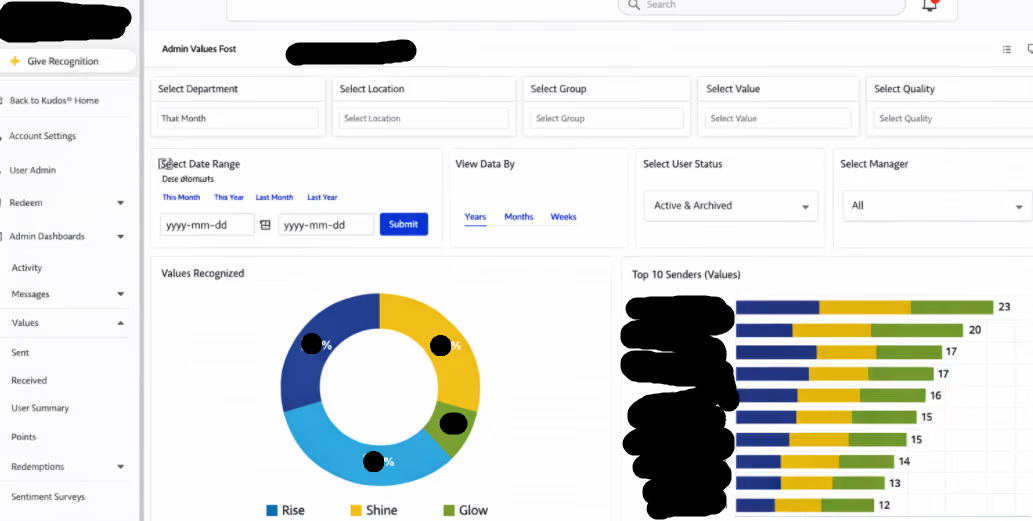
The analytics were also appreciated, with a real-time dashboard showing how each campaign was performing, who was opening their gift, who wasn't, and how much the program was costing.
As a consultant, I worked with a client late last year to review their rewards and recognition program. The problem was that they were remote-first and getting together for a birthday party or group lunch was not an option, considering they were spread out across the entire eastern time zone.
They tried sending e-cards and hosting virtual happy hours but their reviews were in the tank. Their employees told leaders in their engagement survey that recognition and appreciation were not enough.
After a review of a variety of platforms, we settled on Kudos for a few reasons: ease of use, on-the-spot recognition capabilities, analytics, and pricing. It was easy to set up and quick to implement. I reached out to the company a few weeks ago and so far, it is going well.
It would be nice for the standard plan to include more features. Since we stayed on the standard plan, we didn't have as much customization as we'd like, though it did solve our problem of low administrative burden for on-the-spot recognition.
The implementation cost also seemed a bit unnecessary for a company our size, as we could have figured it out without the training.
It is a great platform for small and mid-sized businesses who need to scale employee recognition in a remote-first environment. The upfront pricing for the standard plan was also appreciated, as we didn't need to go back and forth just to get a basic idea of cost.
Overall, it is easy to use and doesn't require an IT background to get started.
Budget is key. There is not only the cost for the points and rewards, but also the cost to use the platform. A small few dollars per month may seem minor, but a company needs to budget for it.
Since this was roughly 6 months ago from implementation, I can't say how it has evolved over time.
Kudos is great for small businesses and remote companies.
Kudos is not good for those with a very small budget, as you need to factor in not only the cost of the reward itself, but also the price of the platform.
Awardco

Awardco

Motivosity
Motivosity
C.A. Short Company
C.A. Short Company

Bonusly
Bonusly

WorkTango
WorkTango
Kudos isn’t ideal for small teams looking for a quick, self‑service recognition app or companies that want a full HR suite with performance reviews and compensation management built in. If you’re under 200 employees or prefer a lightweight, budget-friendly option, Kudos may feel like overkill.
ATCO, DHL Express, Bulgari, Arch Insurance, KidsPeace, Make-A-Wish
- Recognition Wall: Public, values‑aligned feed for peer‑to‑peer and manager recognition
- Points‑Based Rewards: Configurable reward points with automated allocations and anti‑gaming controls
- Multi‑Catalog Rewards Storefronts: Supports gift cards, merchandise, experiences, and donations
- E‑Cards and Celebrations: Automated cards for birthdays, anniversaries, and onboarding
- Nomination & Incentive Programs: Build campaigns for awards and challenges with proof‑of‑completion options
- Sentiment Survey: Monthly emoji‑based pulse of morale with trend tracking
- Pulse Surveys: Customizable eNPS and engagement surveys with AI‑summarized analytics
- Culture Insights Dashboard: Centralized culture index combining recognition, morale, churn, and loyalty data
- Kudos TV: Broadcast recognition messages across physical screens (ideal for deskless workers)
- Security Certifications: SOC 2 Type II and ISO 27001
- Integrations: 80+ HRIS connections via Merge API
- AI Recognition Assistant: Helps refine recognition messages for tone and clarity
- Chat & Collaboration: Microsoft Teams, Outlook, SharePoint, Skype, and Slack
- SSO: ADP, Azure AD, Okta, LinkedIn, and many more
- User Provisioning: ADP, BambooHR, Workday, Paylocity, and more
- Browser Extensions: Brave, Microsoft Edge, Chrome, Firefox
- For everything else, they have the Kudos API, and you can even request new integrations through their chatbot.
Kudos starts at $3.25 per user per month for a minimum of 500 employees. Actual pricing will vary depending on the number of users and contract length.
Kudos is a cloud-based platform that integrates with many other existing business software solutions, including Microsoft Teams, Microsoft Outlook, Slack, and more. Implementation services are provided by Kudos® to ensure a smooth technical setup and effective business adoption.
Kudos provides structured onboarding, live admin training, and quarterly success reviews to help teams configure programs and drive adoption. Dedicated customer success managers assist with setup, reporting, and internal rollout.
Kudos®, Inc are the makers of the platform that bears the same name. It is a SaaS solution for employee engagement and workplace culture management. Since their inception in 2010, they’ve been leveraging the perks of social software and to help strengthen people’s relationship to their workplace. By extension, improving the company culture.
Company HQ
Calgary, Alberta
Number of Employees
50-200
Year Founded
2010
Amount Raised
FAQ
About SSR

We spend hundreds of hours researching the best HR and recruiting software so you don’t have to. We never take money from vendors during our research phase and rely heavily on practitioners and experts to help us recommend the right software. However we may earn a small fee if you click on vendor links on this page.

