


Hellora stands out among recruiting CRMs because it's built specifically for healthcare—a sector facing acute talent shortages where recruiters are trapped in expensive job boards and drowning in unsearchable candidate databases. Rather than chase every industry like competitors do, the team focused on solving healthcare's actual problems using domain-specific data (licensing databases, EMR systems) that generic CRMs can't access.
Ratings
Ease of Use
Best For
Key Differentiator
Price
Free Trial
PROS
- Designed specifically for healthcare hiring with training on clinical roles, licenses, and workflows that general-purpose CRMs lack.
- Semantic search finds candidates in existing ATS databases beyond keyword matching.
- Automatically updates candidate profiles using healthcare licensing databases and data shared across the Hellora Healthcare Network.
- Outreach from recruiters' existing email accounts (Outlook/Gmail) rather than separate recruiting domains.
- Shows reasoning for candidate recommendations instead of opaque scoring, allowing recruiters to evaluate suggestions.
- Includes employee referral workflows with text-based submissions, SMS campaigns by department, and automated reward adjustments.
CONS
- Limited to U.S. healthcare, restricting use for multi-industry or international recruiting.
- Conversation history and meeting tracking still developing, with no native calendar integration yet.
- Pricing requires direct negotiation rather than published per-unit rates, making budget forecasting difficult.

Need Help? Talk to an HR Software Advisor!
Tell us more about your company & an HR Software Advisor will help you find the right software





We found Hellora to be a thoughtfully designed recruiting CRM that takes the opposite approach of most platforms in the space. Rather than build yet another one-size-fits-all solution, the team deliberately narrowed their focus to U.S. healthcare—a specific market we think deserves that attention. Healthcare recruiters face a genuine problem: most already manage 600k-2M candidates buried in legacy systems, but those databases are virtually unusable due to messy, unstructured data scattered across spreadsheets, emails, and free-form fields.
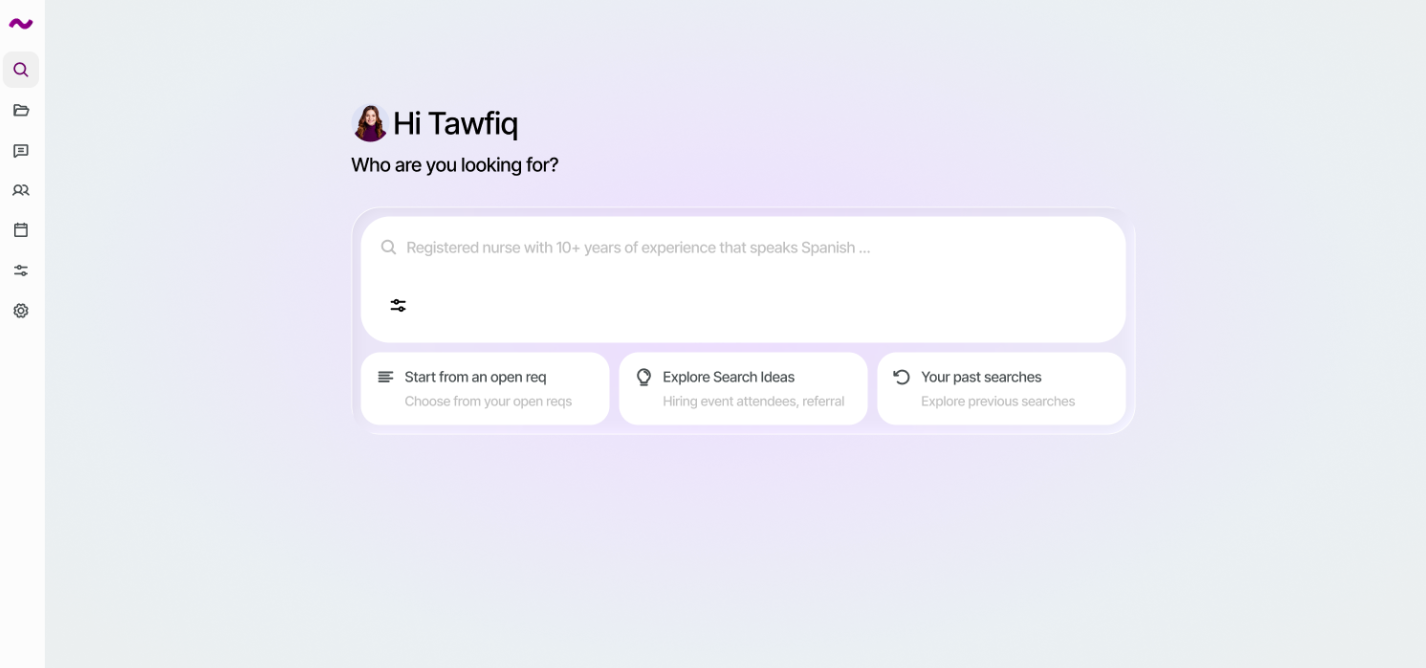
The platform's standout capability is transforming these "dead" candidate databases into active talent pools. Hellora solves this with Eve, an AI agent that uses vector search to identify conceptual matches. In practice, this means it can infer that a "charge nurse" role indicates leadership experience, or that employment at a known EPIC-using hospital suggests EMR proficiency. We found this approach valuable because it surfaces candidates who might not appear in traditional keyword searches. The platform also explains why each candidate matched a query rather than simply returning a ranked list, which forces recruiters to think critically about recommendations rather than accepting AI results uncritically.
This transparency extends into how Hellora maintains those candidate profiles. To help address profile staleness, the platform uses continuous enrichment: Eve pulls updates from public state and federal license databases and monitors the Hellora Healthcare Network (a shared pool where candidates who apply to one Hellora client can update their profile across relevant clients with permission). This is a practical feature for organizations managing large databases, though the value depends on how many of your candidates are also in the Hellora network. Organizations with unique candidate pools outside this network will see less benefit from network-based enrichment.
Once candidates are surfaced and profiles are current, Hellora generates email and SMS campaigns with personalized messaging. Eve creates initial drafts based on templates that recruiters customize with AI prompts (e.g., "mention the last hiring event this candidate attended"). All messages are reviewed and edited by humans before sending; the system does not auto-send, as it should not. The platform reports that customers achieve 33-50% response rates with AI-assisted outreach compared to <1% from traditional outreach. While response rates vary significantly by candidate pool, industry, and outreach quality, these figures sound plausibly promising. Plus, we observed that the system sends outreach from recruiters' existing Outlook or Gmail accounts rather than from dedicated recruiting domains. This approach may improve deliverability and feel more personalized to recipients.
Hellora also maintains equally robust employee referral capabilities alongside the CRM. Employees can submit referrals via text message without needing to download an app or log into email. Recruiting teams can send targeted SMS campaigns to specific departments or locations. Eve automatically identifies referrals submitted through external application channels and deduplicates candidate records (matching variations like "Bob" and "Robert"). These features reduce administrative overhead compared to manual referral tracking, though the quantified impact depends on your baseline referral volume and current tracking process.
Hellora's healthcare-focused design is both a strength and a limitation. It allows the product to leverage healthcare-specific data sources (licensing databases, EMR systems) that generic CRMs cannot access. But this specialization means the platform won't serve organizations hiring across multiple industries or geographies.
We also notice that several capabilities are still maturing or absent: native interview scheduling is not available, candidate profiles don't consolidate interaction data from phone calls or Zoom meetings, and ongoing relationship management relies primarily on outreach campaigns rather than conversation history. Thankfully, the vendor confirmed these features are on the roadmap.

Hellora

Hellora

ERIN
ERIN

Basile by HelloWork
Basile by HelloWork

EmployeeReferrals.com
EmployeeReferrals.com

Humanly
Humanly
Hellora serves leading U.S. healthcare organizations, including:
- Fairview Health Services (56,000 employees)
- BrightSpring Health Services (55,000 employees)
- BJC Healthcare (35,000 employees)
- Saint Luke's Health System (35,000 employees)
- Semantic candidate search — Finds qualified candidates in existing databases through conceptual matching rather than keyword-only filtering
- Continuous profile enrichment — Automatically updates candidate data from public licensing databases and the Hellora Healthcare Network
- AI-generated outreach — Eve creates personalized email and SMS campaigns with recruiter review before sending
- Unified inbox — Consolidates candidate replies from email and SMS in one interface
- Text-based employee referrals — Employees can submit referrals via SMS without app downloads or logins
- Department-targeted SMS campaigns — Recruiting teams can send referral campaigns to specific teams or locations
- Automated referral capture — Eve identifies referrals submitted through external application channels and deduplicates candidates
- Hiring event management — Employees can refer candidates to hiring events with automatic reward adjustments
Pricing ranges from $12,000 to $150,000 per year, depending on the organization's size. Pricing is custom and requires direct negotiation. Implementation typically takes 6–8 weeks including kick-off, integration, and launch planning. Pre-built integrations with major ATS and HRIS platforms eliminate technical work for customers.
Free trials are not offered. Pilots may be available for qualifying organization sizes.
U.S.-based healthcare organizations with 2,000+ employees that manage substantial candidate databases and want to reduce job board spending and systematize candidate re-engagement. The healthcare specialization appears justified by access to domain-specific data. Organizations hiring across industries or internationally will likely find the narrow scope limiting.
Hellora originated as Eqo, an employee referral platform focused on text-based referral submissions. Over the past two years, the platform expanded into recruiting CRM functionality as the team identified broader demand for candidate re-engagement in healthcare. The product's evolution accelerated with the introduction of Eve, an AI system designed to reduce manual work in candidate search and outreach.
Eve now handles tasks that previously required significant administrative effort: ingesting unstructured candidate data, deduplicating profiles, capturing referrals from external sources, and generating outreach messages. The vendor describes Eve as functioning like a full-time employee, though this characterization reflects reduction in manual tasks rather than an independent measure of productivity impact.
Company HQ
Number of Employees
Year Founded
Amount Raised
FAQ
Who is Hellora built for?
U.S. healthcare organizations with 2,000+ employees. The platform is optimized for healthcare-specific hiring workflows and is not designed for multi-industry or international recruiting.
Does Hellora support employee referrals?
Yes. Employee referrals are built into the platform. Employees submit referrals via text without needing apps or email logins. Recruiting teams can send SMS campaigns to specific departments or locations, and Eve captures referrals submitted through external application channels and removes duplicate entries.
What integrations does Hellora offer?
Hellora has pre-built 16 integrations with major ATS and HRIS platforms as of this writing, requiring no technical setup from your team.
How does Eve work?
Eve processes unstructured candidate data (resumes, emails, event logs, previous applications) to build searchable profiles. It uses semantic search to match candidates conceptually, enriches profiles using licensing databases, generates outreach messages based on recruiter-provided templates, and drafts candidate replies. All AI-generated messages are reviewed by recruiters before sending.
How long is implementation?
Implementation spans 6-8 weeks and covers kick-off, integration, and launch planning. Pre-built integrations eliminate technical work from your team.
Do you offer a free trial?
No. Pilots may be available for certain organization sizes. Contact the vendor to discuss.
What does Hellora cost?
Custom pricing ranging from $12,000 to $150,000 per year depending on organization size. You'll need to contact the vendor for a specific quote.
Can Hellora reduce job board costs?
Hellora is designed to reduce reliance on expensive job boards by helping recruiters re-engage candidates in existing databases and boost employee referrals. The actual savings depend on your current job board spending and referral volume. We did not independently verify cost reduction claims.
What support is included?
Every customer receives a dedicated account manager. Self-service resources include FAQs, product documentation, and video tutorials.
Is Hellora available outside the U.S.?
No. The platform is built for U.S. healthcare and relies on U.S. licensing databases and SMS infrastructure. There are no announced plans for international expansion.
About SSR

We spend hundreds of hours researching the best HR and recruiting software so you don’t have to. We never take money from vendors during our research phase and rely heavily on practitioners and experts to help us recommend the right software. However we may earn a small fee if you click on vendor links on this page.

