


.png)

Deel’s main advantage is that they offer a full range of global operations services rolled into one user-friendly platform. Their tool covers compliance, insurance, payroll, and taxes. As a start-up having spent the last three years in hypergrowth, it offers a technology-driven approach to operations.
Ratings
Ease of Use
Best For
Key Differentiator
Price
Free Trial
PROS
- Excellent 24/7 customer service with fast onboarding (2-3 days) and local payroll experts in each jurisdiction.
- Seamless integration with platforms like QuickBooks, BambooHR, and Greenhouse, plus custom integration options.
- User-friendly, self-service features enable quick setup; identity verification often takes under 24 hours.
- Automated invoices simplify payments, provided they're in English.
CONS
- Key features like onboarding automation are add-ons, which may increase costs.
- Limited flexibility in modifying contracts or service agreements; changes often require an addendum.
- Invoices cannot be generated in languages other than English.

Need Help? Talk to an HR Software Advisor!
Tell us more about your company & an HR Software Advisor will help you find the right software





We first came across Deel in early 2021, relatively shortly after their foundation in 2019, in the midst of the pandemic. Back then, they were amongst a small-but-growing group of exciting new companies spearheading the category of Global Payroll Software.
While researching those companies and testing their products, Deel immediately stood out for their crisp and sleek design, ease of use, intuitive workflows, and highly attentive customer support and sales team.
Years later, it’s great to still see them among the now ‘usual suspects’ when it comes to international payroll software. That being said, they’ve also expanded and are currently among the top companies developing HR software specific to remote teams.
We last tested their tool in 2026, and it was immediately clear that it had grown quite a bit since the last demo. While initially focused on hiring and payroll, the platform has expanded its functionality to include a wider range of capabilities, such as Core HR tools, equity management, flexible workspaces, benefits, and other perks like discounts from brands.
The main modules, like hiring, have also acquired a new level of sophistication. The product's core now includes immigration support, background checks, and a module called “Shield”, which provides further advice on the best way to avoid fees when hiring team members and freelancers overseas.
Deel is notable for having a good balance of EOR and contractor focus. This flexibility is part of what we find great about the international payroll platform. For instance, we know of small businesses that started their Deel journey using it only to hire contractors globally. After a while, if their business is ready, they can use the same tool to hire people locally via the EOR offering.
For EOR customers, their international team helps with navigating local labor laws, compliance documents, essentially hiring the employee on your behalf and acting as the legal entity. One thing to note is that, depending on the country, the legal entity might not be Deel itself but one of their partners.
Lastly, the previously-mentioned “Shield” module is worth a closer look. It’s basically an extension of their contractor hiring workflow that includes an expert assessment for individual workers to determine whether, given the particular set of factors, the worker and employer would be better served by the individual working as a contractor, or as an employee. At the same time, engaging people this way means that Deel will absorb all the liability should there be any compliance issues.
Between this flexibility and their transparent pricing, we’ve always been happy to include Deel among our selection of the best Global Payroll, EOR, PEO software, and other software categories related to human resources software.




From an HR perspective, it's like moving from chaos to calm.
- Empowerment: The platform feels like a strategic partner, allowing us to focus on what truly matters in HR.
- Single Source of Data: Deel serves as a central hub for employee data—eliminating the need to open multiple sheets to gather information such as periods, employee records, and performance. It’s professional, organized, and aligned with leadership needs.
- Confidence: Deel provides a sense of relief and assurance. As an HR professional, I don’t need to worry about international labor laws, especially during onboarding processes.
- Deel supports faster growth by minimizing legal risk and enabling lean, efficient HR operations.
- For C-level leaders, it’s a strategic solution that supports the achievement of company goals.
- It reduces waiting time for global expansion efforts.
- Its easy access to data helps predict trends, analyze scenarios, and support timely decision-making.
Our organization was struggling with complex HR processes such as recruitment, onboarding, and paying international contractor employees while ensuring compliance with each country’s labor laws.
After implementing Deel, a key improvement has been the consolidation of our entire international workforce management into one tool.
This is a fully automated platform, which eliminates the need for manual administrative tasks.
With the full interface in place, the platform ensures compliance with labor laws in every region. Deel allows our HR teams to focus on strategic work instead of administrative activities.
- Report customization is limited. While the data exists, additional work is needed—such as pivoting—to extract certain valuable insights.
- It currently works only on PC and lacks a mobile-friendly version, unlike other apps.
- It can be expensive for smaller startups.
- Deel’s support channels are primarily AI bots, which can delay urgent responses when quick answers are needed.
- Deel offers greater flexibility in currencies and allows contractors to choose their payment methods.
- It has better infrastructure and operates in over 100 countries.
- It provides a unified dashboard for managing and viewing data.
For HR teams, focus on integration, compliance, and risk mitigation. For the IT team, consider pricing, especially if it comes from the IT budget, and whether the platform offers strong global support.
Deel has evolved from a payroll solution to an all-in-one infrastructure. It now includes robust IT equipment and can scale into an HRIS for both global and domestic teams. Recently, it has introduced AI support to assist with in-process tasks.
Deel is well-suited for tech startups and software development companies, especially those with more than 50 employees.
Deel may not be ideal for domestic small businesses with limited budgets.

I use Deel multiple times each month as our system for hiring, onboarding, and paying people in different countries. I start by adding new hires or contractors, collecting their contracts, IDs, direct deposit details, and any tax forms required by compliance in the platform.
I then add country-specific details—e.g., salary, currency, pay frequency, and mandatory deductions—so that payroll runs smoothly without manual calculations.
Each pay cycle, I review the payroll dashboard, check costs per country, and approve payments so that Deel can send money in the employee's or contractor's local currency.
Then I export payroll reports and employer-side payslips for the record of employment documents and to provide them to the finance team.
I also use Deel for benefits administration, including medical, health, dental, pension, and life insurance.

- I like Deel because it lets us hire and pay in many countries from one place, without setting up an entity.
- Another reason I like this solution is that it calculates payroll, payroll taxes, and any contributions automatically for each country, which saves time and reduces errors.
- A third is the compliance support. No matter how deep we research, local experts are always better and help us align with market practices.
We bought Deel when we moved from a single country to a distributed team across several countries and regions. We needed one system to hire employees through EOR, pay contractors, and run payroll where we had entities, without juggling a different local vendor in every country.
The main benefit for us is centralized global payroll with automated local tax, contributions, and multi-currency payments, so payroll and compliance work shifted from spreadsheets and email to one workflow.
Another main benefit is compliance support, with local contract support and country rules in the platform, which gives our HR and legal teams more confidence when entering new markets.
Having Deel admin access reduced the time spent coordinating with external payroll providers and internal finance each cycle, since everyone now works from the same global reports and dashboards.
- Some features feel less mature than those in a dedicated HRIS, which means we have to pair Deel with other systems for deeper HR needs.
- I also dislike that very basic changes require support tickets, and even then, resolutions take longer than expected or are never resolved. I had a case where one employee was added by mistake—they said it would disappear from the account, but it never did. That employee now appears twice, which confuses headcount and creates extra admin work.
- Reporting and workflow customization feel limited, so for more complex reporting, we still have to rely on Excel or other tools.
The main reason I picked Deel compared to other EOR providers was their broader country coverage, which helped with pricing.
Another reason was that the portal seemed user-friendly—it is easier for new employees to go through onboarding flows, submit expenses, or provide other information, as the portal is very self-explanatory.
Define your requirements and map your countries and hiring types first. Know exactly which countries you need now and over the next 12 months, plus your mix of EOR, contractors, and owned entities, since not every tool covers all equally well.
Check pricing and any hidden costs. Get a full breakdown of per-employee fees, including any additional tools you use (like I used benefits, which impacted total pricing depending on the insurance plan each employee chose), and compare the pricing with your budget.
Test integrations and workflows—confirm that it connects smoothly to other HRIS systems and accounting tools, and run a trial of the core features like payroll and onboarding. Evaluate the depth of compliance support.
When I started using Deel in 2021, it mainly covered contractors. Later, they added EOR and global payroll. Over time, they added other HR features like benefits administration and device management. Nowadays, I am also noticing AI tools in the portal.
Deel is really good for startups or companies that want to expand their team in different countries without setting up entities.
I see Deel as a good fit for marketing agencies, consultancies, and e-commerce businesses with distributed teams, where speed to hire and payment reliability matter more.
Companies with simple domestic payroll needs and no international hiring should look for local expert options.
Also, companies with fewer than 15–20 people in just 1–2 other countries should consider a local market vendor, as Deel’s pricing can be expensive compared to local alternatives.

We use Deel specifically for our international team. Our W2 employees are managed through a different payroll provider. Since our payroll is set up on autopilot, I don’t log in to Deel very often. I typically log in about once per week.
We keep our Deel usage simple and primarily use it for payroll. In the past, we have also used it as an EOR for an employee in Canada.
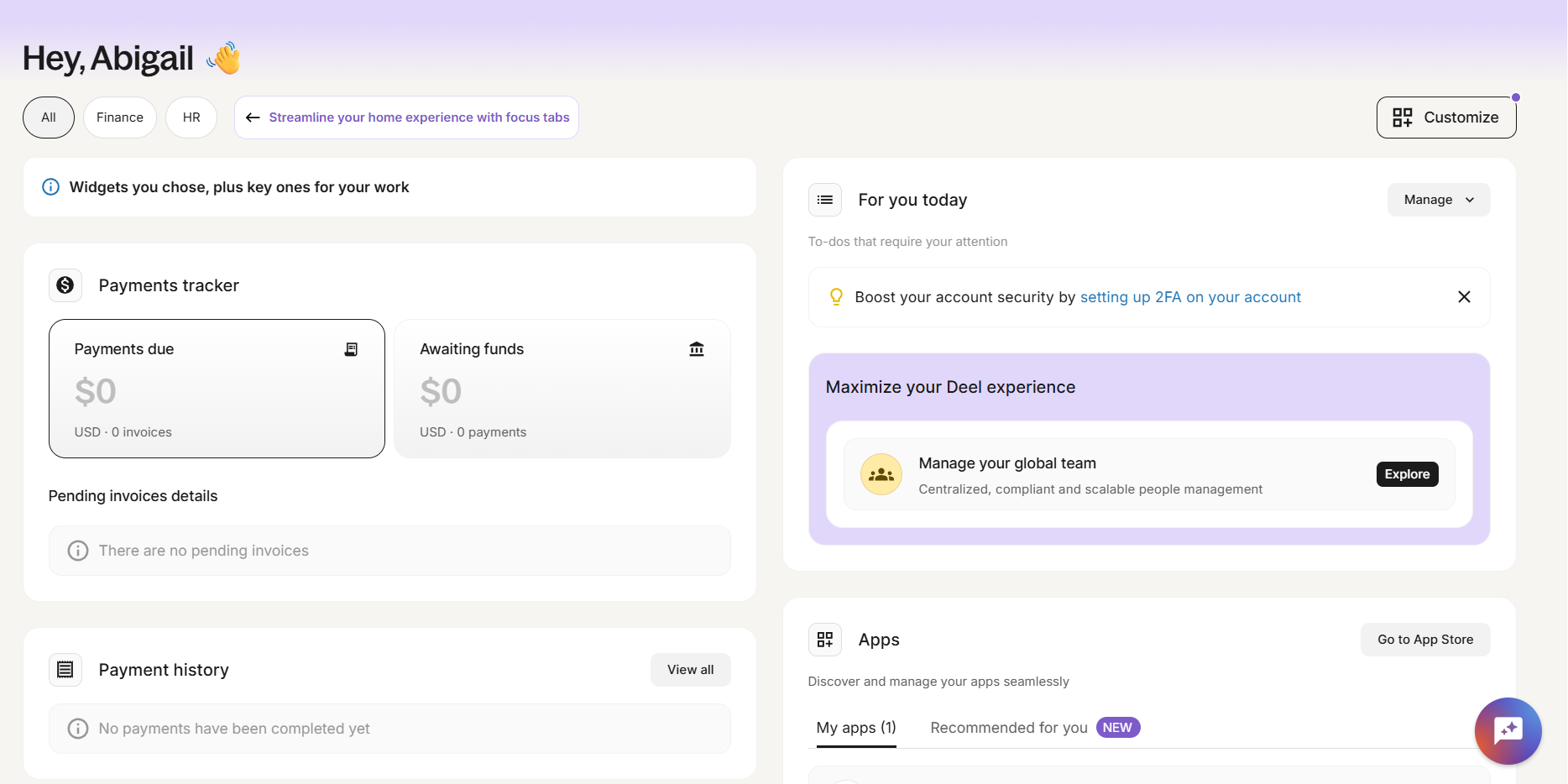
One pro of Deel is that it’s always very easy to get in touch with support.
We have used Deel for at least a few years. I have personally used Deel for just over one year. The pain point we were trying to solve was implementing a seamless payroll process for our international team.
We have also used Deel as an EOR for our international employees. We initially started using Deel specifically for our international team, and it worked really well for those employees.
The key benefit it provides is simple payroll processing, regardless of where the person resides. The site is easy to use and navigate. Another benefit is the responsiveness of the support team.
One con of Deel is the offboarding process and its unclear procedures. I wish they would improve this part. Another con is that support often passes you between multiple people, none of whom have prior context, which leads to repeating the same information.
Deel is fine, but I think their competitors are better. I prefer every other payroll platform I have used over Deel.
One criterion to consider before using Deel is what your team structure looks like. Deel is helpful because employees or contractors can be onboarded regardless of location. I found that, for us, it made the most sense to use Deel specifically for our international team.
I can’t think of any specific changes that have been made in the one-plus year I’ve used Deel.
I can’t think of any specific changes that have been made in the one-plus year I’ve used Deel.
I would say Deel is great for organizations of any size. It’s probably best for companies with international teams.
.png)
Deel

Deel
Native Teams
Native Teams

ADP
ADP

Multiplier
Multiplier
G-P
G-P
Deel might be a bit pricey for companies who want to use their Employer of Record services, which start at $599. And since this vendor is best suited for teams engaged in multinational or multistate hiring and payroll, it’s less ideal for organizations without such needs.
Deel serves over 10,000 customers, including big names like Nike, Shopify, Dropbox, Notion, Reddit, and Airtable. Their client roster also has a strong contingent of SMBs and start-ups.
- Employee Onboarding & Offboarding: Deel claims that you can “onboard or offboard anyone in minutes” with its platform. Collect and send documents, background checks, and other necessary documents to maintain compliance.
- Global Payroll: Operate payroll for contractors and full-time employees alike in over 90 countries. Deel has entities in over 200 countries with in-house payroll experts who can provide direct, country-specific support. Deel also provides tax services to make paying taxes a breeze. It almost goes without saying, but you can pay international employees in their currencies of choice.
- Employer of Record: For countries where your company does not have a local entity, Deel offers EOR services and can hire employees on your behalf.
- Global HR Management Tool: Deel HR combines onboarding, time off, expenses, documents, compensation changes, and more in its user-friendly self-serve platform. Additionally, they also offer org charts and searchable personnel directories.
- In-house Open API: Deel can help leverage your existing tech stack to automate tedious and time-consuming HR operations like contract creation, timesheet syncing, and more.
Deel offers pre-built integrations with 15+ HRIS, accounting, and ATS platforms like Quickbooks, Bamboo, Greenhouse, and more. According to their website, an integration with Lever is coming soon. The Deel API allows HR managers to build custom integrations to automate across their tech setups.
Deel offers pricing tailored to specific business needs across its products:
- Deel Contractor: $49/month, covering compliance, payments, and contractor management in 150+ countries.
- Deel EOR (Employer of Record): $599/month, enabling international hiring without an entity, including payroll, taxes, and benefits in 150+ countries.
- Deel Payroll (Global Payroll): $29 per employee/month, for payroll services in businesses with existing entities across multiple countries.
- Deel US Payroll: Custom pricing, for US-specific payroll, tax calculations, and compliance across all states (no current public starting rate).
- Deel US PEO: $95 per employee/month, for HR, payroll, and benefits in the US under a co-employment model.
- Deel Engage: $20 per employee/month, for performance, learning, career, and feedback management tools.
- Deel IT: Pricing varies by module (insufficient public data to quote a single flat rate), for device lifecycle management, app provisioning, security, and IT support.
- Deel HR: $5 per employee/month, offering global HR management, compliance, and automation tools.
- Deel Immigration: Custom pricing for relocation, visa sponsorship, and immigration management in 40+ countries.
Custom quotes are available for enterprise and specialized needs.
Deel is best for SMBs that are growing and want to explore different global markets and talent pools, though there is also a large market for mid-market and enterprise companies.
As a new product, Deel has changed a lot since its inception. Its newest offering, DeelHR, allows companies to complete most of their HR operations tasks in Deel.
Deel is quite quick to implement if you choose to hire people solely as contractors. It’s somewhat of a self-service process if you go at it like this, but we do recommend getting a demo and emailing their support team as much as you need, especially if it’s your first time setting up a global payroll solution for a remote team.
You’d start by signing up, inviting team members to join, and having them onboard themselves by signing a contract, validating their ID, and choosing a fund withdrawal method. We found the process to be quite straightforward. One notable thing is how strong the platform is with GDPR compliance and security. For instance, they send a verification code each time you sign in, right to your email, which is far more convenient than having to use a separate app for it.
For the EOR part, implementation is more complex, but you certainly get more hand-holding from the Deel team in the process. So, you’d get an estimated timeline upon beginning.
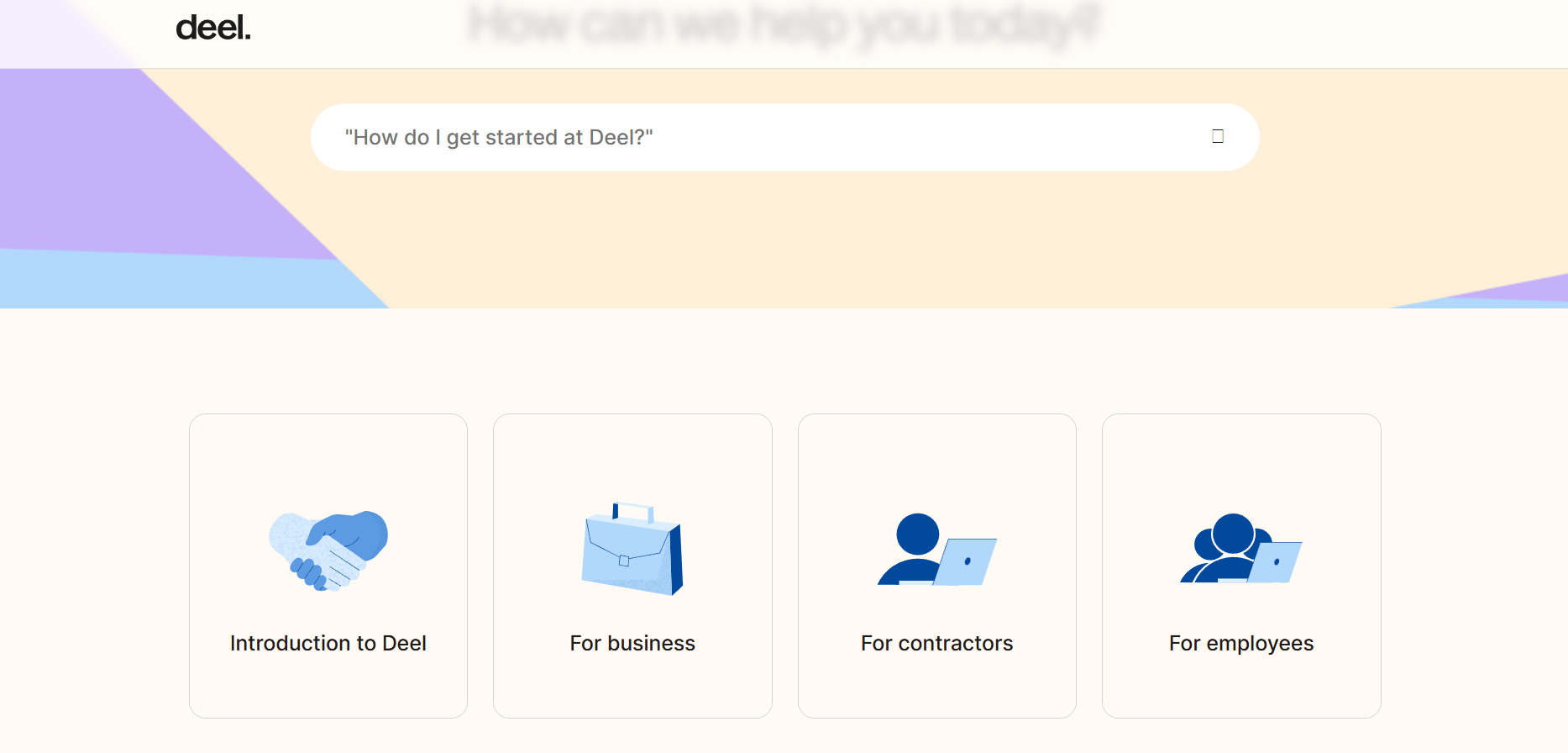
Deel has a fairly comprehensive searchable FAQ section accessible to current and prospective customers. For current clients, they offer 100% in-house support with a 1.25 min first response time from local country experts. Additionally, they have a large database of video tutorials explaining how to utilize their software.
Deel was founded in 2019 by Shuo Wang and Alex Bouaziz. After they graduated from MIT in 2014, the pair began to notice a common occurrence among their friends; they would get rejected from high-skilled jobs that they were great fits for only because of visa and immigration hurdles.
Years later, as the trend continued to hold true, they decided to create an EOR and couple it with the right tech that could let people hire an employee overseas in a few minutes. As they say around the Bay Area, where the company was founded, they ate their own dog food, using Deel to hire people wherever they needed.
The product continued to expand with the vision of becoming a global HR and payroll platform. Their payroll services are now available in 100+ countries while contractor management are in over 150 countries.
As of this writing, Deel has grown to 4,500+ employees across 110 countries, with an ARR of over $500 million.
Company HQ
SF Bay Area
Number of Employees
4,500+ employees across 110 countries
Year Founded
2019
Amount Raised
Series D, current total raised $679M
FAQ
About SSR

We spend hundreds of hours researching the best HR and recruiting software so you don’t have to. We never take money from vendors during our research phase and rely heavily on practitioners and experts to help us recommend the right software. However we may earn a small fee if you click on vendor links on this page.

