


As it’s usual with all of Zoho's product, Zoho Recruit is quite robust and feature-rich. It also has a free plan, which includes the ATS, and supports 26 different languages, allowing recruiters to cast a wide net.
Ratings
Ease of Use
Best For
Key Differentiator
Price
Free Trial
PROS
- ATS + CRM in one platform
- Backed by a company like Zoho, notable for reliability and good customer service.
- 24/5 support
- Priced quite modestly after the free version
- Certain features like video interviews are available as optional add-ons.
CONS
- The free plan only allows 256MB of storage.
- Additional features, such as the client portal, mass email, workflow alerts, and API calls cost extra.
- Some users have complained about the quality of some of the integrations.
- The career site is not fully customizable until past a certain paid plan.

Need Help? Talk to an HR Software Advisor!
Tell us more about your company & an HR Software Advisor will help you find the right software





Can a platform pack an Applicant Tracking System and a Candidate Relationship Management tool into a single hub? This is what the guys at Zoho set out to do with their recruiting product. Notably, this is only one of Zoho’s products that has become popular with many HR teams, along with Zoho People and Zoho Shifts. Zoho Recruit is only one of Zoho’s 50+ products helping businesses not only in recruitment but also in finances, sales, marketing, support, and collaboration.
That being said, Zoho Recruit is notable for being tailored to the needs of staffing agencies, internal HR teams (at big and small companies), and even freelance headhunters alike. At each of those use cases, and the many iterations therein, Zoho can source candidates from over 75 job boards and keep track of every touchpoint; from application to hire.
Typical talent acquisition tasks like email management, interview scheduling, and updating candidate’s status, can be automated. Although used by bigger companies, this is part of what has made Zoho Recruit popular with small companies and startups, where time is of the essence and maybe recruitment is a shared responsibility across roles.
Although we cover this in more detail on our pricing section, Zoho Recruit has always been a popular bet for its value too. Their free plan is good enough for small recruiting firms or freelancers focusing on one job opening, and it just keeps getting bigger after that.
To give you an idea, the Standard plan includes 250 active jobs, AI candidate matching, advanced analytics, automatic screenings and assessments, background checks, and assignment rules you can set up. A nice thing about their pricing is that popular modules like video interviews (one-way or live) are available as separately-priced add-ons. This ability to mix and match is something that has always made Zoho stand out. You can switch as you go, according to your needs. This is especially worth considering as their plans have evolved over the years to include the features that start making waves in the market.




I use Zoho Recruit for recruitment and applicant tracking. It also works as our CRM and as an interview tracker.
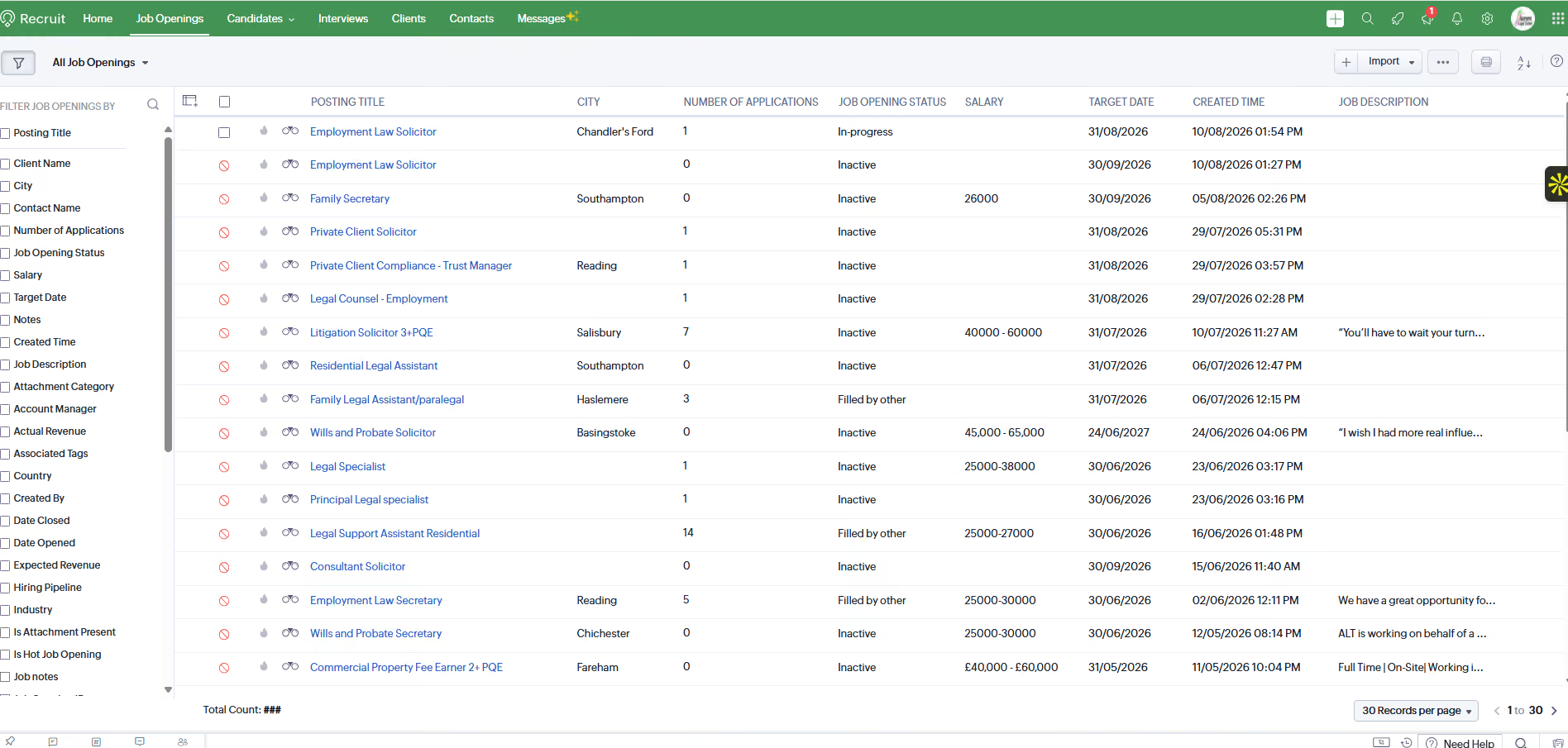
- Zoho Recruit is easy to use.
- It is flexible.
- It is customisable.
I have used Zoho Recruit for 8 months. We bought Zoho Recruit to get a better, more functional CRM than what we had before.
- It was difficult to verify my account, as I wasn't a limited company.
- It took a long time before I could use templates because of this.
- The click-through between certain pages in Zoho Recruit could be better.
Zoho Recruit does everything I need. I struggled with uploading bulk notes to the other CRMs I used. With ZOHO, you have a workaround for that.
Think about what you want the product to achieve. I would also recommend researching Zoho Recruit through YouTube videos.
I can't see that Zoho Recruit has changed for my needs.
Any type of business can benefit from Zoho Recruit, whether you are a sole trader or a company with multiple users. You can set up different pipelines, which is great.
Zoho Recruit will be a good fit for all, from my experience.
We use Zoho Recruit as a CRM. We use it for candidate tracking. We also use it for client tracking. And we use it to keep track of deals. Those four things cover most of what we do in Zoho Recruit.
Zoho Recruit keeps us organized. Zoho Recruit is easy to use. It holds candidates, clients, and deals in the same place.
I love Zoho Recruit. I have been working with it for 2 months. Zoho Recruit has been a game changer. It gets us organized. It keeps us up on tasks. It keeps the momentum going. Two months in, Zoho Recruit is already part of how we work.
I wish Zoho Recruit had more connectivity to databases. Better database connections in Zoho Recruit would save us manual work.
Zoho Recruit is easier to use. That is the main reason I prefer it.
Price and features. Check that the features you need are included in the Zoho Recruit plan you are quoted.
Zoho Recruit has simplified life for us. I have only used Zoho Recruit for 2 months, so I cannot speak to how it has changed before that.
Everyone. Zoho Recruit suits anyone who needs to track candidates, clients, and deals.
Retail. Retail teams likely would not use the candidate and deal tracking in Zoho Recruit the way we do.

I use Zoho Recruit for database work and as a systematic platform for our data. I rely on it regularly for these tasks.
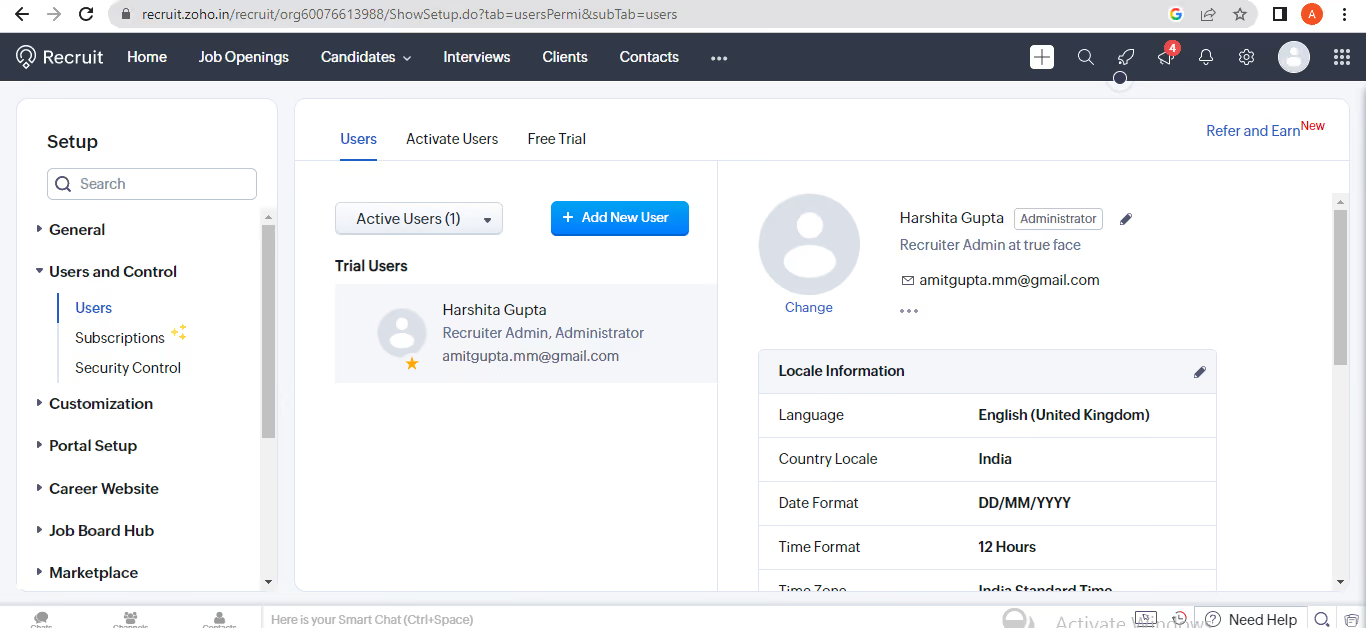
The GUI of Zoho Recruit is friendly and easy to navigate.
We got Zoho Recruit for our startup consultancy business, and it came recommended by Google. I've been using it since we brought it on board.
Zoho Recruit is difficult for new users to learn at first. The learning curve took some time for our team.
Zoho Recruit’s support function and detailed tabs stand out. These make it more thorough than other tools I've tried.
Think about the safety of data and how it's represented for end users. These factors matter a lot when choosing a tool like Zoho Recruit.
Zoho Recruit’s upgrades have improved over time. The updates have made it more useful as our needs changed.
Zoho Recruit is a good fit for startups and new ideas. Teams just getting started can benefit most from it.
I’m not sure for whom Zoho Recruit will not be a good fit for.

Manatal

Manatal

Monday.com
Monday.com

Dover
Dover

GoHire
GoHire

Wellfound
Wellfound
Those wanting a simpler tool sharply focused on certain parts of the recruitment process— for instance, video interviews or career site design— may find Zoho’s Recruits offering too general. Since they cover such a broad spectrum of needs, it can take them time to get the design up to modern standards, in some cases.
Bosch, Deloitte, Saint-Gobain, PWC, Allianz
- Automated candidate relationship workflows: Create custom workflows that send alerts and triggers at specific candidate touch points, ensuring you never miss an opportunity to connect with job seekers.
- Background screening: You won’t need an additional software for background checks, as Zoho Recruit has this as a built-in feature.
- Resume extractor: Use a Chrome plug-in to parse resumes from most websites.
- Resume parser mapping: Standardize parsed resumes to a structure preferred by your company.
- Parsing review: Review the parsed resume for inconsistencies.
- Client Portal: Your staffing agency can provide a portal for your clients to input their open roles, provide feedback on candidates up for review, and even make interview decisions.
Zoho Recruit also has capabilities for:
- Resume inboxes (get resumes from emails)
- Candidate import from documents
- Duplication checker
- Assessments and feedback
- Candidate management
- Interview scheduling
- Note taking tool
- Career site
Zoho Recruit integrates with the top products on several categories, for instance:
- Job boards: Indeed, Monster, CareerBuilder and over 70 more
- Recruiting: DaXtra, LinkMatch, Hiretual, SignalHire
- Background checks: Checkr, Verified First, HireRight
- Collaboration: Slack, Zoho Cliq, Zapier
- Social media: LinkedIn, Facebook, Twitter
Also, Zoho Recruit has open API capabilities and the Zapier integration; so you can integrate seamlessly with your tech stack.
For corporate HR and staffing agencies, Zoho Recruit provides plans with a 15-day free trial and a 45-day money-back guarantee. Here are the detailed pricing options for annual billing:
- Corporate HR can choose from three plans: Free, Standard ($25/month), and Enterprise ($50/month). Add-ons like Employee License ($10/month), Vendor Portal ($6/month), and Video Interview ($12/job opening) are available to paid plan users.
- Staffing firms have access to four plans: Free Forever, Standard ($25/month), Professional ($50/month), and Enterprise ($75/month). They can also add features like Video Interviews ($12/license/month) and Client Portal ($6/license/month) to their plans.
Zoho Recruit is ideal for startups and small to medium-sized companies across various industries.
Zoho Recruit’s most recent updates highlight a dual focus: building intelligence directly into candidate evaluation through Zoho’s own large language model, Zia, while also making efforts to improve user experience on everyday workflows.
- AI-Powered Assessments and Zia LLM: Recruiters can now generate ready-to-use assessments tailored to each role, with Zoho’s native AI model powering the process. The goal is fairness, consistency, and structured recruitment without the manual legwork.
- Profile Summary by Zia: Scanning resumes one at a time is giving way to instant AI summaries. With Zia’s help, recruiters can expect to save time and effort on shortlisting, as they can now view key candidate highlights in either bulleted or descriptive form.
- Numerical Rating in Interviewer Assessments: Candidate evaluation has gained more precision with a numerical rating system. Interviewers can score answers by number, set thresholds, and even switch between rating styles (star, thumbs-up, or numeric) with results converting automatically for consistency.
- Real-Time Notifications in Vendor Portal: Vendors now get instant alerts when jobs are shared or edited, notes are added, or candidate statuses change.
- Smarter Cooling-Off Periods: The cooling-off functionality has been extended to cover the Career Site, Vendor Portal, and Employee Referrals. Recruiters can set durations, trigger alerts, and ensure candidates and vendors enjoy a smoother process.
- Bulk Action Buttons: Custom buttons in List View allow teams to act on multiple records at once, such as candidates, jobs, or clients, from the toolbar.
- Custom Buttons and Links in Portals: Portals for candidates, clients, and vendors now support custom actions. Recruiters can design experiences where users trigger specific workflows themselves.
- CV-Library Integration: UK-based hiring is expected to become easier with this new integration, as it lets recruiters tap into millions of resumes, refine searches, and unlock CVs with credits within Zoho Recruit.
With the Zoho Recruit platform, you only need to set up a Zoho Recruit account to get started. After that, you can now post a job and start sourcing candidates.
For bigger teams, based on complexity of customer requirements and the amount of requested features, Zoho Recruit’s implementation time can vary widely, from a couple of weeks or even up to several months.
Customer support caters to new and existing customers who have questions about pricing, licenses, and other services. In addition, Zoho has offices worldwide, so you won’t have to worry about your concerns getting lost in an email inbox. Their support is typically handled on a 24/5 basis.
The Zoho story goes back to 1996, with the founding of AdventNet Inc. Back then, the company made a network management tool that was popular internationally, but mainly in the Japanese market. Then, in 2001, they launched Zoho CRM, which quickly became one of their best-selling apps.
Then, in 2005, the company caught up with the times and started offering cloud-based applications. They began with the Writer app, then Show (a presentation tool), Creator (custom application builder), and Zoho Sheets. It wasn’t long until they realized that there could be a Zoho tool for just about every kind of business app. If you’re curious, the Zoho ‘about page’ actually has an interactive timeline where you can see the evolution of the company year to year. Nowadays, Zoho has over 75 million users worldwide, several offices across the globe, and more than 50 products for marketing, finance, customer and tech support, team collaboration, and of course, HR and recruitment.
Company HQ
Austin, Texas and Chennai, Tamil Nadu
Number of Employees
13,000+
Year Founded
1996
Amount Raised
FAQ
About SSR

We spend hundreds of hours researching the best HR and recruiting software so you don’t have to. We never take money from vendors during our research phase and rely heavily on practitioners and experts to help us recommend the right software. However we may earn a small fee if you click on vendor links on this page.

