


Pinpoint is among the most sophisticated applicant tracking systems: it’s got a modern UI, extensive integrations, and a top-notch career site builder meant for in-house talent acquisition and HR teams at fast-growing companies.
Ratings
Ease of Use
Best For
Key Differentiator
Price
Free Trial
PROS
- Pinpoint is an agile ATS that is highly customizable and values collaborative hiring.
- It’s got a simple and transparent pricing structure.
- Pinpoint offers unlimited jobs and team members in all of its plans.
- Their customer service team is highly praised by users.
- The career site builder is very robust, allowing teams to attract and convert the right talent.
- There are over 100 HR software integrations to choose from, and Pinpoint’s team is adding 3-5 every month.
CONS
- The employee onboarding module does cost extra.
- It isn’t the best fit if you’re looking for the cheapest ATS.
- There free trial is only available upon request.

Need Help? Talk to an HR Software Advisor!
Tell us more about your company & an HR Software Advisor will help you find the right software





Pinpoint was started with the goal of building a user-friendly applicant tracking system that created a strong candidate experience, as well as a robust system for recruiting teams to leverage when hiring.
The look and feel is in keeping with best in class software companies globally. So, it’s easy on the eyes. Where it stands out from the crowd is that this system was built with the user in mind - both candidates and recruiters/hiring managers/TA admin.
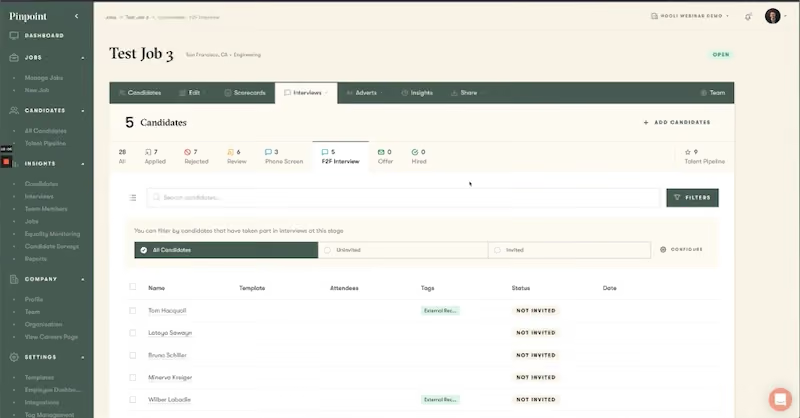
This manifests through one of the most powerful features: the ability for recruiting teams to build and manage beautiful career sites that are designed to attract and convert candidates. It’s easy to apply, and for those not ready they can opt into a talent community to stay in touch with your company.
In the recent past Pinpoint has also built out an employee onboarding module. The idea was to keep the positive experience going for hires as opposed to dumping them into an old school HRIS. This module is also build with simplicity, but everything you’d expect from a modern onboarding solution - from work buddies to I9s.
For recruiting teams, you can manage your multilingual career site and showcase employee testimonials, create custom user roles, manage talent pipelines, and manage the entire recruiting process with different workflows for different types of roles.
Pinpoint also stands out when it comes to power. Your team can build in automations (send candidates an email when they move to a new stage in hiring process), automate interview scheduling, or take a look at how your team is doing when it comes to equitable hiring practices.
Like all strengths, power can also be a weakness. If you’re a small company that only hires a few people per year, or has one HR person that does recruiting for 5% of their time, this system is too much for your team. You’ll be better off using an ATS that is only for posting jobs and collecting resumes.
As mentioned previously, this solution is also not for global Fortune 500 companies that need all the many bells and whistles you’ll find in a much more complex solution like WorkDay, or the ability to straight up customize your solution like you can by spending a few hundred thousand on Taleo consultants.
That said, it’s hard to encourage you enough to get a demo of this platform assuming you aren’t a Fortune 500, extremely small company, or looking for the cheapest solution around - this ATS is that good!




I used Pinpoint to build a candidate database. I used it to store candidate data such as resumes, cover letters, job applications, degrees held, addresses, telephone numbers, and availability.
We also used Pinpoint for job postings, and it can be connected to your company's webpage. I used Pinpoint to track where a candidate was in the hiring process, including interviewing, sending the offer letter, and tracking background check status.
Pinpoint is very user friendly and aesthetically pleasing. It is a modern applicant tracking system and position management system in one.
I used Pinpoint for 4 months on a contract for a tech contract company. The company purchased Pinpoint to organize and track recruitment efforts more efficiently and effectively.
Before using Pinpoint, the company bounced between different email accounts and recruitment platforms. They also had different users come and go through temporary positions with the company.
Some recruiters would end up reaching out to the same person, which looked very unprofessional. Pinpoint allowed a centralized location for all users to input candidate data and track where the candidate was in the recruitment process.
It was the most user friendly and intuitive applicant tracking software I've ever used, so I don't have any cons to share.
Pinpoint has excellent support and is available for a call or video chat to assist you. Their onboarding is efficient and informative. It is more user friendly than some competitors and is a great fit for small to mid-size companies. I prefer Pinpoint over Workday and PeopleSoft because of the ease of use.
Consider the size of your organization, as Pinpoint is great for small to midsize companies. Also consider who will use the software, as it does require the user to have some knowledge of recruiting and HR and be comfortable with data entry.
Pinpoint has become more intuitive and has more integrations with other systems. It is not a full HRIS that can manage payroll and performance reviews, but it can connect to popular systems that do those things.
Small to midsize organizations would benefit from Pinpoint. It may be too simple for a large enterprise that needs a complete HRIS to manage 400 or more employees.
A large enterprise or a company with only 5 employees or fewer.

I used Pinpoint to review anonymized resumes - applications via our website for various roles. I also used Pinpoint to partner with hiring managers, creating notes and rankings for candidates. Pinpoint was my primary ATS, so I also tracked candidate flow, from application through multiple stages, to hire or dispositioning as rejected.
- I liked that the resumes were anonymized but still parsed very well.
- I liked that hiring teams could leave their feedback directly in the tool.
- I liked that each requisition was customizable - I was able to add additional interview stages and exercises to fit each role.
At the time that we purchased Pinpoint, my organization was in a time of high growth. While we had previously done much of our hiring via referral, we now needed to attract talent from external sources.
We also had begun a DEI initiative and were searching for an ATS that would anonymize (“blind”) in order to avoid any unconscious bias as we grew our team. The team had been using Excel prior to tracking candidates and needed a tool to house the candidate information and interview data.
This was also due to an upcoming compliance audit for which we wanted to ensure all interview feedback was captured in a timely and efficient way. The hiring managers found the tool to be user-friendly, and we remained a Pinpoint client until the time of our company’s acquisition.
- The reporting capabilities were minimal when trying to analyze the source of hire, etc.
- While the anonymity of resumes was our primary reason for buying Pinpoint (for DEI purposes), many hiring managers found it difficult to review these de-identified resumes.
- Pinpoint did not connect to our HRIS at the time, so candidates hired had to be added post-offer-acceptance manually.
Pinpoint allows companies to de-identify resumes - removing college graduation years, pronouns, surnames, etc. This further removes an opportunity for implicit bias and allows candidates to be evaluated based solely on their experience, skills, and competencies.
Will Pinpoint integrate with your ATS? Are your hiring managers committed to a hiring process that redacts the candidate's name and other identifying information until after the candidate is selected for the first interview? Will your hiring teams fully leverage the functionality, including evaluation forms, for consistency and compliance?
Pinpoint didn't evolve during the time that I used it, but was one of the only ATS we found that aided our efforts to remove unconscious bias from the hiring process.
An organization committed to DEI and one where hiring teams are comfortable or can be trained to use a tool for collecting of feedback and candidate evaluation.
Pinpoint didn't work well for referrals, so I wouldn't recommend it to an organization that often hires from within or via referral.

I created branded careers pages to strengthen our employer brand and attract more qualified applicants. I collaborated with hiring managers by assigning roles, collecting structured feedback, and coordinating interviews using shared scorecards.
The system’s automation features allowed me to send personalized messages to candidates. This reduced time-to-hire and improved overall candidate engagement. I also generated reports on source of hire, time-to-fill, compliance, and diversity metrics.
- Pinpoint was very user-friendly.
- It supported collaboration between HR teams and hiring managers.
- The careers site and branding tools helped attract more qualified candidates and increased engagement with open opportunities.
- Automation tools for candidate communication and interview scheduling saved a lot of time and improved the candidate experience.
We primarily needed Pinpoint for recruitment and applicant tracking. We were also able to use it for compliance and reporting, including EEO, VETS-4212, and other reporting needs.
It supported communication and documentation throughout the interview process, allowing us to track candidate details, referrals, and more. We also used Pinpoint as a pipeline tool, which was a significant benefit. This allowed us to organize and reuse previous applicants for current roles effectively.
- Configuring workflows and integrations for the first time was very time-consuming.
- Switching between roles or editing email templates was a bit confusing.
- It had limited ability to pull data from multiple sites and systems.
Pinpoint stands out from many competitors due to its clean interface and strong focus on candidate experience. Compared to tools like Greenhouse or Workable, it’s easier to learn and operate with minimal training.
I appreciated the ability to customize the careers site and branding without needing technical support.
Teams should prioritize ease of use, ensuring both recruiters and hiring managers can operate the system with minimal training. It's important to assess scalability and integration options.
Choose a tool that can grow with your organization and easily connect with existing systems.
In 2024, they introduced features for skill extraction, talent pools, improved candidate pipeline management, and a more robust application flow.
I would recommend Pinpoint for small businesses with 500–2,000 employees that handle recruitment in-house and have moderate hiring needs.
Pinpoint wouldn’t be a good fit for large companies with extensive recruitment operations and complex hiring needs.

Greenhouse

Greenhouse

Workable
Workable

Gem
Gem

VidCruiter
VidCruiter

Deel
Deel
Pinpoint is for companies that hire a lot (at least 30/yr, the more the better), and put a focus on talent. Realistically, you get what you pay for in this solution, and so if you are optimizing around price, this isn’t the solution for you.
It’s also worth noting that companies that have bad existing systems sometimes struggle to utilize Pinpoint. If your recruiters/hiring managers/employees have been used to the brain damage of a legacy system, it will take time for them to trust and utilize the power of this ATS - don’t underestimate that.
Pinpoint is also not a good fit for companies that don’t hire much. It starts at $345 per month, so it is really hard to rationalize if you are hiring only a dozen or two per year. They do have smaller customers with less than 100 employees, but most of these companies are growing rapidly.
Lastly, if your team requires massive customization, this is not the ATS for you. A good way to tell if this is your company is to look at your budget. If you have >$100k/year allocated just to customizing the ATS, then stick to the legacy providers (well, actually you should re-evaluate why you need these specific customizations and if sticking with a sub par legacy ATS is worth it).
Pinpoint is closing in on 1,000 customers with current names like CoinShares, Pathways Global, and Grant Thornton.
- Career Site Builder: This is one of the best parts of Pinpoint. Your recruiting team now doesn’t have to rely on IT or marketing to change your career site. You can also add information about your ERGs, career paths, interview prep info, and anything else you want to showcase to candidates.
- Employee Onboarding: Pinpoint customers can use the system to onboard new employees (as a note, this module is extra outside of the core ATS). It covers the warm and fuzzy stuff like who your work mentor will be and what to expect culturally, as well as the typical employee paperwork, handbooks, etc.
- Job Board Distribution: You can easily distribute jobs to publishers like Google, LinkedIn, Indeed, etc.
- Recruitment Process Automation: The point of an ATS is to automate in order to help your recruiters save time. Their automation allows you to simply set up this then that type of workflow to save you time (and sanity). For example, you may want to automatically send an email linking candidates to relevant employee profiles, and a scheduling link, when they are moved to a certain stage in the recruiting process.
- DEI: Equality reporting is a big part of their product strategy. You can take a look at how candidates of various demographics do in the process, and what touchpoints they have. You can also do blind recruiting so that gender/race doesn’t influence your colleagues.
- Candidate Feedback: This system also has a built-in candidate survey to collect standardized (eNPS) and unstructured feedback on your candidate journey.
- Custom Report Builder: You can build your own custom reports based on any data available in Pinpoint. Maybe I want to build a report showing me the pipeline for Java engineers in Boston, or a report that shows me the time to hire remote customer service agents. The world is your oyster. You can also schedule reports to be sent out whenever you want (maybe certain reports go off quarterly to the C-suite before board meetings so they know what’s going on in TA).
Like most top ATS’s Pinpoint has invested in their integrations so that if you love your video interview platform, you don’t have to give it up to use their system.
They have integrations with:
- Assessment tools like Vervoe and Coderbyte
- HRIS’s like Bob and Bamboo
- Job boards like LinkedIn and talent.com
- Lots of other tools from background checks to SSO
They add 3-5 new integrations each month, many of which you can activate in minutes when you use Pinpoint.
In general, Pinpoint’s pricing is based on the size of your company. Their pricing starts at $345 per month when billed annually, according to our research.
Companies that want enterprise features (multi-page career sites, multi-lingual support, custom integrations, help on data migrations, etc) will start at $1,200/mo (also billed annually).
We think this pricing is fairly comparable with other truly best-in-class ATSs. This product becomes valuable to companies when they start hiring more than a dozen people per year, otherwise, you may be better off using simpler solutions.
We also appreciate they have a lot more transparency on pricing versus many other players in the space.
Pinpoint is a wonderful ATS for companies that value their candidate experience, and have the need for a tool that will help increase the productivity of their recruiting team through a better career site, talent CRM, and integrations with your favorite HR Tech.
Pinpoint's recent updates focus on recruiter workflow efficiency, internal mobility, and broader AI and screening capabilities:
- Saved filtered candidate views let recruiters store and reuse search filters by stage, location or custom attributes for parallel pipelines and passive candidate pools
- Radius-based location filtering enables geographic search around a fixed address for proximity-sensitive roles
- Internal job visibility widget displays open roles without requiring employee login, supporting internal mobility in distributed environments
- Onboarding without confirmed start dates supports contingent offers, phased starts and visa or relocation-dependent hiring
- Organization-wide workflow automation lets admins apply standardized rules across all job templates for high-volume recruiting
- Expanded job drawer metadata access gives all users visibility into custom fields and job post metadata regardless of permission level
- One-way video interviews added for fast, consistent early-stage screening
- AI tool integrations allow Pinpoint to connect with existing AI tools in the recruiter's stack
- Support chat repositioned to left margin to reduce UI disruption during resume review and job configuration
The current record for go live at Pinpoint is 3 days. However, the average timeline is more like 4-12 weeks, depending on how complex your organization is (large enterprise customers are looking at 3-6 months). Companies that are more organized and execution oriented will see drastically lower implementation times.
Any size company gets a dedicated account manager to walk them through the entire implementation process.
Recently, they’ve added a self-serve onboarding process. There are 2 hours of explainer videos that help you navigate through each step of the process. This is great for companies that don’t want to wait to schedule time with their account rep and want to just get going.
Each customer gets a dedicated rep that looks after you throughout implementation. Afterwards, you have access to the customer success team. Most interactions start with chat where the average time to speak to a human (not a bot!) is 2 minutes.
Pinpoint was started by Tom Hacquoil. Tom had previously run a cloud computing company where M&A was a big part of their growth strategy. He realized very quickly that talent was the most essential aspect of growing this company. So, he started a bootcamp to train new employees.
Tom didn’t think any existing options met his bar for a quality candidate experience, so he built his own tool to manage applicants for the bootcamp. This was the first version of Pinpoint.,
From there, the product grew with recruiting and candidates in mind, while translating the best ideas from sales/marketing/product/customer service to recruiting.
Company HQ
Jersey, UK
Number of Employees
71
Year Founded
2017
Amount Raised
Pinpoint has impressively bootstrapped its business. It is really hard to get a complex product like an ATS to this point without raising tons of venture capital money, but they’ve done it!
FAQ
About SSR

We spend hundreds of hours researching the best HR and recruiting software so you don’t have to. We never take money from vendors during our research phase and rely heavily on practitioners and experts to help us recommend the right software. However we may earn a small fee if you click on vendor links on this page.