Lattice offers a suite of performance management and engagement tools to drive productivity and improve company cultures. Besides the expected features of performance reviews, surveys, 1:1s, etc, Lattice can help incentivize top performers by linking their performance with compensation.
Ratings
Ease of Use
Best For
Key Differentiator
Price
Free Trial
PROS
- Lattice allows managers to record their 1:1 meetings with employees in real time. That way, both parties can go back later and revisit what was discussed during the meeting – as well as make sure nothing gets lost in translation!
- The platform has a host of tools supporting employee development and performance-based compensation setting, which isn’t common for the average performance management product.
- Review templates and survey questions are among several things that can be customized to ensure you’re getting relevant data.
CONS
- Starting at $11 per person per month, Lattice’s pricing is on the expensive side compared to competitors.
- The platform is feature-rich, which is great but also means that it takes some time for the average user to get acclimated with it.
- The available selection of third-party integrations is rather limited, with a few users complaining that their HRIS isn’t covered. That said, Lattice does have an open API that allows users to plug-in other third party tools.

Need Help? Talk to an HR Software Advisor!
Tell us more about your company & an HR Software Advisor will help you find the right software





Lattice is an employee performance management and engagement platform that’s best suited for medium and large-sized companies. Agencies, technology services companies, bank and credit unions, and life science companies can use Lattice to manage employee performance, OKRs and goals, employee engagement, analysis, and more.
For starters, Lattice provides tools for you to manage and analyze individual and team performance. These tools include 360-degree and project-based reviews, 1:1 meetings, continuous feedback and public recognition. Employees can get feedback from their managers as well as give managers feedback.

With Lattice, you can link employee performance data with compensation which has several benefits, including recognizing high performers, motivating other team members to be top performers too and driving retention rates.
Working hand in hand with the performance management module is Lattice’s OKR and Goals module. Through it, you can set and track goals at the individual, team, department and company level to ensure utmost alignment.

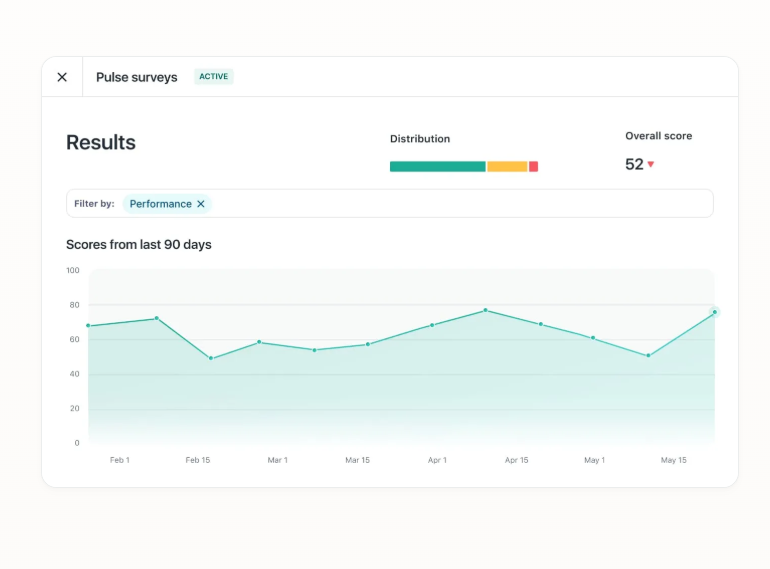
Lattice also offers pulse surveys, onboarding and exit surveys, as well as eNPS surveys, which provide real-time data that can be used to develop collaborative action plans for improvement.
Employee development is another thing emphasized through the platform. With competency matrices, individual development plans, career tracks, and more 1:1s. employees can see their role expectations, potential paths to advancement and formulate short-term and long-term career goals.
Finally, Lattice allows you to appreciate top performers with rewards – all of which can be automated through the platform’s workflows.




We implemented Lattice at Primer.ai to leverage technology in automating and supporting the facilitation of our performance review process.
Depending on an organization’s needs, Lattice offers a suite of features that help HR leaders make data-driven decisions based on feedback gathered through performance reviews, engagement surveys, pulse check-ins, and recognition feeds.
The platform is intuitive and integrates with commonly used apps like Slack, making it accessible to employees in their existing workflows. In Lattice, we were able to design multiple review types (self, peer, upward, and downward) and curate qualitative questions to assess behavior, knowledge, skills, and impact.
We conducted training sessions on how to use the platform and guided managers in goal-setting and conducting performance conversations.
The platform is user-friendly and provides a seamless experience for both front-end and back-end users. It offers a wide range of features that simplify gauging employee sentiment, such as pulse check-ins, engagement surveys, onboarding/offboarding questionnaires, and performance reviews.
The recent addition of the AI Agent supports a self-service model that empowers team members to get answers quickly.
When I was at Primer.ai, the company did not have a formalized performance review process. There was also no intuitive or seamless platform in place to deploy reviews to over 100 employees.
As an HR team, we aimed to build our capabilities to standardize and execute a formal review process, while also creating the conditions that support strong individual and collective performance.
After thorough evaluation, we chose Lattice to facilitate written reviews during the performance review period. We used the first cycle launched on the platform as a teaching opportunity to improve managers' capabilities in performance assessment and feedback delivery.
I've implemented Lattice at both Primer.ai and Sidebench and consider it the gold standard in people success management. Based on my experience, I don’t have any notable dislikes, as the platform continues to improve its offerings.
Lattice has been the only people success management tool I've used that fully meets my expectations, even after vetting other options. It is significantly more intuitive and straightforward.
As a super user, I appreciate the platform’s extensive library of resources and training, which helps users get up to speed quickly.
Pricing may influence whether a company can adopt this tool, given its wide range of powerful features. Lattice segments its platform into specific toolsets, allowing companies to choose which ones to invest in based on their goals.
Before implementation, it's important to have a clear vision of what performance management and success should look like. Aligning your team’s priorities with the platform’s features will help ensure a more successful adoption.
Recently, there has been significant investment in AI, including the rollout of AI Agent, which shifts some HR responsibilities to a self-service model for employees (e.g., Q&A support). This feature acts as an extension of the HR team and supports informed decision-making based on insights from the platform.
Small and large organizations alike can benefit from Lattice, especially when there is a defined performance philosophy and a clear vision for performance management and success, supported by the platform’s features.
All organizations can benefit from implementing Lattice as their people success management platform.

Key workflows that Lattice supports in our organization include performance reviews, goal setting, feedback and recognition, engagement surveys, and career development. Lattice allows us to create development plans for employees and help them map out their career paths.
Engagement surveys help us understand employee sentiment and identify areas for improvement. Recognition and continuous feedback promote regular, meaningful communication among team members. Goal setting provides a structured platform for both individual and team objectives.
Lastly, performance reviews allow employees to track their progress and receive feedback from managers and peers.
The biggest takeaways for me are the user-friendly interface, real-time feedback, and insights into employee engagement.
Lattice is easy to navigate, making it easy to train staff and leaders on the functionality of the platform.
In relation to real-time feedback, it enables stronger communication within teams. Lastly, the engagement survey tools offer insight into employee sentiment and morale.
My organization decided to purchase Lattice to enhance our employee performance management and engagement processes. The goal was for the platform to facilitate continuous feedback, goal setting, and performance reviews in a structured way. We believed this tool would help promote a culture of transparency and communication.
We have been using Lattice for two years. Since implementing Lattice, we have improved our ability to track employee performance and align it with both individual goals and organizational objectives.
Three cons regarding Lattice are the mobile platform, the reporting features, and the pricing structure.
The pricing structure for smaller organizations could be challenging, as it is not inexpensive. The mobile platform isn't as intuitive as the desktop version, so there are opportunities of improvement.
Lastly, the reporting features are at face value and don't have a drill-down option to gain more insight into the analytics.
What sets Lattice apart from its competitors is that it integrates multiple HR processes into a single platform. I’m able to use Lattice to manage performance, employee engagement, and career development in one place, which offers strong overall value.
When considering Lattice, it’s important to evaluate integration capabilities with payroll, HRIS systems, and communication tools to ensure a smooth transition. Some competitors may have limitations in this area. Organizations should also assess the level of customization needed to fully leverage the tool’s value.
Lattice has introduced enhanced features that provide users with greater access and flexibility, demonstrating a strong commitment to user feedback. These updates have helped Lattice maintain its position as a leader in the space.
Lattice is well suited to mid-sized and large organizations that need a comprehensive platform for managing multiple HR functions.
Lattice may not be a good fit for small teams with basic HR needs.

We use Lattice primarily for OKRs. They are integrated into our performance review process to evaluate individual achievements against broader business goals. The platform helps each employee understand how their work aligns with the company’s mission.
We track progress throughout each quarter, using Lattice to set, monitor, and revise goals as needed. The visibility it provides supports better performance discussions and alignment.
It is simple to use and integrates with other systems via APIs, allowing it to scale with the business. The customer support team is responsive and helpful. The interface is user-friendly, with clear visuals that make goal tracking easier.
My organization purchased Lattice in 2020 to implement and manage OKRs across the business. The platform has been in continuous use since its introduction, with increasing effectiveness over time.
We needed a tool that would align individual objectives with company goals, and Lattice offered a structured way to do that. It provided visibility into progress at every level, allowing teams to stay on track.
Although the tool is easy to use, OKRs can become convoluted as they are built out. If one OKR is not correctly linked to the appropriate parent objective, it can affect all connected goals. The platform can be expensive for smaller businesses.
Lattice has strong brand visibility, especially through HR conferences and events. It stands out by offering SHRM/PHR credits through its training seminars, which adds value for HR professionals.
One of the most important factors is whether the HR team can secure company-wide buy-in for using OKRs. Early adoption must be driven from the top, so HR should work closely with leadership to develop a structured rollout plan.
The platform also requires ongoing management and has a learning curve, so the HR team should be ready to deliver training across all levels after implementation.
In my experience, Lattice has remained consistent and reliable. Their team is easy to reach and quick to resolve issues. There have been steady improvements to the UI and reporting features, and they communicate updates clearly.
Lattice works best for companies with around 50 to 250 employees. Beyond that size, managing OKRs can become more challenging. For larger organizations, the tool may be more suitable for tracking eNPS and engagement metrics rather than goal setting.
Lattice may not be suitable for very large organizations with many moving parts or unclear priorities, where OKR management could become difficult to scale.

Deel

Deel

Trakstar
Trakstar

Small Improvements
Small Improvements
Teamflect
Teamflect

WorkTango
WorkTango
Small businesses with under 30 employees can do without Lattice and other performance management tools for that matter. Such tools by design, target bigger companies that need help aligning everyone in the company towards the same goals, getting visibility into improvement areas as well as listening and acting on feedback at different levels/departments. Furthermore, the platform’s pricing is a little out of reach for small businesses, so not a worthy investment overall.
Lattice has a large customer base that includes some noteworthy names such as Reddit, Webflow, Braze, Monzo, Valtech, Demandbase, and more.
- Performance reviews: Lattice lets you set project-based and 360-degree performance reviews, which can be annual or quarterly. You can put in-line notes and tags on feedback, set automatic rules for rating scales, and more. It also makes it easy to track everyone’s accomplishments and improvement areas with context from updates, peer feedback, and goals. Plus, Lattice's easy-to-use templates, workflows, and administrative dashboards make the process of designing and launching calibration reviews even easier.
- Updates: You can make sure everyone is on the same page by keeping an eye on employee updates with Lattice’s Employee Update tools. The Updates tool lets managers create a template for sending employees updates at a frequency that works best for their team – it can be weekly, biweekly, or monthly. You can send out update questions to employees from the preset templates and they can respond to the questions.
- Employee engagement & recognition: Lattice’s employee engagement module lets you deliver various surveys, including pulse surveys, eNPS (employee net promoter score) surveys, as well as onboarding and exit surveys. These surveys help you track the total number of responses, overall score, and previous score for each survey – and then use this data to identify behavior trends among your teams.
Lattice also makes it easy to recognize your employees using the Praise tool. With Praise, you can enable a public praise wall where everyone can see and recognize hard work and celebrate wins.
Lattice also has features for:
- Goals and OKRs management
- 1-on-1s
- Compensation management
- Reporting and analytics
Lattice integrates with several HRIS, SSO, project management, and communication tools including Slack, BambooHR, Namely, Microsoft Teams, Zenefits, ADP, and Workday. It also has an open API, allowing businesses to plug in various other solutions and custom tools per their needs.
Lattice offers four pricing plans, including:
- Performance Management + OKRs & Goals: This plan costs $11 per person/month. It includes 360 degree, manager, and peer performance review. It also includes custom question templates, performance reporting, analytics, dynamic org chart, regular business reviews, and performance management training.
- Engagement: It costs +$4 per person/month and includes employee engagement surveys, automated pulse surveys, eNPS, onboarding and exit surveys, engagement and performance insights, real-time pulse insights, engagement training, and regular business reviews.
- Grow: It costs +$4 per person/month and includes competency matrices, growth plans, individual development plans, career tracks, competency-based review questions, growth areas, career vision tools, and development analytics.
- Compensation: It costs +$6 per person/month and includes compensation review setup, bonus plan payout and one-time bonus, commission, manager, supervisor, and admin review, notes, promotion handling, and cycle progress tracking.
Lattice is most suitable for growing and large businesses and enterprise-level corporations that want to improve performance and track goals. With its ability to streamline communication and goal tracking, Lattice is especially suitable for hybrid and distributed workforces.
You can sign up for a free account from Lattice’s website. You may also purchase a plan right away from their pricing page. While configuring your account, we highly recommend checking out the Getting Started guide, available on Lattice’s help center page. This guide breaks down several processes, including how to define your company’s structure within the platform, how to add users and more.
All of Lattice’s plans include in-app chat support. Customers may also access Lattice’s online help center, how-to documents, regular webinars, videos, and performance management best practices.
Lattice was founded in 2015 to help people optimize their working hours, seeing how we spend the majority of our waking hours at work. Its founders believe that with the right tools, productivity across teams can be improved and managers can be turned into leaders.
The company emphasizes diversity and inclusion, and in 2022 it was named one of Fortune’s Best Workplaces for Women. According to its Chief Revenue Officer and Executive Sponsor of the Women at Lattice Employee Resource Group, Dini Mehta, the company places a great deal of focus on ways to remove barriers and bias for employees in the workplace.
Company HQ
San Francisco, California, United States
Number of Employees
500+
Year Founded
2015
Amount Raised
Lattice has raised $328.5M over 9 funding rounds, the most recent of which was held in January 2022.
FAQ
About SSR

We spend hundreds of hours researching the best HR and recruiting software so you don’t have to. We never take money from vendors during our research phase and rely heavily on practitioners and experts to help us recommend the right software. However we may earn a small fee if you click on vendor links on this page.