




BambooHR has remained one of the top names in HR software for years. They have won numerous awards for customer support, ease of use, and good value. Their numerous features can be flexibly packaged according to your needs.
Ratings
Ease of Use
Best For
Key Differentiator
Price
Free Trial
PROS
- Flexible packaging and custom pricing is the way they roll. You can pick out one or two packages and pick other modules as add-ons based on your needs.
- Very simple and straightforward tool, easy to use.
CONS
- Payroll is only available for US-based employees
- Customer support is only offered during US business hours.
- Some modules like time tracking, performance management, and surveys are only available as add-ons.

Need Help? Talk to an HR Software Advisor!
Tell us more about your company & an HR Software Advisor will help you find the right software





BambooHR tries to accommodate one or another version of their technology to fit your business. Their HR platform spans across the employee lifecycle as they have tons of other functionalities (like a full ATS or a performance management module) in addition to the core HRIS offer.
They do offer the core HR part as a stand-alone product. The way they package features can be flexible. For instance, they have a small business package called Essentials.
This package covers all the HR Management features like employee records, benefit tracking, standard reporting, document storage and more. It also has the employee self-service module, which is where workers can manage their time off, consult the employee directory and org chart, see a company calendar, and do all this from either the desktop version or the mobile app.
Further, Modules like payroll, time tracking, and performance management are offered as add-ons. If you need more, you can opt for the Advantage package. This plan includes onboarding and offboarding features, the Applicant Tracking System, advanced reporting, company branding, access to the open API, satisfaction surveys, and much more.
The flexibility of building out your plan like this is part of what keeps drawing one HR team after another to the tool. Arguably, it’s also what makes BambooHR one of the most popular HR software products of all time.
The product itself is fairly easy to use and figure out on your own. It’s one of the most simple tools to navigate that packs so many features. At SSR, we’ve demoed the tool, tried it for free, and even worked at companies where it was the HRIS of choice. We can say it’s rare to have to consult any help articles in order to make use of the tool. You just log in, do what you have to do, and trust that your colleagues will be notified.
Take the process of requesting time off, for instance. A worker would log in, send the request to their manager, and the manager gets an email notification. Once approved or rejected, the worker gets an email notification as well and the company calendar is updated accordingly. There’s no need for the worker to log back into the tool.
Lastly, BambooHR also have numerous amenities like an app marketplace of HR/recruiting vendors that integrate with their system, an HR glossary, and host HR events on occasion.
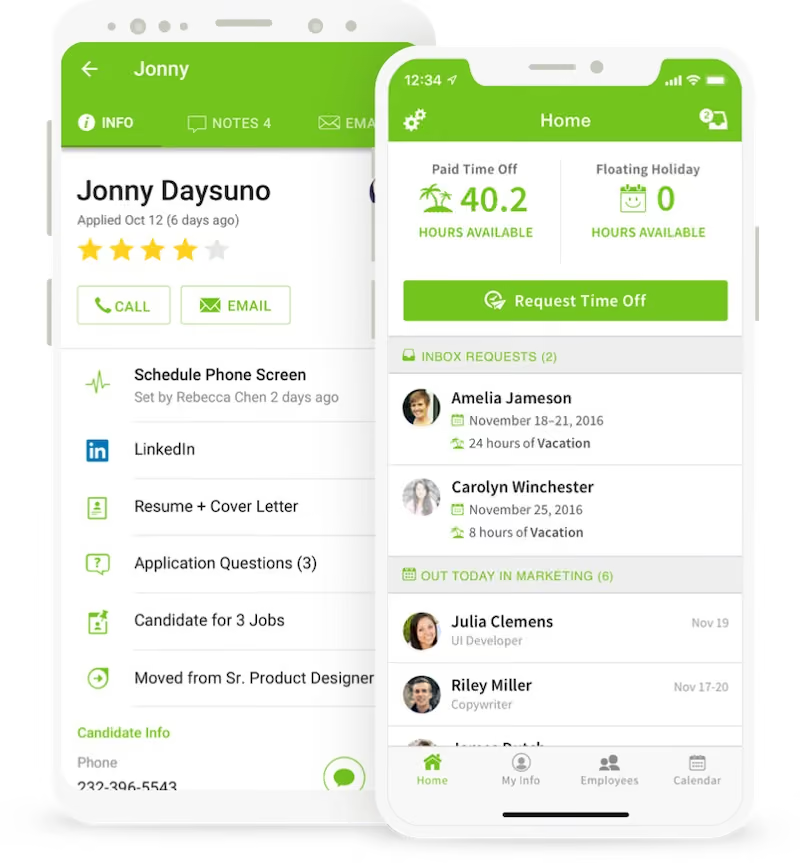



I use BambooHR every day; it is generally the first platform I log in to. We use the ATS to hire all of our employees, so I am logging in to check our general applicant posting, move qualified applicants to talent pools, and then check other postings.
This may involve me checking in with hiring managers to ensure they are updating statuses, so we can ensure our reports are accurate at the conclusion of a recruitment period for a given position.
At the end of the hiring process, we will send out rejections through BambooHR, which is very easy and streamlined, as long as your templates are set up.
I am currently preparing for our 2027 review cycle, which involves working within the performance management module. There are many fantastic workflows you can use in BambooHR!
- The platform is user-friendly. If employees have a general sense of technology, they should be able to figure out how to find things within the software.
- I like the mobile app; it is nice being able to look things up on the go or when you are away from your desk.
- Reporting: as an HR professional, I am constantly trying to build business cases for certain initiatives or demonstrate ROI, so it is very helpful to have data at my fingertips.
I have used BambooHR in two separate organizations. I have used the tool for a total of 3 years. We wanted to streamline our orientation process to make things easier for new hires, managers, and human resources.
The performance management module is fantastic, and it really helps streamline annual reviews and forces managers to seriously look at individual performance.
When reviewing HRIS platforms, data analytics was very important to me, and I felt that BambooHR has very strong reporting capabilities.
I always say that there is no perfect HRIS system, because IT people and HR people are inherently different.
- I wish I could create an exit interview survey and automate a workflow within the software. It would be so nice to send a survey directly to an employee through the platform; I would love that.
- I wish that we could add and remove fields in the employee directory. It is frustrating, for example, that there is a "home phone" field, but no "mobile work phone," and we cannot adjust it to our liking.
- I also wish it had SMS capabilities without having to purchase additional software and create an integration.
Prior to BambooHR, we used EMPForce, and the software and customer support were terrible. Bamboo's support is not perfect, but it's not terrible either. Bamboo does care about its customers, so I would prefer BambooHR.
They should think about their end goal and what they need to fix. There are many possibilities with an HRIS, and implementing software can be daunting, but if you know you want to fix hiring and performance management, you know what to evaluate when looking at software.
They are always asking for feedback and ideas. They recently added benchmarking to their reporting, which is super helpful for seeing where you stand compared to other similarly situated organizations.
For all types. I have used it at a large union-based organization and a small non-profit.
I would say an organization that is scared of change and of shifting from paper-based workflows to cloud-based workflows.

We use BambooHR for employee self-service. It connects directly to our payroll system, and team members can see each other's PTO schedule and their anniversaries. It lets HR manage employee documents and assign expiration dates on important documents such as driver's licenses. We also use it to create forms to sign.
- BambooHR has an intuitive interface where new users don't need much training to use it.
- The onboarding process is great, where we can create signature orders to have new hires sign paperwork.
- It keeps many HR functions in one platform, which is very convenient. We can save employee personnel files, track expiration dates, etc.
We chose BambooHR because it's easy to use and helps us recognize and celebrate our employees. I've used it for about two years and it's a great fit for the team. For a company our size (under 100 employees), it's a solid, affordable HRIS that covers everything we need and keeps our HR processes all in one place.
- BambooHR is fairly easy to use, but not very customizable.
- It's a jack of all trades and master of none. So it really works for smaller companies with simpler needs.
- HR reporting functions are a bit limited.
I enjoy the simplicity and the many features offered in one platform. For smaller companies with simpler needs, BambooHR would meet most of their HR needs so they don't have to purchase many off-the-shelf solutions.
Consider the simplicity or complexity you expect out of an HRIS. If your organization needs deep customization, this might not be the solution for you.
BambooHR has expanded to include performance management, recruiting, payroll, and some AI capabilities.
Companies that have simple needs and prefer one system rather than multiple best-in-class solutions will find BambooHR a perfect fit.
Companies that require deep customization might find BambooHR's capabilities a bit underwhelming.

I used BambooHR on a daily basis as that was our company's single source of truth. From processes such as onboarding to offboarding, performance management, reporting, and any other employee documentation, that would all be on BambooHR.
- Onboarding - When we would get a new hire, we would onboard them into BambooHR (enter their personal data, work information, compensation, etc.)
- Offboarding - Ensure that their profile and everything were terminated in BambooHR - this helped with reports and also a live headcount throughout.
- Reporting - We generated reports on a weekly and monthly basis depending on the request. For example, headcount, new hires and terminations, PTO, and any other employee data.
- Org Chart - Our HR team worked very closely with the leadership and management team; therefore, we would often get requests on org charts and updating them.
- Other Misc Tasks - Updating employee information, reviewing any PTO requests, making changes when requested (promotions, manager change, compensation change, etc.)
- I loved how easy and user-friendly the platform was. One of my first projects was to learn the system and teach it to the organization, and we barely ran into any issues as the system was super easy to use.
- Since everything was in one place, it was easy to rely on. I knew what to search, who to search for, and where to locate what I needed very easily. The platform had made our data location much easier than expected.
- The reports system which they had was incredible. They had many options to select from and we were able to customize it depending on the report we needed.
- Amazing customer service - if we had a glitch or had any question to ask, their representatives were so helpful in assisting us right away.
We bought BambooHR because we needed a better HRIS for our organization as we were growing. We needed a platform that handled everything in one place. Prior to switching to BambooHR, we had a couple of platforms which we used; however, they were not very effective or efficient and caused extra workload for our HR team.
Once we moved to BambooHR, we realized that we now have a "single source of truth" for all company personnel and data to rely on. There were numerous key benefits which we were a fan of, i.e. reporting, org charts, employee data, performance review cycle, and integrations of other processes such as recruitment and payroll.
I used BambooHR for 2.5 years and absolutely loved how easy everything was.
- The cost - BambooHR is very costly. For growing and scaling businesses (100+ employees), it may be good; however, once there is a certain number of employees, it may be difficult to cover the costs as it is very expensive to afford.
- Integrations - there are limited ones and may not be supported by other applications or other types of software. This can cause some limitations in the processes which companies may have.
- Some processes may be a bit limited - for example, we had a very specific way of doing performance reviews. Even though a majority of it was done on BambooHR, we had to take care of some external feedback on our other platforms to have the entire process take place.
I have used a number of tools and by far love BambooHR the most. It is a very simple, easy, and user-friendly platform and can be taught and learnt in an instant. It also has the core HR features which are critical and essential for companies, plus having everything in one place makes our jobs much easier.
I would definitely recommend and prefer this platform over any other because it is so easy to use and definitely one of the lesser complicated HRIS.
The criteria which organizations should focus on are:
- The employees - how many? And how many are projected to join/leave the organization? This can help with the cost analysis.
- Does the HR team need this software for their organizational purposes or just for tracking? If it is needed for proper organization, processes, and operations - then BambooHR is the perfect choice.
- Think of both the HR team and employees in general. It is super important to ensure that when an employee wants to make a change in their own personal data, they can simply do so without having to bother any admin professional.
BambooHR changed over time as it started to add more HR operations, such as payroll and recruitment. I believe that they want to become more centralized so that everything can truly just be done on one platform, and it would be less of a hassle for users.
BambooHR is good for a mid-sized company (100+ employees) and HR teams/departments.
BambooHR is not a good fit for large companies (10,000+ employees)
.avif)
Deel

Deel

Paylocity
Paylocity
HiBob
HiBob

Rippling
Rippling

Gusto
Gusto
Many of BambooHR’s features work grandly for businesses in virtually every part of the world. However, modules like payroll, hiring & onboarding, and time tracking are certainly either thought of for US business practices or, in the case of payroll, only available for US employees. International or remote businesses looking for an HRMS to handle both HR and payroll needs would not be a good fit. Unless, that is, they use the HR part only and integrate payroll through another vendor, like one of the best international payroll providers.
Among the 20,000+ companies that use BambooHR, you’d find names like Quora, Universal Group, Reddit, Asana, Change.org, University of Maryland, Grammarly, Stance, Postmates, Wistia, the Jacksonville Jaguars, and ZipRecruiter.
BambooHR has two feature sets. Essentials provides human resources management modules, employee self-service tools, and baseline customer support.
Advantage includes everything in Essentials but adds premium customer support, hiring and onboarding systems, an ATS, training, reporting, a job site, company branding, and access to BambooHR's partner marketplace and open API integration.
Add-ons such as time tracking, payroll, and performance management are available at additional costs.
Here’s a breakdown of some of the top features:
- People Data & Analytics: BambooHR strives to be the single and secure database where all your employee information is stored and managed. They couple that with powerful, intuitive reporting tools and a strong focus on security.
- Mobile Hiring App: One of their most-talked-about perks, their hiring app gives recruiters the ease to perform most applicant tracking tasks from their phone if needed.
- Automated onboarding: Set up tasks to new hires for them to complete at a time of their choosing.
- Introductions: BambooHR makes introductions easy with resources like customizable new-hire packets and get-to-know-you emails.
- Electronic signatures: New employees can sign the stuff they need to without stepping a foot in the office.
BambooHR also has capabilities for:
- Attendance tracking
- Benefits administration
- Compliance
- Employee communication tools
- Employee engagement
- Reporting and analytics
- Payroll
- Performance appraisal
- Time tracking
- Workforce management
- Compensation management
- Performance management tools and surveys
BambooHR has an API with lots of partnerships and an app marketplace, although these are only available from the Advantage onwards. If you do go with that plan, the platform integrates with most applicant tracking systems, as well as solutions for employee assessments, background checks, employment verification, payroll, benefits administration, ERP & accounting, training, onboarding, performance management, recognition, and more. Their marketplace keeps growing and already features a few hundred vendor integrations.
BambooHR uses per-employee, per-month pricing, varying by company size: companies with 26+ employees pay per-employee, while those with 25 or fewer pay a flat monthly rate (starting at $250).
Three plans are offered:
- Core: $10/employee/month
- Pro: $17/employee/month (Includes Core + more)
- Elite: $25/employee/month (Includes Pro + advanced features, training, and AI assistant)
Add-ons include Payroll, Benefits Administration, Time Tracking, and Employer of Record. Bundling Payroll and Benefits Administration saves 15% (U.S. employees only). Volume and non-profit discounts are available.
BambooHR is a good fit for companies looking for a very customizable HR product, with pricing that reflects their needs. It’s also popular among teams that are partially or even fully remote.
BambooHR’s latest product enhancements reflect a continued push toward mobile accessibility, simplified task management, and greater workflow flexibility. These enhancements are unlikely to change how users perceive the platform overall, but they do reinforce BambooHR’s value as a system geared toward SMBs looking for pragmatic, incremental improvements in hiring efficiency.
Key feature changes include:
- Hiring widget in Android mobile app: Recruiters using Android devices can now monitor new applicants directly from their home screen and access the candidate list with one tap. This should improve responsiveness for hiring managers or recruiters working in the field or away from a desktop.
- Updated import tasks modal: BambooHR has introduced a redesigned interface for importing tasks, intended to streamline checklist creation during onboarding and offboarding. With this UI enhancement, admins can manage multiple hires at once or coordinate cross-departmental workflows.
- Support for up to 15 job pipeline stages: The previous 10-stage cap has been raised to 15, allowing for more granular hiring workflows. This is useful for teams that want to separate screening, interviews, assessments, and approvals into distinct stages without relying on workaround labels or notes.
Getting started with BambooHR is as easy as signing up for their free trial and then getting in touch with their team. They'll likely want to talk to you about choosing a plan that's based on your needs, and the implementation of that will vary accordingly.
BambooHR does more of a self-service approach to customer success. The Essentials package includes email support and access to their Customer Success Webinar library. For their telephone support, you’d have to upgrade to the Advantage plan. From our understanding, both kinds of personal support are only offered in US business hours.
BambooHR was started in 2008 by Ben Peterson and Ryan Sanders. Their goal was to create a product that customers would love using and that would save countless man hours. At the same time, they wanted the company behind this product to be a place people would enjoy working at.
This approach worked, as they have kept growing both their employee and customer count quite steadily over the years. They had 470 employees around the end of 2019. Now, as of Summer 2025, they have over 1730. Their product is used by thousands of companies in well over 100 countries.
An interesting bit about the way they manage their company is that they have an “anti-workaholic policy”. Basically, BambooHR employees are forbidden from laboring over 40 hours per week.
Also noteworthy is the fact that while both founding members are still on the board, BambooHR’s CEO is now Brad Rencher. He was previously a marketing executive at Adobe Inc., before being recruited for the post in October 2019.
Company HQ
Lindon, Utah
Number of Employees
1250+
Year Founded
2008
Amount Raised
According to their Crunchbase profile, BambooHR has raised an undisclosed amount of funding over 2 rounds. The last one of which was in Summer 2016. Among others, BambooHR is funded by Sorenson Capital.
FAQ
How come BambooHR is so popular?
We’d argue that BambooHR was one of the first companies to bring HR functionalities to the SaaS realm with modern UX design. However, while many companies do that now, they’ve secured their position as a household name in HR software due to their ever-growing features and flexible packages; which suit SMBs and enterprises alike.
Is BambooHR Free?
As of summer 2025, BambooHR doesn’t offer a stand-alone free-for-life product. They do have a free trial, however, and they’ve been known to extend it based on your needs and plans. That being said, it does eventually cost, but the pricing is completely customized based on what features you need.
About SSR

We spend hundreds of hours researching the best HR and recruiting software so you don’t have to. We never take money from vendors during our research phase and rely heavily on practitioners and experts to help us recommend the right software. However we may earn a small fee if you click on vendor links on this page.

